
If you have received a message containing “MBN”, you may be wondering what the abbreviation means and why someone chose to use it instead of writing the full phrase.
Like many internet abbreviations, its meaning depends on the conversation, the relationship between the people involved, and the tone of the message.
In casual texting and online conversations, MBN most commonly stands for “Must Be Nice.” People generally use it as a short reaction when someone describes a fortunate, enjoyable, or privileged situation. Depending on the context, the phrase can be genuinely positive, playful, sarcastic, or slightly envious.
You may encounter MBN in text messages, group chats, comments, Instagram posts, TikTok conversations, and other informal online spaces.
Understanding the surrounding message is therefore important because the same three letters can communicate different emotions. The following guide explains the common meaning, tone, usage, possible misunderstandings, and appropriate ways to respond.
Quick Answer
MBN meaning in text is usually “Must Be Nice.” It is commonly used in casual chats and social media when someone mentions something enjoyable, convenient, or fortunate. Depending on the tone, MBN can express genuine happiness for someone, playful envy, admiration, or mild sarcasm. The surrounding conversation usually reveals which interpretation is intended.
Meaning & Definition
The most common meaning of MBN in texting is “Must Be Nice.” It is an informal abbreviation used to react to something another person has said about their situation, experience, possessions, plans, or good fortune.
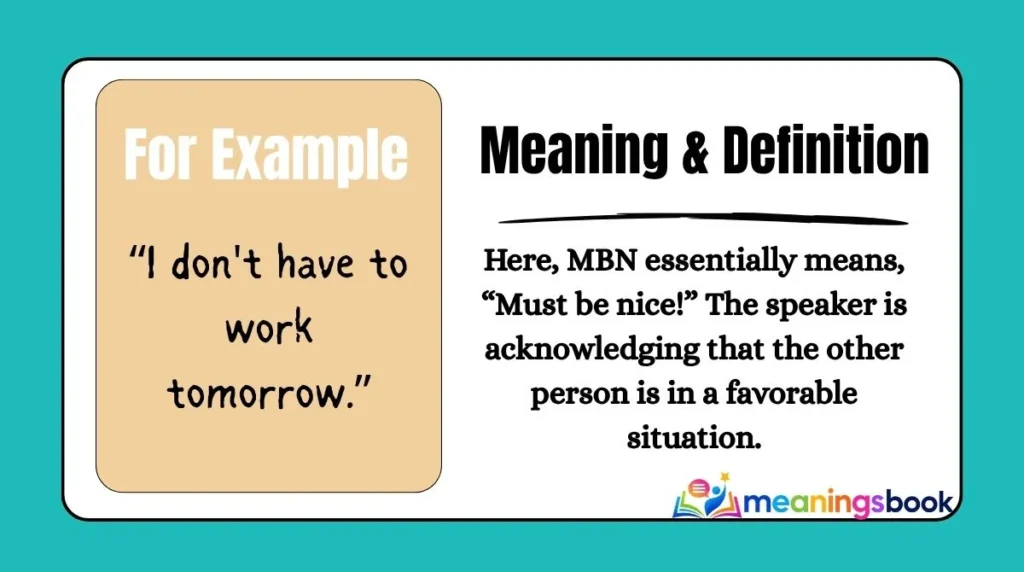
For example, imagine someone texts:
“I don’t have to work tomorrow.”
A friend might respond:
“MBN 😂”
Here, MBN essentially means, “Must be nice!” The speaker is acknowledging that the other person is in a favorable situation. The response might contain a little playful jealousy, but it does not necessarily mean the person is genuinely upset.
Another example could be:
“We’re spending the weekend at the beach.”
A response such as “MBN” could mean that the sender wishes they could enjoy the same experience.
What emotion does MBN express?
The abbreviation does not have one fixed emotional tone. It can communicate:
- Admiration: “That sounds great.”
- Envy: “I wish I could do that too.”
- Playful jealousy: “Lucky you!”
- Sarcasm: “Well, aren’t you fortunate?”
- Genuine approval: “That must be nice.”
The presence of emojis, punctuation, and the relationship between the people can make the intended tone clearer.
For instance, “MBN 😂” often sounds playful, while “MBN!” may sound enthusiastic. A short “mbn” could be casual and neutral, although it may also sound slightly dry depending on the conversation.
The phrase generally responds to a situation rather than introducing a new subject. Someone tells you about an advantage or enjoyable experience, and MBN serves as a quick reaction.
It is also worth remembering that abbreviations can have multiple interpretations in different communities. However, when MBN appears in an ordinary personal text or social-media conversation, “Must Be Nice” is the most useful interpretation to consider first.
Background
The abbreviation MBN developed from the practice of shortening frequently used phrases in digital communication. Texting, instant messaging, and social media encourage people to communicate quickly, and abbreviations allow common expressions to be written with fewer characters.
The full expression “must be nice” existed long before internet slang. It is an ordinary English phrase that can be used sincerely to acknowledge someone’s pleasant circumstances. Online communication simply made it convenient to shorten the phrase to its initial letters.
There is not a single clearly established moment or individual responsible for creating MBN as an internet abbreviation. Its development is better understood as part of the broader evolution of texting shorthand and online slang.
Many digital abbreviations work in a similar way. People take the first letters of a familiar phrase and use them as a compact response. Once enough people understand the abbreviation, it can become recognizable within informal online communication.
Why did MBN become useful?
The full phrase “must be nice” is already relatively short, so MBN is not necessarily about saving a large amount of typing time. Instead, abbreviations can make conversations feel more casual and digitally native.
The shortened version can also carry a particular online tone. Writing “MBN 😂” may feel more playful or conversational than responding with the complete phrase.
Its meaning is strongly connected to context. Someone might write MBN after hearing about a vacation, a day off, a new purchase, a successful event, or another favorable circumstance. In each case, the basic idea remains an acknowledgment that the situation sounds good.
It is important not to invent a complicated historical origin for the abbreviation. There is no need to assume that MBN began on one particular platform or was created by one particular online community. Its usage fits naturally into the wider pattern of English texting abbreviations.
Because slang changes over time, individual communities may also use the same letters differently. Therefore, the safest approach is to consider the surrounding words before deciding exactly what the sender intended.
Usage in Different Contexts
MBN is primarily an informal expression, and its interpretation can change according to the situation.
In chat
In private messages, MBN usually means “Must Be Nice.” A friend might use it after you mention that you have the day off, received something you wanted, or are going somewhere enjoyable.
For example:
Person A: “I get to sleep until noon tomorrow.”
Person B: “MBN 😭”
The response probably means, “Must be nice; I wish I could sleep that late.”
On social media
On social platforms, MBN can appear as a comment or reply to someone’s post. A person may post about traveling, enjoying a luxury experience, attending an event, or receiving some other benefit.
Someone commenting “MBN” is generally reacting to the favorable situation. The comment may be sincere or playful.
In casual conversation
Although MBN is primarily written shorthand, the underlying phrase “must be nice” is common in spoken English. People normally say the complete phrase aloud rather than pronouncing the individual letters.
The spoken version can have very different tones. “Must be nice!” can sound genuinely happy, teasing, or sarcastic depending on facial expression and voice. Text messages lack those signals, so emojis and surrounding words can become important.
In professional settings
MBN is generally not appropriate for formal workplace communication unless the environment is exceptionally casual and everyone understands the abbreviation.
For a professional email, it would usually be clearer to write something like:
- “That sounds great.”
- “That must be enjoyable.”
- “I’m glad that worked out for you.”
Using unexplained slang in a formal setting can create unnecessary ambiguity.
The key distinction is that MBN is informal conversational shorthand, not a phrase that should automatically be interpreted the same way in every professional, technical, or specialized context.
Meaning in Chat, WhatsApp, Instagram, and TikTok
Across messaging and social-media platforms, MBN generally retains the same basic meaning: “Must Be Nice.” The platform itself usually does not change the abbreviation’s meaning.
In a WhatsApp conversation, MBN can be used as a quick response to a friend’s good news.
Friend: “I finished my exams, so I’m going on vacation tomorrow.”
You: “MBN 😭”
The message could communicate playful envy and admiration.
On Instagram, MBN may appear under a post, in a reply, or in direct messages. Someone might post a picture from an expensive restaurant or a beautiful destination, and another person could comment:
“MBN 👀”
The comment could mean, “Must be nice!” with an implication that the commenter would also enjoy that experience.
TikTok
On TikTok, abbreviations are frequently used in comments and replies. MBN may be used when a creator describes an unusually convenient, exciting, or fortunate situation.
For example, if someone posts that they have an entire week away from work, a viewer might respond:
“MBN 😂”
The expression is usually casual and does not require a lengthy explanation.
Emojis can change the tone
Because MBN is so short, emojis can provide useful emotional clues:
- MBN 😂 — probably playful
- MBN 😭 — often humorous envy
- MBN 👀 — interested or envious reaction
- MBN! — potentially enthusiastic
- MBN 🙄 — may sound sarcastic or teasing
These interpretations are not fixed rules. A person’s normal communication style matters too.
If someone simply sends “MBN” without an emoji, do not automatically assume they are being rude. They may simply be using a common shorthand response.
Meaning in Physics, Medical, and Aircraft Terminology
When searching for an abbreviation, it is easy to assume that the same three letters must have one universal definition. That is not the case.
Physics
MBN is not a standard general physics abbreviation that should automatically be interpreted as one specific term. If you encounter MBN in a physics textbook, research paper, laboratory document, or technical discussion, the surrounding material should be checked for a field-specific definition.
Technical abbreviations can be created for individual studies, equations, instruments, materials, or procedures. Therefore, it would be misleading to assign the texting meaning “Must Be Nice” to MBN in a technical physics context without looking at the surrounding material.
Medical terminology
MBN does not have one universally applicable medical meaning that should automatically replace its common texting interpretation. Medical documents frequently use specialized abbreviations, and some abbreviations can mean different things in different specialties.
If MBN appears in a medical report, prescription-related material, clinical notes, or healthcare discussion, it should be interpreted according to the terminology defined by that specific source or medical context.
Aircraft and aviation terminology
Likewise, MBN should not automatically be treated as a universal aviation abbreviation. Aviation uses many standardized codes and abbreviations, and three-letter combinations can have specialized meanings depending on the system involved.
If you encounter MBN in an aviation document, flight-related database, airport information, or technical material, the specific aviation context should be checked.
The important distinction is simple: MBN is commonly understood as “Must Be Nice” in informal texting, but specialized fields can use abbreviations independently. Never assume that internet slang and technical terminology share the same definition.
Common Misconceptions
One common misunderstanding is assuming that MBN is always sarcastic. It is not.
Someone can use MBN sincerely:
“You get to work from home every Friday?”
“MBN!”
The person may genuinely think that arrangement sounds appealing.
Another person might use exactly the same abbreviation sarcastically:
“He gets everything paid for by his parents.”
“MBN 🙄”
Here, the response may suggest envy or criticism.
MBN does not automatically mean jealousy
The phrase can imply envy, but that is not guaranteed. Context matters. A close friend might say MBN simply to celebrate your good fortune while joking that they want the same opportunity.
MBN is not necessarily rude
A very short message can sometimes look dismissive. However, MBN itself is not inherently insulting. Its tone depends on how it is used.
MBN is not always a technical abbreviation
If you see MBN in a casual text, there is usually no reason to search for an obscure technical interpretation first. Informal conversational context strongly favors the slang meaning.
The capitalization does not necessarily matter
People may write:
- MBN
- mbn
- Mbn
In casual messaging, capitalization generally does not change the intended phrase.
Context is more important than the letters alone
If someone sends MBN immediately after you tell them about a promotion, vacation, free day, or exciting purchase, the meaning becomes much easier to identify.
When an abbreviation seems ambiguous, read the sentence before it and consider the relationship between the participants. Those clues are often more informative than the abbreviation itself.
Similar Terms & Alternatives
Several expressions can communicate a similar reaction to MBN.
“Lucky you”
This is one of the closest alternatives. It acknowledges that someone has a fortunate situation and can be either sincere or playful.
“Must be nice”
This is simply the complete version of MBN. It communicates the same basic idea without abbreviation.
“Good for you”
This can be sincere, supportive, or sarcastic depending on tone. It is broader than MBN because it can respond to achievements as well as favorable circumstances.
“I’m jealous”
This directly expresses envy. Unlike MBN, it makes the speaker’s emotional reaction more explicit.
“Wish I could”
This emphasizes that the speaker would like to experience the same thing.
“Living the life”
This is a casual way of complimenting someone’s enjoyable or fortunate circumstances.
“Goals”
On social media, someone may use “goals” when they admire another person’s lifestyle, achievement, appearance, trip, or experience.
Although these expressions overlap with MBN, they are not identical. MBN specifically centers on the idea that the other person’s situation sounds pleasant or fortunate.
How to Respond to It
Your response should depend on the tone of the conversation.
If someone says “MBN” after you mention something good happening to you, you can respond casually.
Friendly response
“Haha, yeah, I’m pretty lucky!”
This works when the sender is clearly joking.
Playful response
“You know it 😂”
This keeps the conversation light.
Include them
“You should come with me next time!”
This works when the situation actually allows the person to participate.
Humble response
“Honestly, I got really lucky this time.”
This is useful if you want to acknowledge their reaction without sounding boastful.
If they seem genuinely envious
“I hope you get the chance to do it too!”
This turns the conversation into a supportive exchange.
If you’re unsure about their tone
You generally do not need to confront them over a simple MBN. Look at the surrounding conversation first. If the person normally jokes with you, the abbreviation is probably playful. If the conversation has been tense, the same phrase could carry more sarcasm.
The best response is therefore not a fixed phrase. Match the emotional tone of the conversation and the relationship you have with the sender.
Differences from Similar Words
| Expression | Basic meaning | Typical tone |
|---|---|---|
| MBN | Must Be Nice | Casual, playful, sometimes envious |
| Must be nice | Same as MBN | Casual, sincere or sarcastic |
| Lucky you | You are fortunate | Friendly, teasing, or envious |
| Good for you | Positive acknowledgment | Supportive or sometimes sarcastic |
| I’m jealous | I wish I had the same thing | Direct, often playful |
| Wish I could | I would like the same opportunity | Envious or hopeful |
| Goals | I admire or want something similar | Positive, social-media oriented |
The major difference is that MBN is a reaction rather than a detailed statement. It often lets the sender acknowledge someone’s good fortune without explaining exactly how they feel.
For example:
“I got tomorrow off.”
“MBN.”
The response is intentionally brief.
By contrast:
“I’m jealous; I wish I had tomorrow off too.”
This communicates essentially the same emotional idea but makes the speaker’s feelings much more explicit.
Tone is another major distinction. “Must be nice” can be interpreted as genuine admiration or sarcasm. The abbreviated form can have the same ambiguity.
Therefore, if someone sends MBN after you share good news, do not automatically interpret it as either praise or criticism. Consider the entire conversation.
Relevance in Online Conversations & Dating Apps
MBN can appear in modern online conversations because dating apps, social platforms, and private messaging all rely heavily on short, informal responses.
On a dating app, for example, someone might mention:
“I work remotely and spend a few months each year traveling.”
A match could reply:
“MBN 👀”
In this situation, MBN might mean that the lifestyle sounds attractive. The eyes emoji could add curiosity or interest, but the exact intention still depends on the rest of the conversation.
Another example:
“I have the whole weekend free.”
A person might respond:
“MBN 😂”
This could simply be playful banter.
MBN can contribute to flirting
The phrase itself is not inherently romantic or sexual. However, people can use ordinary slang in flirtatious conversations. If the surrounding exchange is already playful, MBN may function as light teasing.
For example:
“You get to spend the weekend at that resort?”
“MBN 😏”
The emoji and conversation could make the message more flirtatious than the abbreviation alone.
Don’t overinterpret it
A particularly important point for dating apps is that MBN by itself does not prove romantic interest. It may simply mean “Must Be Nice.”
Look for broader conversational signals instead: whether the person asks questions, continues the conversation, jokes with you, or shows genuine interest.
Online communication often removes vocal tone and facial expressions. As a result, a three-letter response can seem more mysterious than it really is. In most casual contexts, MBN is simply a compact way of saying that someone’s situation sounds good.
Frequently Asked Questions
What does MBN mean in text?
MBN usually means “Must Be Nice” in text messages. People use it when someone tells them about something enjoyable, convenient, fortunate, or desirable. It can express admiration, playful envy, or mild sarcasm. The exact tone depends on the surrounding conversation, emojis, punctuation, and relationship between the people communicating.
What does MBN mean in chat?
In chat, MBN generally means “Must Be Nice.” It is a quick reaction to someone’s good fortune or enjoyable situation. For example, if a friend says they have a three-day weekend, replying “MBN” can mean that you think their situation sounds great and perhaps wish you had the same opportunity.
Is MBN a slang term?
Yes, MBN is commonly used as informal internet and texting shorthand. It comes from the phrase “Must Be Nice” and is most appropriate for casual communication. It is not normally necessary in formal writing, where spelling out the phrase or choosing a clearer response is usually better.
What does MBN mean on social media?
On social media, MBN usually means “Must Be Nice.” Someone may comment it after seeing another person’s vacation, lifestyle, achievement, purchase, or other fortunate experience. Depending on the post and the commenter’s personality, it can sound genuinely complimentary, playful, or slightly sarcastic.
Can MBN have different meanings?
Yes, MBN can have other meanings in specialized contexts, but “Must Be Nice” is the common interpretation in casual texting. Technical, professional, medical, or organizational contexts may use abbreviations independently. If MBN appears in specialized material, the surrounding terminology should be used to determine its intended definition.
Is MBN rude or sarcastic?
MBN is not automatically rude or sarcastic. It can be a friendly reaction meaning that someone’s situation sounds enjoyable. However, “Must Be Nice” can also be used sarcastically, particularly when someone appears unusually fortunate. Emojis, punctuation, and the relationship between the speakers can help reveal the intended tone.
How do you respond to MBN in a text?
You can respond casually depending on the situation. If the person is joking, something like “Haha, I know 😂” works well. If they seem genuinely interested, you could explain more about what you mentioned. If they appear envious, a friendly response such as “Hope you get to do it sometime too!” can keep the conversation positive.
What is the difference between MBN and “lucky you”?
MBN and “lucky you” are similar, but MBN is a shorter and more informal reaction. Both can acknowledge someone’s fortunate circumstances. “Lucky you” can sound more directly complimentary, while MBN may carry a playful or mildly envious undertone. Neither expression is automatically sarcastic; context determines the tone.
Conclusion
MBN most commonly means “Must Be Nice” in text and online conversations. It is a compact, informal reaction people use when someone describes a fortunate, enjoyable, convenient, or desirable situation. Depending on the conversation, it can communicate genuine admiration, playful envy, humor, or sarcasm.
You may see MBN in text messages, WhatsApp chats, Instagram comments, TikTok conversations, and dating-app messages. The abbreviation generally keeps the same basic meaning across these platforms, although emojis and surrounding messages can change its tone.
MBN should not automatically be treated as a universal technical abbreviation. If it appears in a specialized medical, scientific, aviation, or professional context, the surrounding material should be examined because specialized abbreviations can have separate meanings.
Ultimately, context is the most important clue. When someone sends MBN after hearing your good news, they are usually saying, “Must Be Nice.” Whether that is sincere, playful, or sarcastic depends on the conversation and the relationship between the people involved.

I am Ethan Whitmore, an English teacher and vocabulary enthusiast who explains words, phrases, and meanings in text through simple examples to make English easier for everyone.



