
When someone replies with “mhm” in a text message, it can be surprisingly difficult to know exactly what they mean. Unlike many internet abbreviations that have one clear definition, “mhm” is usually a conversational response whose meaning depends heavily on tone and context.
People commonly use it in texting, private chats, social media comments, and everyday digital conversations to show agreement, acknowledgment, attention, or a simple “yes.”
Sometimes it sounds warm and interested, while in other situations it can feel brief, uncertain, distracted, or even slightly dismissive. That is why people often search for the MHM meaning in text after receiving a short reply containing only these three letters.
Understanding the surrounding conversation is usually more important than treating “mhm” as a fixed abbreviation. Looking at the message before it, the relationship between the speakers, and the overall tone can help reveal what the sender intended.
Quick Answer
MHM meaning in text is usually an informal way of saying “yes,” “yeah,” “I agree,” or “I understand.” It commonly appears in chats and text messages as a brief acknowledgment. Depending on context, “mhm” can sound friendly and attentive, neutral, hesitant, or slightly dismissive, so the surrounding conversation helps determine its exact tone.
Meaning & Definition
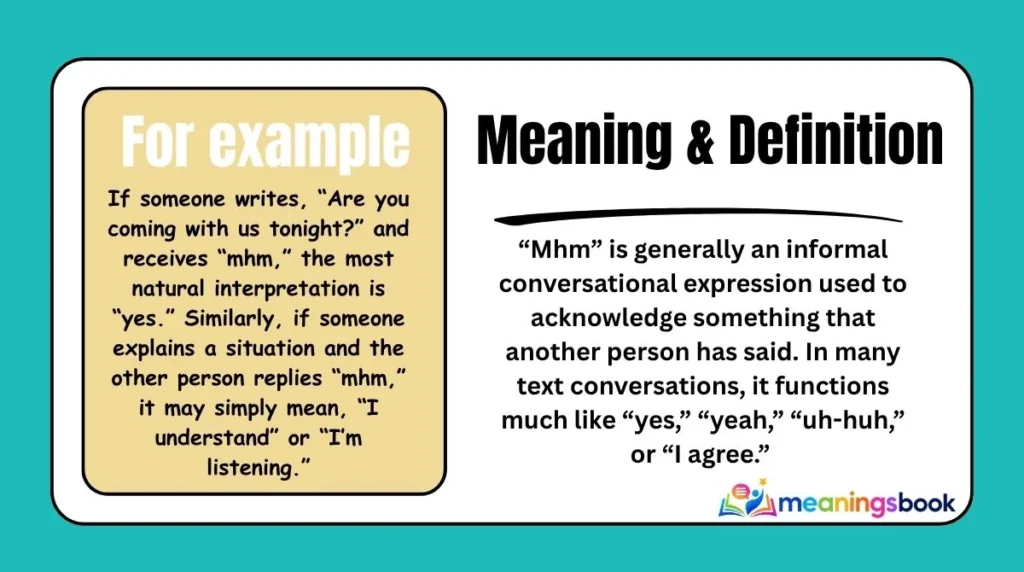
“Mhm” is generally an informal conversational expression used to acknowledge something that another person has said. In many text conversations, it functions much like “yes,” “yeah,” “uh-huh,” or “I agree.” It can communicate that the sender has heard the other person, understands what they are saying, or accepts a statement.
For example, if someone writes, “Are you coming with us tonight?” and receives “mhm,” the most natural interpretation is “yes.” Similarly, if someone explains a situation and the other person replies “mhm,” it may simply mean, “I understand” or “I’m listening.”
However, “mhm” does not always carry exactly the same emotional meaning. A short “mhm” can be warm when used naturally during an ongoing conversation. It can also be deliberately brief when someone does not have much more to say. In some situations, it may indicate uncertainty rather than strong agreement.
The spelling can also influence how the expression feels. Variations such as “mm-hmm,” “mhm,” “mhm!” and “mhmm” may communicate slightly different tones. An exclamation mark can make the response appear more enthusiastic, while a very short lowercase “mhm” may appear casual or restrained.
Unlike a formal abbreviation with a technical definition, “mhm” is better understood as a written representation of a sound people make in spoken conversation. It often imitates a quiet affirmative response.
Therefore, the safest interpretation is usually acknowledgment or agreement, while recognizing that the emotional tone depends on context. A person who writes “mhm” may be saying “yes,” “I hear you,” “exactly,” or simply “okay, I’m following.”
Background
The expression “mhm” is closely connected with informal spoken conversation rather than being a modern acronym formed from several words. People have long used short vocal sounds such as “mm-hmm” or “uh-huh” to indicate agreement, attention, or acknowledgment during conversations.
Written communication eventually began representing these conversational sounds with spellings such as “mm-hmm,” “mhmm,” and “mhm.” Digital messaging made this particularly common because texting often attempts to reproduce the speed and informality of face-to-face speech.
There is no single universally established origin that should be treated as the definitive starting point for the exact spelling “mhm.” Different spellings have developed naturally in informal writing, and people may choose one form based on personal preference, typing habits, or the tone they want to convey.
The expression became especially useful in messaging because a traditional “yes” can sometimes sound more formal or definite than intended. “Mhm” provides a softer, conversational alternative. It can show that someone is listening without interrupting the flow of a discussion.
For example, compare these replies:
- “Yes.” — direct and definite.
- “Yeah.” — casual and straightforward.
- “Mhm.” — conversational acknowledgment.
- “Absolutely!” — enthusiastic agreement.
These differences are not rigid rules. A person’s usual texting style matters considerably.
“Mhm” is therefore best understood as an informal written representation of an affirmative or acknowledging sound. Its widespread use in digital communication reflects the broader tendency for texting to imitate natural speech. Rather than having one complicated historical definition, its meaning developed from ordinary conversational behavior and became adapted to online communication.
Because there is no single fixed emotional interpretation, readers should avoid assuming that every “mhm” means exactly the same thing. The surrounding words, punctuation, timing, and relationship between the people communicating can all influence how it should be understood.
Usage in Different Contexts
The meaning and tone of “mhm” can shift depending on where and how it appears. Although the basic idea is usually acknowledgment or agreement, the context can make the expression sound enthusiastic, neutral, uncertain, or uninterested.
In Chat
In private messaging, “mhm” commonly means “yes,” “okay,” or “I understand.” It may be used when someone wants to acknowledge a message without writing a longer response.
Example:
“So we’re meeting at 7?”
“Mhm.”
Here, the response most likely means “Yes, that’s right.”
It can also indicate active listening:
“I had a really stressful day today.”
“Mhm, I’m listening.”
The second person may be signaling that they are paying attention.
On Social Media
On social platforms, “mhm” may appear in comments, direct messages, or replies. Its interpretation can depend strongly on the surrounding discussion. A supportive comment may make it sound agreeable, while a sarcastic exchange can make it sound skeptical or dismissive.
In Professional Fields
“Mhm” is generally informal and is not normally appropriate as a formal professional abbreviation. In a workplace chat, however, colleagues who communicate casually may use it simply to acknowledge information.
For formal communication, expressions such as “Understood,” “Yes,” “Agreed,” or “Confirmed” are usually clearer.
In Casual Conversations
Casual conversation is where “mhm” is most natural. Friends, family members, partners, and acquaintances may use it as a quick response while listening or agreeing.
Its tone can be especially subtle in short messages. A friendly “mhm 😊” may feel very different from a standalone “mhm.” Context is therefore essential.
Meaning in Chat, WhatsApp, Instagram, and TikTok
“Mhm” can appear on virtually any platform that supports informal conversation. The basic meaning usually remains connected to acknowledgment, agreement, or listening, but the platform and relationship between users can affect how it feels.
On WhatsApp, someone might reply “mhm” to confirm that they understand a plan:
“I’ll send you the details tonight.”
“Mhm, okay.”
On Instagram, it may appear in direct messages or comments. If someone says, “That outfit looks good on you,” a reply such as “mhm 😌” could simply acknowledge the compliment, although emojis and the broader conversation may add a playful tone.
On TikTok, users may use “mhm” in direct messages or comments as a short reaction to something they agree with. For example:
“That part was definitely the funniest.”
“Mhm 😂”
Here, the expression reinforces agreement.
In ordinary text messages, “mhm” can also be used when a person wants to keep a conversation moving without giving a long answer:
“You know what I mean?”
“Mhm.”
The expression may sometimes look cold when sent alone, especially if the previous message was emotional or required a detailed response. For instance:
“I was really upset about what happened.”
“Mhm.”
The sender could mean “I understand,” but the recipient might interpret it as disinterest because there is no additional supportive language.
That distinction is important. Digital messages remove many vocal cues such as facial expressions, volume, and intonation. As a result, a simple expression can be interpreted differently by different people.
Punctuation, capitalization, emojis, and follow-up messages can provide additional clues. “Mhm!” generally appears more energetic than “mhm.” Likewise, “mhmm” may feel softer or more drawn out to some readers.
The safest approach is to interpret the expression within the full conversation rather than assigning it one universal emotional meaning.
Meaning in Physics, Medical, and Aircraft Terminology
“Mhm” does not have a standard, broadly recognized technical meaning in physics, medical terminology, or ordinary aircraft terminology simply because it appears as “mhm” in lowercase.
Physics
“Mhm” is not a standard physics term or commonly recognized physics abbreviation. Readers should not automatically assign it a scientific meaning based on the letters alone. Technical abbreviations in physics are normally defined by the specific subject, formula, unit, paper, or professional context.
Medical Terminology
“Mhm” is not a standard medical diagnosis, treatment term, or universally recognized medical abbreviation in ordinary medical terminology. If it appears in a medical document, its meaning would need to be determined from the surrounding documentation rather than assumed to be the same as its texting meaning.
Medical abbreviations can vary by institution and specialty, so unfamiliar abbreviations should be checked against the relevant professional context rather than interpreted casually.
Aircraft or Aviation Terminology
“Mhm” is not a standard everyday aviation term meaning “yes” or another technical aircraft concept. Aviation uses many specialized abbreviations, codes, and identifiers, and individual letter combinations can have specialized meanings in particular systems. That does not make every occurrence of “mhm” an aviation abbreviation.
Therefore, if you encounter “mhm” in an ordinary text, chat, or social media message, the conversational interpretation is usually far more relevant than searching for a technical definition.
Common Misconceptions
One common misconception is that “mhm” always means enthusiastic agreement. It usually signals acknowledgment or agreement, but it does not necessarily show excitement. Someone can say “mhm” simply because they understand what was said.
Another misunderstanding is assuming that “mhm” always sounds rude or dismissive. A standalone response can sometimes feel cold, especially after an emotional message, but that is not its inherent meaning. Friends may use it casually without intending any negativity.
People may also confuse “mhm” with an acronym. In most everyday texting situations, it is better understood as a written conversational sound rather than an abbreviation in which each letter represents a separate word.
Another misconception is that spelling variations always have fixed meanings. Forms such as “mhm,” “mhmm,” and “mm-hmm” can carry slightly different impressions, but there is no universal rule stating that one spelling must always mean something specific.
Context matters more than spelling alone.
For example:
“Do you agree?”
“Mhm.”
This likely indicates agreement.
But:
“I thought you were going to help me.”
“Mhm.”
The second reply could sound dismissive, skeptical, or even annoyed depending on the conversation.
A final misconception is that a short response necessarily means the sender wants to end the conversation. Sometimes it does, but sometimes the person is simply acknowledging the message while thinking about what to say next.
Instead of judging “mhm” in isolation, consider the entire exchange. Look at what was said immediately before it, whether the sender normally uses short replies, and whether they continue the conversation afterward.
Similar Terms & Alternatives
Several expressions can resemble “mhm,” but they are not always identical in tone.
- Yeah — A casual way to say yes or agree. It is often more explicit than “mhm.”
- Yep — Usually a clear, informal yes.
- Yup — Similar to “yep,” with a casual tone.
- Uh-huh — A spoken-style acknowledgment that can mean yes or indicate that someone is listening.
- Okay — Usually signals acceptance or acknowledgment rather than necessarily agreement.
- I know — Shows awareness and can sometimes sound stronger or more dismissive.
- True — Often indicates agreement with a statement.
- Exactly — Expresses stronger agreement or confirmation.
- Right — Can indicate agreement or that the person is following the conversation.
- Mm-hmm — A common spelling variation that closely represents the same conversational sound.
The important difference is that these expressions can carry different emotional levels. “Exactly” often communicates stronger agreement than “mhm,” while “okay” may acknowledge information without agreeing with it.
How to Respond to It
How you respond to “mhm” depends on what you think the sender intended and whether the conversation needs to continue.
If you simply wanted confirmation, you may not need to respond at all. For example:
“So you’ll be there at 8?”
“Mhm.”
The conversation can naturally move forward.
If you want to keep the discussion going, ask a relevant follow-up:
“Mhm.”
“What do you think about it?”
If you are unsure whether the person agrees, you can clarify:
“Do you mean yes?”
For a friendly conversation, a natural response might be:
“Haha, I knew you’d agree.”
If their response seems unusually short during a serious conversation, you can gently check in:
“Everything okay?”
Avoid automatically assuming that “mhm” is rude. If the person normally communicates with short messages, it may be completely ordinary for them.
You can also match the tone. If the conversation is casual, a short response such as “yeah” or “same” may be appropriate. If the subject is important, a more explicit reply can prevent misunderstandings.
The best response is therefore based on the purpose of the conversation rather than the three letters alone.
Differences from Similar Words
| Expression | Typical meaning | Common tone |
|---|---|---|
| Mhm | Yes, I understand, I’m listening | Conversational, neutral to warm |
| Yeah | Yes or agreement | Casual and direct |
| Yep | Yes | Casual, clear |
| Okay | I acknowledge or accept that | Neutral |
| Uh-huh | Yes or I’m listening | Conversational |
| Exactly | Strong agreement | More emphatic |
| Sure | Yes, certainly, or willingness | Agreeable |
| Right | Agreement or acknowledgment | Context-dependent |
“Mhm” is distinctive because it can acknowledge what someone says without always providing a strongly worded answer. It is often softer than “yes” and less explicit than “exactly.”
For instance, “Yes, I agree” clearly states agreement. “Mhm” may communicate the same idea but in a more relaxed and conversational way.
Tone can also change the interpretation. “Mhm!” may sound enthusiastic, while “mhm…” can appear hesitant or uncertain. A plain “mhm” is usually more neutral.
Another important distinction is between acknowledgment and agreement. In some conversations, “mhm” means “I hear you” rather than “I completely agree with you.” This is why interpreting it as a definite endorsement in every situation can lead to misunderstandings.
Relevance in Online Conversations & Dating Apps
In modern online conversations, “mhm” is especially common because people often use short responses to communicate quickly. It can appear in ordinary texting, social media messages, private chats, and dating-app conversations.
On dating apps, the meaning can depend strongly on the relationship between the two people. Early in a conversation, a standalone “mhm” may feel less engaging if the other person has been asking questions and trying to start a discussion. It could indicate simple acknowledgment, a reserved communication style, distraction, or limited interest.
However, one short message is rarely enough to determine someone’s feelings. If the person follows “mhm” with another question, continues responding, uses friendly emojis, or actively participates in the conversation, the message may simply be casual acknowledgment.
Consider:
“Would you like to grab coffee this weekend?”
“Mhm 😊”
This is likely a positive response.
Compare that with:
“I’d really like to get to know you better.”
“mhm”
The second example may feel less enthusiastic because the emotional weight of the original message is greater.
The relationship also matters. A close friend might use “mhm” constantly without intending anything negative, while a new romantic contact using repeated one-word replies might give the impression of low engagement.
Rather than analyzing one message too closely, look for patterns. Are they asking questions? Do they respond consistently? Do they contribute to the conversation? Do their other messages sound interested?
In online communication, overall behavior usually provides more useful information than interpreting a single short expression.
Frequently Asked Questions
What does MHM mean in text?
MHM usually means “yes,” “yeah,” “I understand,” or “I’m listening.” It is an informal written representation of a conversational sound similar to “mm-hmm” or “uh-huh.” The exact tone depends on context. It can communicate agreement, acknowledgment, or attention without necessarily expressing strong enthusiasm.
What does MHM mean in chat?
In chat, MHM commonly functions as a short acknowledgment. Someone may use it to say they agree, understand what you said, or are following the conversation. Because chat removes vocal tone and facial expressions, the same “mhm” can sometimes seem friendly, neutral, hesitant, or dismissive depending on the surrounding messages.
Is MHM a slang term?
MHM is generally an informal conversational expression rather than a traditional acronym. It is commonly used in casual texting and online communication and represents a sound people may make when agreeing or acknowledging something. Its informal nature makes it more suitable for personal conversations than formal writing.
How do you respond to MHM?
You can respond to MHM according to the situation. If it confirms something you asked, you may simply continue the conversation. If you need clarification, ask a direct follow-up such as “So, is that a yes?” If the conversation is emotional and the response seems unusually brief, you can also ask whether everything is okay.
What does MHM mean on social media?
On social media, MHM usually means “yes,” “I agree,” or “I understand.” It may appear in comments, replies, or direct messages. The surrounding conversation can change its tone. An emoji or enthusiastic punctuation may make it feel warmer, while a standalone “mhm” may appear more neutral or reserved.
Can MHM have different meanings?
Yes, MHM can have slightly different meanings depending on context. It may indicate agreement, acknowledgment, understanding, or active listening. In some situations, it can sound hesitant or dismissive. The safest interpretation comes from examining the message that came before it and the sender’s overall communication style.
Does MHM mean the person is annoyed?
Not necessarily. MHM does not automatically indicate annoyance. A person may use it casually to show that they are listening or agree with you. However, if it appears as a very short response during a serious conversation, it could feel dismissive. The sender’s other messages and usual texting habits provide better clues.
What is the difference between MHM and yeah?
MHM and “yeah” can both mean yes or agreement, but MHM often sounds more like a conversational acknowledgment. “Yeah” is usually a clearer verbal answer, while MHM can mean “I hear you” as well as “I agree.” Neither expression has a fixed emotional tone, so context remains important.
Conclusion
“Mhm” is a simple but flexible expression that most often communicates “yes,” “yeah,” “I understand,” or “I’m listening.” It is especially common in informal texting, chats, social media, and other casual digital conversations. Rather than functioning like a technical acronym, it generally represents a conversational sound used to acknowledge what someone has said.
Its tone can vary considerably. A friendly “mhm” may show agreement or attention, while a very brief response in a serious conversation may seem distant or dismissive. That difference comes from context, relationship, punctuation, surrounding messages, and the sender’s usual communication style.
There is no standard technical meaning that should automatically be assigned to “mhm” in physics, medical terminology, or aviation simply because the same letters appear there.
When you encounter it in everyday communication, the conversational meaning is usually the relevant one. Ultimately, reading the full exchange rather than focusing on one short response is the best way to understand what the sender intended.

I am Ethan Whitmore, an English teacher and vocabulary enthusiast who explains words, phrases, and meanings in text through simple examples to make English easier for everyone.



