If someone sends you “TMB” in a text message, you may wonder whether it is slang, an abbreviation, or something specific to the conversation. In everyday texting, TMB most commonly means “text me back.”
It is a short way of asking someone to reply to a message, especially when the sender wants a response later or does not want to continue waiting. You may see TMB in private texts, group chats, social media messages, or casual online conversations.
Because abbreviations can have different meanings depending on the situation, context still matters when interpreting it. People often search for TMB meaning in text because short forms can be confusing when they appear without explanation.
Understanding the tone behind the abbreviation can also help you decide how to respond. Whether it appears between friends, family members, coworkers, or romantic partners, the surrounding conversation usually makes its intended meaning clear.
Quick Answer
TMB meaning in text is most commonly “text me back.” People use TMB in casual texting and online chats when they want someone to reply to a message. For example, “I have to go now, TMB” means “I have to go now, text me back.” It is informal and usually friendly or conversational.
Meaning & Definition
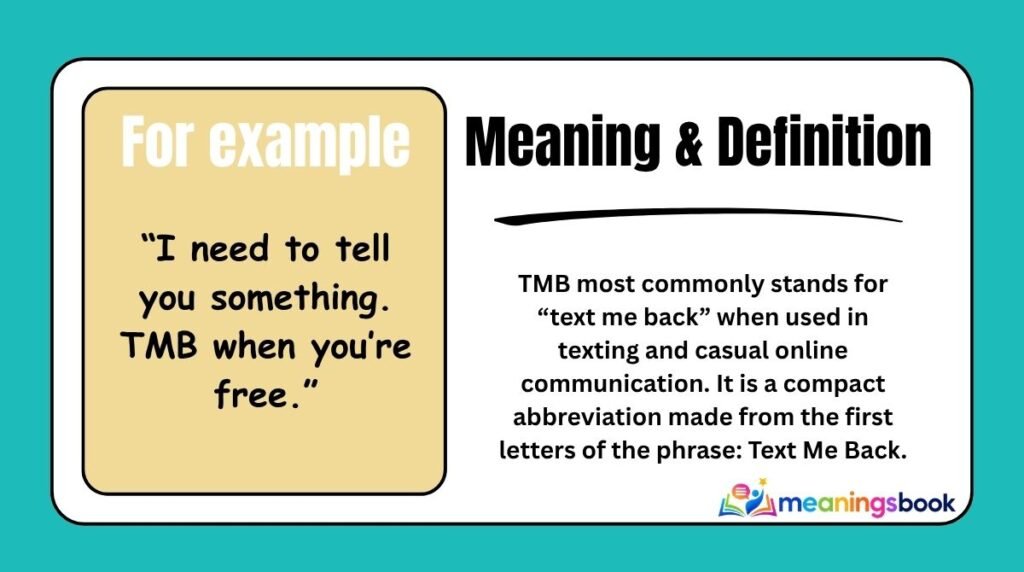
TMB most commonly stands for “text me back” when used in texting and casual online communication. It is a compact abbreviation made from the first letters of the phrase: Text Me Back.
When someone writes TMB, they are generally asking you to respond to them by text. The request does not necessarily mean that the response must happen immediately. The exact urgency depends on the conversation.
For example:
- “I’m heading to class. TMB later.”
- “I need to tell you something. TMB when you’re free.”
- “Did you see my message? TMB.”
- “I’m going offline now, TMB.”
In each example, TMB functions as a request for a reply.
The expression is especially useful in situations where someone has to leave a conversation but wants it to continue later. Instead of writing the complete sentence “text me back when you get a chance,” they can simply write “TMB.”
The tone can vary slightly. Between close friends, it may sound casual and relaxed. Between romantic partners, it can sometimes carry a stronger emotional expectation, particularly if the person has been waiting for a reply. In other situations, it may simply be a practical request.
TMB is generally considered informal texting language rather than standard formal English. It is therefore more appropriate for messages, chats, comments, and casual conversations than for formal business correspondence or academic writing.
The safest interpretation is “text me back” when TMB appears by itself in a normal texting conversation. However, if the surrounding message suggests another subject or a specialized context, the abbreviation should be interpreted according to that context rather than automatically assuming one meaning.
Background
The exact history of TMB as a texting abbreviation is not clearly established. There is no need to assume that it originated from one particular person, website, or specific event. Like many short forms used in digital communication, it follows a simple abbreviation pattern that makes longer phrases faster to type.
Texting encouraged people to shorten common expressions, particularly phrases that appear frequently in everyday conversations. “Text me back” naturally lends itself to the initials T-M-B, making TMB easy to type and understand among people familiar with texting abbreviations.
The growth of mobile messaging, instant messaging, and social platforms helped create an environment where short expressions became normal parts of casual communication. Users often prioritize speed and convenience, especially when chatting from a phone.
TMB fits this pattern because the full phrase is already familiar. Someone does not need to explain what “text me back” means; the abbreviation simply compresses it.
It is also important not to treat every abbreviation as having one universal definition. Online language changes quickly, and the same combination of letters can occasionally represent different words or phrases in different communities. That does not mean every possible expansion is equally relevant to everyday texting.
For ordinary personal messages, “text me back” is the clearest and most useful interpretation of TMB. If a person uses the abbreviation in an unusual setting, the surrounding words should be considered before deciding what it means.
Another reason TMB can feel confusing is that three-letter abbreviations often overlap with initials, names, technical terms, and organization-specific shorthand. A reader should therefore consider the conversation rather than interpreting the letters in isolation.
In casual digital communication, however, TMB is best understood as a request for a reply.
Usage in Different Contexts
The meaning and tone of TMB can become clearer when you look at how it is used in different communication settings.
Chat
In private chats, TMB is usually a straightforward request to receive a response. A person might write, “TMB when you get home,” meaning they want the other person to send a message after arriving home.
The tone is generally informal. Depending on the relationship, it can sound friendly, affectionate, impatient, or simply practical.
Social Media
TMB can also appear in direct messages, comments, or casual interactions on social platforms. Someone might ask another person to continue a conversation privately by saying “TMB” or “TMB later.”
The abbreviation is more likely to appear in casual communication than in formal posts.
Professional Fields
TMB is not a standard universal professional abbreviation meaning “text me back.” In a workplace, its interpretation depends heavily on the organization’s terminology and the subject being discussed.
For professional communication, it is usually clearer to write the complete request, such as “Please text me back when you have a moment,” especially when communicating with someone who may not recognize the abbreviation.
A specialized field could also use TMB for something unrelated to texting. Therefore, professional context should be considered carefully.
Casual Conversations
Among friends, relatives, or people who regularly communicate by phone, TMB can be a quick and natural way to request a response.
For example:
“I’m busy right now, TMB tonight.”
This simply means the person wants the conversation to continue later.
Overall, the conversational setting determines the tone, but in ordinary personal texting, TMB most commonly communicates a request to text back.
Meaning in Chat, WhatsApp, Instagram, and TikTok
TMB can be used across many digital platforms because its meaning does not depend on one particular messaging service. Whether it appears in a text message, WhatsApp chat, Instagram direct message, or TikTok conversation, the most likely casual interpretation is still “text me back.”
For example, someone might send:
- “Gotta go, TMB.”
- “TMB when you’re free.”
- “I’ll explain later, TMB.”
- “Did you get home? TMB.”
On WhatsApp, the abbreviation may be used when someone wants to pause a conversation and receive a reply later. On Instagram, it can appear in direct messages when two people are having a casual conversation. On TikTok, it could occur in private messaging or informal interactions.
The tone depends strongly on the relationship between the people involved.
If a close friend says:
“TMB when you can.”
it usually sounds relaxed.
If someone says:
“TMB ASAP.”
the added wording makes the request sound more urgent.
Likewise, if a romantic partner sends “TMB,” the abbreviation itself does not automatically indicate affection, anger, or relationship problems. Those emotional meanings come from the surrounding conversation.
For example, “TMB ❤️” may feel warmer because of the emoji, while “TMB.” after an argument could sound more serious. The abbreviation has not necessarily changed meaning; the context has changed the tone.
Because social media communication often relies on abbreviations, emojis, punctuation, and short phrases together, it is better to interpret TMB as part of the entire message rather than focusing only on the three letters.
Meaning in Physics, Medical, and Aircraft Terminology
TMB does not have one universal meaning across physics, medicine, and aviation. These fields use many abbreviations, and the same three letters can represent specialized terms depending on the subject, organization, or technical document.
Physics
There is no broadly applicable physics definition that should automatically be assigned to TMB in an ordinary conversation. If you encounter TMB in a physics paper, textbook, laboratory document, or technical discussion, the surrounding material should be checked for the specific definition.
It would be inaccurate to claim that TMB always represents one particular physics term.
Medical Terminology
TMB may appear as an abbreviation in specialized medical or scientific contexts, but that does not mean its medical interpretation is the same as its texting meaning. Medical abbreviations can be highly context-dependent.
If TMB appears in a medical document, it should be interpreted using the terminology and context of that document rather than assuming it means “text me back.”
Aircraft and Aviation Terminology
TMB does not have a single universal aviation meaning that should be assumed whenever the abbreviation appears in an aircraft-related context. Aviation terminology can vary between operational, technical, organizational, and location-specific contexts.
Therefore, if TMB appears in an aviation document or communication, the surrounding information is essential.
For ordinary texting, none of these specialized possibilities should override the obvious conversational meaning without evidence. When someone sends “TMB” in a personal message, “text me back” remains the most natural interpretation.
Common Misconceptions
One common misunderstanding is assuming that every occurrence of TMB means “text me back.” Although this is the most common interpretation in casual texting, abbreviations can have different meanings in specialized environments.
Another misconception is that TMB always indicates urgency. It does not. The abbreviation simply communicates a request for a reply. Whether that reply is expected immediately or later depends on the rest of the message.
For example:
“TMB tonight.”
is not necessarily urgent.
By contrast:
“TMB ASAP.”
clearly communicates greater urgency because of “ASAP.”
People may also misread TMB as a completely different abbreviation because three-letter combinations are often reused. This is particularly possible when TMB appears in a professional, technical, or specialized conversation.
Another misunderstanding is assuming that the abbreviation itself reveals the sender’s emotions. TMB can sound friendly, neutral, impatient, or affectionate depending on punctuation, surrounding words, timing, and the relationship between the people communicating.
For instance, “TMB 😊” may feel friendly, while “TMB!!!” could feel more forceful. However, neither punctuation nor emoji creates a fixed definition.
It is also unnecessary to assume that TMB is inherently romantic. Friends, relatives, coworkers, and romantic partners can all use a request to “text me back.”
The best approach is simple: look at the surrounding message first. If the conversation is ordinary personal texting and someone asks you to reply, “text me back” is the most likely meaning.
Similar Terms & Alternatives
Several abbreviations and phrases can appear in similar situations, although they are not necessarily exact equivalents.
TB — Text Back
TB can sometimes be used as a shortened reference to texting back, although it is less explicit than TMB. The exact interpretation depends on the conversation.
LMK — Let Me Know
LMK asks someone to provide information or tell you something. It is different from TMB because the focus is on receiving information rather than simply getting a text reply.
Example:
“LMK when you arrive.”
HMU — Hit Me Up
HMU is a casual way to tell someone to contact you. It can involve texting, calling, or messaging and is therefore broader than TMB.
BRB — Be Right Back
BRB means that the sender is temporarily leaving the conversation and expects to return. It describes the sender’s action rather than asking another person to respond.
Reply / Reply Back
These are direct alternatives to the idea behind TMB. They are clearer and more appropriate when communicating with someone who may not understand texting abbreviations.
The important distinction is that TMB specifically centers on asking someone to send a message back. Other abbreviations may ask someone to contact you, provide information, or wait for your return.
How to Respond to It
How you respond to TMB depends on what the sender is asking and whether you are ready to continue the conversation.
If you can respond immediately, you can simply answer the message normally.
For example:
- “Sure, I will.”
- “Okay, TMB? I’m here now.”
- “Yep, I’ll message you later.”
- “Sure, I’ll text you when I’m free.”
- “Got it. Talk later.”
If you are unsure what the person means, you can politely ask:
“Do you mean text you back later?”
This can be useful when the conversation is ambiguous.
If the person sends “TMB” after telling you something important, a response such as “Sure, I’ll text you when I’m available” acknowledges the request without creating confusion.
In a casual conversation, you generally do not need to make the response complicated. TMB is already informal, so a short and natural reply is usually appropriate.
The relationship also matters. A close friend may expect a relaxed response, while a professional contact may be better answered with a clearer sentence.
If someone sends only “TMB,” they are most likely asking you to respond. You can therefore reply directly or let them know when you will be available.
Differences from Similar Words
The easiest way to understand TMB is to compare it with related expressions.
| Expression | Meaning | Main Difference |
|---|---|---|
| TMB | Text me back | Directly asks for a text response |
| LMK | Let me know | Asks for information or an update |
| HMU | Hit me up | Invites someone to contact you |
| BRB | Be right back | Says the sender will return soon |
| Talk later | Continue the conversation later | Does not specifically request a text |
| Reply | Respond to the message | More direct and less slang-like |
TMB is therefore more specific than HMU. If someone says “HMU,” they could mean “contact me” by text, phone, or another method. TMB specifically points toward a text or written message.
It is also different from BRB. BRB means the person using the abbreviation is temporarily leaving and expects to return. TMB asks the other person to send a response.
LMK is another common source of confusion. “LMK” asks someone to provide information, while TMB primarily asks them to respond.
The tone also differs. TMB is informal and conversational. A sentence such as “Please reply when convenient” is more neutral and suitable for professional situations.
Understanding these differences makes it easier to choose the right interpretation when short abbreviations appear in digital conversations.
Relevance in Online Conversations & Dating Apps
TMB can appear in modern online conversations whenever people communicate through short messages. On dating apps, social platforms, and private messaging services, people often use abbreviations because they make conversations quicker and less formal.
In a dating conversation, someone might say:
“I’m heading out for dinner. TMB later.”
This normally means they want the other person to message them later.
The relationship can influence how the request feels. If two people have been talking regularly, TMB may sound casual and natural. If someone is waiting for an important response, the same abbreviation could feel more demanding.
For example:
“TMB when you get home.”
sounds like a simple request.
But:
“Why haven’t you answered? TMB.”
may sound impatient because of the surrounding language.
The abbreviation itself does not establish romantic interest, anger, or emotional attachment. Those meanings depend on the broader conversation.
On dating apps in particular, context is important because people often use short messages, emojis, abbreviations, and informal language. Reading only “TMB” is not enough to determine the sender’s feelings.
If you receive it in an online conversation, the safest interpretation is generally that the person wants you to send a message back. Look at the previous and following messages to understand whether they mean “reply when you can,” “continue talking later,” or something more urgent.
Frequently Asked Questions
What does TMB mean in text?
TMB most commonly means “text me back” in casual texting. It is used when someone wants another person to reply to a message. For example, “I’m busy now, TMB later” means “I’m busy now, text me back later.” The exact tone can depend on the surrounding conversation and the relationship between the people communicating.
What does TMB mean in chat?
In chat, TMB usually means “text me back.” A person may use it when they want you to respond after they leave the conversation or become unavailable. For example, “Gotta go, TMB” means they are leaving but want you to send them a message afterward. It is informal and generally used in casual communication.
Is TMB a slang term?
TMB can be considered an informal texting abbreviation rather than conventional formal English. It shortens the phrase “text me back” to make digital communication faster. People are more likely to use it in personal messages, casual chats, and social media conversations than in formal documents or professional correspondence.
How should you respond to TMB?
You can respond to TMB by acknowledging the request or simply continuing the conversation. Natural responses include “Sure, I’ll text you later,” “Okay, I will,” or “Sure, I’ll message you when I’m free.” If you are unsure about what the sender means, asking for clarification is also perfectly reasonable.
What does TMB mean on social media?
On social media, TMB generally means “text me back” when used in a casual conversation. It can appear in direct messages or informal interactions when someone wants a response. Social media context does not automatically change the meaning, although specialized communities can sometimes use the same abbreviation differently.
Can TMB have different meanings?
Yes, TMB can have different meanings in specialized contexts, although “text me back” is the common interpretation in casual texting. Technical, medical, professional, or organizational contexts may use the same letters for other purposes. When the conversation is not ordinary personal messaging, use the surrounding subject matter to determine the intended meaning.
Does TMB mean the person is angry?
No, TMB does not automatically mean that someone is angry. It simply expresses a request for a response. The tone depends on the surrounding words, punctuation, timing, and relationship. “TMB when you’re free” sounds relaxed, while “TMB now!” can sound more urgent because of the additional wording.
What is the difference between TMB and LMK?
TMB means “text me back,” while LMK means “let me know.” TMB primarily asks someone to send a reply, whereas LMK asks them to provide information or an update. For example, “TMB later” requests a message, while “LMK when you arrive” asks the person to report when they have arrived.
Conclusion
TMB is a simple and useful abbreviation commonly encountered in casual digital communication. In ordinary texting, its most common meaning is “text me back,” which is a short way of asking someone to send a response.
It can appear in private messages, group chats, social media conversations, and other informal online interactions. The abbreviation itself does not indicate a specific emotion or relationship status.
Its tone can be friendly, neutral, affectionate, or urgent depending on the surrounding words and the people involved. TMB should also not automatically be assigned the same meaning in technical, medical, aviation, or professional contexts because specialized fields may use abbreviations differently.
When you encounter TMB, the best approach is to consider the complete conversation rather than interpreting the letters alone. In most ordinary personal messages, however, understanding TMB as “text me back” will give you the clearest and most natural interpretation.

I am Ethan Whitmore, an English teacher and vocabulary enthusiast who explains words, phrases, and meanings in text through simple examples to make English easier for everyone.