
Short abbreviations can make online conversations faster, but they can also be confusing when you see one without any context. HY is a good example because its meaning depends heavily on the tone and situation in which it appears.
People may encounter HY in text messages, group chats, comments, direct messages, or casual conversations on social media. In many informal conversations, HY is used as a shortened form of “hell yeah,” expressing strong agreement, excitement, or an enthusiastic “yes.”
However, abbreviations are not always universal, so the surrounding message matters before deciding exactly what someone means.
Someone searching for the HY meaning in text may simply want to know whether the sender is agreeing, greeting them, or using an abbreviation with another meaning.
Understanding the tone of the conversation, the words around HY, and the relationship between the people involved can make its intended meaning much easier to identify.
Quick Answer
HY usually means “hell yeah” in text messages, expressing strong agreement, excitement, or an enthusiastic yes. The abbreviation is most common in informal chats, texting, and social media rather than professional communication. For example, “Want to come with us?” followed by “HY!” generally means “Hell yeah!” However, context should always be considered because short abbreviations can have different interpretations.
Meaning & Definition
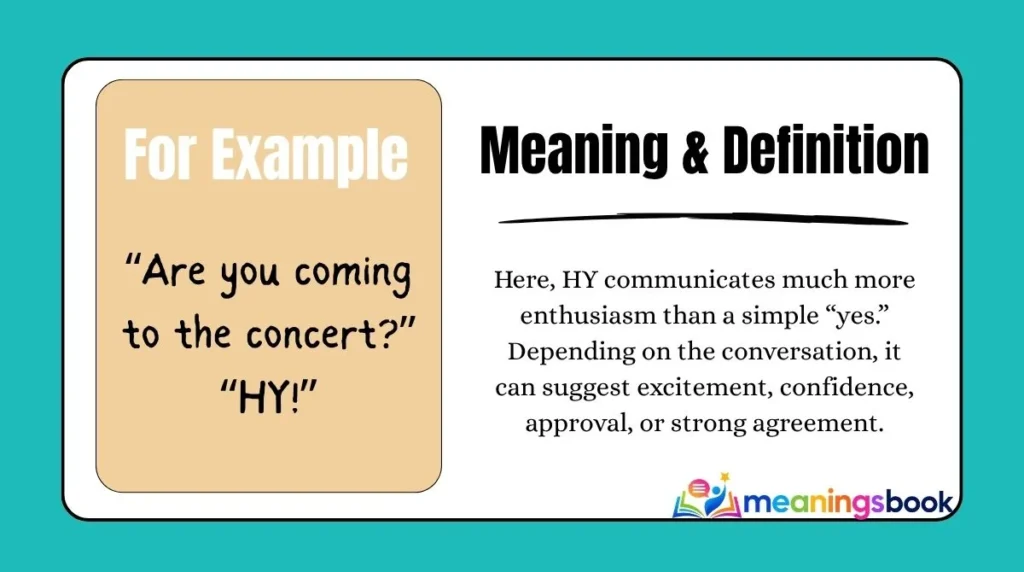
The most common informal interpretation of HY in texting is “hell yeah.” It is an enthusiastic expression used when someone strongly agrees with something or wants to communicate an excited “yes.”
For example:
“Are you coming to the concert?”
“HY!”
Here, HY communicates much more enthusiasm than a simple “yes.” Depending on the conversation, it can suggest excitement, confidence, approval, or strong agreement.
The expression is generally casual and somewhat emphatic. The word “hell” gives the phrase stronger emotional force than expressions such as “yes,” “sure,” or “okay.” Because of that, HY is more suitable for conversations with friends, people who regularly use slang, or informal online communities.
The capitalization can vary. A person might write HY, hy, or occasionally use the phrase in full as “hell yeah.” Capitalization normally does not create a major difference in meaning.
For example:
- “You wanna go out tonight?” — “HY!”
- “That was the best game ever.” — “HY, it was!”
- “Would you do it again?” — “Hy 😂”
In each example, the basic idea is enthusiastic agreement.
However, it is important not to assume that every occurrence of HY automatically means “hell yeah.” People create and use abbreviations differently, and a two-letter combination can have several meanings in different communities. If HY appears by itself and the surrounding conversation provides no clues, asking what the person means may be the safest approach.
In ordinary texting, though, “hell yeah” is the key slang interpretation to recognize.
Background
The abbreviation HY does not have one universally documented origin as a texting expression. It is best understood as a shortened form created from the initial letters of “hell yeah.” Like many internet abbreviations, it fits a broader pattern of shortening frequently used phrases to make digital communication quicker.
Texting and online messaging have encouraged people to compress common expressions into a few letters. Abbreviations such as “LOL,” “OMG,” and “BRB” became widely recognizable because they save typing time. Less standardized expressions, including HY, can develop within particular groups or online communities without becoming universally understood.
The full phrase “hell yeah” is an informal emphatic expression of agreement or enthusiasm. When shortened to HY, the writer keeps the first letters of the two words while removing everything else.
There is no need to assume that HY originated on one specific social-media platform. It can appear across different forms of informal digital communication, and its use may vary from one group to another.
Another reason HY can be confusing is that texting language is highly flexible. People may invent abbreviations, use familiar abbreviations in unusual ways, or rely on private jokes and group-specific language. A person who regularly communicates with friends who use HY may immediately recognize it, while someone encountering it for the first time may not.
Therefore, the safest general understanding is that HY is commonly used as an informal abbreviation for “hell yeah,” but its exact meaning should be determined from context.
Usage in Different Contexts
In Chat
In private chats, HY can express enthusiastic agreement.
Example:
“Want to grab food later?”
“HY!”
The response means something similar to “Absolutely!” or “Definitely!”
On Social Media
HY can appear in comments or replies when someone strongly agrees with a post.
Example:
“Summer vacation needs to come faster.”
“HY 😂”
Here, the person is enthusiastically agreeing with the statement.
In Casual Conversations
Among friends, HY may be used when someone wants to sound energetic or excited rather than simply saying “yes.”
For instance:
“Are you ready for this?”
“HY!”
The abbreviation adds emphasis and an informal tone.
In Professional Communication
HY is generally not a good choice for formal workplace communication unless the people involved already use casual slang with each other. In an email to a manager, customer, client, or professional contact, “yes,” “absolutely,” or “certainly” would normally be clearer and more appropriate.
The distinction is important because an abbreviation that feels natural in a group chat may look confusing or overly casual in a professional setting.
Meaning in Chat, WhatsApp, Instagram, and TikTok
On messaging and social-media platforms, HY is generally understood through the surrounding conversation rather than through the platform itself.
In a WhatsApp conversation, HY can be a quick enthusiastic response:
Friend: “Movie tonight?”
You: “HY 😂”
The intended meaning is essentially “Hell yeah!”
In Instagram comments or direct messages, HY may be used to strongly agree with someone’s statement.
Post: “This outfit is perfect.”
Comment: “HY 🔥”
The comment communicates strong approval.
TikTok
TikTok conversations can contain large amounts of informal slang and abbreviated language. HY may therefore appear in comments or messages as an enthusiastic reaction.
For example:
“Would you try this challenge?”
“HY!”
Again, the meaning is likely an emphatic yes when the context supports it.
General Texting
In ordinary SMS or messaging, HY is useful when the sender wants a short, energetic response. It is especially understandable when the question requires a yes-or-no answer.
The important point is that HY does not gain a completely different standard meaning simply because it appears on WhatsApp, Instagram, or TikTok. The surrounding conversation remains the strongest clue.
Meaning in Physics, Medical, and Aircraft Terminology
A common reason people search for abbreviations is that they encounter the same letters in different fields. HY, however, should not automatically be interpreted as a technical abbreviation simply because it appears in a specialized context.
Physics
HY is not a standard standalone physics term with one universally recognized meaning comparable to established symbols or abbreviations. If HY appears in physics material, its meaning would need to be determined from the specific textbook, equation, diagram, research paper, or notation being used.
It should therefore not automatically be interpreted as “hell yeah” in an academic setting.
Medical Terminology
HY is not a single standard medical abbreviation with one universal definition. Medical abbreviations can be highly context-dependent, and institutions may use their own shorthand. A medical document should therefore be interpreted according to its surrounding terminology and, when necessary, the healthcare professional or source that produced it.
It would be unsafe to assume that a medical occurrence of HY has the same meaning as texting slang.
Aircraft or Aviation Terminology
HY is not, by itself, a universal aviation term that should automatically be interpreted as the texting abbreviation “hell yeah.” Aviation uses numerous standardized codes and abbreviations, and their meanings depend on the particular coding system involved.
If HY appears on an aviation document, flight-related system, technical chart, or aircraft-related record, the relevant aviation code list or document should be used to determine its meaning.
In short, the casual texting interpretation and technical abbreviations should be kept separate.
Common Misconceptions
One common misunderstanding is assuming that HY always means “hell yeah.” While that is a common informal texting interpretation, context matters.
Another mistake is confusing HY with similar-looking abbreviations. Because two-letter abbreviations are extremely short, they can easily be misread or mistyped.
People may also assume that HY is a polite or neutral way of saying yes. It is usually more expressive than that. The phrase behind it contains informal language, so it can sound enthusiastic, playful, or emphatic.
A further misconception is that HY has exactly the same meaning on every platform. In reality, online communities often develop their own abbreviations. Someone’s intended meaning can sometimes be understood only from the conversation.
Tone also matters. For example:
- “HY!” can sound excited.
- “HY 😂” can sound playful.
- “hy” in a casual conversation may feel less emphatic.
- “HY!!!” can communicate especially strong enthusiasm.
Finally, don’t automatically interpret HY as slang when it appears in a technical document. A specialized context may use the same letters for an unrelated abbreviation or code.
Similar Terms & Alternatives
Several expressions can communicate a similar idea to HY:
| Term | Typical meaning | Tone |
|---|---|---|
| HY | Hell yeah | Very informal, enthusiastic |
| Hell yeah | Strong agreement or excitement | Informal, emphatic |
| Yeah | Yes or agreement | Casual |
| Yup | Yes | Casual, relaxed |
| Absolutely | Strong agreement | Neutral to enthusiastic |
| Definitely | Strong agreement or certainty | Neutral |
| For sure | Definitely / yes | Casual |
| 100% | Complete agreement | Informal |
| Of course | Yes / naturally | Neutral or friendly |
| OMG yes | Very excited agreement | Highly informal |
The closest direct alternative is “hell yeah” because that is the phrase HY commonly abbreviates.
If you want to sound less informal, “absolutely,” “definitely,” or “certainly” may communicate agreement more appropriately.
How to Respond to It
If someone sends you HY and the context clearly suggests “hell yeah,” you can respond naturally without overthinking the abbreviation.
If you agree
- “Haha, let’s do it!”
- “I knew you’d say yes 😂”
- “Awesome!”
- “Same here!”
If you want to continue the conversation
- “Haha, when are you free?”
- “Perfect. What time?”
- “I’m in too!”
- “Let’s make it happen.”
If you aren’t sure what they mean
A simple clarification works:
- “HY means hell yeah, right?”
- “Haha, what do you mean by HY?”
- “Wait, what does HY mean here?”
There is nothing unusual about asking for clarification. Two-letter abbreviations can be ambiguous, particularly when there is little surrounding context.
The best response also depends on the relationship. A playful response may fit a close friend, while a more straightforward response may be better with someone you do not know well.
Differences from Similar Words
HY and “yes” can communicate the same basic decision, but their tone is different.
Yes is neutral and broadly appropriate. It can be used in formal, casual, and professional settings.
Yeah is more casual but still relatively mild.
Absolutely communicates strong agreement while remaining suitable for many situations.
Hell yeah, and therefore HY when used in that sense, is more energetic and informal. It can communicate excitement rather than merely agreement.
For example:
- “Do you want to go?” — Yes. → straightforward
- “Do you want to go?” — Yeah! → casual
- “Do you want to go?” — Absolutely! → enthusiastic but relatively polished
- “Do you want to go?” — HY! → highly informal and emphatic
This difference is useful when deciding whether to use the abbreviation yourself. HY may fit naturally in a friend’s group chat but would usually be inappropriate in a formal business email.
Relevance in Online Conversations & Dating Apps
HY can occasionally appear in online conversations where people communicate casually and want to show enthusiasm quickly. On dating apps, for example, someone might use HY in response to an invitation or suggestion.
Example:
“You want to get coffee this weekend?”
“HY 😊”
In this situation, the message likely communicates an enthusiastic yes.
However, HY does not inherently indicate romantic interest. Its meaning is primarily determined by the message it responds to. If someone uses it after a date invitation, it can show enthusiasm about the invitation, but the abbreviation itself should not be treated as a special dating signal.
Tone can also vary between people. One person may use HY frequently as a normal slang expression, while another may use it only when particularly excited.
The same principle applies to social media and group chats: look at the surrounding conversation before assigning extra meaning to a short abbreviation.
If someone sends only “HY” with no context, it may be reasonable to consider the conversation immediately before it. If the preceding message was a yes-or-no question, “hell yeah” is a particularly natural interpretation.
Frequently Asked Questions
What does HY mean in text?
HY commonly means “hell yeah” in text messages. It is an informal abbreviation used to express strong agreement, excitement, or an enthusiastic yes. For example, if someone asks, “Want to come with us?” and you reply “HY!”, you are essentially saying “Hell yeah!” The exact interpretation can still depend on the surrounding conversation.
What does HY mean in chat?
In casual chat, HY usually means “hell yeah.” It can be used as a short, energetic response to a question, invitation, opinion, or suggestion. The abbreviation is informal, so it is more likely to appear between friends or in casual online conversations than in professional messages.
Is HY a slang term?
HY can function as an informal slang abbreviation for “hell yeah.” It is not normally considered formal language. Because slang and texting abbreviations can vary between communities, not every person will immediately recognize HY. Context is especially important when the abbreviation appears without any additional words.
What does HY mean on social media?
On social media, HY commonly expresses enthusiastic agreement or approval. Someone might use it in a comment, reply, or direct message when they strongly agree with another person. For example, responding “HY!” to “That was an amazing performance” communicates an emphatic agreement.
How should I respond to HY?
If HY means “hell yeah,” you can respond in the same casual tone. Replies such as “Absolutely!”, “Let’s do it!”, “Haha, same!” or “Perfect!” can work naturally. If you are uncertain about what the sender intended, simply ask them what they mean rather than guessing.
Can HY have different meanings?
Yes, HY can have different meanings depending on context. In informal texting, “hell yeah” is a common interpretation, but abbreviations can also be used differently by particular groups or in specialized settings. If HY appears in a technical, medical, academic, or professional document, the surrounding material should be used to determine its intended meaning.
Does HY mean yes?
HY can mean an emphatic “yes” when it is being used as “hell yeah.” It generally conveys more enthusiasm than a simple “yes.” The expression can communicate excitement, strong approval, or willingness to do something. The context of the conversation should confirm whether that interpretation fits.
Is HY appropriate in professional messages?
HY is usually too informal for most professional communication. In a workplace email, formal message, or communication with a client, clearer alternatives such as “yes,” “absolutely,” “certainly,” or “definitely” are generally better. HY is more suitable for casual conversations where informal slang is already being used.
Conclusion
HY commonly means “hell yeah” in text, especially when someone wants to express strong agreement, excitement, or an enthusiastic yes. It is primarily an informal abbreviation suited to texting, casual chats, social-media comments, and conversations between friends.
The tone can range from playful to highly enthusiastic depending on capitalization, punctuation, emojis, and the surrounding message.
Although “hell yeah” is the key meaning to recognize, HY should not automatically be assigned that interpretation in every situation. Two-letter abbreviations can be ambiguous, and specialized fields may use the same letters differently.
In professional, medical, academic, or aviation contexts, the surrounding information should always be checked.
Ultimately, context is the best guide. If HY appears after a question such as “Do you want to come?” it will often mean an enthusiastic “Hell yeah!” When there is not enough context, asking the sender is the simplest way to avoid misunderstanding.

I am Ethan Whitmore, an English teacher and vocabulary enthusiast who explains words, phrases, and meanings in text through simple examples to make English easier for everyone.



