If someone sends you “ofc” in a text, chat, comment, or social media message, they are usually using a short form of “of course.”
This abbreviation is especially common in casual digital communication because it saves time while still expressing agreement, certainty, or reassurance. You may see it in conversations with friends, family members, classmates, coworkers, or people you meet online.
People often search for the ofc meaning in text because abbreviations can be confusing when they appear without context.
A simple three-letter message can communicate different shades of meaning depending on the conversation, punctuation, and relationship between the people involved. For example, “ofc!” can sound enthusiastic and friendly, while “ofc.” may feel more neutral or restrained.
Understanding this abbreviation is useful for interpreting messages naturally rather than treating every short form as formal slang. The following sections explain its meaning, common uses, differences from similar expressions, and how to respond appropriately.
Quick Answer
OFC means “of course” in text and online conversations. It is commonly used in chats, social media, and casual messaging to show agreement, confirmation, or reassurance. For example, “Are you coming?” — “OFC!” means “Of course!” The abbreviation is informal and is generally used in relaxed digital communication.
Meaning & Definition
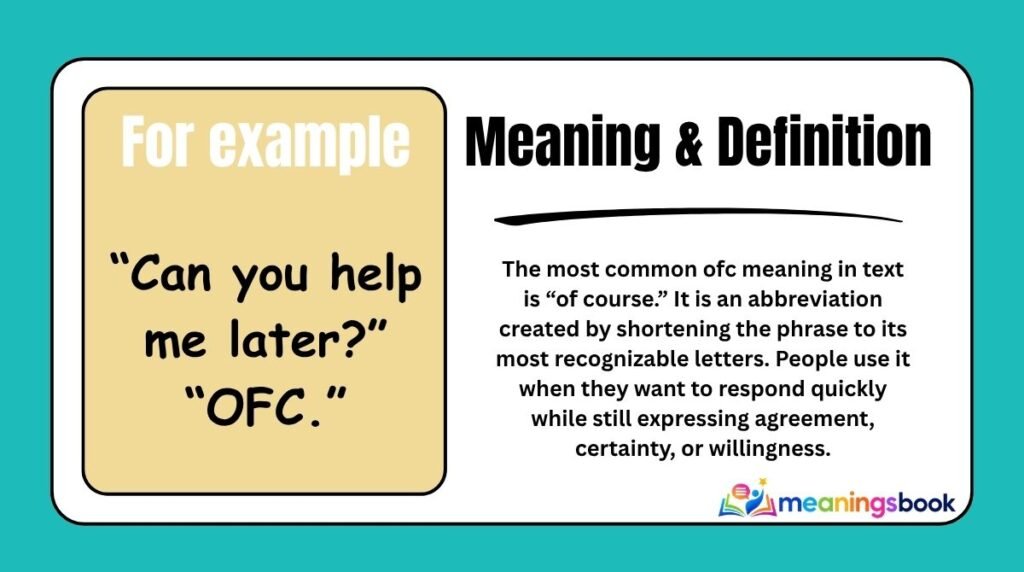
The most common ofc meaning in text is “of course.” It is an abbreviation created by shortening the phrase to its most recognizable letters. People use it when they want to respond quickly while still expressing agreement, certainty, or willingness.
For example:
- “Can you help me later?”
“OFC.”
Here, “ofc” means “of course,” indicating that the person is willing to help.
It can also be used to confirm something that seems obvious or expected:
- “You’re coming with us, right?”
“OFC!”
In this situation, the abbreviation communicates strong confirmation.
The tone can vary according to the surrounding message. “OFC!” can sound enthusiastic, warm, or excited. “ofc” without punctuation can feel casual and matter-of-fact. In some conversations, “ofc” can even communicate reassurance, particularly when someone is worried about whether another person agrees with them.
The abbreviation is primarily associated with informal written communication. It is much more natural in a text message, direct message, comment, or casual online conversation than in a formal business document or academic assignment.
It is also worth distinguishing ofc from an entirely different phrase that happens to use the same letters. In ordinary texting and social media, however, “ofc” overwhelmingly refers to “of course.” The surrounding conversation should still be considered before interpreting any abbreviation.
Simple examples
Question: “Are you free tonight?”
Reply: “OFC.”
Meaning: “Of course.”
Question: “Can I tell you something?”
Reply: “OFC!”
Meaning: “Of course!”
Message: “OFC I remember.”
Meaning: “Of course I remember.”
The expression is therefore best understood as a convenient digital abbreviation rather than a complicated piece of internet slang.
Background
“OFC” is a shortened form of the ordinary English expression “of course.” There is no need to assume that it originated from a particular social-media platform or from a specific internet community. Like many texting abbreviations, it developed naturally from the tendency to shorten frequently used phrases in fast digital communication.
Text messaging encouraged people to communicate with fewer characters and less typing. As online conversations became increasingly informal, abbreviations such as “ofc” became convenient alternatives to writing the complete phrase.
The exact point at which individuals began using “ofc” cannot reliably be assigned to one person, website, or platform. Its development is better understood as part of the broader evolution of internet and texting language.
The phrase “of course” itself is much older than digital communication. What changed in modern messaging is the way people write it. Instead of typing the full two-word expression, users can write three letters and rely on the reader to recognize the intended phrase.
This is similar to other common digital abbreviations. People may shorten “thank you” to “ty,” “please” to “pls,” or “be right back” to “brb.” These forms are designed primarily for convenience and conversational speed.
Importantly, using “ofc” does not necessarily indicate a special internet subculture or a particular age group. Its use can depend on personal communication habits, platform culture, and the informality of the conversation.
Because it is derived directly from a familiar English phrase, its meaning is usually easy to infer from context. If someone says, “OFC you can come,” they are simply writing “Of course you can come” in a shorter, more casual form.
Usage in Different Contexts
The meaning of ofc remains generally consistent across contexts, but its tone can change depending on where and how it appears.
In Chat
In private chats, “ofc” commonly expresses agreement or willingness.
“Can you send me the photo?”
“OFC.”
The response means “Of course” and suggests that the request is acceptable.
On Social Media
People may use “ofc” in comments, replies, captions, or direct messages.
“Are you going to the concert?”
“OFC!”
Here, it can express enthusiasm or certainty.
In Professional Communication
“OFC” is usually better suited to informal workplace messaging than formal professional writing. In a quick internal chat with coworkers, someone might write:
“Can you review this?”
“Ofc, I’ll check it.”
However, in a formal email, report, application, or official document, writing “of course” is generally clearer and more professional.
In Casual Conversations
Friends and family members may use “ofc” when agreeing with a question or reassuring someone.
“You still got my back?”
“OFC.”
The abbreviation here communicates reassurance and familiarity.
Tone Matters
The same abbreviation can carry slightly different emotional tones:
- “ofc” — casual and straightforward
- “OFC!” — enthusiastic or emphatic
- “ofc :)” — warm and friendly
- “ofc lol” — playful or relaxed
- “ofc.” — potentially neutral or brief
These distinctions are not fixed rules. The meaning should be interpreted alongside the rest of the conversation.
Meaning in Chat, WhatsApp, Instagram, and TikTok
On messaging and social-media platforms, ofc generally has the same meaning: “of course.” The platform itself usually does not create a different definition.
On WhatsApp, someone might reply:
“Can you call me later?”
“OFC.”
This simply means “Of course.”
In Instagram comments or direct messages, users may use it to agree with another person:
“You have to come next time!”
“OFC!”
It can also appear in casual comments:
“You look amazing!”
“OFC haha.”
The exact tone depends on the surrounding interaction.
TikTok
On TikTok, “ofc” may appear in comments, captions, replies, or messages. A user could write:
“You made this yourself?”
“OFC!”
Again, the intended meaning is “Of course!”
Other Chat Platforms
The same abbreviation can appear on Discord, Snapchat, Facebook, X, Instagram, gaming chats, and other digital platforms. Its basic meaning does not normally change simply because the platform changes.
One important point is that abbreviations often become more expressive through punctuation, capitalization, emojis, or additional words. Compare:
- “ofc”
- “ofc!”
- “OFC 😂”
- “ofc haha”
- “ofc, don’t worry”
All can mean “of course,” but their emotional tones may differ.
Meaning in Physics, Medical, and Aircraft Terminology
In ordinary texting, OFC means “of course.” However, abbreviations can have specialized meanings in technical fields, so context matters.
Physics
There is no broadly standard physics meaning that should automatically be assigned to OFC when someone asks about texting. A specialized document could use an abbreviation according to its own terminology, but that would be different from the everyday texting use.
Therefore, seeing “OFC” in a casual message should not lead you to assume it refers to a physics concept.
Medical Terminology
“OFC” can potentially appear as an abbreviation in specialized medical or clinical contexts, where abbreviations may have meanings defined by a particular field, document, or institution. However, this does not replace the common texting meaning.
If you encounter “OFC” in a medical record or professional healthcare document, the surrounding terminology should be used to determine its intended meaning rather than assuming it means “of course.”
Aircraft and Aviation
There is likewise no reason to interpret “OFC” as “of course” automatically when it appears in an aviation document. Aviation materials can contain many specialized abbreviations, and their meanings depend on the particular context.
For everyday texting, however, the overwhelmingly ordinary interpretation is “of course.”
The key distinction is simple: digital conversation uses “ofc” as a casual abbreviation, while technical fields may use the same letters independently as field-specific shorthand.
Common Misconceptions
One common misunderstanding is thinking that ofc has a hidden or complicated slang meaning. In most everyday texts, it does not. It is simply a shortened form of “of course.”
Another misconception is that “ofc” always sounds enthusiastic. That is not necessarily true. The tone depends heavily on punctuation, capitalization, and the surrounding conversation.
For example:
“OFC!!!”
may sound highly enthusiastic, while:
“ofc”
may simply be a quick confirmation.
Some readers may also interpret a short “ofc” as dismissive because it contains very little text. However, brevity does not automatically mean annoyance or sarcasm.
Another potential mistake is assuming that every occurrence of the letters “OFC” has the texting meaning. Abbreviations can have specialized meanings in professional, technical, organizational, or personal contexts.
Finally, “ofc” should not automatically be interpreted as romantic or flirtatious. Someone using it in a dating conversation may simply be saying “of course.” The relationship and surrounding messages determine whether there is any additional emotional meaning.
Similar Terms & Alternatives
Several expressions can communicate ideas similar to ofc, although their tone may differ.
“Of course”
This is the complete form and the clearest alternative. It works in both casual and more polished communication.
“Sure”
“Sure” can indicate agreement or willingness, but it is not always as strong as “of course.”
“Absolutely”
“Absolutely” often communicates stronger enthusiasm or certainty.
“Definitely”
“Definitely” emphasizes certainty and can sound slightly more deliberate.
“Certainly”
“Certainly” is more formal and is less common in casual texting.
“Yep” or “Yeah”
These are casual ways to agree, but they do not always carry the reassuring tone that “of course” can have.
“For sure”
“For sure” is another informal expression of agreement or confirmation.
The best interpretation depends on the exact message. “OFC,” “sure,” and “absolutely” may all indicate agreement, but they are not always interchangeable in tone.
How to Respond to It
When someone sends “ofc,” you usually do not need to overthink the response. If they are agreeing with your request or question, you can simply continue the conversation.
For example:
Them: “OFC!”
You: “Awesome, thanks!”
Or:
Them: “Ofc, I can help.”
You: “I really appreciate it.”
If someone uses “ofc” in response to an invitation:
Them: “OFC, I’ll be there.”
You: “Great! See you then.”
If the message is part of a friendly or playful conversation, you can respond casually:
“Haha, I knew you’d say yes 😂”
If you are unsure what the person means because the message lacks context, you can simply consider the previous message. Usually, the surrounding conversation makes the intended meaning obvious.
There is generally no need to ask, “What does OFC mean?” unless the abbreviation appears in an unusual or technical context.
Differences from Similar Words
| Expression | Basic meaning | Typical tone |
|---|---|---|
| OFC | Of course | Casual, conversational |
| Of course | Strong agreement/confirmation | Neutral to friendly |
| Sure | Agreement or willingness | Casual, neutral |
| Absolutely | Strong agreement | Enthusiastic |
| Definitely | Strong certainty | Confident |
| Certainly | Agreement/confirmation | More formal |
| For sure | Definite agreement | Casual |
The biggest difference is often tone rather than basic meaning.
For example, “OFC!” and “Absolutely!” can both communicate strong agreement, but “OFC!” feels more like casual digital conversation. “Certainly” is grammatically ordinary but sounds considerably more formal.
Likewise, “sure” can sometimes sound uncertain depending on context:
“Sure, I guess.”
That does not have the same confident feeling as:
“OFC!”
Therefore, when interpreting a message, look beyond the abbreviation itself. Punctuation, emojis, surrounding words, and the relationship between the speakers can all influence the tone.
Relevance in Online Conversations & Dating Apps
OFC is common in modern online communication because people often prefer short, quick responses. On dating apps, social platforms, and messaging services, users may use it when agreeing to plans, answering questions, or reassuring another person.
For example:
“Want to grab coffee this weekend?”
“OFC 😊”
The abbreviation simply communicates agreement. The emoji may add friendliness, while the overall conversation determines whether the exchange feels romantic, friendly, or casual.
Similarly:
“You still want to talk later?”
“OFC.”
This can communicate reassurance without necessarily implying romantic interest.
Dating-app conversations require particular attention to context because people often use very short messages. A phrase like “OFC” alone does not establish attraction, commitment, sarcasm, or emotional intensity.
If someone repeatedly responds with short abbreviations, it could simply reflect their texting style. On the other hand, enthusiastic wording, follow-up questions, emojis, and continued engagement may provide additional clues about their tone.
The safest interpretation is therefore the straightforward one: “ofc” means “of course” unless the surrounding context clearly indicates another meaning.
Frequently Asked Questions
What does OFC mean in text?
OFC means “of course” in text messages. It is an informal abbreviation used to express agreement, confirmation, certainty, or reassurance. For example, if someone asks, “Are you coming?” and you reply “OFC,” you are saying “Of course.” It is particularly common in casual messaging and online conversations.
What does OFC mean in chat?
In chat, OFC usually means “of course.” Someone may use it to quickly agree with a question, confirm a plan, or reassure another person. For example, “Can you help me?” followed by “OFC” means “Of course.” The abbreviation is casual and works best in informal conversations.
Is OFC a slang term?
OFC is best described as an informal abbreviation rather than a separate slang word. It shortens the familiar phrase “of course” for faster digital communication. People commonly use it in texts, direct messages, comments, and casual online chats. Its meaning is generally straightforward unless the surrounding context gives the abbreviation a specialized meaning.
What does OFC mean on social media?
On social media, OFC normally means “of course.” It can appear in comments, replies, direct messages, captions, or conversations. For example, someone might respond “OFC!” to an invitation or question. Capitalization, punctuation, emojis, and surrounding words can make the response sound more enthusiastic, friendly, or neutral.
How do you respond to OFC in a message?
You can respond to OFC according to the conversation. If someone agrees to help, you might say “Thanks!” If they agree to your plans, “Great!” or “See you then!” works naturally. When the conversation is playful, a casual response or emoji can also fit. Usually, no special response is required.
Can OFC have different meanings?
OFC can have different meanings in specialized contexts, but in ordinary texting it usually means “of course.” Technical, professional, medical, or organizational documents may use the same letters as an abbreviation for something else. When interpreting it, consider the subject of the conversation and the setting rather than assuming every occurrence has the texting meaning.
Does OFC mean yes?
OFC can effectively mean yes when it is used to agree with a question or request. However, its fuller meaning is “of course,” which often sounds stronger or more reassuring than a simple “yes.” For example, “Can you come?” — “OFC!” communicates enthusiastic or confident agreement.
Does OFC sound rude in texting?
OFC is not inherently rude, although a very short reply can sometimes feel blunt depending on context. “OFC!” may sound enthusiastic, while a bare “ofc” can feel neutral or brief. Punctuation, emojis, previous messages, and the relationship between the people involved can all affect how the response is perceived.
Conclusion
OFC is a simple and widely understandable abbreviation for “of course” in casual digital communication. People use it in texts, chats, social-media conversations, comments, and direct messages to express agreement, confirmation, certainty, or reassurance. Its meaning usually remains consistent across platforms such as WhatsApp, Instagram, and TikTok.
The tone, however, can change depending on capitalization, punctuation, emojis, and the surrounding conversation. “OFC!” may sound enthusiastic, while “ofc” may simply provide a quick confirmation. The abbreviation does not automatically indicate sarcasm, romance, or a particular emotional attitude.
Although the same letters can potentially have specialized meanings in technical or professional settings, the ordinary interpretation in texting is “of course.”
When you encounter it online, start with that meaning and then use the surrounding context to understand the speaker’s exact tone. In most everyday conversations, ofc is simply a convenient, informal way to say “of course.”

I am Ethan Whitmore, an English teacher and vocabulary enthusiast who explains words, phrases, and meanings in text through simple examples to make English easier for everyone.