When someone sends a short message such as “IMO, this is the best option,” the abbreviation can seem confusing if you have never seen it before.
IMO is a common internet abbreviation that appears in text messages, online chats, social media posts, comments, forums, and casual conversations. Because people often use abbreviations to make communication faster, understanding these short expressions can make online conversations much easier to follow.
People usually search for IMO meaning in text because they have encountered the abbreviation in a message or comment and want to know what the sender intended. In most everyday situations, IMO means “in my opinion.”
It signals that the person is sharing a personal view rather than presenting something as an established fact. The expression is generally informal, neutral, and easygoing. Understanding how it works in different contexts can also help you decide whether a response should be casual, serious, or simply acknowledge the other person’s viewpoint.
Quick Answer
IMO meaning in text is “in my opinion.” It is commonly used in texts, chats, comments, and social media when someone wants to introduce a personal opinion or judgment. For example, “IMO, that movie was great” means “In my opinion, that movie was great.” It usually signals a personal perspective rather than an objective fact.
Meaning & Definition
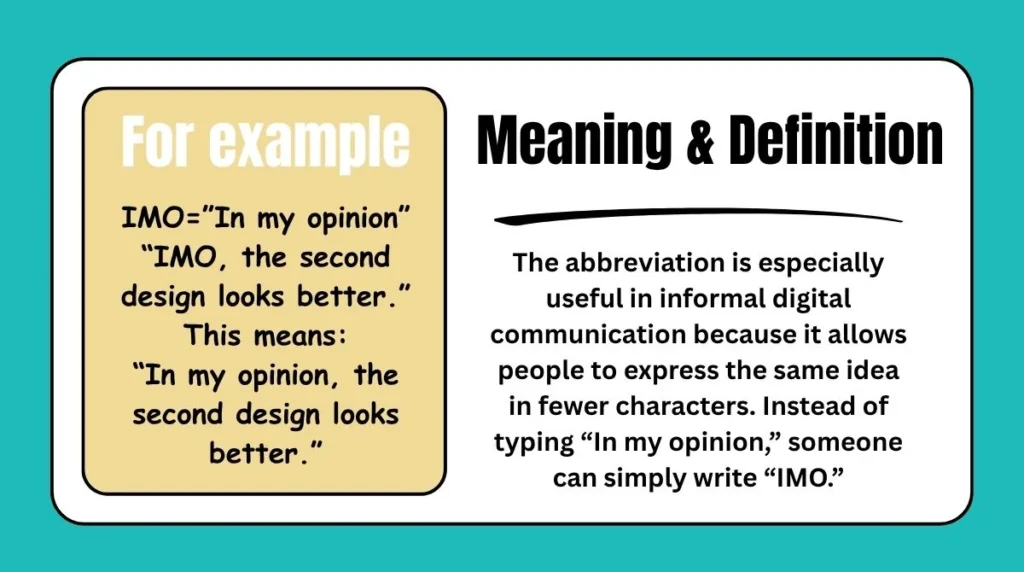
IMO stands for “in my opinion.” It is an abbreviation people use when they want to make it clear that what follows is their personal belief, preference, judgment, or viewpoint.
For example:
“IMO, the second design looks better.”
This means:
“In my opinion, the second design looks better.”
The abbreviation is especially useful in informal digital communication because it allows people to express the same idea in fewer characters. Instead of typing “In my opinion,” someone can simply write “IMO.”
What does IMO communicate?
The important part of IMO is that it identifies a statement as subjective. A person using IMO is generally not claiming that everyone must agree with them. They are presenting their own perspective.
Consider these two statements:
- “That is the best restaurant in town.”
- “IMO, that is the best restaurant in town.”
The first sounds more like a general or absolute claim. The second clearly frames the statement as the speaker’s personal opinion.
IMO can introduce positive, negative, or neutral opinions:
- “IMO, this update is much better.”
- “IMO, the ending was disappointing.”
- “IMO, we should leave earlier.”
- “IMO, blue looks better than black.”
The tone is usually casual and conversational. It can appear at the beginning of a sentence, but people may also place it in the middle or use it as a short standalone response.
For instance:
“IMO, you should take the earlier flight.”
Or:
“The first option is cheaper, but IMO the second one is worth it.”
Although IMO is most strongly associated with internet and text communication, its meaning is straightforward enough that it can also be understood when spoken aloud. The exact tone depends on the surrounding conversation, but the basic function remains the same: it marks what follows as the speaker’s personal opinion.
Background
IMO developed as part of the broader culture of abbreviated communication. As people began communicating through online discussion systems, instant messaging, chat rooms, forums, email, and later social media, shortened expressions became a convenient way to communicate quickly.
The exact individual moment when IMO was first used is difficult to establish with certainty, so it would be misleading to attribute its creation to a particular person or platform without reliable evidence. What can be said confidently is that IMO belongs to a broader family of internet abbreviations designed to represent common conversational phrases in a compact form.
The logic behind the abbreviation is simple:
- I = In
- M = My
- O = Opinion
Over time, IMO became familiar enough that many internet users could understand it without needing the phrase written out.
The popularity of abbreviations such as IMO is connected to the nature of digital communication. Texting and online discussions often favor speed, brevity, and informal language. A three-letter abbreviation can communicate a phrase instantly to someone who knows the convention.
IMO also fits naturally alongside other opinion-related expressions. For example, people may write “IMO” before recommending a movie, evaluating a product, discussing a sports team, commenting on an idea, or giving personal advice.
Its continued use does not depend on one particular social-media platform. It can appear anywhere people exchange informal written opinions.
Importantly, IMO does not inherently indicate that an opinion is correct, incorrect, controversial, sarcastic, or serious. The abbreviation simply identifies the statement as belonging to the speaker’s perspective. The surrounding words and conversation provide the additional meaning.
Usage in Different Contexts
The meaning of IMO stays consistent across most contexts, but the way people use it can vary depending on the setting.
Chat
In private chats, IMO is commonly used when someone wants to give an honest personal view.
“IMO, you should wait until tomorrow.”
It can make advice sound less like an order and more like a personal recommendation.
Social Media
On social platforms, IMO can introduce an opinion in a post, comment, or reply.
“IMO, this is one of their best songs.”
Because social-media discussions often contain differing opinions, IMO can emphasize that a statement represents the writer’s own judgment.
Professional Fields
IMO is less formal than phrases such as “in my assessment,” “in my view,” or “I recommend.” It may appear in informal workplace chats, team messaging, or casual discussions among colleagues, but it is generally better to use the full phrase in formal reports, official correspondence, or highly professional writing unless the abbreviation is clearly accepted within that environment.
For example, in a casual work chat:
“IMO, we should test the new version first.”
In a formal document, writing “In my opinion” may be more appropriate.
Casual Conversations
In everyday online conversations, IMO is often used for preferences and judgments:
“IMO, pizza is better than burgers.”
“IMO, that was the funniest part.”
It can also soften disagreement:
“IMO, I think the first option makes more sense.”
The expression does not automatically make disagreement polite, however. The rest of the message determines the overall tone.
Meaning in Chat, WhatsApp, Instagram, and TikTok
On messaging and social-media platforms, IMO generally has the same meaning: “in my opinion.” The platform does not normally change the definition.
In WhatsApp
Someone might write:
“IMO, we should meet on Saturday.”
Here, the sender is simply expressing a personal preference.
In Instagram comments
A user could comment:
“IMO, this is your best photo.”
The abbreviation signals that the comment is the person’s own assessment.
On TikTok
A TikTok comment might say:
“IMO, the original version is better.”
Again, IMO tells readers that the person is giving a personal opinion.
In private messages
A friend might say:
“IMO, you handled that situation really well.”
The phrase works naturally in informal conversations because it is short and recognizable.
Does capitalization matter?
Usually, IMO, imo, and sometimes Imo are understood in the same way. Online communication often ignores strict capitalization rules, particularly in quick messages.
The difference is mainly stylistic rather than semantic. “IMO” may look more like a conventional abbreviation, while “imo” can feel more casual.
Examples in context
Person A: “Which one should I buy?”
Person B: “IMO, get the black one.”
Person A: “Did you like the movie?”
Person B: “IMO, the first half was better.”
In both examples, the sender is clearly giving a personal judgment.
Meaning in Physics, Medical, and Aircraft Terminology
The standard meaning of IMO in ordinary texting and online communication is “in my opinion.” It is important not to automatically apply that internet meaning to specialized fields.
Physics
IMO is not a standard fundamental physics term or universal physics abbreviation meaning “in my opinion.” A physics textbook may contain other abbreviations that happen to use the same letters, depending on the subject or notation system, but IMO itself should not be treated as a standard physics concept.
Medical terminology
IMO is not universally recognized as a standard medical term meaning “in my opinion.” Medical abbreviations can vary between institutions, specialties, and documents. Because ambiguous abbreviations can be problematic in healthcare, the surrounding medical context is particularly important.
Therefore, seeing IMO in a medical-related message does not automatically mean the writer is using the internet abbreviation.
Aircraft and aviation terminology
IMO is also not a standard aviation term that should automatically be interpreted as “in my opinion.” Aviation uses many specialized abbreviations, and the meaning of any abbreviation depends on the specific document, communication system, or operational context.
The key distinction
If you encounter IMO in a casual text, comment, or chat, “in my opinion” is the normal interpretation. If you encounter the same letters in a specialized technical document, do not assume the internet meaning without checking the context.
Common Misconceptions
One common misunderstanding is thinking that IMO means the speaker believes something is unquestionably true. In reality, the abbreviation does almost the opposite: it identifies the statement as a personal opinion.
For example:
“IMO, this is the best choice.”
The sender is not necessarily claiming that everyone should agree. They are saying that from their perspective, it is the best choice.
Another misconception is that IMO always signals disagreement. It does not. Someone can use it to agree, recommend something, praise an idea, criticize something, or simply state a preference.
For example:
“IMO, you made the right decision.”
That is supportive rather than argumentative.
Some people also confuse IMO with other abbreviations that express opinions more strongly or differently. For example, IMHO means “in my humble opinion,” while IMNSHO is an extended form meaning “in my not-so-humble opinion.” These expressions can carry different shades of tone.
Another misconception is that capitalization changes the meaning. In most casual digital communication, “IMO” and “imo” mean the same thing.
Finally, IMO does not automatically make a statement polite. Compare:
“IMO, I prefer the first option.”
with:
“IMO, your idea is terrible.”
Both identify an opinion, but the second can still sound harsh.
Similar Terms & Alternatives
Several abbreviations and phrases are related to IMO.
| Term | Meaning | Typical tone |
|---|---|---|
| IMO | In my opinion | Casual, neutral |
| IMHO | In my humble opinion | Casual, often modest or playful |
| IMNSHO | In my not-so-humble opinion | Informal, humorous or emphatic |
| I think | Personal belief or judgment | Very natural, conversational |
| In my view | Personal perspective | Neutral to somewhat formal |
| In my opinion | Personal viewpoint | Neutral |
| Personally | Individual preference or belief | Casual |
| From my perspective | Personal viewpoint | More polished/formal |
The best alternative depends on the situation.
For everyday texting, “I think” may sound more natural than an abbreviation:
“I think we should wait.”
For a professional discussion, “In my view” or “From my perspective” can sound more appropriate:
“From my perspective, the second approach is more practical.”
IMHO is especially close to IMO, but it adds the word humble, which can make the expression sound more modest, self-aware, or humorous. In actual online conversations, people may use IMHO ironically, so tone still depends on context.
How to Respond to It
You usually do not need a special response when someone writes IMO. Simply respond to the opinion itself.
If you agree, you could say:
“I agree.”
“Yeah, I think so too.”
“Same here.”
If you disagree politely:
“I see your point, but I think the other option works better.”
“That makes sense, although I see it differently.”
If you want more explanation:
“What makes you think that?”
“Why do you prefer that one?”
If the message is advice:
“Thanks, I’ll consider that.”
If the person says:
“IMO, you should go for it.”
You could reply:
“I was thinking the same thing.”
Or:
“Maybe. I’m still deciding.”
The appropriate response depends less on the abbreviation itself and more on what the person is actually saying. IMO simply tells you that their statement represents their personal viewpoint.
Differences from Similar Words
IMO is different from several expressions that can look similar in a conversation.
IMO vs. IMHO
IMO means “in my opinion,” while IMHO means “in my humble opinion.” Both introduce personal viewpoints. IMHO can sound slightly more self-conscious, modest, or playful.
IMO vs. I think
These expressions are very similar in everyday conversation. “I think” is a normal phrase, while IMO is a compact internet abbreviation.
“IMO, this is better.”
and
“I think this is better.”
communicate essentially the same idea.
IMO vs. IMNSHO
IMNSHO is more emphatic and humorous. It expands the idea of a personal opinion with “not-so-humble.” It is much less straightforward and is more likely to be used playfully.
IMO vs. “fact”
IMO identifies a personal perspective. A factual statement is presented as something that can be independently established rather than merely a person’s preference.
For example:
“IMO, this is the best phone.”
is an opinion.
“This phone was released in 2025.”
is presented as a factual claim.
The distinction matters because an opinion can be reasonable without being objectively provable.
Relevance in Online Conversations & Dating Apps
IMO can appear naturally in modern online conversations because people frequently share recommendations, preferences, judgments, and personal perspectives through digital platforms.
On dating apps, someone might use it while discussing restaurants, movies, travel, hobbies, or first-date ideas:
“IMO, coffee is better than dinner for a first date.”
The abbreviation does not have a special dating-specific meaning. It still means “in my opinion.”
Context can, however, affect how the statement feels. Between close friends, IMO may sound completely casual. Between people who have just met, it may make a strong preference sound slightly less absolute.
For example:
“IMO, that place would be a great date spot.”
This communicates a suggestion without presenting it as the only correct choice.
In dating conversations, people may also use IMO when discussing compatibility:
“IMO, communication matters more than having the same hobbies.”
Here, the person is sharing a personal belief or value.
It is useful to avoid reading too much into the abbreviation itself. IMO does not inherently indicate flirting, attraction, sarcasm, disagreement, or emotional distance. Those meanings come from the surrounding conversation, relationship, wording, and tone.
In short, when IMO appears in an online conversation, focus on the sentence that follows it. The abbreviation simply tells you that the speaker is expressing their own perspective.
Frequently Asked Questions
What does IMO mean in text?
IMO means “in my opinion” in text messages. People use it to introduce a personal belief, preference, judgment, or recommendation. For example, “IMO, the blue one looks better” means “In my opinion, the blue one looks better.” It is informal and commonly understood in digital communication.
What does IMO mean in chat?
In chat, IMO means “in my opinion.” It is usually used when someone wants to share a personal viewpoint without presenting it as an objective fact. You might see it before an opinion, recommendation, criticism, or preference in a conversation with friends, coworkers, or online acquaintances.
Is IMO a slang term?
IMO is best described as an informal internet abbreviation rather than traditional slang. It stands for “in my opinion” and is widely used in texts, chats, comments, and online discussions. Because it is informal, writing the full phrase may be preferable in formal or highly professional communication.
What does IMO mean on social media?
On social media, IMO normally means “in my opinion.” Users put it before a personal judgment or preference, such as “IMO, this is their best song.” The abbreviation can appear in captions, comments, replies, direct messages, and discussions across different social platforms.
How do you respond to IMO in a text?
Respond to the opinion rather than to the abbreviation itself. If you agree, you can say “I agree” or “Same here.” If you disagree, you can politely explain your perspective. If you are interested in their reasoning, ask something like, “Why do you think that?” The appropriate response depends on the conversation.
Can IMO have different meanings?
IMO can have other interpretations in specialized contexts, but “in my opinion” is the standard meaning in ordinary texting and online conversations. If the abbreviation appears in a technical, medical, aviation, or organizational document, the surrounding context should be considered before deciding what it means.
Is IMO the same as IMHO?
IMO and IMHO are closely related but not identical. IMO means “in my opinion,” while IMHO means “in my humble opinion.” Both introduce a personal viewpoint. IMHO may add a modest, self-aware, or sometimes humorous tone, while IMO is simpler and more direct.
Does IMO mean the person is disagreeing?
No, IMO does not specifically mean disagreement. It simply indicates that the following statement is the speaker’s personal opinion. Someone can use IMO to agree, praise, recommend, criticize, or express a preference. The actual tone and meaning of the message come from the words surrounding the abbreviation.
Conclusion
IMO is a simple and widely understood abbreviation that means “in my opinion.” It is primarily used in informal digital communication, including text messages, chats, social-media comments, posts, and online discussions. Its main purpose is to show that the following statement represents the writer’s personal viewpoint rather than an unquestionable fact.
The abbreviation can be used for recommendations, preferences, criticism, praise, advice, and everyday judgments. Related expressions such as IMHO and “in my view” communicate similar ideas but can have slightly different tones or levels of formality.
IMO does not have one special meaning on WhatsApp, Instagram, TikTok, or dating apps; its basic interpretation remains the same. However, specialized contexts may use abbreviations differently, so technical or professional material should always be interpreted according to its context. When you see IMO in an ordinary conversation, the safest and most natural interpretation is “in my opinion.”

I am Ethan Whitmore, an English teacher and vocabulary enthusiast who explains words, phrases, and meanings in text through simple examples to make English easier for everyone.