If you have received a message containing “DW,” you may have wondered what the abbreviation means or how you should respond.
Short forms like this are common in texting, messaging apps, comments, and social media because people often prefer quick ways to communicate. The meaning of an abbreviation can also depend on the surrounding conversation, making context especially important.
In everyday digital communication, “DW” most commonly means “don’t worry.” People use it to reassure someone, reduce concern, or let them know that a problem is not serious. For example, if someone apologizes for being late, a friend might reply, “DW, it’s okay.”
Because abbreviations can have other meanings in specialized settings, it is useful to distinguish casual texting from professional or technical language.
Understanding the tone behind “DW” can also help you decide whether a simple acknowledgment, reassurance, or friendly response is appropriate.
Quick Answer
DW Meaning in Text is most commonly “don’t worry.” It is widely used in texting, chats, and social media to reassure someone or tell them not to be concerned. For example, “DW, you’re fine” means “Don’t worry, you’re fine.” The exact meaning can vary in specialized contexts, so surrounding words should always be considered.
Meaning & Definition
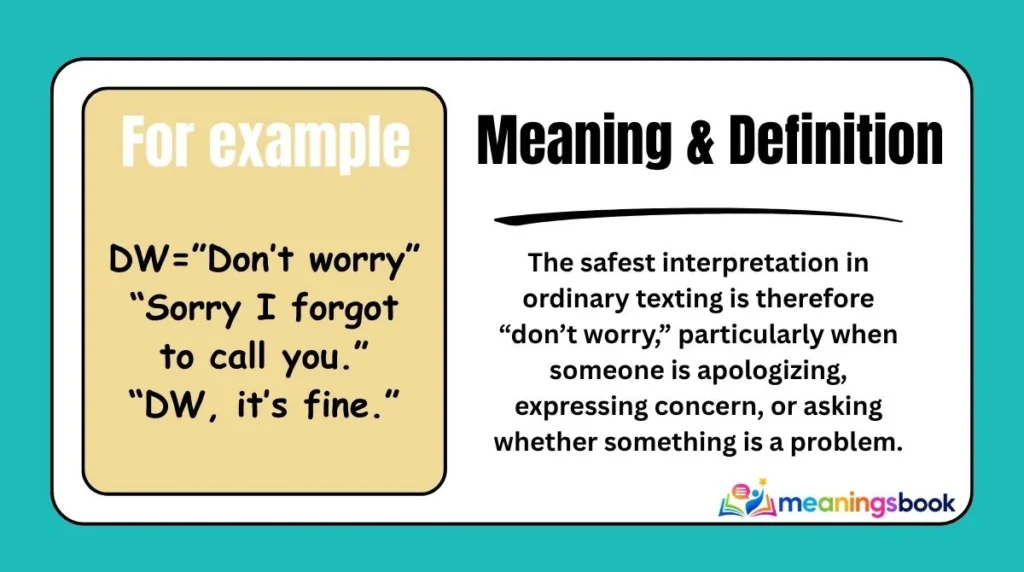
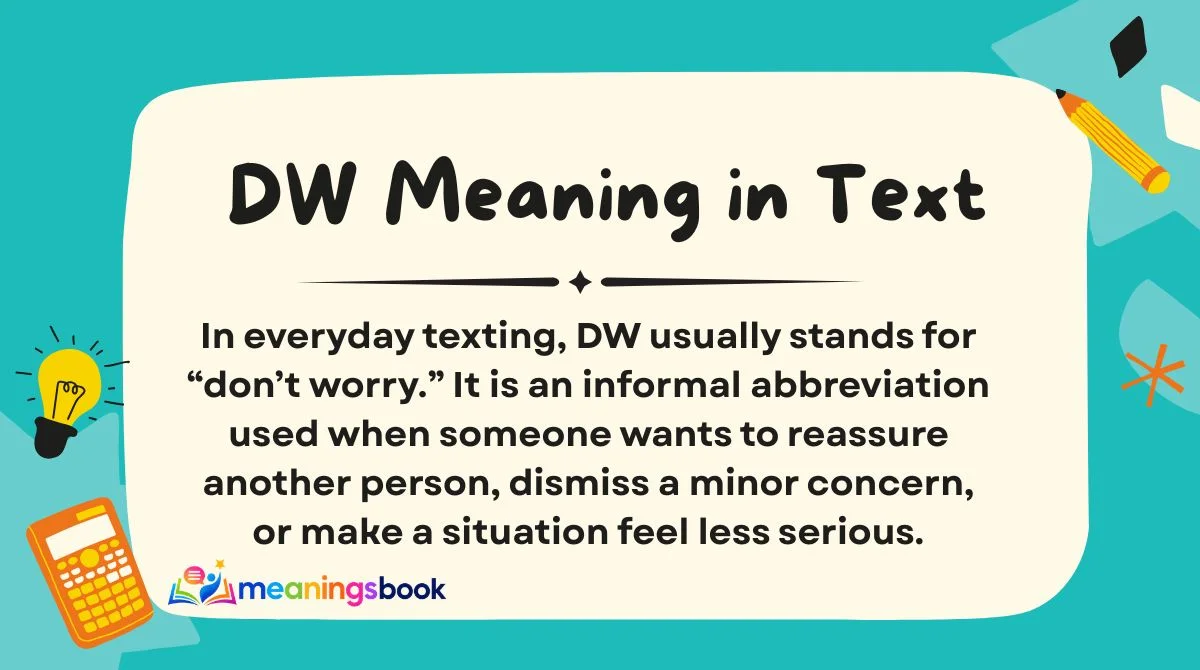
In everyday texting, DW usually stands for “don’t worry.” It is an informal abbreviation used when someone wants to reassure another person, dismiss a minor concern, or make a situation feel less serious.
For example:
“Sorry I forgot to call you.”
“DW, it’s fine.”
Here, “DW” tells the other person that there is no need to feel guilty or concerned.
The expression can also be used before another reassuring statement:
“DW, I’ll handle it.”
This means the speaker is telling the recipient not to worry because the situation is under control.
What does “DW” communicate?
The abbreviation can communicate several closely related ideas:
- Reassurance: “Don’t worry about it.”
- Forgiveness: “It’s okay; you didn’t cause a problem.”
- Comfort: “There is no need to be concerned.”
- Reassurance about plans: “Everything should be fine.”
- Dismissal of a minor issue: “It isn’t important enough to worry about.”
Its tone is generally casual and friendly. However, tone can change according to the conversation. “DW” by itself may sound brief or slightly dismissive if the other person is discussing a serious concern. Adding words such as “it’s okay,” “you’re good,” or “I understand” can make the reassurance clearer.
Is DW slang?
“DW” is best described as an informal texting abbreviation rather than a traditional slang word. It is especially common in digital communication where short messages are convenient.
The abbreviation does not normally require capitalization in casual writing. Someone may write “dw,” “DW,” or “Dw,” with the intended meaning usually remaining clear from context.
The safest interpretation in ordinary texting is therefore “don’t worry,” particularly when someone is apologizing, expressing concern, or asking whether something is a problem.
Background
The abbreviation “DW” is closely connected to the longer phrase “don’t worry.” It is difficult to identify one specific person, message, or event responsible for creating it. Like many texting abbreviations, it developed as part of the broader habit of shortening common expressions in digital communication.
People have long used abbreviated forms in informal writing to communicate more quickly. As texting and online messaging became everyday forms of communication, frequently used phrases naturally acquired shorter versions.
“Don’t worry” is particularly suitable for abbreviation because it is a common conversational expression. It appears in many situations: apologizing, asking for reassurance, discussing mistakes, making plans, or helping someone who feels uncertain. Turning it into “DW” allows the same basic message to be communicated with just two letters.
Why did “DW” become convenient?
Text-based conversations often move quickly. A person may want to reassure someone without writing a complete sentence. Instead of typing:
“Don’t worry, everything is okay.”
they may simply write:
“DW, everything’s okay.”
The abbreviation is especially useful when the surrounding conversation already makes the meaning obvious.
There is not necessarily a difference in meaning between “DW” and “don’t worry.” The main difference is style. The full phrase sounds more conventional, while “DW” feels quicker and more informal.
Context remains important
Although “don’t worry” is the standard interpretation in ordinary texting, abbreviations can have different meanings in different communities and professional environments. Therefore, it would be inaccurate to claim that “DW” always means exactly the same thing everywhere.
For everyday messages, however, the phrase “don’t worry” is the primary interpretation readers are likely to consider. If a message says “DW about it,” “DW, I got this,” or “DW you’re okay,” the intended meaning is particularly clear.
Usage in Different Contexts
The meaning and tone of “DW” can be understood most easily by looking at the situation in which it appears.
Chat
In private chats, “DW” is commonly used as a quick reassurance. A person might use it after a friend apologizes or worries about causing inconvenience.
Example:
“Sorry, I’m going to be ten minutes late.”
“DW!”
The response means that being late is not a major problem.
It can also appear with additional information:
“DW, I already finished it.”
Here, the sender is reassuring the recipient that they do not need to take action.
Social Media
On social media, “DW” can appear in comments, replies, direct messages, or captions. Its function is usually similar to its use in private chats.
For instance:
“I hope I didn’t ruin your post.”
“DW 😂”
The abbreviation reassures the person while keeping the interaction casual.
Professional Fields
In professional communication, “DW” should be interpreted more carefully. In a workplace message, its meaning could still be “don’t worry,” particularly between coworkers who communicate informally.
However, professional or technical contexts may use the same letters for other terms. Therefore, someone should not automatically interpret every occurrence of “DW” as texting slang.
When writing a formal email or business document, spelling out “don’t worry” is generally clearer than using an informal texting abbreviation.
Casual Conversations
Among friends and acquaintances, “DW” is particularly natural. It can soften an apology, reassure someone after a mistake, or signal that an issue has been resolved.
Example:
“I forgot to bring your charger.”
“DW, I have another one.”
The abbreviation makes the response feel relaxed and conversational.
Overall, the surrounding words, relationship between the speakers, and communication platform help determine how “DW” should be understood.
Meaning in Chat, WhatsApp, Instagram, and TikTok
Across popular messaging and social platforms, “DW” generally carries the same everyday meaning: “don’t worry.” The platform itself usually does not change the basic interpretation.
In WhatsApp conversations, someone might send:
“DW, I’ll send it later.”
This means:
“Don’t worry, I’ll send it later.”
It can be used between friends, family members, classmates, or other people who communicate casually.
On Instagram, “DW” may appear in direct messages or comments. A user could write:
“DW about the photo!”
The speaker is reassuring the other person that they should not be concerned about the photo.
TikTok
TikTok users may use abbreviations such as “DW” in comments or direct messages. For example:
“DW, you weren’t the only one who noticed 😂”
Here, the abbreviation creates a casual and friendly tone.
General texting
The same principle applies to ordinary SMS or other chat services:
“I might be late.”
“DW, take your time.”
The response means that the recipient should not feel pressured or worried.
Does the capitalization matter?
Usually, no. “DW,” “dw,” and “Dw” can all mean “don’t worry” in casual communication. Capitalization often reflects the person’s typing habits rather than a different definition.
The abbreviation can also appear alone:
“DW!”
Or as part of a longer sentence:
“DW, everything is sorted.”
The second version provides more context and may sound warmer or clearer.
Meaning in Physics, Medical, and Aircraft Terminology
“DW” does not have one universal technical definition across physics, medicine, and aviation. These fields use many abbreviations, and the meaning of two letters can depend on the specific subject, document, institution, or terminology system.
Physics
There is no single universally recognized physics meaning of “DW” that should automatically replace the ordinary texting interpretation in every context. Technical physics literature can use abbreviations for specialized concepts, but their meanings depend on the particular subject and source.
Therefore, seeing “DW” in a physics-related document does not automatically mean “don’t worry.”
Medical terminology
“DW” is not a universal standalone medical abbreviation with one meaning applicable to all medical situations. Healthcare terminology contains numerous abbreviations whose interpretations depend on the specialty and context.
For medical information, it is particularly important not to guess the meaning of an unfamiliar abbreviation from two letters alone.
Aircraft and aviation terminology
Similarly, “DW” does not have one universal aviation meaning that applies to every aircraft, airport, or aviation document. Aviation uses standardized terminology in many areas, but abbreviations can vary according to the specific system or document.
If “DW” appears in a technical aviation context, the surrounding material should be checked before assigning a meaning.
The important distinction
For ordinary texting and social media, “DW” most commonly means “don’t worry.” In technical contexts, however, it should not automatically be interpreted that way.
This distinction prevents a common mistake: assuming that an abbreviation has the same definition everywhere simply because it is familiar in online conversation.
Common Misconceptions
Several misunderstandings can occur when people encounter “DW” without enough context.
1. Assuming it always means “don’t worry”
“Don’t worry” is the primary meaning in casual texting, but abbreviations can have other meanings in specialized contexts. The surrounding conversation should therefore be considered.
2. Thinking it is always dismissive
“DW” is often reassuring, but the emotional tone depends on how it is used. For example:
“DW, it’s totally fine 😊”
sounds warm and supportive.
By contrast:
“DW.”
could feel abrupt if someone is discussing a serious issue.
The words surrounding the abbreviation and the relationship between the speakers influence how it feels.
3. Confusing it with similar abbreviations
People sometimes confuse “DW” with other short forms simply because they contain the same letters or appear in similar online environments. However, abbreviations such as “DM,” “BTW,” and “IDK” have different meanings.
4. Assuming capitalization changes the meaning
In casual messaging, “dw” and “DW” normally communicate the same idea. Capitalization is generally a matter of typing style rather than a separate definition.
5. Treating texting language as formal writing
Although “DW” is easy to understand in a casual conversation, it may be inappropriate or unclear in formal documents. In professional writing, spelling out “don’t worry” is usually the safer choice.
6. Ignoring the conversation around it
A two-letter abbreviation rarely provides complete information by itself. Looking at the sentence before and after “DW” usually makes the intended meaning much easier to identify.
Similar Terms & Alternatives
Several abbreviations and expressions can appear in conversations where “DW” is used.
| Term | Meaning | Typical use |
|---|---|---|
| DW | Don’t worry | Reassurance |
| NP | No problem | Responding to an apology or request |
| NBD | No big deal | Saying something is not important |
| YW | You’re welcome | Responding to thanks |
| IDK | I don’t know | Expressing uncertainty |
| BTW | By the way | Introducing an additional point |
| DM | Direct message | Referring to private social messaging |
| IDC | I don’t care | Expressing lack of concern or interest |
These expressions are not interchangeable.
For example, “DW” focuses on reassuring another person:
“DW, you didn’t do anything wrong.”
“NP” usually responds to an apology, request, or favor:
“Sorry about that.”
“NP.”
“NBD” minimizes the importance of an issue:
“I forgot to bring the notes.”
“NBD.”
These differences matter because choosing the wrong abbreviation can subtly change the tone of a message.
Other natural alternatives to “DW” include:
- “Don’t worry.”
- “It’s okay.”
- “No worries.”
- “You’re fine.”
- “It’s all good.”
- “No need to worry.”
- “Everything’s okay.”
The best choice depends on the relationship and seriousness of the conversation.
How to Respond to It
How you respond to “DW” depends on what the other person is reassuring you about.
If someone says:
“DW, it’s okay.”
you can simply acknowledge the reassurance:
“Okay, thanks!”
or:
“Glad to hear that.”
If the person is reassuring you after an apology, you might say:
“Thanks for understanding.”
If “DW” is being used in a friendly conversation, you can keep your response equally casual:
“Haha, okay 😄”
If you are still concerned
You do not have to accept the reassurance immediately if something remains unclear. You can ask a follow-up question:
“Are you sure?”
or:
“Okay, but let me know if there’s a problem.”
If someone says “DW” after you apologize
A simple response such as:
“Thanks, I appreciate it.”
is appropriate.
If “DW” seems unclear
Context can resolve most cases. If the abbreviation appears in a technical, workplace, or unfamiliar setting and “don’t worry” does not make sense, ask what the sender means rather than guessing.
The main goal is to match the tone. A casual “DW 😊” usually deserves a casual response, while a serious conversation may benefit from a more thoughtful sentence.
Differences from Similar Words
Although “DW,” “no worries,” “no problem,” and “it’s okay” can all provide reassurance, they are not exactly identical.
DW vs. “No worries”
DW is an abbreviation for “don’t worry.” “No worries” is a complete expression that can reassure someone or respond to an apology.
“DW, I can wait.”
and
“No worries, I can wait.”
communicate nearly the same idea, but the second is more fully written.
DW vs. “No problem”
“No problem” often responds directly to an apology or request.
“Sorry I’m late.”
“No problem.”
“DW” can also work here, but its emphasis is more directly on telling the other person not to worry.
DW vs. “It’s okay”
“It’s okay” explicitly indicates that the situation is acceptable. “DW” focuses on reducing the other person’s concern.
“DW, you’re okay.”
combines both ideas.
DW vs. “NBD”
“NBD,” meaning “no big deal,” minimizes the importance of an event. It can overlap with “DW,” but the emphasis differs.
“DW” = You don’t need to worry.
“NBD” = This isn’t a significant problem.
Understanding these small distinctions can help you interpret the emotional tone of short messages more accurately.
Relevance in Online Conversations & Dating Apps
“DW” can appear naturally in online conversations, including direct messages and dating-app chats. In these settings, it usually has the same basic meaning: “don’t worry.”
For example, someone might say:
“Sorry, I disappeared for a few hours. DW if I reply slowly sometimes.”
Or:
“DW, I’m not offended 😂”
In a dating conversation, the abbreviation can help keep a message relaxed and prevent a minor situation from becoming unnecessarily serious.
Context affects the tone
The relationship between the people matters. A close friend using “DW” may sound warm and reassuring. Someone you barely know might use it simply as a quick response.
In dating conversations, short messages can sometimes be difficult to interpret emotionally because they lack facial expressions and vocal tone. “DW” itself does not necessarily indicate romantic interest, disinterest, affection, or annoyance. Those conclusions should come from the broader conversation rather than the abbreviation alone.
For example:
“DW 😊”
may feel friendly because of the emoji, while:
“DW.”
may appear more abrupt.
Neither format automatically proves a particular emotion.
When “DW” is useful online
People commonly use it to:
- reassure someone after an apology,
- reduce anxiety about plans,
- dismiss a minor problem,
- show that they are not upset,
- make conversations feel more relaxed.
Ultimately, the safest approach is to interpret “DW” together with the complete message and the relationship between the speakers.
Frequently Asked Questions
What does DW mean in text messages?
DW usually means “don’t worry” in text messages. It is an informal abbreviation used to reassure someone or tell them that a situation is not serious. For example, “DW, you’re fine” means “Don’t worry, you’re fine.” The abbreviation is particularly common in casual conversations with friends, family, and other people who use informal messaging.
What does DW mean in chat?
In chat, DW generally means “don’t worry.” Someone may use it after you apologize, express concern, or ask whether something is a problem. For example, “DW about it” means “Don’t worry about it.” The tone is usually casual, although the exact emotional effect depends on the rest of the conversation.
Is DW a slang term?
DW is best described as an informal texting abbreviation rather than a conventional slang word. It shortens the common phrase “don’t worry” for faster digital communication. You may see it in texts, private messages, comments, and other casual online conversations. It is generally less appropriate in formal documents or professional writing.
What does DW mean on social media?
On social media, DW usually means “don’t worry.” It can appear in comments, direct messages, replies, and casual posts when someone wants to reassure another person. For example, “DW, everything is good” tells the recipient that they do not need to be concerned.
How should I respond when someone says DW?
You can respond naturally with “Thanks,” “Okay, I appreciate it,” or another acknowledgment. If the person is reassuring you after an apology, “Thanks for understanding” works well. If you remain concerned, you can ask, “Are you sure?” The appropriate response depends on what the other person is reassuring you about.
Can DW have different meanings?
Yes, DW can have other meanings in specialized contexts. In ordinary texting, “don’t worry” is the most common interpretation, but technical, professional, or organizational contexts may use the same letters differently. If “don’t worry” does not fit the surrounding sentence, consider the subject and context before deciding what the abbreviation means.
Does DW mean “don’t worry” on WhatsApp?
Yes, DW commonly means “don’t worry” on WhatsApp. People often use it in casual chats to reassure friends, family members, or other contacts. A message such as “DW, I’ll take care of it” means that the recipient should not be concerned because the sender intends to handle the situation.
Does DW mean something romantic in texting?
No, DW does not inherently have a romantic meaning. It normally means “don’t worry,” whether the conversation is between friends, acquaintances, coworkers, or romantic interests. A romantic interpretation would need to come from the broader conversation, relationship, or other messages rather than from “DW” itself.
Conclusion
“DW” is a common informal abbreviation in digital communication, and its most familiar meaning in texting is “don’t worry.” People use it to reassure someone, respond to an apology, reduce concern, or indicate that a minor issue is not important. It commonly appears in text messages, chats, social media conversations, WhatsApp messages, and other casual online interactions.
The abbreviation is generally straightforward, but context still matters. “DW” can sound warm, neutral, or slightly abrupt depending on the surrounding words, punctuation, emojis, and relationship between the people communicating. It also should not automatically be given the texting meaning when it appears in a specialized professional or technical setting.
If you encounter “DW” in an ordinary casual conversation, “don’t worry” is usually the appropriate interpretation. When the context does not fit, however, checking the surrounding conversation or asking the sender is the best way to avoid misunderstanding.

I am Ethan Whitmore, an English teacher and vocabulary enthusiast who explains words, phrases, and meanings in text through simple examples to make English easier for everyone.