Have you ever come across the word “prolonged” in a message, online post, medical report, news article, or everyday conversation? Understanding its meaning can help you interpret what someone is trying to communicate.
Although it may look like a complicated word, its meaning is quite simple once you see how it works in different sentences.
The word is commonly used when something continues for a longer period than expected, usual, or necessary.
For example, people may talk about a prolonged discussion, a prolonged illness, a prolonged delay, or a prolonged period of silence. In each case, the word emphasizes duration rather than simply describing an event.
People often search for the prolonged meaning because they want a straightforward definition, examples, synonyms, or an explanation of how the word is used in a particular situation. Its interpretation can also depend on the subject being discussed, especially in medical, scientific, and professional contexts.
In this guide, you will learn what prolonged means, where the word comes from, how to use it correctly, and how it differs from similar words.
Quick Answer
Prolonged means continuing for a long time or lasting longer than usual or expected. It is commonly used to describe situations such as delays, illnesses, discussions, periods of waiting, or difficult circumstances. For example, a prolonged delay means a delay that continues for an extended period.
Meaning & Definition
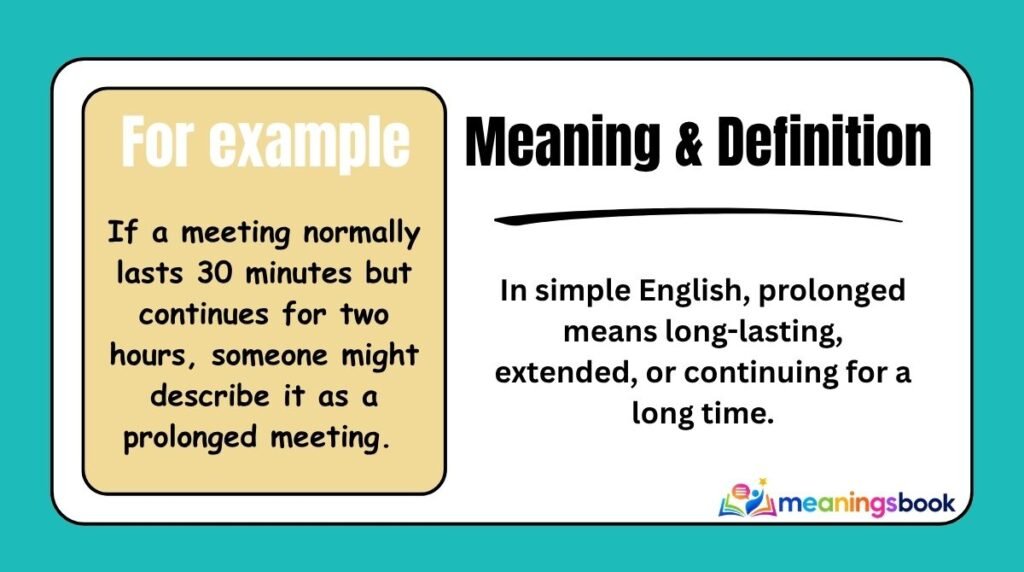
The word prolonged is an adjective that describes something that lasts for an extended period. It often suggests that an event, activity, condition, or situation continues longer than people would normally expect.
In simple English, prolonged means long-lasting, extended, or continuing for a long time.
For example, if a meeting normally lasts 30 minutes but continues for two hours, someone might describe it as a prolonged meeting. Similarly, if a person experiences a delay that continues throughout the day, it could be called a prolonged delay.
The word does not always mean that something is unpleasant. Its emotional meaning depends on the situation. A prolonged holiday might be enjoyable, while a prolonged illness or prolonged period of uncertainty might be difficult.
Examples of Prolonged in Sentences
Here are some everyday examples:
- Prolonged delay: The flight experienced a prolonged delay because of bad weather.
- Prolonged illness: She needed additional rest after a prolonged illness.
- Prolonged discussion: The team had a prolonged discussion about the project.
- Prolonged silence: His prolonged silence made everyone wonder what had happened.
- Prolonged exposure: Prolonged exposure to loud noise can damage hearing.
- Prolonged conflict: The two groups experienced a prolonged conflict.
Each example describes something that continues for an extended duration.
Is Prolonged Always Negative?
No. The word is neutral by itself, although it frequently appears in negative situations.
For example, a prolonged celebration may be enjoyable, but a prolonged power outage can cause serious inconvenience. The word simply highlights the length of time involved.
How to Understand It Easily
When you see the word prolonged, ask yourself one question: What is continuing for a long time?
The answer will usually make the sentence easier to understand.
For instance, in “The patient experienced prolonged discomfort,” the discomfort continued for an extended period. In “They enjoyed a prolonged vacation,” the vacation lasted longer than usual or expected.
Background
The word prolonged comes from the verb prolong, which means to make something last longer or extend its duration.
Its history is connected to the Latin word prolongare, meaning to lengthen or extend. The Latin elements relate to the idea of extending something forward or making it longer.
Over time, the related forms entered English and became useful for describing the duration of events, activities, and conditions. The adjective prolonged developed as a way to describe something that has been extended or has continued for a considerable period.
How the Word Developed in English
English uses several forms of the same word:
- Prolong: To make something last longer.
- Prolongs: Makes something last longer.
- Prolonged: Lasting for an extended time or having been extended.
- Prolonging: The act of making something continue longer.
- Prolongation: The act or process of extending something.
Consider these examples:
- “They decided to prolong the meeting.” This means they chose to make the meeting last longer.
- “The meeting was prolonged.” This describes a meeting that lasted longer than expected or was extended.
- “They are prolonging the discussion.” This describes an ongoing action that is making the discussion continue.
Why Is Prolonged Commonly Used?
The word is useful because it communicates more than the basic idea that something happened. It emphasizes that the duration was extended or noteworthy.
For example, saying “There was a delay” tells the reader that something did not happen on time. Saying “There was a prolonged delay” emphasizes that the delay continued for a considerable period.
The same distinction applies to conversations, illnesses, negotiations, and other situations.
Is There One Exact Length of Time That Counts as Prolonged?
No. There is no universal number of minutes, hours, or days that makes something prolonged.
A prolonged meeting might last several hours, while a prolonged recovery might take weeks or months. The appropriate interpretation depends on the activity, condition, and normal expectations associated with it.
Therefore, the word should be understood relative to the situation rather than as a fixed measurement of time.
Usage in Different Contexts
The meaning of prolonged remains broadly consistent across different settings: something lasts for an extended period. However, the specific interpretation changes according to the subject.
1. In Chat and Messaging
In everyday messages, prolonged can describe a long conversation, a delay in replying, or a period without communication.
Examples:
- “Sorry for the prolonged wait.”
- “We had a prolonged conversation last night.”
- “The prolonged silence was unusual.”
These sentences describe the duration of a situation. They do not automatically reveal the speaker’s feelings or intentions.
2. On Social Media
On social platforms, prolonged may appear in captions, comments, news discussions, or posts about personal experiences.
Examples:
- “After a prolonged break, I am finally posting again.”
- “The prolonged wait for the announcement is over.”
- “A prolonged period of hard work finally paid off.”
The word can make a caption sound more formal or descriptive than simpler alternatives such as “long” or “extended.”
3. In Professional Communication
In workplaces, prolonged is often used to describe delays, negotiations, meetings, investigations, and interruptions.
Examples:
- “The project faced a prolonged delay.”
- “The company entered prolonged negotiations.”
- “The prolonged review process affected the deadline.”
In professional writing, the word helps communicate that the duration of an event is important to the situation.
4. In Casual Conversations
People may use prolonged when discussing events that lasted longer than expected.
For example:
“Was the meeting short?”
“No, it was prolonged and took nearly three hours.”
Although people often choose simpler words in casual conversation, prolonged remains understandable and grammatically correct.
5. In News and Public Discussions
News reports may describe prolonged negotiations, prolonged protests, prolonged rainfall, or prolonged economic difficulties.
In these examples, the word emphasizes the duration of an event rather than its precise cause or outcome.
Key point: The word retains its central meaning across these settings. The surrounding sentence tells you what lasted a long time and why that duration matters.
Meaning in Chat, WhatsApp, Instagram, and TikTok
When someone encounters prolonged on a messaging or social media platform, the word generally has its ordinary English meaning. It is not a widely established abbreviation or internet slang term with a separate universal definition.
What Does Prolonged Mean in Text Messages?
In text messages, prolonged usually describes something that has continued longer than expected.
For example:
Message: “Sorry for the prolonged response time.”
Meaning: The person is apologizing because responding took longer than expected.
Another example:
Message: “We had a prolonged conversation yesterday.”
Meaning: The conversation lasted a long time.
The word itself does not indicate whether the sender is angry, upset, romantic, or sarcastic. Those interpretations require additional context.
What Does Prolonged Mean on WhatsApp?
On WhatsApp, someone might use the word while explaining a delay or discussing a situation that has continued for a long time.
Examples:
- “Sorry for the prolonged wait.”
- “There has been a prolonged power cut.”
- “Our discussion turned into a prolonged conversation.”
The first example is an apology, the second describes an extended power interruption, and the third describes a lengthy discussion.
What Does Prolonged Mean on Instagram?
On Instagram, the word can appear in captions, comments, stories, and messages.
For example:
“After a prolonged break, I am back!”
This means the person has been away for an extended period.
Similarly, “A prolonged journey taught me patience” describes a journey that lasted a long time. The sentence may be literal or figurative depending on the post.
What Does Prolonged Mean on TikTok?
On TikTok, prolonged can appear in videos or captions discussing long-lasting experiences, such as a prolonged challenge, a lengthy wait, or an extended recovery.
For example:
“After a prolonged editing session, the video is finally ready.”
This means the editing process took a long time.
Is Prolonged a Slang Word?
No. Prolonged is a standard English word, not a specific texting abbreviation. People may use it online, but its basic definition does not change simply because it appears on a social platform.
Meaning in Physics, Medical, and Aircraft Terminology
The word prolonged can appear in technical writing, but its interpretation depends on the field. It is important to distinguish between an ordinary descriptive word and a specialized technical term.
Prolonged Meaning in Physics
In physics, prolonged is not a single, universally defined technical quantity. It is an ordinary adjective used to describe something that continues for an extended duration.
For example:
- Prolonged exposure to radiation describes exposure continuing over an extended period.
- Prolonged heating describes heating that continues for a long time.
- Prolonged vibration describes vibration that persists for an extended duration.
The scientific meaning depends on the process being discussed. The word itself does not specify a numerical duration, intensity, or physical measurement.
Prolonged Meaning in Medical Terminology
In medical contexts, prolonged describes a symptom, condition, process, or response that lasts longer than expected or than is typical.
Examples include:
- Prolonged fever: A fever that continues for an extended period.
- Prolonged bleeding: Bleeding that lasts longer than expected.
- Prolonged recovery: A recovery process that takes an extended amount of time.
- Prolonged pain: Pain that continues for a long period.
The exact duration that qualifies as prolonged depends on the medical condition and clinical circumstances. The word alone does not establish a diagnosis or indicate how serious a condition is.
If the term appears in a medical report, its significance should be interpreted alongside the surrounding information and, when necessary, guidance from a qualified healthcare professional.
Prolonged Meaning in Aircraft and Aviation Terminology
In aviation, prolonged is generally an ordinary descriptive word rather than a standalone, universally recognized aircraft term.
For example, a report might mention prolonged ground delays, prolonged turbulence, or prolonged flight operations. In each case, the word indicates an extended duration.
However, specialized aviation procedures and technical documents may define specific time limits or conditions separately. Those definitions should not be inferred from the word prolonged alone.
Why Context Matters in Technical Fields
The same word can describe very different durations in different fields. A prolonged medical symptom, a prolonged physics experiment, and a prolonged aircraft delay do not necessarily involve the same length of time.
Always read the surrounding sentence to understand what is being described and whether the field provides a specific technical definition.
Common Misconceptions
Although prolonged is a straightforward word, several misunderstandings can occur when people encounter it.
1. Thinking It Always Means Something Bad
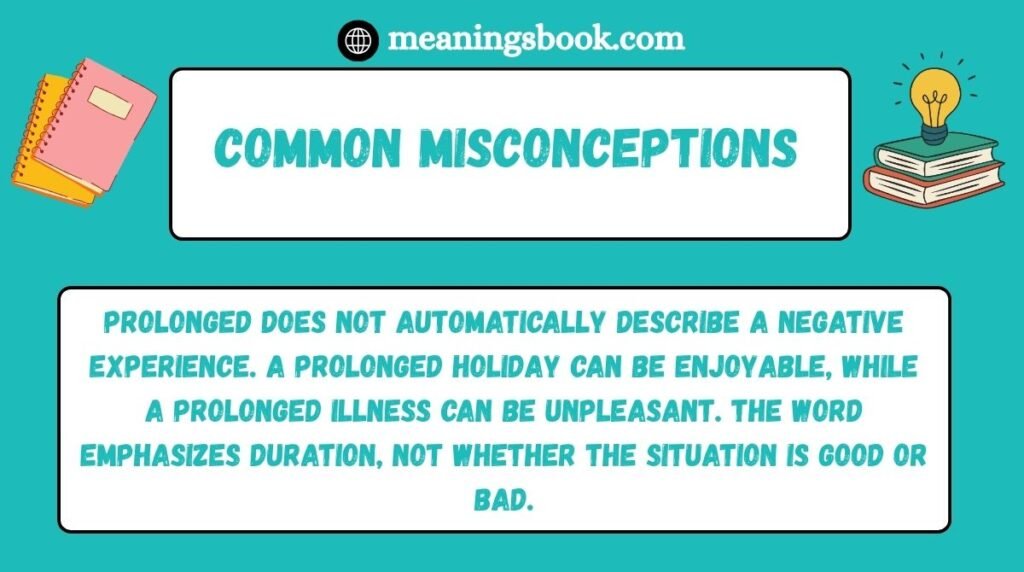
Prolonged does not automatically describe a negative experience.
A prolonged holiday can be enjoyable, while a prolonged illness can be unpleasant. The word emphasizes duration, not whether the situation is good or bad.
2. Assuming It Has a Fixed Time Limit
There is no universal rule that something must last a particular number of hours or days to qualify as prolonged.
A duration that is prolonged in one situation may be normal in another. Context determines whether the description is appropriate.
3. Confusing Prolonged With Permanent
Prolonged means lasting for an extended period. It does not mean that something will continue forever.
For example, a prolonged delay may eventually end, and a prolonged recovery may eventually be completed.
4. Treating It as Internet Slang
The word is standard English rather than a dedicated social media abbreviation.
Its appearance in a WhatsApp message, Instagram caption, or TikTok video does not automatically give it a new slang meaning.
5. Assuming It Means Deliberately Extended
Prolonged can describe something that has been deliberately extended, but it can also describe a situation that simply continues for a long time.
For example, someone might deliberately prolong a meeting, whereas a meeting might become prolonged because of unexpected problems.
6. Confusing It With Stronger or More Specific Words
Words such as chronic, permanent, excessive, and continuous may overlap with prolonged in certain situations, but they are not interchangeable in every sentence.
For example, a prolonged illness is not necessarily a chronic illness. The first expression emphasizes duration, while the second can refer to a condition that persists over a long period or follows a chronic course.
Understanding these distinctions helps you choose the correct word.
Similar Terms & Alternatives
Several English words have meanings close to prolonged. The best alternative depends on the sentence and the degree of formality you want.
| Word or phrase | Meaning | Example |
|---|---|---|
| Extended | Made longer or lasting longer than usual | An extended meeting |
| Lengthy | Taking a long time or involving considerable length | A lengthy discussion |
| Long-lasting | Continuing for a long time | A long-lasting effect |
| Persistent | Continuing despite difficulty or attempts to stop it | Persistent pain |
| Enduring | Lasting over time; often suggesting resilience | An enduring friendship |
| Continuous | Continuing without interruption | Continuous rainfall |
| Chronic | Persisting over a long period, especially in medical contexts | A chronic condition |
| Sustained | Maintained over a period of time | Sustained effort |
| Drawn-out | Lasting longer than necessary, often with a negative tone | A drawn-out argument |
| Lingering | Remaining or continuing longer than expected | A lingering feeling |
Which Alternative Should You Choose?
Use extended when something has been lengthened or continued beyond its original period.
Use lengthy when you want to emphasize that something takes a lot of time or contains many details.
Use persistent when something continues despite attempts to stop, remove, or resolve it.
Use continuous when there are no interruptions during the relevant period.
Use drawn-out when a situation feels unnecessarily long or frustrating.
Use prolonged when you want a relatively formal and neutral way to describe an extended duration.
These words have overlapping meanings, but choosing the right one makes your writing more precise.
How to Respond to It
If someone uses prolonged in a message, your response should depend on the situation. You do not need to explain the word back to the sender unless they ask what it means.
When Someone Apologizes for a Prolonged Delay
Message: “Sorry for the prolonged delay.”
Possible responses:
- “No problem. Thanks for letting me know.”
- “That’s okay. I appreciate the update.”
- “No worries. I’m glad you got back to me.”
These responses are polite and natural.
When Someone Mentions a Prolonged Wait
Message: “We’ve had a prolonged wait at the airport.”
Possible responses:
- “That sounds frustrating. I hope everything gets sorted out soon.”
- “How long have you been waiting?”
- “I hope you can leave soon.”
Choose a response that fits the circumstances.
When Someone Mentions a Prolonged Illness
Message: “I’ve been dealing with a prolonged illness.”
Possible responses:
- “I’m sorry you’ve been going through that. I hope you feel better soon.”
- “That sounds difficult. How are you feeling now?”
- “Wishing you a smooth recovery.”
A supportive response is generally more appropriate than making assumptions about the person’s health.
When Someone Uses the Word in a Professional Message
Message: “The project has experienced a prolonged delay.”
Possible responses:
- “Thank you for the update. Could you share the revised timeline?”
- “Understood. Please let me know when the next update is available.”
- “What factors are contributing to the delay?”
These replies acknowledge the situation and, when appropriate, ask for useful information.
When You Do Not Understand the Sentence
It is perfectly acceptable to ask for clarification.
You could say, “Do you mean that it has lasted longer than expected?”
This question confirms the intended meaning without making the conversation awkward.
Differences from Similar Words
Prolonged is closely related to several common English words, but each one emphasizes a slightly different aspect of time.
Prolonged vs. Extended
Prolonged describes something that continues for a long time or lasts longer than expected.
Extended often emphasizes that something has been lengthened or given additional time.
Example:
- “The meeting was prolonged.” The meeting lasted a considerable time.
- “The meeting was extended by 30 minutes.” The meeting’s scheduled duration was increased by a specified amount.
Prolonged vs. Lengthy
Prolonged emphasizes duration, particularly when the duration is noteworthy or longer than expected.
Lengthy generally means long in duration, size, or detail.
Example:
- “The patient experienced prolonged discomfort.”
- “The report contains a lengthy explanation.”
The first emphasizes the duration of discomfort, while the second emphasizes the length of the explanation.
Prolonged vs. Persistent
Prolonged focuses on how long something lasts.
Persistent focuses on something continuing despite difficulty, resistance, or attempts to resolve it.
Example:
- “Prolonged pain” emphasizes pain that lasts a long time.
- “Persistent pain” emphasizes pain that continues or does not go away.
The expressions can overlap, but they do not always communicate exactly the same thing.
Prolonged vs. Continuous
Prolonged emphasizes extended duration, while continuous emphasizes a lack of interruption.
Example:
- “There was prolonged rainfall throughout the week.” This emphasizes the extended period of rainfall.
- “There was continuous rainfall for six hours.” This emphasizes that the rain did not stop during that period.
Something can be prolonged without being continuous if it occurs intermittently over an extended period.
Prolonged vs. Permanent
Prolonged means lasting a long time, while permanent means intended or expected to last indefinitely rather than being temporary.
Example:
- “The repair caused a prolonged disruption.”
- “The company introduced a permanent change.”
A prolonged situation can end, so the two words should not be used interchangeably.
Relevance in Online Conversations & Dating Apps
The word prolonged can appear in online conversations and dating apps, particularly when people discuss communication, waiting, relationships, or periods of separation.
However, it is not a widely established dating abbreviation or romantic slang expression. Its ordinary meaning remains the most reliable interpretation.
Prolonged Silence in a Relationship
Someone might say:
“We’ve had a prolonged period of silence.”
This means the communication gap has lasted for a considerable time.
It does not necessarily mean the relationship has ended or that one person has lost interest. The reason for the silence would need to be understood from the broader situation.
Prolonged Conversations
A person might write:
“We had a prolonged conversation last night.”
This means the conversation lasted a long time. Depending on the context, it could have been serious, enjoyable, emotional, or simply lengthy.
The word itself does not indicate whether the conversation was romantic.
Prolonged Waiting for a Reply
Someone might describe a prolonged wait for a response when another person takes a long time to reply.
For example:
“The prolonged wait for a reply made me anxious.”
This sentence explicitly communicates anxiety. Without that additional information, prolonged waiting alone does not establish how the person feels.
Prolonged Dating or Relationship Challenges
In discussions about relationships, people may use prolonged to describe an extended disagreement, a lengthy period of uncertainty, or a difficult situation that has continued for a long time.
For example:
“They finally resolved their prolonged disagreement.”
This means the disagreement lasted for an extended period before being resolved.
How Should You Interpret It?
When you encounter prolonged on a dating app or in a private message, consider three things:
- The subject: What is lasting a long time?
- The surrounding words: Is the person describing a delay, silence, illness, or discussion?
- The relationship context: Does the rest of the conversation clarify the person’s feelings or intentions?
Avoid assuming that the word has a hidden romantic meaning. In most cases, its ordinary English definition is sufficient.
FAQs
1. What does prolonged mean in simple English?
Prolonged means lasting for a long time or continuing longer than expected. For example, a prolonged meeting is one that lasts a considerable amount of time. The word can describe positive, negative, or neutral situations, depending on what is being discussed.
2. What does prolonged mean in a text message?
In a text message, prolonged usually describes something that has continued for an extended period. For example, “Sorry for the prolonged delay” means the sender is apologizing because the delay lasted longer than expected. The word is standard English, not a specific texting abbreviation.
3. Is prolonged a slang word?
No, prolonged is a standard English adjective rather than a widely established slang term. People may use it in messages, social media captions, or online discussions, but its ordinary meaning remains the same: lasting for an extended time.
4. What is an example of prolonged in a sentence?
An example is, “The company experienced a prolonged period of uncertainty before making its decision.” This means the uncertainty continued for a considerable time. Other examples include prolonged illness, prolonged silence, prolonged negotiations, and prolonged delays.
5. Does prolonged mean forever?
No, prolonged does not mean forever. It describes something that lasts a long time, often longer than expected, but it can eventually end. Permanent is a closer word when something is intended or expected to last indefinitely rather than temporarily.
6. What is the difference between prolonged and persistent?
Prolonged emphasizes the length of time something lasts, while persistent emphasizes that it continues despite difficulty, resistance, or attempts to stop it. For example, prolonged pain focuses on its duration, whereas persistent pain suggests that the pain continues or does not go away.
7. What does prolonged mean in medical terms?
In medical writing, prolonged describes a symptom, condition, or process that lasts longer than expected or is typical. Examples include prolonged bleeding and prolonged recovery. The exact duration depends on the condition, so the word alone cannot establish a diagnosis or determine how serious a medical problem is.
8. How do you respond when someone says prolonged?
Your response depends on the situation. If someone apologizes for a prolonged delay, you can say, “No problem, thanks for the update.” If they describe a prolonged illness, a supportive response such as “I hope you feel better soon” is appropriate. You can also ask for clarification if the context is unclear.
Conclusion
Understanding the prolonged meaning is straightforward: it describes something that lasts for an extended period or continues longer than usual or expected. The word is used in everyday conversations, professional writing, social media, medical discussions, and scientific descriptions.
Examples such as prolonged delays, prolonged conversations, prolonged silence, and prolonged recovery show how the same word can apply to many different situations. Although it often appears in discussions about difficulties, prolonged is not inherently negative. Its meaning depends on the event or condition being described.
It is also important to distinguish prolonged from related words such as extended, lengthy, persistent, continuous, chronic, and permanent. Each term has a slightly different emphasis, and choosing the right one helps communicate more accurately.
When you encounter the word in a message, report, or online post, examine the surrounding sentence to understand its intended meaning. In most situations, prolonged simply means that something has lasted a long time, without suggesting that it will continue forever or carry a hidden meaning.

I am Ethan Whitmore, an English teacher and vocabulary enthusiast who explains words, phrases, and meanings in text through simple examples to make English easier for everyone.