
When someone sends IMAO in a text message, comment, or social media conversation, it can be confusing at first. Short internet expressions often look similar, and a single letter can change the meaning completely.
IMAO is one of those abbreviations that people may encounter while reading casual online conversations, especially when someone is sharing an opinion in a humorous, self-aware, or slightly sarcastic way.
Understanding the surrounding message is important because informal abbreviations do not always have one universal interpretation.
People commonly search for the meaning of IMAO because it can resemble better-known expressions such as IMO, IMHO, or LMAO. Its unusual appearance can therefore make readers wonder whether it is a deliberate abbreviation, a playful variation, or simply a typing mistake.
In most casual contexts, IMAO is used as an opinion-related expression, with the letters standing for “in my arrogant opinion.” The phrase is generally humorous and can signal that the writer is knowingly presenting a strong personal view.
Quick Answer
IMAO meaning in text is usually “in my arrogant opinion.” It is an informal, humorous abbreviation used when someone wants to give a personal opinion while jokingly making that opinion sound overly confident or self-important. You may see it in chats, comments, forums, and social media posts, particularly when the speaker is being playful or sarcastic.
Meaning & Definition
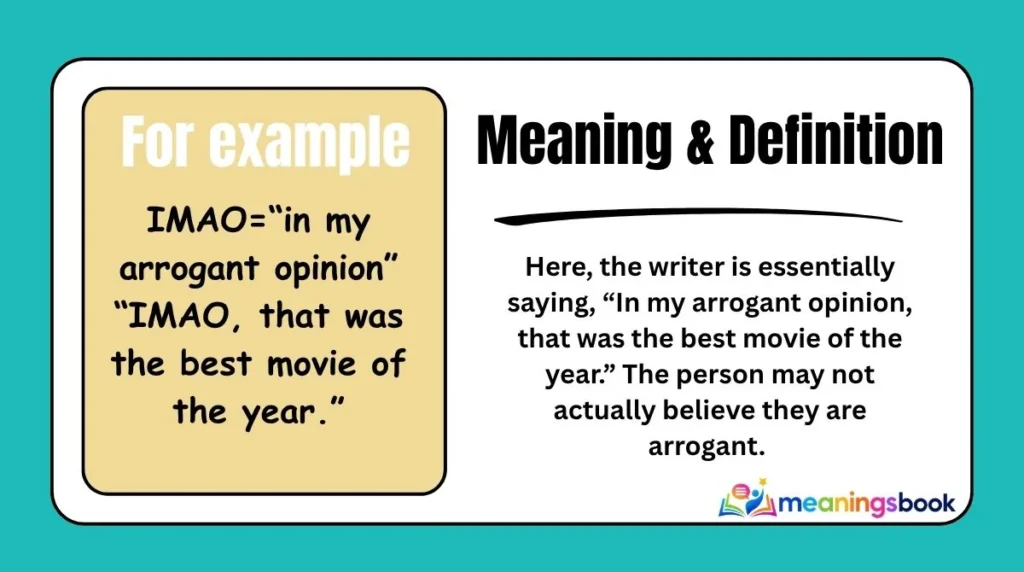
IMAO most commonly means “in my arrogant opinion.” It is an informal internet abbreviation built around the familiar phrase “in my opinion,” but it adds the word arrogant to give the expression a humorous or self-mocking tone.
The important part of the expression is that it introduces a personal viewpoint. When someone writes IMAO, they are generally signaling that what follows is their own judgment rather than an objective fact. The addition of “arrogant” can make the statement sound deliberately overconfident, cheeky, or sarcastic.
For example:
“IMAO, that was the best movie of the year.”
Here, the writer is essentially saying, “In my arrogant opinion, that was the best movie of the year.” The person may not actually believe they are arrogant. Instead, the exaggerated wording can make the message more playful.
IMAO can therefore soften an opinion in an unusual way. Rather than presenting a statement as an unquestionable fact, the writer openly frames it as a personal judgment. At the same time, the word “arrogant” creates a joking sense of confidence.
The tone depends heavily on the conversation. Among friends, IMAO may sound humorous and relaxed. In a disagreement, it could be used sarcastically to emphasize that the speaker is standing firmly behind their opinion. In some situations, however, a reader who does not recognize the abbreviation may interpret it literally or assume the writer is being genuinely arrogant.
It is also important not to automatically confuse IMAO with LMAO, which is a laughter-related abbreviation. Likewise, IMO normally means “in my opinion,” while IMHO means “in my humble opinion.” IMAO changes the tone by replacing the humble attitude with a deliberately arrogant one.
Because online slang evolves quickly, individual users may occasionally use IMAO differently or type it accidentally. Context should therefore remain the final guide when interpreting it.
Background
IMAO developed as part of the broader culture of internet shorthand, where users began shortening frequently used expressions to communicate more quickly. Abbreviations such as IMO, IMHO, LOL, and other initialisms became common in online communication because typing a few letters was faster than writing a complete phrase.
The exact history of IMAO as a specific expression is not something that should be treated as having one definitive inventor or universally documented starting point. It is best understood as a playful extension of established opinion abbreviations rather than as a formal term with a clearly established origin.
The basic structure is easy to understand. IMO represents “in my opinion.” IMHO adds “humble,” creating “in my humble opinion.” IMAO uses “arrogant” instead, producing “in my arrogant opinion.” The contrast between “humble” and “arrogant” creates the humor.
This construction works because internet language frequently relies on familiar expressions and modifies them for comedic effect. Once users understand the basic abbreviation pattern, creating a variation such as IMAO is relatively intuitive.
The expression is therefore closely connected to informal digital communication rather than formal writing. It is much more likely to appear in a casual message, online comment, forum discussion, meme-related conversation, or social media exchange than in a business report, academic paper, or formal letter.
Another reason IMAO can cause confusion is that internet abbreviations often look extremely similar. A reader might see IMAO and immediately think of LMAO because both contain “MAO.” However, their meanings are different. LMAO relates to laughing, while IMAO is generally used to introduce an opinion.
It is also possible for people to type IMAO accidentally when they intended another abbreviation. For that reason, the surrounding words matter. If the sentence discusses someone’s view, judgment, ranking, preference, or argument, the opinion-related interpretation makes much more sense.
Usage in Different Contexts
The meaning and tone of IMAO can change slightly depending on where it appears.
Chat
In private chats, IMAO is usually casual and playful. A person might use it before giving a strong preference or judgment.
For example:
“IMAO, pizza is better than burgers.”
The writer is not necessarily claiming to be genuinely arrogant. The phrase can simply add humor to an ordinary opinion.
Social Media
On social media, IMAO may appear in comments, captions, replies, or discussions. Because public conversations can involve disagreements, the abbreviation can help frame a statement as a personal opinion.
For example:
“IMAO, the original version was much better.”
Depending on the surrounding discussion, this could sound humorous, confident, or mildly sarcastic.
Professional Fields
IMAO does not normally belong in formal professional writing. In a workplace chat between close colleagues, someone might use it jokingly, but it would generally be inappropriate for formal reports, official correspondence, academic writing, legal documents, or professional presentations.
A professional setting requires greater clarity because the reader may not understand informal internet abbreviations. Writing “In my opinion” is usually clearer and more appropriate.
Casual Conversations
Among friends, IMAO can be a fun way to introduce a strong personal preference. It can even be intentionally exaggerated.
For instance:
“IMAO, you absolutely need to try that restaurant.”
The speaker is expressing a personal recommendation while making the statement sound playfully self-important.
Overall, IMAO works best when the conversation is informal and the participants understand internet slang. Its humorous quality comes from the contrast between presenting an ordinary opinion and labeling that opinion as “arrogant.”
Meaning in Chat, WhatsApp, Instagram, and TikTok
On messaging and social media platforms, IMAO generally retains its opinion-related meaning. The platform itself usually does not change what the abbreviation stands for, although the tone can vary according to the conversation.
In Text Messages
A person may write:
“IMAO, that ending was perfect.”
The message communicates a personal judgment and adds a playful sense of exaggerated confidence.
On WhatsApp
WhatsApp conversations are often informal, so IMAO may be used between friends or family members who are comfortable with internet shorthand.
Example:
“IMAO, you’re making the wrong choice 😂”
The laughing emoji could make the teasing tone even clearer.
On Instagram
On Instagram, IMAO might appear in comments or replies when someone gives an opinion about a photograph, video, trend, outfit, song, or other content.
For example:
“IMAO, this is your best look.”
Here, the abbreviation introduces the speaker’s personal judgment.
On TikTok
TikTok conversations frequently use informal language, abbreviations, humor, irony, and exaggerated statements. IMAO can fit into this style when someone is expressing a strong personal opinion.
For example:
“IMAO, this trend needs to disappear.”
The phrase can make the comment sound deliberately dramatic.
The most important point is that IMAO is not a platform-specific abbreviation. Its basic meaning remains “in my arrogant opinion,” whether it appears in a text message, WhatsApp chat, Instagram comment, or TikTok discussion.
However, context determines whether the writer is being serious, playful, sarcastic, or self-deprecating. Emojis, punctuation, previous messages, and the relationship between the participants can all provide useful clues.
If the surrounding conversation is about laughing or something extremely funny, a reader should also consider whether the writer may have accidentally typed IMAO instead of another abbreviation such as LMAO. A single unusual abbreviation should not be interpreted in isolation.
Meaning in Physics, Medical, and Aircraft Terminology
IMAO does not have a widely recognized standard meaning in mainstream physics terminology, medical terminology, or aircraft/aviation terminology that should automatically be assumed when you encounter the abbreviation in an ordinary message.
Physics
In physics, IMAO is not a standard general-purpose abbreviation that has a commonly recognized definition comparable to established scientific terms and symbols. If you encounter it in physics-related material, the surrounding document or field-specific terminology would need to be examined rather than assuming that it means “in my arrogant opinion.”
Scientific writing normally avoids ambiguous internet slang because precision is important.
Medical Terminology
IMAO is likewise not a standard medical term that should automatically be interpreted as a diagnosis, procedure, condition, medication, or clinical concept.
If IMAO appears in a medical conversation, it could potentially be a local abbreviation, an internal notation, or an unrelated acronym. In such circumstances, guessing would be inappropriate. The surrounding document and the relevant medical context should determine its meaning.
Aircraft and Aviation
IMAO is not a broadly recognized standard aviation abbreviation that should be assumed simply because it appears near aircraft-related information.
Aviation terminology often contains highly specialized abbreviations, so an unfamiliar acronym should be verified from the specific aviation context rather than assigning it an internet-slang meaning.
Therefore, when someone sends IMAO in a casual text or social media conversation, the opinion-related meaning is the relevant interpretation. When the same letters appear in a technical document, they should not automatically be assigned the slang definition.
Common Misconceptions
One of the biggest misconceptions about IMAO is that it automatically means the same thing as LMAO. This is understandable because the abbreviations look similar, but they serve different purposes.
LMAO is associated with laughing, while IMAO is generally an opinion-related expression meaning “in my arrogant opinion.”
Another common misunderstanding is assuming that IMAO literally means the speaker considers themselves arrogant. Usually, the word “arrogant” is part of the humor. The writer may be deliberately exaggerating their confidence rather than making a serious statement about their personality.
People may also confuse IMAO with IMO, which simply means “in my opinion.” Both expressions introduce a personal view, but IMAO adds a humorous or self-important tone.
Similarly, IMAO may be confused with IMHO, meaning “in my humble opinion.” These expressions create almost opposite humorous attitudes. IMHO presents the speaker as humble, while IMAO jokingly presents the speaker as arrogant.
Another possibility is a typing error. Internet conversations happen quickly, and users often make spelling or abbreviation mistakes. If someone normally uses LMAO and suddenly writes IMAO while discussing something funny, it may simply be an accidental substitution.
The best way to avoid misunderstanding is to read the complete sentence. Ask what the person is actually doing with the abbreviation. Are they introducing an opinion? Laughing? Making a joke? Responding to an argument? The surrounding language usually provides the answer.
It is also a mistake to assume that every acronym has exactly one meaning everywhere online. Internet language is flexible, and some abbreviations are used differently by different communities. Context remains more reliable than the letters alone.
Similar Terms & Alternatives
Several abbreviations are closely related to IMAO or may be confused with it.
IMO — “In My Opinion”
IMO is a straightforward way to introduce a personal viewpoint. It is more neutral than IMAO.
Example:
“IMO, the first option is better.”
IMHO — “In My Humble Opinion”
IMHO introduces an opinion while using “humble” as a modest or sometimes humorous qualifier.
Example:
“IMHO, that’s the best song on the album.”
LMAO — “Laughing My Ass Off”
LMAO is used to express strong amusement. It does not normally introduce an opinion.
Example:
“LMAO, I can’t believe you actually did that.”
LOL — “Laughing Out Loud”
LOL is another common laughter-related abbreviation. It can also simply signal that something is funny or that the message is not meant too seriously.
In My Opinion
This is the full, clear alternative to IMO. It works in both casual and formal contexts.
Personally
“Personally” can introduce a viewpoint without using slang.
For example:
“Personally, I prefer the second option.”
The main distinction is tone. IMAO is deliberately informal and potentially humorous, while “in my opinion” is neutral and universally clear.
How to Respond to It
You usually do not need a special response just because someone uses IMAO. Treat it as an introduction to their personal opinion and respond to the opinion itself.
If you agree, you could say:
“Honestly, I agree.”
Or:
“Same here 😂”
If you disagree, you can keep the conversation friendly:
“I see your point, but I think the opposite.”
For a playful conversation, you might respond to the exaggerated “arrogant” wording:
“That is a very confident opinion 😂”
Or:
“Your arrogance has been noted.”
If the person is making a recommendation, you could ask a follow-up question:
“What makes you like it so much?”
If you are unsure what IMAO means in their message, there is nothing wrong with asking:
“What do you mean by IMAO?”
However, clarification is often unnecessary when the sentence clearly introduces an opinion.
Your response should also match the relationship. A joke may work well between friends but sound inappropriate with a stranger or professional contact.
The key is not to focus too much on the abbreviation itself. Once you recognize IMAO as an opinion-related expression, the rest of the message usually tells you what the person wants to communicate.
Differences from Similar Words
The easiest way to understand IMAO is to compare it with the abbreviations it most closely resembles.
| Expression | Common meaning | Main purpose | Typical tone |
|---|---|---|---|
| IMAO | In my arrogant opinion | Introduces a personal opinion | Playful, confident, sarcastic |
| IMO | In my opinion | Introduces a personal opinion | Neutral, casual |
| IMHO | In my humble opinion | Introduces a personal opinion | Humble, polite, sometimes humorous |
| LMAO | Laughing my ass off | Expresses strong amusement | Informal, humorous |
| LOL | Laughing out loud | Expresses amusement | Casual, often lighthearted |
The difference between IMAO, IMO, and IMHO is mainly tone.
If someone says:
“IMO, this is the best option.”
They are simply stating a personal view.
If they say:
“IMHO, this is the best option.”
They are framing the opinion with a modest or humorous attitude.
If they say:
“IMAO, this is the best option.”
They are jokingly giving the opinion an arrogant or overly confident flavor.
The difference between IMAO and LMAO is more fundamental. LMAO is about laughter, whereas IMAO is about an opinion.
Because these abbreviations look similar, checking the surrounding sentence is particularly important. If the words that follow describe a preference, judgment, or argument, IMAO is likely being used in its opinion-related sense.
Relevance in Online Conversations & Dating Apps
IMAO can appear in modern online conversations when people share strong opinions while keeping the tone casual. It may be used in discussions about music, movies, food, fashion, relationships, hobbies, sports, or everyday preferences.
In dating-app conversations, the expression can sometimes make a message sound more playful or confident. For example, someone might write:
“IMAO, pineapple on pizza is completely underrated.”
The point is not necessarily to sound arrogant. The exaggerated wording can make the opinion feel more humorous and conversational.
A person could also use IMAO while discussing dating preferences:
“IMAO, good conversation matters more than having the same hobbies.”
Here, the abbreviation simply signals that the statement represents the speaker’s personal viewpoint.
The relationship between the people involved matters. If two people are already joking with each other, IMAO may come across as playful banter. If the conversation is tense, the same expression could sound smug or sarcastic.
Tone can also be influenced by punctuation and emojis. A message such as “IMAO 😂” is more likely to be playful than a serious-looking statement followed by no indication of humor. However, emojis do not guarantee a particular interpretation.
On social media and dating platforms, people often use exaggerated language to make their messages more entertaining. IMAO fits that style because it turns a simple “in my opinion” statement into something more humorous.
Still, the abbreviation should not be treated as a signal of someone’s actual personality. Someone using “in my arrogant opinion” is often making a joke about confidence rather than genuinely describing themselves as arrogant.
Frequently Asked Questions
What does IMAO mean in text?
IMAO usually means “in my arrogant opinion.” It is an informal abbreviation used to introduce someone’s personal opinion, often with a humorous, exaggerated, or sarcastic tone. The word “arrogant” is generally playful rather than a literal statement that the speaker is arrogant.
What does IMAO mean in chat?
In chat, IMAO generally means “in my arrogant opinion.” Someone may use it before expressing a preference, judgment, or strong viewpoint. For example, “IMAO, that’s the best restaurant here” means the person is confidently presenting their personal opinion, often with a joking tone.
Is IMAO a slang term?
Yes, IMAO is best understood as an informal internet abbreviation or slang expression rather than formal English. It is most appropriate in casual digital communication, such as chats, comments, social media conversations, and messages between people who are familiar with online shorthand.
How do you respond to IMAO?
You can respond to the opinion that follows IMAO. If you agree, say something like “I agree” or “Same.” If you disagree, politely explain your view. If the conversation is playful, you can also joke about the exaggerated “arrogant” wording.
What does IMAO mean on social media?
On social media, IMAO generally means “in my arrogant opinion.” It is used when someone wants to express a personal judgment while adding a humorous or overly confident tone. The exact emotional tone can depend on the surrounding post, comment, emojis, and relationship between the users.
Can IMAO have different meanings?
IMAO most commonly refers to “in my arrogant opinion” in casual online communication, but abbreviations can occasionally be used differently by particular communities. It can also be a typing mistake for another abbreviation. If the context does not involve an opinion, examine the surrounding message before deciding what the writer intended.
Is IMAO the same as LMAO?
No. IMAO and LMAO normally have different meanings. IMAO refers to “in my arrogant opinion,” while LMAO is a laughter-related abbreviation. Because the two expressions look similar, they can sometimes be confused, especially when a person types quickly.
Is IMAO appropriate for professional messages?
IMAO is generally better suited to informal communication than formal professional writing. In a business email, academic document, report, or official message, writing “in my opinion” is clearer and more professional. A casual workplace chat may be different if the participants regularly use internet slang.
Conclusion
IMAO is an informal internet abbreviation that most commonly means “in my arrogant opinion.” It is used to introduce a personal viewpoint while adding a humorous, exaggerated, or self-aware sense of confidence. The expression is particularly suited to casual conversations, text messages, social media comments, and other forms of online communication.
One of the main reasons IMAO causes confusion is its similarity to abbreviations such as IMO, IMHO, and LMAO. IMO simply introduces an opinion, IMHO adds a humorous sense of humility, and LMAO expresses laughter. IMAO stands apart by using “arrogant” as a playful twist on the familiar opinion format.
Context is still important. A person may use IMAO sincerely, jokingly, sarcastically, or simply as a playful way to sound confident. It is not normally a standard term in physics, medicine, or aviation. When you encounter it in a casual online message, however, the surrounding sentence will usually make its intended meaning clear.

I am Ethan Whitmore, an English teacher and vocabulary enthusiast who explains words, phrases, and meanings in text through simple examples to make English easier for everyone.



