If someone sends you “mhm” in a text message, you may wonder whether they are agreeing, simply acknowledging what you said, or trying to end the conversation.
The expression is common in informal digital communication, especially in texting, messaging apps, social media comments, and casual conversations. Unlike many internet abbreviations, “mhm” is generally not an acronym.
It is a written representation of a short sound people make when acknowledging or agreeing with something. Its exact tone can depend heavily on the surrounding conversation, punctuation, and relationship between the people communicating.
A friendly “mhm!” can sound warm and enthusiastic, while a brief “mhm.” may feel more neutral or even slightly dismissive. Understanding these subtle differences can help prevent unnecessary misunderstandings.
Below, we’ll explain what “mhm” means, where it is used, how it differs from similar expressions, and how you can respond naturally.
Quick Answer
What does mhm mean in text? It usually means “yes,” “yeah,” or “I agree,” and is commonly used as a casual acknowledgment in texting and online conversations. Depending on context and tone, “mhm” can also mean that someone is listening, confirming what you said, or giving a brief response without adding much to the conversation.
Meaning & Definition
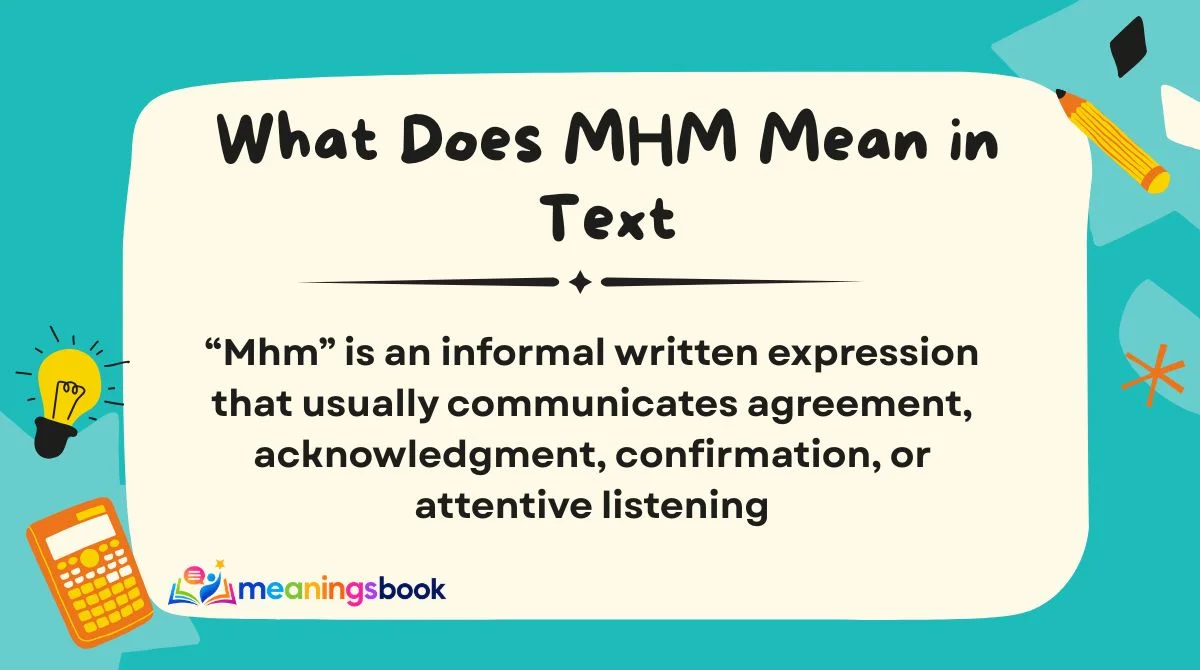
“Mhm” is an informal written expression that usually communicates agreement, acknowledgment, confirmation, or attentive listening. It represents the sound a person might naturally make when saying “yes” without using the full word.
For example:
Person A: Are you coming with us tonight?
Person B: Mhm.
Here, “mhm” most likely means yes.
It can also indicate that someone is following what you are saying:
Person A: So I finished my work and then went home.
Person B: Mhm.
In this case, the person may not necessarily be agreeing with a specific statement. They may simply be signaling, “I’m listening.”
Common meanings of “mhm”
Depending on context, it can communicate:
- Yes: “Mhm” = “Yes.”
- Agreement: “Mhm” = “I agree.”
- Acknowledgment: “Mhm” = “I understand” or “I hear you.”
- Confirmation: “Mhm” = “That’s correct.”
- Continued attention: “Mhm” = “Go on, I’m listening.”
The expression is particularly useful because it is short and conversational. Someone can acknowledge a message without writing a complete sentence.
However, “mhm” does not always communicate enthusiasm. A person who replies only with “mhm” may be agreeing while still keeping the conversation brief. To understand the intended tone, look at the rest of the conversation.
Punctuation can also influence how it feels. “Mhm!” may sound enthusiastic, while “mhm.” can appear more restrained. “Mhm…” may suggest hesitation, uncertainty, or a desire to communicate something more complicated, depending on the situation.
Background
“Mhm” does not have a single established expansion in the way abbreviations such as “LOL” or “BRB” do. It is better understood as a written conversational sound, similar to expressions such as “mm-hmm” or “uh-huh.”
People have long used short vocal sounds to acknowledge another speaker. In spoken conversation, someone might respond with a quick “mm-hmm” while listening. Written communication can reproduce that sound as forms such as “mhm,” “mm-hmm,” or “mhmm.”
The exact spelling varies because informal expressions are often written according to how they sound rather than according to a strict spelling system. There is therefore no universal rule requiring everyone to write the expression in exactly the same way.
The growth of texting and instant messaging made short conversational responses especially common. Instead of typing “yes, I understand,” a person can simply write “mhm.” This keeps the interaction quick and resembles natural speech.
It is important not to invent a specific historical creator or exact date for “mhm.” Its development is better understood as part of the broader use of written representations of conversational sounds.
The expression also differs from many internet slang terms because its meaning is usually relatively straightforward. The main challenge is not understanding the basic meaning but interpreting the tone.
For example:
“Mhm, that makes sense.”
This is clearly an acknowledgment.
Compare that with:
“Mhm.”
The second response provides much less information. It could indicate agreement, listening, uncertainty, or simply a short acknowledgment.
Consequently, context is more important than trying to assign one fixed definition to every use of the expression.
Usage in Different Contexts
The meaning of “mhm” can shift slightly depending on where and how it appears.
In Chat
In private conversations, “mhm” commonly functions as a quick yes or acknowledgment.
“Are you still awake?”
“Mhm.”
It can also encourage someone to continue speaking:
“And then she told me what happened…”
“Mhm, go on.”
The second example suggests active listening rather than simple agreement.
On Social Media
“Mhm” may appear in comments, replies, or direct messages. A person might use it to agree with a post or react casually to another person’s statement.
For example:
“That movie was way better than I expected.”
“Mhm, definitely.”
Here, it reinforces agreement.
In Professional Fields
In professional communication, “mhm” is generally informal. It may appear in casual workplace messaging, but it is usually less appropriate for formal emails, reports, or official communication.
Instead of:
“Mhm, received.”
a professional message might say:
“Yes, I received it. Thank you.”
The more formal wording reduces ambiguity.
In Casual Conversations
Among friends, “mhm” can feel completely natural. Its interpretation often depends on familiarity and the overall tone of the exchange.
A close friend may understand a simple “mhm” as friendly acknowledgment, whereas someone unfamiliar with your communication style might interpret the same response as uninterested.
Meaning in Chat, WhatsApp, Instagram, and TikTok
Across messaging and social platforms, “mhm” generally retains its basic meaning of yes, agreement, acknowledgment, or listening.
On WhatsApp, someone might use it as a quick response to a question:
“Did you get home?”
“Mhm.”
On Instagram, it can appear in direct messages or comments:
“You were right about that song.”
“Mhm 😭”
The emoji can make the message feel more expressive and change how the short response is perceived.
On TikTok, “mhm” may occur in comments or private messages as a reaction to a relatable statement:
“That part was so accurate.”
“Mhm 😂”
The expression can also be repeated:
“Mhmm.”
A longer spelling may simply make the response feel more drawn out or expressive. It does not necessarily represent a completely different word.
Similarly, capitalization can affect presentation:
- mhm — casual and understated
- Mhm — ordinary sentence-style response
- MHM — potentially more emphatic, depending on context
- mhmm — often a more drawn-out acknowledgment
- mhm! — potentially enthusiastic
These aren’t rigid rules. Online communication does not have a standardized system where every spelling has exactly one emotional meaning.
The surrounding words matter considerably. Compare:
“Mhm, I agree.”
with:
“Mhm.”
The first clearly communicates agreement. The second leaves more room for interpretation.
If “mhm” appears by itself after you have shared a long message, it may simply mean the person has read and acknowledged it. If the conversation is emotional or argumentative, however, the same response may be perceived differently.
Meaning in Physics, Medical, and Aircraft Terminology
“Mhm” does **not have a standard, widely recognized technical meaning in physics, medical terminology, or aircraft/aviation terminology simply because it appears as this exact expression.
Physics
“Mhm” is not a standard general physics abbreviation or established unit, formula, or physical quantity. If you encounter it in a physics document, its meaning would need to be determined from the specific source or surrounding notation.
Medical Terminology
“Mhm” is not a standard medical diagnosis or universally recognized medical abbreviation in ordinary clinical terminology. Medical abbreviations can vary between institutions and specialties, so an isolated abbreviation should not automatically be assigned a technical meaning.
Aircraft and Aviation
“Mhm” is also not a standard general aviation term that corresponds to the everyday texting expression. Aviation has many standardized abbreviations and codes, but “mhm” in a casual message should not automatically be interpreted as an aviation abbreviation.
This distinction is important. A short combination of letters can potentially have specialized meanings in a particular document, database, organization, or technical system. That does not mean the technical interpretation is the meaning of the everyday texting expression.
When you see “mhm” in a normal text or social media message, the conversational interpretation is generally the relevant one.
Common Misconceptions
One common misunderstanding is assuming that “mhm” must be an acronym with a specific phrase behind each letter. Usually, it is not. It represents a conversational sound associated with acknowledgment or agreement.
Another misconception is that “mhm” always means enthusiastic agreement. It does not. A short “mhm” can simply mean “yes,” “I understand,” or “I’m listening.”
People may also interpret “mhm” as rude when it appears without additional words. That interpretation can sometimes happen, but the expression itself is not inherently rude.
For example:
“Can you send me the file?”
“Mhm.”
This could simply mean yes.
But:
“I spent three hours working on this, and I’m really proud of it.”
“Mhm.”
could feel less engaged because the response gives no additional reaction.
Another misunderstanding involves “mhm” and “hmm.” They are not necessarily interchangeable. “Mhm” generally signals acknowledgment or agreement, while “hmm” more often indicates thinking, uncertainty, hesitation, or consideration.
Finally, punctuation should not be treated as a universal emotional code. While “mhm!” can appear enthusiastic and “mhm…” can suggest hesitation, individuals have different texting styles.
Similar Terms & Alternatives
Several expressions can perform a similar conversational function.
“Mm-hmm”
“Mm-hmm” is a common written representation of the same general affirmative sound. It can mean “yes” or “I’m listening.”
“Yeah”
“Yeah” is more explicit than “mhm” and clearly communicates agreement or affirmation in most contexts.
“Yep”
“Yep” is a casual way of saying “yes.” It can sound slightly more definite than a standalone “mhm.”
“Uh-huh”
“Uh-huh” can communicate agreement or acknowledgment and is often associated with conversational listening.
“Okay”
“Okay” usually means acknowledgment or acceptance, but it does not always mean agreement.
“I know”
“I know” indicates that the speaker already understands or is aware of something. It is therefore more specific than “mhm.”
“Hmm”
“Hmm” usually has a different function. It can suggest thinking, uncertainty, doubt, or consideration rather than straightforward agreement.
Understanding these distinctions helps you interpret short replies without assuming that every two- or three-letter response carries the same meaning.
How to Respond to It
The best response depends on what the other person appears to be communicating.
If “mhm” answers your question and confirms something, you may not need to respond at all.
For example:
You: “Are you ready?”
Them: “Mhm.”
You: “Okay, let’s go.”
If you want to keep the conversation going, you can ask a follow-up question:
“Mhm.”
“So what do you think?”
If you are unsure whether they are agreeing or merely listening, a simple clarification can help:
“Do you mean yes?”
For a casual conversation, you could respond naturally with:
- “Okay 😊”
- “Gotcha.”
- “Haha, fair.”
- “Exactly.”
- “Right?”
- “So what happened next?”
If the person sends only “mhm” after an emotional or detailed message, avoid automatically assuming they are annoyed. You can look at their previous messages and overall communication style before deciding what the response means.
When the context is ambiguous, the safest approach is often to continue naturally rather than overanalyzing one short message.
Differences from Similar Words
| Expression | Typical meaning | Common tone |
|---|---|---|
| Mhm | Yes, agreement, acknowledgment, or listening | Casual, understated |
| Mm-hmm | Yes or acknowledgment | Conversational |
| Yeah | Yes or agreement | Casual and direct |
| Yep | Yes | Casual and definite |
| Uh-huh | Yes or listening | Conversational |
| Okay | Acknowledgment or acceptance | Neutral |
| Hmm | Thinking, hesitation, uncertainty | Reflective or uncertain |
| Nope | No | Casual and definite |
The main difference is that “mhm” often communicates its meaning through tone and context rather than explicit wording.
“Yeah” is generally clearer because it directly expresses agreement. “Okay” may acknowledge information without necessarily agreeing with it. “Hmm,” meanwhile, usually signals thought or uncertainty rather than affirmation.
For this reason, replacing “mhm” with another expression can slightly change the emotional tone of a conversation.
Relevance in Online Conversations & Dating Apps
“Mhm” can be particularly noticeable in dating conversations because short messages are often analyzed for emotional tone.
If someone responds:
“Mhm, I’d like that.”
the meaning is fairly clear and positive because the second part provides additional information.
But if someone responds only:
“mhm”
after a longer message, the meaning is less certain. They might be agreeing, listening, busy, or simply keeping the exchange brief.
The relationship between the people also matters. Close friends may regularly use short responses without intending anything negative. Two people who have just started talking may interpret the same response differently because they have less knowledge of each other’s texting habits.
On dating apps, it is therefore useful to consider the whole conversation rather than treating one short reply as a definitive signal of someone’s feelings.
The same principle applies to social media. An “mhm” comment can express agreement, recognition, or a casual reaction depending on the post.
If the conversation matters and the meaning genuinely seems unclear, asking a straightforward follow-up is more reliable than trying to decode the expression in isolation.
Frequently Asked Questions
What does mhm mean in text?
“Mhm” usually means yes, yeah, I agree, or I understand in text messages. It is an informal written representation of an affirmative conversational sound. Depending on the situation, it can also show that someone is listening or acknowledging what you said without necessarily adding a detailed response.
What does mhm mean in chat?
In chat, “mhm” commonly means yes or acknowledgment. Someone may use it to answer a question, confirm information, or show that they are following the conversation. Because it is brief, the exact tone can depend on the surrounding messages, punctuation, emojis, and relationship between the people chatting.
Is mhm a slang term?
“Mhm” is an informal conversational expression rather than a conventional acronym. It is widely used in casual speech and written communication to represent a sound associated with agreement or acknowledgment. It can be considered informal internet or texting language, although it is not slang in the same sense as many deliberately shortened internet expressions.
What does mhm mean from a girl or guy?
“Mhm” does not have a special meaning based simply on whether the sender is a girl or a guy. It generally communicates acknowledgment, agreement, or listening. The person’s individual texting style and the surrounding conversation are more useful for understanding the intended tone than the sender’s gender.
How do you respond to mhm?
You can respond naturally according to the conversation. If “mhm” confirms something, you can continue with the next point. If you want more engagement, ask a follow-up question such as “What do you think?” or “Really?” If you are unsure what the person means, you can simply ask them to clarify.
What does mhm mean on social media?
On social media, “mhm” generally communicates agreement, acknowledgment, or a casual reaction. Someone might comment it beneath a statement they agree with or use it in a direct message. The surrounding post, comments, emojis, and conversation should be considered because the expression itself is intentionally brief.
Can mhm have different meanings?
Yes, “mhm” can have slightly different meanings depending on context. It may mean “yes,” “I agree,” “I understand,” or “I’m listening.” Its basic function is usually affirmative or acknowledging, but the emotional tone can range from warm and engaged to neutral or brief.
Is mhm the same as hmm?
No, “mhm” and “hmm” usually serve different purposes. “Mhm” generally indicates agreement, acknowledgment, or listening, while “hmm” more often suggests thinking, uncertainty, hesitation, or consideration. Context can affect both expressions, but they should not automatically be treated as interchangeable.
Conclusion
“Mhm” is a short, informal expression commonly used in texting, chat, social media, and everyday digital conversations. Its most common functions are to say yes, express agreement, acknowledge information, or show that someone is listening.
Unlike many popular texting abbreviations, it is generally not an acronym with a fixed expanded phrase. Instead, it represents a conversational sound that people use naturally in speech and reproduce in writing.
The tone of “mhm” can vary considerably. A longer or more expressive version may feel warmer, while a standalone response can be neutral or simply brief. Context, punctuation, emojis, and the relationship between the people involved can all affect interpretation.
It also does not have a standard everyday meaning in physics, medicine, or aviation simply because the same letters might appear in a specialized context. When you receive “mhm,” consider the surrounding conversation rather than interpreting the word in isolation.

I am Ethan Whitmore, an English teacher and vocabulary enthusiast who explains words, phrases, and meanings in text through simple examples to make English easier for everyone.