When someone sends “DND” in a message, sees it in a profile, or notices it beside a phone notification setting, the meaning can seem unclear at first. In most texting and online conversations, DND means “Do Not Disturb.”
It is commonly used when someone does not want to receive interruptions, calls, notifications, or messages for a certain period. You may see it in a simple message such as “I’m on DND,” in a status such as “DND until 8,” or when someone explains why they have not replied.
The abbreviation is especially common because smartphones and messaging platforms use “Do Not Disturb” as a built-in feature. However, context matters because “DND” can occasionally refer to something completely different, such as the tabletop game Dungeons & Dragons.
Understanding the surrounding conversation, tone, and platform usually makes the intended meaning easy to identify.
Quick Answer
DND meaning in text is usually “Do Not Disturb.” People use it to say they do not want interruptions, calls, notifications, or messages for a while. It is especially common in texting and social media conversations when someone is unavailable or wants quiet time. Depending on context, DND can also refer to Dungeons & Dragons.
Meaning & Definition
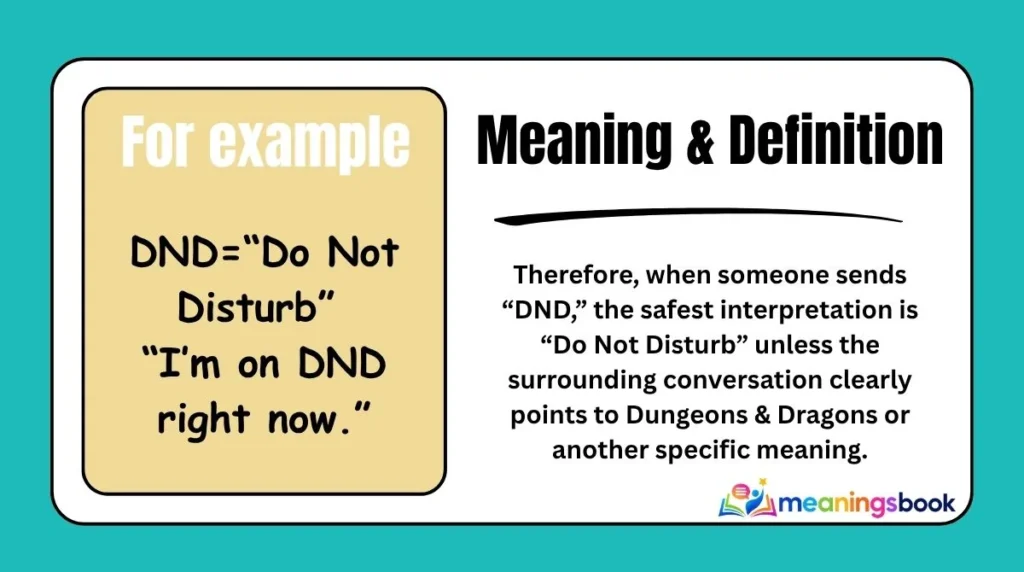
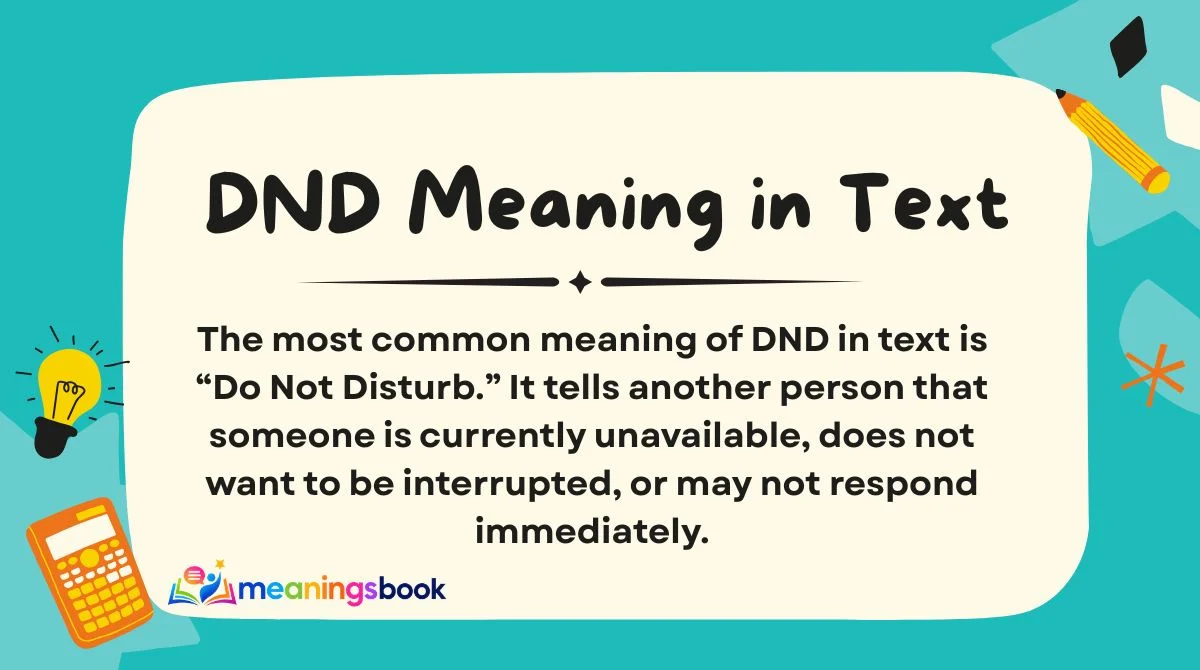
The most common meaning of DND in text is “Do Not Disturb.” It tells another person that someone is currently unavailable, does not want to be interrupted, or may not respond immediately.
For example, someone might text:
“I’m on DND right now.”
This usually means that the person has enabled a Do Not Disturb setting on their phone or simply wants others to understand that they are taking a break from notifications and conversations.
The abbreviation can also be used as a short status rather than a complete sentence. Someone might write:
- “DND until tomorrow.”
- “Study time — DND.”
- “On DND, will reply later.”
- “Sorry, my phone was on DND.”
The exact intention depends on the situation. In some cases, DND literally refers to a phone’s notification mode. In other cases, it is simply a convenient way of communicating “please don’t interrupt me.”
DND does not necessarily mean that someone is angry, ignoring you, or deliberately avoiding your message. A person might activate the setting while sleeping, studying, working, driving, exercising, watching a movie, or simply taking some personal time.
There is another well-known meaning: DND can stand for “Dungeons & Dragons,” the tabletop role-playing game. This meaning is more likely when the conversation includes terms such as characters, campaigns, dice, dragons, spells, classes, or gaming.
Capitalization is not always consistent. People may write “DND,” “dnd,” or occasionally “Do Not Disturb.” In ordinary texting, the context usually matters more than capitalization.
Therefore, when someone sends “DND,” the safest interpretation is “Do Not Disturb” unless the surrounding conversation clearly points to Dungeons & Dragons or another specific meaning.
Background
The phrase “Do Not Disturb” existed as an ordinary expression long before people began shortening it in digital conversations. It communicates a simple request: avoid interrupting someone for the moment.
The abbreviation became particularly familiar through phones and other communication devices. Modern smartphones commonly include a Do Not Disturb feature that can silence or limit notifications, calls, and alerts according to the user’s settings. As these features became part of everyday digital life, the abbreviation DND became convenient shorthand in conversations.
For example, instead of typing:
“I have my phone on Do Not Disturb because I am studying.”
someone can simply say:
“I’m on DND studying.”
The shorter form saves time and is easy to understand among people familiar with the feature.
There is no need to assume that DND originated as internet slang. Its most common texting meaning is closely connected to the established phrase Do Not Disturb, which has been adapted naturally into digital communication.
The term also has an independent meaning in gaming. DND is widely used informally as an abbreviation for Dungeons & Dragons, a tabletop role-playing game. That meaning should not be confused with the phone setting.
Because both meanings are recognizable, context is important. A message saying “I’m on DND until 10” almost certainly refers to Do Not Disturb. A message saying “Our DND campaign starts tonight” clearly refers to Dungeons & Dragons.
In other words, DND is not necessarily a single-purpose slang abbreviation. Its interpretation depends on what people are discussing.
Usage in Different Contexts
In Chat
In private messages, DND most commonly means that someone does not want interruptions or may not answer immediately. It can be a straightforward status update rather than an emotional statement.
Example:
“I’m on DND for the next two hours. Talk later.”
The sender is simply explaining their temporary availability.
On Social Media
DND can appear in bios, status messages, captions, comments, or direct messages. Someone might write “DND” to indicate that they are taking a break from notifications or conversations.
A person could also use it casually to communicate a boundary:
“DND — focusing on myself today.”
Here, the abbreviation expresses a request for space rather than necessarily referring to a specific phone setting.
In Professional Situations
In a work-related conversation, DND may refer to an employee’s availability or communication status.
For example:
“I’ll be on DND during the meeting.”
This can mean the person does not want phone notifications or interruptions while concentrating.
In professional communication, however, it is usually clearer to say “Do Not Disturb” or explain the person’s availability when the audience may not know the abbreviation.
In Casual Conversations
Among friends, DND can be extremely informal:
“DND rn, watching a movie.”
Here, “rn” means “right now,” and the overall message simply means the person does not want to be disturbed at that moment.
Tone can vary. DND may be polite, neutral, playful, or firm depending on the rest of the message.
Meaning in Chat, WhatsApp, Instagram, and TikTok
Across messaging and social platforms, DND generally carries the same basic idea: Do Not Disturb or temporarily unavailable.
DND in Chat
In ordinary texting, someone may use DND to explain delayed replies:
“Sorry, I was on DND.”
This suggests that notifications were silenced or that the person was intentionally unavailable.
DND on WhatsApp
Someone might write:
“DND for the evening.”
This can mean they do not want to receive or respond to messages for a while. It does not automatically mean that they have blocked anyone.
DND on Instagram
On Instagram, DND may appear in a direct message, profile description, story, or casual post. Someone could use it to signal that they are not currently interested in chatting.
For example:
“DND today. Need some quiet time.”
The phrase communicates temporary unavailability.
DND on TikTok
On TikTok, users may use DND in captions, comments, messages, or profile text. It can indicate that someone is taking a break from interaction or does not want interruptions.
The meaning can also change completely if the content is about gaming. A TikTok discussing a DND campaign, character, dungeon, or dice is likely using DND to mean Dungeons & Dragons.
Examples
- “DND until after my exam.” → Do Not Disturb.
- “Why are you on DND?” → Why are you unavailable or not receiving notifications?
- “DND tonight, I need sleep.” → Please do not disturb me tonight.
- “We played DND all weekend.” → Dungeons & Dragons.
The surrounding words usually provide the clue.
Meaning in Physics, Medical, and Aircraft Terminology
DND does not have one universal standard technical meaning across physics, medicine, and aviation. It should not automatically be assigned a specialized definition simply because it appears in a technical context.
Physics
There is no broadly recognized, standard physics meaning of DND that should be assumed in ordinary use. A specialized paper, textbook, laboratory, or organization could define its own abbreviation, but that would depend on the specific source and context.
Therefore, seeing “DND” in a physics-related discussion does not automatically establish a particular physics definition.
Medical Terminology
In medical environments, abbreviations can be highly context-dependent, and institutions may use their own shorthand. DND is not a single universally applicable medical term that should automatically be interpreted without context.
If DND appears in medical documentation, the surrounding text, facility terminology, or professional guidance should be checked rather than assuming it means “Do Not Disturb.”
The ordinary phrase “Do Not Disturb” can still be relevant to patient-care situations, but that does not make every occurrence of DND a standardized medical abbreviation.
Aircraft and Aviation Terminology
DND is not a universal aviation term that should automatically be interpreted as a specialized aircraft abbreviation.
There are aviation contexts where three-letter codes can represent airports or other identifiers, so a code such as DND should not automatically be interpreted as texting slang when encountered in travel or aviation information. The exact system and context determine what an aviation code represents.
The key point is simple: do not invent a technical meaning for DND simply because the abbreviation appears in a specialized field.
Common Misconceptions
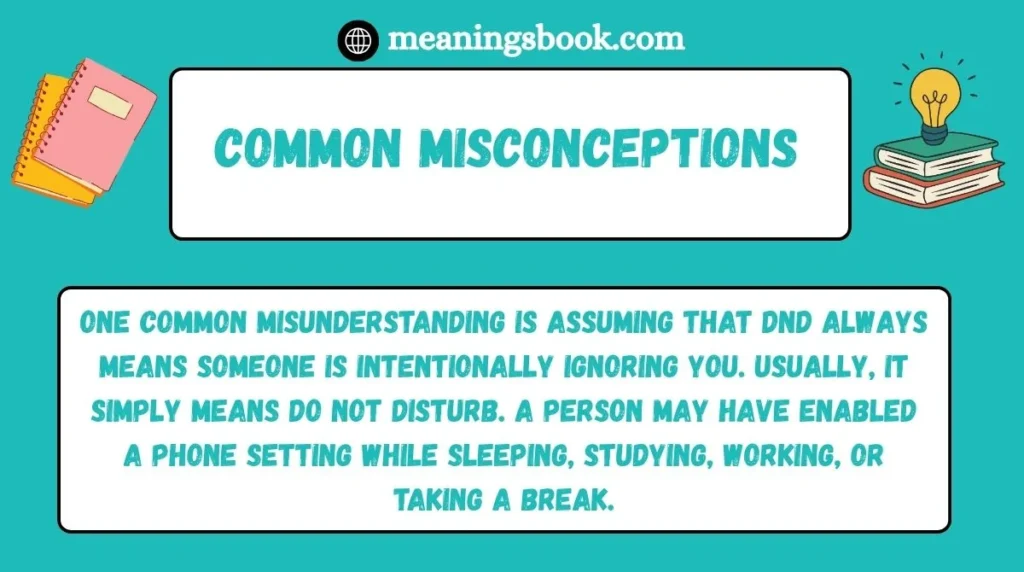
One common misunderstanding is assuming that DND always means someone is intentionally ignoring you. Usually, it simply means Do Not Disturb. A person may have enabled a phone setting while sleeping, studying, working, or taking a break.
Another misconception is that DND means someone has blocked you. It does not. A Do Not Disturb setting and blocking are different things. Someone can have notifications silenced while still receiving messages.
People may also confuse DND with “Do Not Delete.” Although individual people could potentially use DND creatively, that is not the standard interpretation in ordinary texting.
Another important confusion involves Dungeons & Dragons. If a friend says:
“I have DND tonight.”
they could mean that they have a gaming session rather than that they are unavailable because their phone is silenced.
Context solves this ambiguity. Words such as “notifications,” “sleep,” “busy,” or “reply later” point toward Do Not Disturb. Words such as “campaign,” “character,” “dice,” “wizard,” or “DM” point toward Dungeons & Dragons.
Finally, DND does not automatically communicate anger or rejection. The emotional meaning depends on how the person uses it and what happened before the message.
Similar Terms & Alternatives
Several expressions can communicate an idea similar to DND:
Do Not Disturb
This is the full form and the clearest alternative. It can refer either to a phone feature or a direct request for privacy.
AFK
AFK means “Away From Keyboard.” It is commonly associated with gaming and online activity and usually means someone is temporarily away.
BRB
BRB means “Be Right Back.” Unlike DND, it normally suggests that the person expects to return soon.
Busy
“Busy” is a broader expression indicating that someone is occupied and may not be able to respond.
Offline
“Offline” generally means someone is not currently active or connected, although it does not necessarily indicate that they do not want to be disturbed.
Taking a Break
This phrase is more explicit and can describe stepping away from social media, messaging, work, or other activities.
Silent Mode
Silent mode generally refers to reducing or disabling sounds. It does not necessarily communicate the broader idea of avoiding interruptions.
Dungeons & Dragons
This is the most important alternative meaning of DND. In gaming conversations, DND can refer to the tabletop role-playing game rather than Do Not Disturb.
How to Respond to It
Your response should depend on why the person used DND and what your relationship with them is.
If someone says:
“I’m on DND right now.”
a respectful response could be:
“No worries, message me when you’re free.”
If the situation is casual, you could say:
“Got it 👍”
or:
“All good, enjoy your quiet time.”
If you need to know when they will be available, you can politely ask:
“No problem. Let me know when you’re free.”
If someone says they are on DND because they are studying or working, avoid repeatedly messaging them unless something is genuinely urgent.
Sometimes DND is simply an informational status. It does not necessarily require a response at all.
If you are unsure which meaning they intended, context can help. If the conversation is about gaming, you might ask:
“Do you mean Do Not Disturb or Dungeons & Dragons?”
That clarification is especially useful because both meanings are widely recognizable.
The best response is usually short and respectful. If someone is signaling that they do not want interruptions, respecting that boundary is more appropriate than treating DND as an invitation to continue messaging.
Differences from Similar Words
| Term | Meaning | Typical Use | Main Difference |
|---|---|---|---|
| DND | Do Not Disturb | Notifications, messages, availability | Signals that interruptions are unwanted or limited |
| AFK | Away From Keyboard | Gaming and online chats | Means the person is away rather than specifically requesting no interruptions |
| BRB | Be Right Back | Casual texting | Indicates a temporary absence and expected return |
| Busy | Occupied | Work and casual conversation | Gives a general reason for delayed responses |
| Offline | Not currently online | Social platforms and messaging | Describes online status rather than a request for privacy |
| Silent Mode | Sounds are silenced | Phones and devices | Mainly concerns sound, not necessarily communication availability |
| Dungeons & Dragons | Tabletop role-playing game | Gaming conversations | Completely different meaning from Do Not Disturb |
The distinction between DND and AFK is particularly useful. Someone can be AFK without wanting to prevent notifications, while someone can activate DND while still actively using their phone.
Similarly, BRB usually suggests that the person plans to return soon, whereas DND does not provide a specific return time unless one is mentioned.
Relevance in Online Conversations & Dating Apps
DND can be especially useful in online conversations because people are often communicating across different schedules, time zones, and levels of availability.
On dating apps, someone might say:
“I’m on DND tonight. I’ll reply tomorrow.”
This generally means they are taking a break from their phone or conversations. It does not necessarily indicate a loss of interest.
However, context and relationship dynamics matter. If someone regularly uses DND while explaining that they are busy, it may simply reflect their communication habits. If someone says it once while dealing with work, sleep, or personal time, there is usually little reason to interpret it negatively.
DND can also function as a personal boundary. A person may want uninterrupted time without explaining every detail. Respecting that request is generally the best approach.
In dating conversations, it is particularly important not to treat a delayed reply as proof that someone is angry, rejecting you, or talking to someone else. A status such as DND provides limited information about a person’s intentions.
At the same time, DND can sometimes be used casually rather than literally. Someone might say “DND lol” simply to mean “I’m not available right now.”
If the conversation is about tabletop gaming, however, DND may mean Dungeons & Dragons. The surrounding vocabulary should make the intended meaning clear.
Frequently Asked Questions
What does DND mean in text?
DND usually means “Do Not Disturb” in text messages. It tells someone that a person is unavailable, does not want interruptions, or may not respond immediately. It can refer directly to a phone’s Do Not Disturb setting or simply be used as informal shorthand for wanting some quiet time.
What does DND mean in chat?
In chat, DND generally means Do Not Disturb. Someone may use it to explain that they are busy, sleeping, studying, working, or taking a break from messages. For example, “I’m on DND right now” usually means the person may not see or respond to notifications until later.
Is DND a slang term?
DND is commonly used as informal shorthand, but it is not exclusively internet slang. It is an abbreviation of the established phrase “Do Not Disturb,” which is also used as a phone and device setting. Online users frequently shorten the phrase because the abbreviation is quick and widely understood.
What does DND mean on social media?
On social media, DND most often means Do Not Disturb or indicates that someone does not want to interact for a while. It can appear in messages, captions, profiles, or statuses. However, if the surrounding post discusses tabletop gaming, DND may instead mean Dungeons & Dragons.
How do you respond to DND in a text?
A respectful response is usually short, such as “No worries, message me when you’re free” or “Got it, talk later.” If the person is clearly asking for uninterrupted time, there is usually no need to continue messaging. If the meaning is unclear, you can politely ask what they mean.
Can DND have different meanings?
Yes, DND can have different meanings depending on context. The two most recognizable are “Do Not Disturb” and “Dungeons & Dragons.” Technology, personal availability, sleep, or notifications usually point to Do Not Disturb, while characters, campaigns, dice, and role-playing discussions point toward Dungeons & Dragons.
Does DND mean someone is ignoring you?
No, DND does not automatically mean someone is ignoring you. It usually indicates that notifications are being limited or that the person wants uninterrupted time. They may still care about the conversation and respond later. The surrounding message and the person’s normal communication habits provide more useful context.
What does DND mean when someone says “I’m on DND”?
“I’m on DND” usually means “I’m on Do Not Disturb.” The person is telling you that they may not notice notifications or may not be available to respond. It is generally a temporary availability statement rather than a statement that they dislike or are avoiding the other person.
Conclusion
DND most commonly means “Do Not Disturb” in text messages, chats, and social media conversations. People use it to indicate that they are unavailable, want fewer interruptions, or may respond later.
It is often connected to a phone’s Do Not Disturb feature, but it can also be used informally as a simple request for quiet time. DND does not automatically mean someone is ignoring, blocking, or rejecting you. Context is important when interpreting its tone.
Another major meaning is “Dungeons & Dragons,” especially in gaming conversations involving campaigns, characters, dice, or role-playing. DND does not have one universal specialized meaning in physics, medicine, or aviation, so technical contexts should be interpreted carefully rather than assuming a definition.
When you encounter DND in a message, look at the surrounding words and situation. In most everyday texting, however, Do Not Disturb is the most likely meaning.

I am Ethan Whitmore, an English teacher and vocabulary enthusiast who explains words, phrases, and meanings in text through simple examples to make English easier for everyone.