If someone sends you a message containing “HBU,” they are usually asking a simple question about you. This short abbreviation is common in texting, online chats, social media comments, and casual conversations because it saves time while keeping the conversation moving.
People often use it after sharing something about themselves, such as how they are feeling, what they are doing, or what they think.
For example, someone might say, “I’m doing pretty good, HBU?” In this situation, understanding the abbreviation makes the intended question immediately clear. People search for the meaning of HBU because internet slang can be confusing, especially when abbreviations appear without explanation.
Although its meaning is generally straightforward in casual communication, the tone can vary depending on the conversation and the relationship between the people involved. Knowing how it is used can help you understand messages and respond naturally without overthinking the abbreviation.
Quick Answer
HBU meaning in text is “How about you?” It is commonly used in texting, chat, and social media conversations when someone wants to ask for your opinion, feelings, situation, or answer after sharing their own. For example, “I’m fine, HBU?” simply means “I’m fine, how about you?”
Meaning & Definition
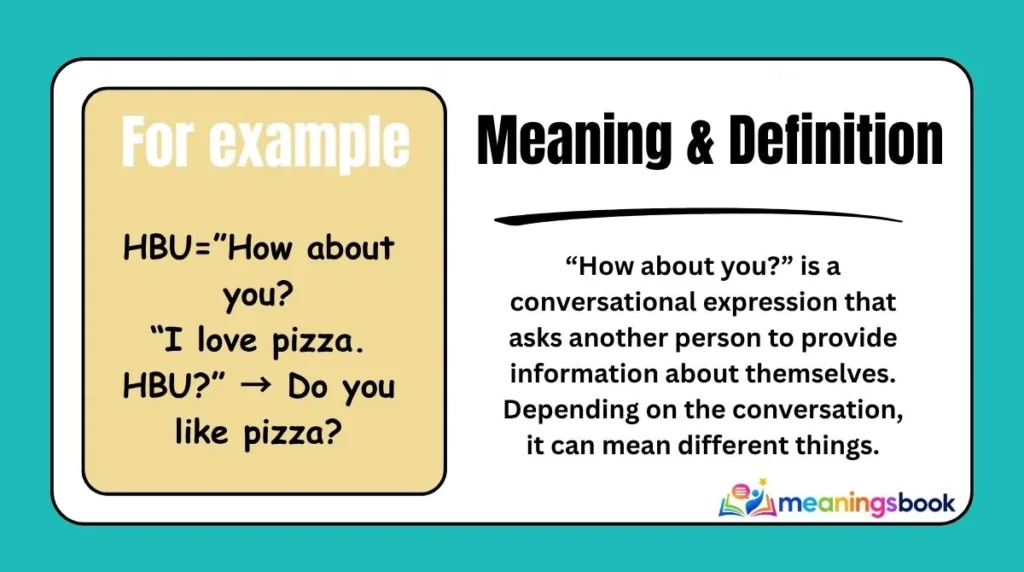
HBU stands for “How about you?” It is a common texting abbreviation used to turn a question or topic back toward the other person.
For example:
“I’m having a great day, HBU?”
This means:
“I’m having a great day. How about you?”
The abbreviation is especially useful when the person has already answered a similar question about themselves and wants to hear your response.
What does “How about you?” mean?
“How about you?” is a conversational expression that asks another person to provide information about themselves. Depending on the conversation, it can mean different things.
For example:
- “I’m tired. HBU?” → How are you feeling?
- “I love pizza. HBU?” → Do you like pizza?
- “I’m staying home tonight. HBU?” → What are you doing tonight?
- “I think the movie was great. HBU?” → What did you think of it?
- “I’m from Lahore. HBU?” → Where are you from?
The basic purpose remains the same: the speaker is inviting you to share your own answer.
HBU is generally informal. It is much more natural in a text message, direct message, or casual online conversation than in formal business writing.
The abbreviation can also make conversations feel quicker and more relaxed. Instead of typing “How about you?” every time, someone can simply type “HBU?” This is particularly common when people are chatting from phones or using platforms where short messages are normal.
Importantly, HBU is not usually a complicated slang expression. Its meaning is relatively direct, and the surrounding message normally makes the intended question obvious.
Background
HBU developed as part of the broader pattern of shortening common phrases in digital communication. People frequently use abbreviations in texting and online conversations because they allow them to communicate quickly with fewer characters.
There is no need to assume that HBU has a special hidden origin or a complicated slang history. It is essentially a shortened form of the ordinary conversational phrase “How about you?”
Digital communication encouraged many everyday expressions to become abbreviated. Similar examples include “wyd” for “what are you doing?”, “hru” for “how are you?”, and “idk” for “I don’t know.” HBU fits naturally into this style because “How about you?” is a phrase people use repeatedly during conversations.
The exact point at which individuals began using HBU cannot be established simply from the abbreviation itself, and its origin should not be confused with a single officially documented invention. Rather, it belongs to the larger development of informal internet and texting language.
Its continued use is partly explained by how useful the phrase is. Conversations often involve exchanging information:
Person A: “I’m doing well. HBU?”
Person B: “I’m good too.”
Instead of repeating the full phrase, the abbreviation keeps the exchange short.
HBU can also appear in uppercase or lowercase:
- HBU
- hbu
- Hbu
These forms normally have the same meaning.
Capitalization generally does not change what the abbreviation means. Lowercase “hbu” may simply feel more casual because lowercase writing is common in personal messaging.
Overall, HBU is best understood as a practical texting abbreviation rather than a term with a separate specialized definition.
Usage in Different Contexts
The meaning of HBU stays fairly consistent, but what the person is asking about depends on the surrounding conversation.
In Chat
In private chats, HBU commonly appears after someone answers a question or shares information.
Example:
“I’m watching a movie right now, hbu?”
The person is asking what you are doing.
Another example:
“I’m feeling much better today. HBU?”
Here, they are asking how you feel.
On Social Media
HBU may appear in comments, direct messages, replies, or posts. Someone might use it when comparing opinions or experiences.
“I liked the new song. HBU?”
This asks whether you liked it too.
In Professional Fields
HBU is not normally considered formal professional terminology. You might encounter it in an informal conversation between coworkers, especially through workplace messaging, but it is generally better to write “How about you?” in formal emails, reports, applications, or official correspondence.
For example, this is casual:
“I can join at 3. HBU?”
A more professional version would be:
“I can join at 3:00. How about you?”
In Casual Conversations
Casual conversation is where HBU fits most naturally. Friends, acquaintances, classmates, and online contacts may use it without any special significance.
The abbreviation can relate to almost any topic:
“I prefer coffee. HBU?”
“I’m free this weekend. HBU?”
“I’m nervous about the exam. HBU?”
In each case, the other person is simply being invited to share their own answer.
Meaning in Chat, WhatsApp, Instagram, and TikTok
HBU can be used across many modern communication platforms because its meaning does not depend on a particular app.
On WhatsApp, HBU is commonly used in one-to-one chats and group conversations.
“I’m staying home tonight, hbu?”
The person is asking what you plan to do.
On Instagram, you might see HBU in direct messages, replies, or informal comments.
For example:
“I love this outfit! HBU?”
Depending on the previous message, this could ask whether you like the outfit too.
TikTok
On TikTok, HBU may appear in comments or direct messages when users compare opinions, preferences, or experiences.
For example:
“This is my favorite creator. HBU?”
The commenter is asking who your favorite creator is or whether you agree.
General Texting
Traditional SMS and other messaging apps use HBU in much the same way:
“I’m good, hbu?”
This is one of the simplest and most common patterns.
The key is to read the words immediately before HBU. The abbreviation usually refers back to the topic already being discussed.
If someone says:
“I love summer. HBU?”
they are asking about your preference.
If they say:
“I’m going to the gym. HBU?”
they are probably asking what you are doing.
Therefore, HBU itself does not tell you exactly what information the other person wants. The conversation supplies that context.
Meaning in Physics, Medical, and Aircraft Terminology
HBU does not have one standard, universally recognized meaning in ordinary physics, medical terminology, or aircraft terminology that should be assumed whenever you see the abbreviation.
Physics
HBU is not a standard everyday physics abbreviation corresponding to the texting expression “How about you?” If you encounter HBU in a physics document, its meaning would need to come from the specific document, institution, equation, or technical context.
It would be inaccurate to automatically assign the texting meaning to a technical abbreviation.
Medical Terminology
HBU is not generally recognized as a universal medical equivalent of “How about you?” Medical abbreviations can vary by specialty and organization, so a technical appearance should always be interpreted from its specific context.
If HBU appears in a medical record or professional document, it should not automatically be interpreted as texting slang.
Aircraft or Aviation Terminology
Likewise, HBU should not automatically be treated as a standard aviation term simply because it appears in an aviation-related document. Technical abbreviations can have specialized meanings in particular systems, organizations, or documents.
The important distinction is that HBU in texting normally means “How about you?” A technical use, if encountered, would require separate contextual verification rather than assuming it has the same meaning.
Common Misconceptions
One common misconception is that HBU has a complicated slang meaning. In ordinary texting, it is much simpler: HBU means “How about you?”
Another misunderstanding is thinking that HBU always asks “How are you?” That can be true in some conversations, but it is not the literal meaning.
Consider:
“I’m going to the beach tomorrow. HBU?”
The person is not asking how you feel. They are asking what you are doing or planning to do.
Similarly:
“I think this restaurant is great. HBU?”
Here, HBU asks for your opinion.
Another misconception is that capitalization changes the meaning. In most casual messages, HBU, hbu, and Hbu mean the same thing.
People can also confuse HBU with other abbreviations because many texting expressions use a similar short format. For example, “HBU?” and “WBU?” can perform a similar conversational function, even though they are formed differently.
It is also important not to assume that HBU signals romantic interest. Someone asking “HBU?” may simply be maintaining a normal conversation. The tone depends on the surrounding messages and relationship between the people involved.
Finally, HBU is not inherently rude, cold, or dismissive. A very short message can sometimes feel abrupt, but that does not mean the abbreviation itself carries a negative attitude.
Similar Terms & Alternatives
Several abbreviations and phrases can serve similar purposes.
WBU
WBU usually means “What about you?” It is very similar to HBU and can often be used in the same situations.
“I’m good, WBU?”
WYD
WYD means “What are you doing?” It is more specifically about someone’s current activity.
“I’m at home, WYD?”
HBU is broader and depends on the previous topic.
HRU
HRU means “How are you?” It directly asks about someone’s well-being.
“Hey, HRU?”
HBU can ask about well-being, but only when the conversation makes that interpretation appropriate.
How about you?
This is the full, standard phrase represented by HBU.
“I’m doing well. How about you?”
It is more appropriate than HBU in formal or professional communication.
And you?
“And you?” is another natural alternative.
“I’m fine. And you?”
It serves a similar conversational purpose without using an abbreviation.
How to Respond to It
When someone sends “HBU?”, the best response depends on what they were talking about immediately beforehand.
If they ask about your feelings:
“I’m doing pretty good, thanks!”
If they ask what you are doing:
“Just relaxing at home. You?”
If they ask for your opinion:
“I actually really liked it.”
If they ask about your plans:
“I’m probably going out with some friends later.”
You can also keep the conversation going by answering and asking another question:
“I’m good! Just finished work. How was your day?”
If the conversation is casual, a short answer is perfectly normal:
“I’m good 😊”
You do not need to respond with another abbreviation. However, abbreviations such as “WBU?” can work naturally if you want to maintain the same casual tone.
The main rule is simple: look at what the other person said before HBU. Their previous statement usually tells you what they want to know about you.
Differences from Similar Words
| Expression | Meaning | Typical Use |
|---|---|---|
| HBU | How about you? | General follow-up question |
| WBU | What about you? | General follow-up question |
| HRU | How are you? | Asking about well-being |
| WYD | What are you doing? | Asking about current activity |
| And you? | Asking for your corresponding answer | Casual conversation |
| How about you? | Full form of HBU | Standard conversational English |
The biggest difference is specificity.
HRU directly asks about someone’s well-being, while WYD specifically asks what they are doing. HBU is more flexible because its meaning depends on the subject of the previous statement.
For example:
“I’m tired. HBU?”
Here, HBU probably asks about your condition.
But:
“I’m going shopping later. HBU?”
Now it probably asks about your plans.
The tone also differs depending on the form. HBU and WBU are informal abbreviations suited to casual digital communication. “How about you?” is more complete and works in a wider range of situations.
None of these expressions is automatically romantic, flirtatious, or serious. Context determines the tone.
Relevance in Online Conversations & Dating Apps
HBU is especially useful in online conversations because it helps keep an exchange going without requiring a long message.
On dating apps, someone might write:
“I love hiking on weekends. HBU?”
They are likely asking about your interests or weekend activities.
Another person might say:
“I’m looking for something serious. HBU?”
In that context, HBU asks about your relationship intentions.
The abbreviation itself does not indicate romantic interest. The surrounding conversation does. If someone is already having a personal or flirtatious conversation, HBU can naturally become part of that exchange, but the abbreviation remains a simple request for your corresponding answer.
It can also be useful when two people are getting to know each other:
“I’m from Karachi. HBU?”
The person wants to know where you are from.
Or:
“I’m more of a dog person. HBU?”
They want to know your preference.
On social platforms, HBU can make conversations feel informal and interactive. It signals that the speaker is not only talking about themselves but also wants your participation.
When interpreting it online, avoid reading too much into the abbreviation alone. The same HBU can be friendly, neutral, curious, or mildly flirtatious depending on the words surrounding it and the relationship between the people communicating.
Frequently Asked Questions
What does HBU mean in text?
HBU means “How about you?” in text messages. People use it after sharing something about themselves when they want the other person to give a corresponding answer. Depending on the conversation, it can ask about your feelings, opinion, plans, preferences, location, or current activity.
What does HBU mean in chat?
In chat, HBU means “How about you?” It is an informal way to return the conversation to the other person. For example, if someone says, “I’m watching TV, HBU?” they are asking what you are doing. The exact question depends on the topic being discussed.
Is HBU a slang term?
HBU is best described as a texting or internet abbreviation rather than a slang word with a separate definition. It shortens the ordinary phrase “How about you?” and is commonly used in informal digital communication such as texts, chats, and social media messages.
How do you respond to HBU?
Respond to HBU by answering the question implied by the previous message. For example, if someone says, “I’m doing great, HBU?” you could reply, “I’m doing great too!” If they are discussing plans, tell them your plans. You can also ask another question to keep the conversation going.
What does HBU mean on social media?
On social media, HBU generally means “How about you?” It can appear in comments, direct messages, replies, and casual conversations. Someone may use it to ask about your opinion, feelings, interests, plans, or preferences after mentioning their own.
Can HBU have different meanings?
In ordinary texting, HBU overwhelmingly means “How about you?” What changes is not usually the abbreviation itself but the information being requested. The surrounding conversation determines whether the person wants to know your feelings, opinion, plans, preferences, or another personal detail.
Is HBU appropriate in professional communication?
HBU is generally best reserved for informal communication. In a professional email, report, formal message, or business document, writing “How about you?” or another complete sentence is usually clearer and more appropriate. HBU may still appear in informal workplace chats where abbreviations are commonly accepted.
Does HBU mean someone is flirting?
HBU does not automatically mean someone is flirting. It simply means “How about you?” and can be used in completely ordinary conversations. If it appears in a dating or romantic conversation, the surrounding messages may make the exchange feel flirtatious, but the abbreviation itself does not carry a romantic meaning.
Conclusion
HBU is a simple and widely understandable texting abbreviation for “How about you?” People use it to invite another person to share their own answer after discussing feelings, opinions, plans, interests, or other personal information. It is particularly common in texts, private chats, social media conversations, and other informal digital communication.
The meaning of HBU itself is usually straightforward, but the exact question depends on the context. “I’m feeling good, HBU?” asks about your well-being, while “I’m going out tonight, HBU?” asks about your plans. Similar expressions such as WBU, HRU, and WYD have related but more specific meanings.
HBU is informal, so the full phrase “How about you?” is generally preferable in formal communication. If you receive HBU in a casual message, simply look at the preceding conversation and answer the question being implied. In most cases, no deeper interpretation is necessary.

I am Ethan Whitmore, an English teacher and vocabulary enthusiast who explains words, phrases, and meanings in text through simple examples to make English easier for everyone.