If someone sends you a message containing “ion,” it can be confusing at first because the word does not look like a typical English abbreviation. In online conversations, however, ion is often used as an informal slang spelling of “I don’t.”
You may see it in texts, social media comments, direct messages, memes, and casual conversations, especially when someone is writing quickly or trying to reproduce a particular style of speech.
For example, a person might say, “ion know what you mean” instead of “I don’t know what you mean.” The exact interpretation can still depend on the surrounding sentence because “ion” also has meanings outside internet slang, including the scientific term used in chemistry and physics.
This is why people commonly search for the meaning of the expression when they encounter it unexpectedly. Understanding the context, tone, and words around “ion” makes its intended meaning much easier to identify.
Quick Answer
Ion meaning in text is usually “I don’t,” especially in casual texting, social media, and online slang. It is an informal phonetic spelling that represents how “I don’t” may sound in rapid speech. For example, “ion know” generally means “I don’t know.” The scientific word “ion” has a completely different meaning, so context is important.
Meaning & Definition
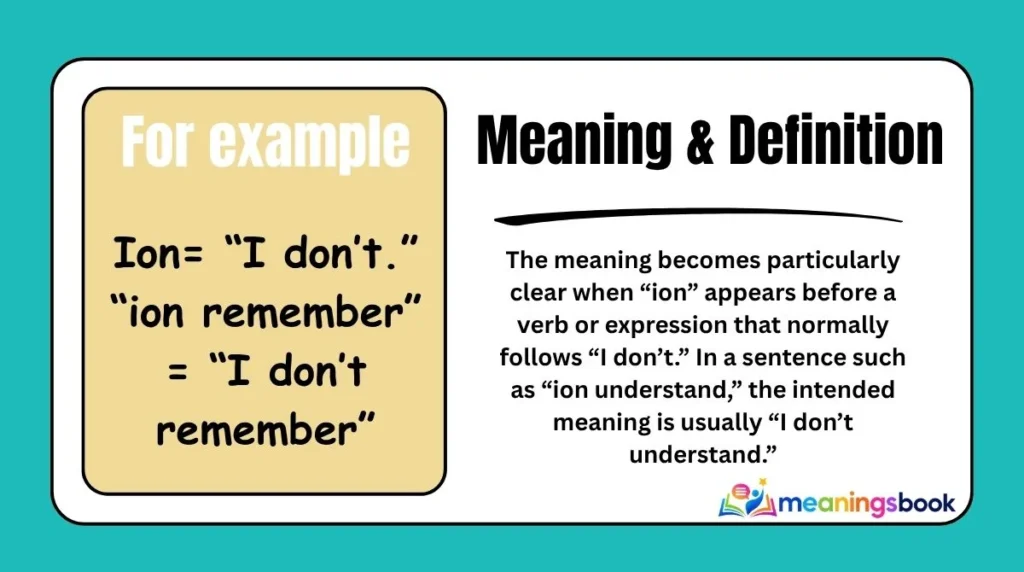
In casual online communication, “ion” commonly means “I don’t.” It is generally used as an informal spelling rather than as a formal abbreviation. People may write it this way to imitate pronunciation, regional speech patterns, conversational language, or the relaxed style commonly found in internet messages.
For example:
- “ion know” = “I don’t know”
- “ion want that” = “I don’t want that”
- “ion care” = “I don’t care”
- “ion think so” = “I don’t think so”
- “ion remember” = “I don’t remember”
The meaning becomes particularly clear when “ion” appears before a verb or expression that normally follows “I don’t.” In a sentence such as “ion understand,” the intended meaning is usually “I don’t understand.”
It is important to recognize that “ion” is not normally standard formal English for “I don’t.” It belongs primarily to informal communication. Someone might use it in a text message, social media post, comment, meme, or private conversation, but it would generally be inappropriate in a formal essay, business report, academic paper, or professional correspondence.
The tone can vary. Sometimes “ion” is simply a casual way of writing. In other cases, it can make a message sound humorous, relaxed, expressive, or intentionally conversational. The surrounding words and the relationship between the people communicating can help determine the tone.
There is also an important distinction between slang and the standard English word ion. In science, an ion is an electrically charged atom or molecule. That scientific meaning has nothing to do with the texting expression “ion” meaning “I don’t.”
Therefore, when you encounter “ion” in a message, do not automatically assume it refers to science. Look at the sentence first. If it appears in something like “ion know,” “ion care,” or “ion want to,” the slang interpretation is usually the natural one.
Background
The informal use of “ion” is best understood as a phonetic or speech-based spelling of “I don’t.” Rather than treating it as a conventional abbreviation created from the first letters of two words, it is more useful to understand it as a written representation of casual pronunciation.
In fast or relaxed speech, words can blend together. “I don’t” may be pronounced in a way that sounds different from its careful, fully articulated form. Internet users sometimes reproduce these pronunciation patterns in writing. As online communication became more conversational, spellings such as “ion” became recognizable within certain informal speech and internet-language communities.
There is not necessarily one specific person, website, event, or date that can be identified as the definitive origin of this usage. Slang develops gradually through speech communities, social interaction, music, regional language patterns, online communities, and repeated informal use. Because of that, it would be inaccurate to claim a single confirmed inventor of the texting meaning.
The rise of social media and mobile messaging helped make informal spellings more visible. Traditional written English tends to preserve standardized spelling, while texting often prioritizes speed, personality, humor, and the reproduction of spoken language. This environment allows nonstandard forms such as “ion” to spread and become recognizable to more readers.
The expression can also function as part of a broader informal writing style. A person who writes “ion know,” for example, may use other conversational spellings in the same message. The purpose is not necessarily to save characters. Instead, the spelling can communicate a particular voice or conversational identity.
It is also worth noting that the slang meaning should not be confused with the scientific term. Ion is an established scientific word with a completely separate history and definition. In science, it refers to an atom or molecule with an electrical charge because it has gained or lost electrons.
Consequently, there are two very different uses of the same written form. The slang use generally means “I don’t,” while the scientific use refers to an electrically charged atom or molecule. Context determines which meaning is intended.
Usage in Different Contexts
The meaning and tone of “ion” can change depending on where it appears. In most informal digital conversations, it is interpreted as “I don’t,” but the surrounding sentence remains important.
Chat
In private chats, “ion” is commonly used as a relaxed alternative to “I don’t.” Someone might write:
“ion know what happened.”
This normally means:
“I don’t know what happened.”
Another example is:
“ion wanna go.”
The intended meaning is generally:
“I don’t want to go.”
Chat communication is usually informal, so nonstandard spellings are much more acceptable than they would be in formal writing.
Social Media
On platforms where users post comments, captions, short messages, or reactions, “ion” can be used to create a casual or conversational tone. It may appear in a humorous statement, reaction, opinion, or meme-style post.
For example:
“ion even know what to say 😂”
Here, the writer is most likely saying, “I don’t even know what to say.”
Professional Fields
In professional communication, “ion” generally should not be used as a substitute for “I don’t.” A workplace email such as “ion know the answer” may appear overly casual or unclear.
In scientific or technical writing, however, ion is a legitimate technical term. In chemistry and physics, it refers to a charged atom or molecule.
Therefore, professional context can completely change the interpretation.
Casual Conversations
Among friends or people who regularly communicate informally, “ion” may feel natural. It can convey a relaxed, conversational style rather than a formal tone.
For example:
“ion really care tbh.”
This generally means:
“I don’t really care, to be honest.”
The expression can therefore be understood as both a meaning and a stylistic choice.
Meaning in Chat, WhatsApp, Instagram, and TikTok
Across messaging and social media platforms, “ion” usually carries the same informal meaning: “I don’t.” The platform itself does not normally change the definition, but the surrounding culture and style of communication can affect how frequently the expression appears.
In WhatsApp conversations, someone might write:
“ion know where he went.”
This usually means:
“I don’t know where he went.”
Because WhatsApp is often used for personal conversations, informal spellings are common. Friends may use shortened words, slang, emojis, and phonetic spellings without expecting them to follow formal grammar.
On Instagram, “ion” may appear in comments, captions, direct messages, or replies.
For example:
“ion even understand this 😂”
The person is essentially saying, “I don’t even understand this.”
The expression can contribute to a casual, humorous, or conversational voice.
TikTok
TikTok comments and captions frequently use highly informal internet language. “Ion” may appear as part of a reaction or opinion.
For example:
“ion know what y’all are talking about.”
This can be understood as:
“I don’t know what you all are talking about.”
It may also appear in short reactions such as “ion care,” “ion wanna,” or “ion think so.”
Why People Use It
People may choose “ion” because it reflects how they speak, fits an established online style, feels more natural among friends, or adds personality to a message. It does not necessarily mean the writer does not know standard spelling.
One important point is that “ion” should not automatically be interpreted as a typo. In many informal messages, it is an intentional spelling. However, if the sentence does not make sense with “I don’t,” the writer may have intended something else.
Meaning in Physics, Medical, and Aircraft Terminology
The word ion has a well-established scientific meaning, particularly in physics and chemistry. This meaning is entirely different from the informal texting expression.
Physics
In physics, an ion is an atom or molecule that has an electrical charge because it has gained or lost one or more electrons.
A positively charged ion is called a cation, while a negatively charged ion is called an anion.
For example, if an atom loses an electron, it can become positively charged. If it gains an electron, it can become negatively charged.
Therefore, in a physics-related sentence such as “the electric field affects the motion of the ion,” the word is being used in its scientific sense, not as internet slang.
Medical Terminology
“Ion” is also a legitimate scientific and medical term. Medicine frequently discusses ions because electrically charged particles play important roles in biological processes.
Examples include sodium, potassium, calcium, and chloride ions. Their movement and concentration are important in areas such as nerve signaling, muscle function, and fluid balance.
However, “ion” by itself is not normally a medical abbreviation meaning “I don’t.” If it appears in medical documentation, the surrounding terminology should be examined before interpreting it as slang.
Aircraft or Aviation Terminology
There is no standard aviation meaning of “ion” that corresponds to the texting expression “I don’t.” The word can appear in technical or scientific discussions related to aviation when ions, ionization, atmospheric science, or other technical subjects are being discussed.
For instance, an aviation-related scientific document could use the word in connection with atmospheric conditions or electrically charged particles.
Therefore, if “ion” appears in a casual message, “I don’t” may be the likely interpretation. If it appears in a technical aviation document, its scientific meaning may be more appropriate.
Common Misconceptions
One of the biggest misconceptions is that “ion” always means the same thing everywhere. It does not. Context is essential.
The first common mistake is assuming that every occurrence of “ion” refers to the slang expression “I don’t.” If you see “ion” in a chemistry textbook, physics article, or technical document, it almost certainly has its scientific meaning instead.
Another misunderstanding is treating “ion” as a formal abbreviation. In casual texting, it functions more like an informal phonetic spelling. It is not generally appropriate to replace “I don’t” with “ion” in formal English.
Some readers may also confuse “ion” with other short forms such as IDK, which means “I don’t know.” The two expressions can communicate similar ideas in certain situations, but they are not interchangeable in every sentence. “Ion” can replace “I don’t” in a larger phrase, whereas “IDK” directly represents “I don’t know.”
For example:
- “ion know” → “I don’t know”
- “IDK” → “I don’t know”
Another misconception is that using “ion” necessarily indicates poor spelling or lack of education. Informal language often intentionally breaks standard spelling to represent pronunciation, identity, humor, or conversational style.
Finally, some people may assume “ion” has a hidden meaning simply because it looks unusual. Usually, there is no complicated hidden message. In a sentence such as “ion want it,” the intended meaning is generally straightforward: “I don’t want it.”
When uncertain, replace “ion” with “I don’t” and read the complete sentence. If the sentence makes natural sense, the slang interpretation is likely correct.
Similar Terms & Alternatives
Several expressions can overlap with the meaning of “ion,” especially in casual texting.
“I don’t”
This is the standard English expression represented by the slang “ion.” It is the safest choice in formal and informal communication.
Example:
“I don’t know.”
“IDK”
“IDK” commonly means “I don’t know.” It is a more recognizable internet abbreviation and can be used independently.
Example:
“IDK what happened.”
“I dunno”
“I dunno” is an informal spelling of “I don’t know.” It has a conversational quality but is different from “ion.”
Example:
“I dunno what to say.”
“IDC”
“IDC” usually means “I don’t care.” Like “ion care,” it can communicate indifference, although the tone may vary.
Example:
“IDC what they think.”
“IDRC”
“IDRC” generally means “I don’t really care.” It is another internet abbreviation rather than a direct equivalent of “ion.”
“Nah”
“Nah” can sometimes communicate disagreement or refusal, but it does not literally mean “I don’t.” Its meaning depends more heavily on the sentence.
For example, “Nah, I’m good” is closer to “No, I’m fine” than to “I don’t.”
The important distinction is that “ion” normally works as part of a sentence, while abbreviations such as “IDK” and “IDC” can often function as complete responses.
How to Respond to It
How you respond to “ion” depends on the complete message, not just the word itself. Since “ion” usually means “I don’t,” you should first read the words that follow it.
If someone says:
“ion know.”
You could simply respond:
“No worries.”
If they say:
“ion understand.”
You might explain the situation:
“I mean that we should meet tomorrow instead.”
If someone writes:
“ion want to go.”
A natural response could be:
“That’s okay. We can stay here.”
You do not normally need to correct someone for using “ion.” In casual communication, it is often intentional. Responding naturally is usually better than focusing on the spelling.
If you are unsure about what they mean, ask for clarification:
“Do you mean you don’t want to?”
This is particularly useful when the message could reasonably have multiple interpretations.
Tone also matters. “Ion care” may sound neutral among close friends, but depending on the conversation, it can come across as dismissive or irritated. In that situation, you may want to address the underlying message rather than the slang itself.
The simplest rule is: interpret the whole sentence first, then respond to the actual idea being communicated.
Differences from Similar Words
| Expression | Usual Meaning | Typical Tone | Example |
|---|---|---|---|
| ion | I don’t | Very informal | “ion know” |
| I don’t | I do not | Standard | “I don’t know” |
| IDK | I don’t know | Informal | “IDK what happened” |
| IDC | I don’t care | Informal | “IDC anymore” |
| I dunno | I don’t know | Casual | “I dunno” |
| nah | No / not really | Casual | “Nah, I’m good” |
The biggest difference is that “ion” is usually a phonetic-style spelling of “I don’t,” whereas IDK and IDC are conventional internet abbreviations.
For example, consider these sentences:
“ion know.”
This means “I don’t know.”
“IDK.”
This also means “I don’t know,” but it is an abbreviation rather than a phonetic spelling.
“I dunno.”
This communicates the same basic idea but imitates casual speech differently.
“nah.”
This usually communicates rejection, disagreement, or refusal and does not directly mean “I don’t.”
There can also be a difference in tone. “I don’t” is neutral and standard. “Ion” can feel more casual, conversational, or stylistically expressive. “IDK” can feel quick and direct. “I dunno” may sound relaxed or uncertain.
These distinctions matter when interpreting messages because two expressions can have similar meanings while producing different impressions.
Relevance in Online Conversations & Dating Apps
The slang use of “ion” is particularly relevant in informal online communication because dating apps, direct messages, social platforms, and private chats often favor conversational language.
On a dating app, someone might write:
“ion usually give out my number this fast.”
The likely meaning is:
“I don’t usually give out my number this fast.”
The phrase may therefore communicate a personal preference or boundary while maintaining a casual tone.
Another example could be:
“ion know if I’m ready for that.”
This means:
“I don’t know if I’m ready for that.”
In dating conversations, tone can be especially important. A short message such as “ion know” could indicate uncertainty, hesitation, or simply a lack of information. It does not automatically communicate rejection.
Similarly, “ion want that” could mean a straightforward refusal, while “ion think so” could indicate disagreement without necessarily being hostile.
The relationship between the people also matters. Close friends may use “ion” frequently and interpret it effortlessly. Someone unfamiliar with the expression may initially think it is a typo.
On social media, the expression can also be part of a person’s broader online writing style. It may be combined with abbreviations, emojis, shortened words, and other informal expressions.
The key is not to overinterpret the slang itself. “Ion” generally tells you how the person is expressing “I don’t,” but the words following it provide the actual message. Context, punctuation, emojis, and the broader conversation can help determine whether the person sounds playful, uncertain, annoyed, dismissive, or simply casual.
Frequently Asked Questions
What does ion mean in text?
In text messages, “ion” usually means “I don’t.” It is an informal, phonetic-style spelling commonly used in casual online communication. For example, “ion know” normally means “I don’t know,” while “ion want to go” means “I don’t want to go.” The scientific word “ion” has a completely different meaning.
What does ion mean in chat?
In chat, “ion” generally means “I don’t.” It is most often used in informal conversations between friends or online users. A message such as “ion understand” can simply be read as “I don’t understand.” The surrounding words should always be considered because “ion” also has a scientific meaning.
Is ion a slang term?
Yes, “ion” can be considered an informal slang spelling of “I don’t.” It is primarily associated with casual digital communication and conversational writing. It is not standard formal English, so it is better suited to texts, comments, messages, and other informal settings than professional or academic writing.
What does ion mean on social media?
On social media, “ion” usually means “I don’t.” It may appear in captions, comments, direct messages, and casual reactions. For example, “ion even know” generally means “I don’t even know.” Users may choose this spelling to make their writing sound more conversational or to reflect informal speech.
How do you respond to ion in a text?
Respond to the meaning of the complete sentence rather than the word “ion” itself. If someone says “ion know,” you might provide the information they need. If they say “ion want to,” you can acknowledge their preference. If the message is unclear, simply ask what they mean rather than assuming.
Can ion have different meanings?
Yes, “ion” can have different meanings depending on context. In informal texting, it commonly means “I don’t.” In science, an ion is an electrically charged atom or molecule. Therefore, the sentence and setting are important. A social media message and a physics textbook may use exactly the same word for completely different purposes.
Is ion the same as IDK?
No, but they can communicate similar ideas in some sentences. “Ion” usually represents “I don’t,” while “IDK” specifically means “I don’t know.” For example, “ion know” and “IDK” can both express uncertainty, but “ion” can also appear in phrases such as “ion care” or “ion want that.”
Does ion mean I don’t know?
“Ion” by itself does not specifically mean “I don’t know”; it usually represents “I don’t.” When it is followed by “know,” as in “ion know,” the complete phrase means “I don’t know.” This distinction is useful because “ion” can be followed by many different verbs and expressions.
Conclusion
The meaning of “ion” in text is usually simple: it is an informal spelling of “I don’t.” You may encounter it in text messages, social media comments, direct messages, casual conversations, and other forms of online communication. Expressions such as “ion know,” “ion care,” and “ion want to” can generally be understood by replacing “ion” with “I don’t.”
The term is best viewed as a conversational or phonetic-style spelling rather than a formal abbreviation. It is therefore much more appropriate for casual communication than professional or academic writing. At the same time, context is essential because “ion” is also an established scientific term referring to an electrically charged atom or molecule.
When you see the word online, look at the surrounding sentence and the setting before deciding what it means. In most casual messages, the intended meaning will become clear from context. Understanding this distinction helps you interpret slang naturally without confusing it with the scientific use of the same word.

I am Ethan Whitmore, an English teacher and vocabulary enthusiast who explains words, phrases, and meanings in text through simple examples to make English easier for everyone.