Abbreviations can make online conversations faster, but they can also leave readers wondering what someone actually meant. CYA is one of those short expressions that can have more than one interpretation depending on the conversation.
You may encounter it in text messages, group chats, social media comments, workplace messages, gaming conversations, or casual exchanges with friends. In many everyday conversations, it is a shortened form of “see ya,” meaning “see you later.”
However, in workplace or more serious discussions, CYA can also mean “cover your ass,” referring to protecting yourself from blame, criticism, or responsibility. Because the same three letters can communicate very different ideas, context is important.
People commonly search for the meaning of CYA because they have received it unexpectedly and want to know whether it is simply a casual goodbye or something more strategic or defensive. Understanding the surrounding message usually makes the intended meaning much easier to identify.
Quick Answer
CYA meaning in text usually means “see ya,” or “see you,” especially in casual chats and messages. It is commonly used as a quick, informal way to say goodbye. In workplace or serious contexts, however, CYA can also mean “cover your ass,” so the surrounding conversation determines the intended meaning.
Meaning & Definition
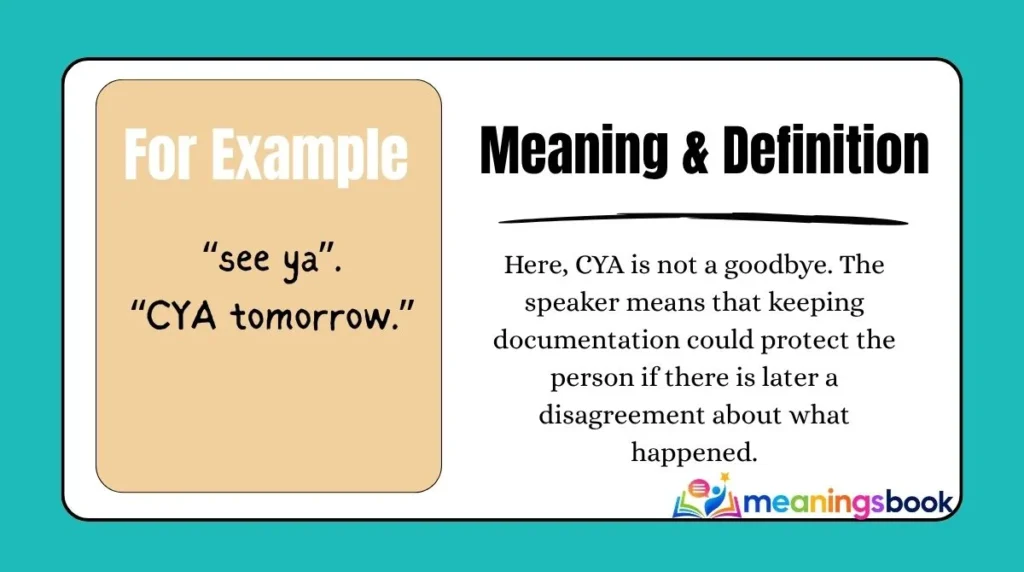
CYA most commonly appears as an informal abbreviation for “see ya,” which itself is a casual version of “see you.” When someone sends “CYA,” they are often simply ending a conversation or saying that they expect to see or speak with you again.
For example:
- “I have to go now. CYA!”
- “CYA tomorrow.”
- “Okay, CYA later.”
- “I’m heading home. CYA.”
In these examples, the expression has a friendly and relaxed tone. It does not usually carry a hidden message or complicated meaning. It functions much like “bye,” “see you,” or “talk later.”
However, CYA has another established informal interpretation: “cover your ass.” This version is especially associated with workplace communication, risk management, accountability, and situations where someone wants to protect themselves from being blamed for a problem.
For example, someone might say:
“Keep a copy of that email for CYA.”
Here, CYA is not a goodbye. The speaker means that keeping documentation could protect the person if there is later a disagreement about what happened.
The difference is usually easy to identify from context. If CYA appears at the end of a friendly conversation, “see ya” is generally the natural interpretation. If it appears alongside words such as documentation, responsibility, approval, records, blame, or workplace problems, “cover your ass” may be intended.
Tone also matters. “See ya” is casual and generally harmless. “Cover your ass” is more blunt and can sound cynical, defensive, or humorous. Because CYA can represent both meanings, readers should avoid automatically assuming one interpretation without considering the surrounding message.
Background
CYA is an example of how spoken language can become compressed into short forms for digital communication. “See ya” is already an informal pronunciation of “see you,” and CYA uses the letters to create an even shorter written version. This makes it particularly suitable for fast conversations where people already understand the informal style.
There is no single universally accepted origin story that can reliably explain every use of CYA. The abbreviation developed as part of a broader culture of shortening phrases, particularly in informal written communication. Similar abbreviations became increasingly familiar through texting, online chat, instant messaging, forums, and social media.
The second meaning, “cover your ass,” follows a different linguistic pattern. It uses the initial letters of the three words and became a recognizable informal expression for taking steps to protect oneself from future criticism, liability, or blame. It is more likely to appear in discussions involving work, mistakes, instructions, records, or responsibility than in ordinary friendly texting.
An important point is that CYA is context-dependent rather than a word with one fixed definition. Acronyms and abbreviations often develop multiple meanings because the same letters can represent different phrases. CYA is a good example of this phenomenon.
The meaning also depends on the relationship between the people communicating. A friend saying “CYA tomorrow” is almost certainly using the casual goodbye meaning. A manager saying “Make sure you get that approval in writing for CYA” is using the defensive or protective meaning.
The expression should therefore be understood as an abbreviation with two widely recognizable informal uses rather than as a specialized technical term. When the surrounding message is available, it is usually the best clue to the intended interpretation.
Usage in Different Contexts
Chat
In ordinary chat, CYA commonly means “see ya” or “see you.” It is often used when someone is leaving the conversation, ending a call, or saying goodbye.
“Got to run, CYA” is essentially equivalent to “I have to go, see you later.”
Social Media
On social platforms, CYA can appear in comments, direct messages, captions, or replies. Its meaning remains dependent on context. A casual comment such as “CYA soon!” generally expresses a goodbye or expectation of seeing someone again.
Professional Fields
Professional conversations require more caution because CYA can mean “cover your ass.” The phrase usually refers to protecting oneself through documentation, confirmation, approvals, records, or other evidence.
For example, “Send the confirmation email for CYA” suggests creating a written record rather than saying goodbye.
Because “ass” is informal and potentially inappropriate in some workplaces, the phrase may also appear in less direct forms such as “cover yourself” or “CYA documentation.”
Casual Conversations
Among friends, CYA is usually friendly and informal. It can communicate a quick goodbye without sounding serious.
For example:
- “Dinner was fun. CYA!”
- “CYA this weekend.”
- “Okay, I’m off. CYA later.”
The tone is generally relaxed rather than formal.
Overall, the safest approach is to look at what the abbreviation is doing in the sentence. If it ends a conversation, “see ya” is likely. If it refers to protection from responsibility or future trouble, “cover your ass” is more likely.
Meaning in Chat, WhatsApp, Instagram, and TikTok
Across messaging and social media platforms, CYA usually follows the same basic meaning rather than having a special platform-specific definition.
On WhatsApp, someone might write “CYA later” after a conversation about meeting friends. In this setting, it naturally means “see you later.”
On Instagram, CYA may appear in direct messages or comments. For example, someone responding to an invitation with “CYA there” is probably saying “see you there.”
On TikTok, the abbreviation can appear in comments or private messages. A person might use it as a short goodbye after discussing a video, creator, event, or upcoming interaction.
Examples include:
- WhatsApp: “I’m going to sleep now, CYA tomorrow.”
- Instagram: “CYA at the party!”
- TikTok: “Alright, CYA in the next live.”
- Group chat: “I have class now, CYA everyone.”
In these examples, the abbreviation saves typing while keeping the tone informal.
There can also be a different interpretation on these platforms when the discussion involves work, conflict, accusations, or responsibility. Someone could write, “Screenshot everything for CYA.” In that case, the intended meaning is likely “cover your ass,” not “see ya.”
The capitalization does not necessarily solve the ambiguity. Both interpretations can be written as CYA, cya, or sometimes c ya. Lowercase “cya” is especially common in casual digital communication and often looks more like ordinary texting slang.
The relationship between the speakers is another useful clue. Friends, partners, gaming teammates, and casual acquaintances are more likely to use CYA as “see ya.” Coworkers discussing an incident, documentation, or responsibility may use it in the “cover your ass” sense.
Therefore, there is no special WhatsApp, Instagram, or TikTok definition that overrides ordinary usage. The platform provides the setting, but the actual conversation determines the meaning.
Meaning in Physics, Medical, and Aircraft Terminology
CYA does not have one universally recognized standard meaning across physics, medicine, and aviation comparable to a formal technical unit, diagnosis, or universally accepted aircraft term.
Physics
In general physics terminology, CYA is not a standard abbreviation with one broadly accepted meaning that readers should automatically assume. If CYA appears in a physics document, its definition would need to be determined from that specific document, field, institution, or surrounding notation.
It should not automatically be interpreted as “see ya” simply because that is common in texting.
Medical Terminology
CYA is not a universally standard medical diagnosis or medical abbreviation with one fixed meaning across healthcare contexts. Medical abbreviations can vary between specialties and organizations, so an unexplained abbreviation in a clinical document should not be interpreted solely from its letters.
If you encounter CYA in medical material, the surrounding terminology and the source’s abbreviation list are more reliable than assuming the texting meaning.
Aircraft and Aviation Terminology
CYA is likewise not a single universally recognized aviation term that has the same meaning everywhere. Aviation uses many specialized abbreviations, and their meanings can depend on the country, organization, document, or operational context.
Consequently, someone seeing CYA in an aviation-related document should check the relevant terminology rather than treating it automatically as internet slang.
The key distinction is simple: CYA is widely understandable as an informal communication abbreviation, but its letters do not create a universal technical definition across every professional field. A specialized document can assign an abbreviation its own meaning, so context remains essential.
Common Misconceptions
One common misconception is that CYA always means “see ya.” That interpretation is very common in casual messaging, but it is not the only recognized use. In professional or problem-related conversations, it can mean “cover your ass.”
Another misunderstanding is assuming that CYA is always friendly. When used as “see ya,” it is usually casual and friendly. When used as “cover your ass,” the tone can be defensive, humorous, blunt, or even critical.
People may also confuse CYA with other short forms that contain similar letters. For example, “CU” can mean “see you,” while “CYT” can mean “see you tomorrow” in some texting contexts. These are related expressions but are not interchangeable in every situation.
A further misconception is that capitalization changes the meaning. Writing “CYA,” “cya,” or “Cya” does not create a reliable distinction between the two major interpretations. The surrounding sentence is much more useful.
Some readers may also assume that CYA is a formal business abbreviation because they see it in workplace messages. In reality, “cover your ass” is informal language. It may be understandable in professional environments, but the wording itself is not especially formal.
Finally, CYA should not automatically be treated as a technical abbreviation in physics, medicine, aviation, or another specialized field. A technical document may use the same letters for a local or field-specific abbreviation, but that meaning must come from the relevant context.
When the meaning is unclear, look at the words immediately before and after CYA. The subject of the conversation usually provides enough information to determine which interpretation makes sense.
Similar Terms & Alternatives
Several expressions can resemble CYA or communicate a similar idea.
| Term | Common meaning | Typical tone |
|---|---|---|
| See ya | See you later | Casual |
| See you | Goodbye or future meeting | Neutral/casual |
| CU | See you | Very informal |
| CYA later | See you later | Casual |
| Bye | Goodbye | General |
| TTYL | Talk to you later | Casual |
| Take care | Friendly farewell | Warm/casual |
| Cover yourself | Protect yourself from blame or problems | Professional/neutral |
| CYA | See ya or cover your ass | Context-dependent |
The closest alternative to the goodbye version is “see ya” itself. “See you later” and “talk to you later” can also serve a similar purpose, although they do not always imply exactly the same future interaction.
For the workplace meaning, “cover yourself” is a less explicit alternative to “cover your ass.” It communicates the idea of protecting yourself without using profanity.
TTYL is worth distinguishing because it means “talk to you later.” It indicates an intention to communicate again, whereas “CYA” in its goodbye sense more directly resembles “see ya.”
“CU” is another common abbreviation that can be confused with CYA. Both can function as casual farewells, but CYA contains the “ya” sound and is often understood as “see ya,” while CU represents “see you.”
Knowing these alternatives can help readers infer meaning when a conversation contains several abbreviations at once.
How to Respond to It
If someone sends CYA as a casual goodbye, you do not need a complicated response. A simple farewell is usually appropriate.
Natural responses include:
- “Cya!”
- “See you later!”
- “Take care!”
- “See you tomorrow.”
- “Bye, talk later!”
- “You too!”
For example:
Person A: “I have to go. CYA!”
Person B: “Cya! Take care.”
If CYA appears to mean “cover your ass,” the response should address the actual situation rather than treating it as a goodbye.
For example:
Person A: “Keep the approval email for CYA.”
Person B: “Good idea. I’ll save a copy.”
If you are unsure which meaning someone intended, you can ask directly:
- “Do you mean see ya?”
- “Do you mean cover your ass?”
- “Just checking—CYA as in see you later?”
In most casual conversations, asking for clarification may be unnecessary because the context makes the meaning obvious. If someone sends “CYA tomorrow,” it is almost certainly a farewell. If they say “Keep the records for CYA,” the protective meaning is much more likely.
The best response therefore depends less on the abbreviation itself and more on the sentence surrounding it.
Differences from Similar Words
CYA and “see you” are very close when CYA is used as a farewell. The main difference is style. “See you” is more conventional, while CYA is shorter and more informal.
CYA and “bye” also overlap, but “CYA” can imply that the speaker expects to see or communicate with the other person again. “Bye” is more general and does not necessarily carry that implication.
CYA and TTYL are related but not identical. TTYL means “talk to you later,” while CYA usually means “see ya” when used as a goodbye. The difference is small in casual conversation but still meaningful.
CYA and “cover yourself” are closer when the subject is workplace protection. “Cover yourself” is less vulgar and generally more suitable for professional communication. CYA in this sense is informal and can sound blunt.
The biggest distinction is between the two meanings of CYA itself:
- “See ya” → a casual farewell.
- “Cover your ass” → protect yourself from blame, responsibility, or future trouble.
Tone can help distinguish them. The farewell version is usually light and conversational. The second can sound cautious, defensive, sarcastic, or practical.
If CYA appears after someone announces they are leaving, interpret it as a goodbye. If it appears in a conversation about emails, evidence, approvals, mistakes, records, or accountability, consider the second meaning.
Relevance in Online Conversations & Dating Apps
CYA can appear naturally in modern online conversations because digital communication favors short, informal expressions. Friends may use it when ending a conversation, while people who have recently met online may use it as a quick and relaxed goodbye.
On dating apps, context is particularly important. Someone who says “CYA later” after arranging another conversation is likely using it as “see ya” or “see you later.” It can sound casual and friendly rather than romantic or emotionally significant.
For example:
“I have to head out now, CYA tomorrow 😊”
Here, the message is simply closing the conversation.
However, CYA should not be interpreted as evidence of someone’s feelings by itself. A short goodbye can be friendly, neutral, playful, or simply practical. The broader conversation matters more than the abbreviation.
The second meaning can occasionally appear online when people discuss work, disputes, money, screenshots, records, or personal protection. For example:
“Save the messages for CYA.”
In that situation, the phrase is about protecting oneself rather than saying goodbye.
Dating-app users should also avoid overanalyzing the abbreviation based solely on capitalization or spelling. “CYA,” “cya,” and “cya later” can all communicate essentially the same casual farewell.
If the context remains ambiguous, a straightforward interpretation is usually best. Read the entire message, consider what was being discussed immediately beforehand, and look at whether the sender is ending the conversation or discussing responsibility.
In online communication, context almost always provides a better clue than the abbreviation alone.
Frequently Asked Questions
What does CYA mean in text?
CYA usually means “see ya,” a casual way of saying “see you” or goodbye. It is especially common in informal texts, chats, and messages between friends. However, CYA can also mean “cover your ass,” particularly when a conversation involves workplace responsibility, documentation, or protecting yourself from blame.
What does CYA mean in chat?
In ordinary chat, CYA generally means “see ya” or “see you later.” Someone may use it when leaving a conversation, going offline, or ending a discussion. For example, “I have to go, CYA” simply means “I have to go, see you later.”
Is CYA a slang term?
Yes, CYA is commonly used as informal internet or texting language. The “see ya” interpretation is especially casual. The phrase “cover your ass” is also informal slang, although it may appear in workplace conversations when people discuss protecting themselves from responsibility or blame.
What does CYA mean on social media?
On social media, CYA usually means “see ya” when it appears in a casual comment, direct message, or conversation. It can also mean “cover your ass” when the discussion involves evidence, responsibility, or protecting oneself. The surrounding message determines which meaning fits.
How do you respond to CYA in a text?
If CYA means “see ya,” you can simply respond with “Cya,” “See you later,” “Take care,” or “Talk later.” If it means “cover your ass,” respond to the practical situation instead. For example, if someone advises you to save documentation, you might say, “Good idea, I’ll keep a copy.”
Can CYA have different meanings?
Yes, CYA has at least two widely recognizable informal meanings. It can mean “see ya,” especially in casual conversations, or “cover your ass,” particularly when discussing responsibility and self-protection. Context, tone, and the surrounding words usually make the intended meaning clear.
Does CYA mean “see you tomorrow”?
CYA can be part of a message meaning “see you tomorrow,” but the abbreviation itself normally means “see ya” rather than specifically “tomorrow.” For example, “CYA tomorrow” clearly communicates “see you tomorrow,” while “CYA” alone simply works as a casual goodbye.
Is CYA a professional abbreviation?
CYA is not generally considered formal professional language. In workplace conversations, it may be used informally to mean “cover your ass,” especially when discussing documentation or accountability. In formal writing, clearer phrases such as “protect yourself,” “maintain documentation,” or “keep a record” are usually more appropriate.
Conclusion
CYA is a short abbreviation whose meaning depends heavily on context. In everyday texting, chatting, and social media conversations, it most often means “see ya,” making it a quick and informal way to say goodbye or indicate that you expect to see someone again.
A second common interpretation is “cover your ass,” which refers to taking steps to protect yourself from blame, criticism, or responsibility. This version is more likely to appear in workplace or problem-solving discussions involving records, approvals, evidence, or accountability.
CYA does not have one universal technical definition in physics, medicine, or aviation, so specialized uses should always be checked against their specific context.
When you encounter CYA, look at the surrounding sentence and the subject of the conversation. If someone is leaving, it probably means “see ya.” If they are discussing protection or documentation, the other meaning may apply.

I am Ethan Whitmore, an English teacher and vocabulary enthusiast who explains words, phrases, and meanings in text through simple examples to make English easier for everyone.