When someone sends a short abbreviation like “ASL” in a message, its meaning may not be immediately obvious. Unlike many modern texting abbreviations, ASL can have more than one interpretation, so the surrounding conversation is important.
People may encounter it in private chats, social media comments, online communities, or casual conversations where abbreviations are commonly used to save time.
One of the most familiar meanings in older internet and chat culture is a question asking for a person’s age, sex, and location. However, ASL can also refer to American Sign Language, particularly when the conversation is about communication, language, accessibility, or deaf culture.
Because these meanings are quite different, people often search for ASL meaning in text after receiving the abbreviation without enough context. Understanding who sent it, what was being discussed, and how the abbreviation was used can help you determine the intended meaning and respond appropriately.
Quick Answer
ASL Meaning in Text most commonly refers to “age, sex, location” in older-style online chats, where someone is asking basic personal details. However, ASL can also mean American Sign Language when discussing language or communication. The surrounding message and conversation topic usually make the intended meaning clear.
Meaning & Definition
ASL has two widely recognized meanings that are important to distinguish.
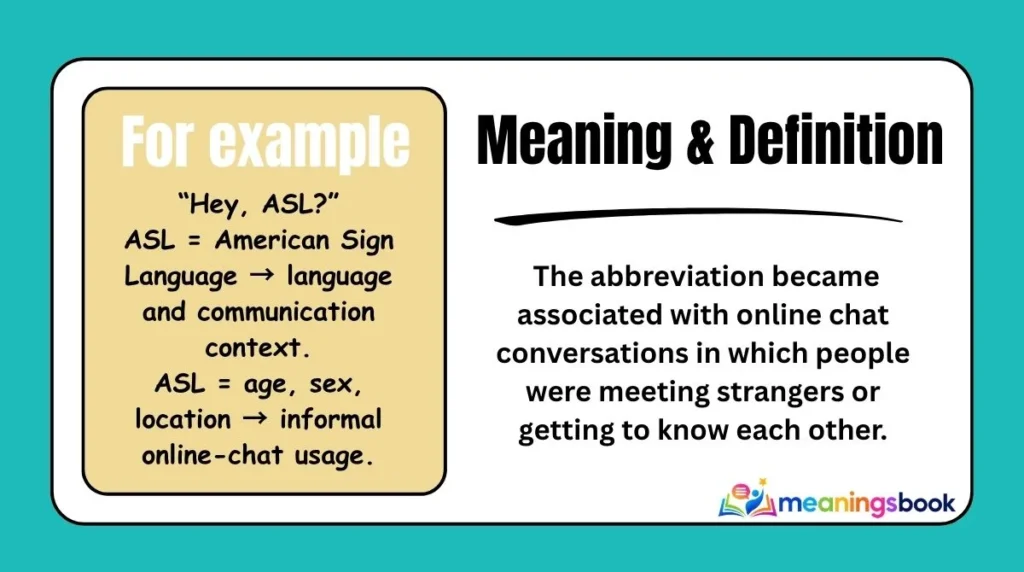
In informal internet and chat language, ASL traditionally means “age, sex, location.” It was commonly used as a quick way for someone to ask another person how old they are, their sex or gender, and where they are located. The abbreviation became associated with online chat conversations in which people were meeting strangers or getting to know each other.
For example:
“Hey, ASL?”
In that context, the person is essentially asking for basic personal information. A response might provide an age and general location, although people should avoid sharing sensitive personal information with strangers.
The second major meaning is American Sign Language, a complete natural language used primarily by many Deaf and Hearing-impaired people in the United States and parts of Canada. In this context, ASL is not slang or a texting abbreviation. It refers to a language and may appear in discussions about signing, interpreting, Deaf communities, education, accessibility, or communication.
Context is therefore essential. If someone says, “Do you know ASL?” they are probably asking whether you know American Sign Language. If someone simply writes “ASL?” in an old-fashioned online chat, they may be asking about age, sex, and location.
The abbreviation can also occur in specialized contexts with meanings specific to a particular organization or field. Those meanings should not automatically be assumed from a short message.
The key distinction
- ASL = age, sex, location → informal online-chat usage.
- ASL = American Sign Language → language and communication context.
The best interpretation depends on the conversation rather than the abbreviation alone.
Background
The “age, sex, location” meaning is strongly associated with early internet chat culture. When online communication was becoming popular, people often interacted with strangers through chat rooms and other text-based services. Short abbreviations made conversations faster and reduced the amount of typing required.
“ASL?” became a recognizable way to ask another participant for three basic pieces of information: age, sex, and location. Because these questions were particularly common when strangers were introducing themselves online, the abbreviation became part of the vocabulary of early internet conversations.
Its popularity has declined as online communication has changed. Modern social platforms usually provide profiles, usernames, photos, biographies, location indicators, and other information that can make a direct “ASL?” question less necessary. Younger users may also be more familiar with newer expressions and may interpret ASL differently.
The other major meaning, American Sign Language, has a completely separate history. ASL as a language is not derived from internet slang. It is the established abbreviation for American Sign Language, a natural signed language with its own linguistic structure.
This distinction is important because the same three letters can represent either an old internet-chat expression or the name of a language.
It is also worth noting that abbreviations evolve. A term that was immediately recognizable in one period of internet culture may be unfamiliar or ambiguous to later users. As a result, someone who receives “ASL?” today may reasonably ask what the sender means.
There is no need to assume that every use of ASL refers to “age, sex, location.” Likewise, it would be inaccurate to assume every use refers to American Sign Language. The surrounding words provide the strongest clue.
Usage in Different Contexts
In Chat
In older informal chat environments, “ASL?” was commonly used as a short personal-information question. Someone might use it near the beginning of a conversation with a stranger.
Example:
“Hi! ASL?”
Here, the intended meaning is likely “What is your age, sex, and location?”
In contemporary messaging, this usage may sound dated or unusual, depending on the people involved.
On Social Media
On social media, ASL is more context-dependent. A post discussing signing, interpreters, Deaf culture, or accessibility is likely using ASL to mean American Sign Language.
For example:
“I’m learning ASL this year.”
Here, there is no reasonable connection to “age, sex, location.” The subject clearly concerns a language.
A random comment containing “ASL?” could potentially use the older chat meaning, but you should consider the account, post, and conversation before interpreting it.
In Professional Fields
In professional communication, ASL should not automatically be interpreted as slang. It may refer to American Sign Language or another field-specific abbreviation. Workplace acronyms can vary significantly between industries and organizations.
If the meaning is unclear in a professional setting, asking for clarification is usually better than guessing.
In Casual Conversations
Among friends, the intended meaning depends heavily on context. A discussion about learning sign language would make “ASL” straightforward. A conversation about meeting people online could make the older “age, sex, location” interpretation more plausible.
The main lesson is simple: ASL does not have one universal meaning in every conversation.
Meaning in Chat, WhatsApp, Instagram, and TikTok
The platform itself does not determine what ASL means. The surrounding conversation does.
On WhatsApp, someone might use ASL in a private message. If the conversation is about meeting someone online or introducing yourselves, “ASL?” could refer to age, sex, and location.
For example:
“We haven’t introduced ourselves yet. ASL?”
However, if the conversation is about languages or signing, ASL probably means American Sign Language.
Instagram comments and direct messages can contain both slang and educational terminology. A comment such as:
“I’ve been studying ASL for two years.”
clearly refers to American Sign Language.
A direct message from an unfamiliar person saying only:
“ASL?”
could have the older chat meaning.
TikTok
TikTok uses a large variety of abbreviations, and ASL may appear in videos or comments about signing and Deaf culture. In that environment, American Sign Language is often the more relevant interpretation when the content is about communication.
At the same time, an individual user could use the abbreviation in its older internet-chat sense.
Why context matters
A three-letter abbreviation does not contain enough information by itself to guarantee the intended meaning. Look at:
- What the conversation is about
- Who sent the message
- What words appear before or after ASL
- Whether the message is a question
- Whether the topic involves language or online introductions
These clues usually make the intended meaning much easier to identify.
Meaning in Physics, Medical, and Aircraft Terminology
ASL does not have one universal technical meaning across physics, medicine, and aviation. Specialized abbreviations can vary by field, institution, or specific technical context, so the abbreviation should not be assigned a technical definition without supporting context.
Physics
ASL is not a universally standard standalone abbreviation in basic physics terminology. If it appears in a physics paper, class note, diagram, or technical document, its meaning should be determined from that specific material.
Medical Terminology
ASL can appear in medical or scientific contexts, but the abbreviation alone does not establish one universal medical definition. Medical abbreviations can have multiple meanings, and professional documents often define abbreviations based on their particular subject.
Therefore, do not assume that a medical use of ASL means “age, sex, location” or American Sign Language without examining the context.
Aircraft and Aviation
ASL is not a universally recognized aviation abbreviation with one meaning that should automatically be applied to every aircraft-related message. Aviation terminology contains many standardized abbreviations, but specific documents, operators, and systems may use abbreviations differently.
If you encounter ASL in an aviation manual, flight document, chart, or technical discussion, use the surrounding terminology or the document’s abbreviation list to determine its intended meaning.
Important: The well-established everyday interpretations discussed in this article should not be forced into specialized technical contexts.
Common Misconceptions
One common misunderstanding is assuming that ASL always means American Sign Language. This is often correct when the topic involves signing or Deaf communication, but it does not explain every use in online conversations.
Another misconception is that “ASL?” always means “Are you asking about American Sign Language?” In older chat-style communication, it traditionally meant age, sex, location.
People may also assume that “ASL” is always slang. It is not. American Sign Language is the name of a natural language, while “age, sex, location” is an informal online-chat abbreviation.
Another issue is confusing the older abbreviation with a request that is automatically appropriate to answer. Even when someone asks for age, sex, and location, you are not obligated to provide personal information. This is especially important when the person is a stranger.
Finally, users sometimes expect every abbreviation to have exactly one fixed definition. Internet language does not work that way. Meanings can change by platform, generation, community, and subject.
Similar Terms & Alternatives
Several abbreviations or expressions can be confused with ASL, although they do not necessarily mean the same thing.
- A/S/L — An alternative written form of “age/sex/location,” particularly associated with older online chat.
- Age — Refers only to how old someone is.
- Location — Refers to where someone is located, without necessarily asking for other personal details.
- American Sign Language — The language meaning of ASL.
- DM — “Direct message,” referring to a private social-media message rather than personal information.
- IRL — “In real life,” commonly used when distinguishing offline life from online interaction.
- BTW — “By the way,” a general texting abbreviation with no connection to ASL’s meanings.
- IDK — “I don’t know,” another common texting abbreviation.
The closest direct alternative to the older chat meaning is A/S/L, while the closest full expression for the language meaning is simply American Sign Language.
How to Respond to It
How you respond depends on which meaning the sender intended.
If someone asks “ASL?” and clearly means age, sex, and location, you can answer only what you are comfortable sharing.
For example:
“I’m in my 20s and based in Pakistan.”
You do not have to provide an exact address or other sensitive information.
If you are unsure, a simple clarification works well:
“Do you mean age, sex, and location?”
If the conversation is about signing and someone asks whether you know ASL, you might respond:
“Do you mean American Sign Language?”
Or, if you know it:
“Yes, I know some ASL.”
If you do not know it:
“No, I don’t know ASL, but I’d like to learn.”
When the sender is a stranger, especially online, it is reasonable to keep your answer general. A short clarification can prevent both misunderstanding and unnecessary disclosure of personal information.
Differences from Similar Words
| Term | Meaning | Typical context | Tone |
|---|---|---|---|
| ASL | Age, sex, location | Older online chats | Informal |
| A/S/L | Age, sex, location | Internet chat | Informal |
| ASL | American Sign Language | Language and communication | Neutral/professional |
| Age | How old someone is | General conversation | Neutral |
| Location | Where someone is | Travel, social, general conversation | Neutral |
| IRL | In real life | Online conversations | Informal |
| DM | Direct message | Social media | Informal |
The most important difference is between ASL as an internet abbreviation and ASL as American Sign Language. They are unrelated meanings that happen to share the same abbreviation.
The form A/S/L can make the older chat meaning easier to recognize because the slash-separated letters visually represent three separate questions. Nevertheless, modern users may still need context to understand it.
Tone also matters. “ASL?” from a stranger can feel abrupt because it asks for personal information immediately. “Do you know ASL?” is usually a completely different question about language ability.
Relevance in Online Conversations & Dating Apps
ASL can occasionally appear in online conversations where people are getting to know one another. The older “age, sex, location” meaning fits particularly well with the early internet culture of meeting strangers through text-based communication.
In modern dating apps, however, users typically have profiles containing information that older chat users had to ask for directly. Consequently, the abbreviation may feel old-fashioned or unusual when used in a contemporary dating conversation.
If someone sends:
“ASL?”
on a dating or social platform, the person may be asking for basic personal information. You can clarify the meaning before answering if you are uncertain.
Context also changes the tone. From a friend, the question may be casual. From a stranger, it may be an attempt to learn personal details quickly. You should decide how much information you want to share.
On social platforms, ASL can instead refer to American Sign Language, especially when the discussion involves signing, accessibility, Deaf communities, education, or language learning.
Therefore, don’t interpret the abbreviation based solely on the platform. Read the surrounding message and consider the relationship between you and the sender.
Frequently Asked Questions
What does ASL mean in text?
ASL in text commonly means “age, sex, location” when used as an informal internet-chat abbreviation. It can also mean American Sign Language, especially in conversations about signing, language, or Deaf communication. The exact meaning depends on the subject and wording of the conversation.
What does ASL mean in chat?
In older or informal online chat, ASL usually means “age, sex, location.” It is a short way of asking someone for basic personal information. If the conversation is about signing or language, however, ASL may mean American Sign Language instead.
Is ASL a slang term?
ASL can function as an informal internet abbreviation, particularly when it means “age, sex, location.” However, ASL is not inherently slang because it is also the established abbreviation for American Sign Language. The context determines whether the letters are being used as chat shorthand or as a language name.
What does ASL mean on social media?
ASL on social media can mean American Sign Language or, less commonly in modern usage, “age, sex, location.” A post about signing, Deaf culture, or language almost certainly points toward American Sign Language, while a direct “ASL?” message may use the older chat meaning.
How do you respond to ASL in a text?
First determine whether the sender means “age, sex, location” or American Sign Language. If you are unsure, ask, “What do you mean by ASL?” If they mean personal information, share only details you are comfortable disclosing. You can also give a general location rather than a precise one.
Can ASL have different meanings?
Yes, ASL can have different meanings depending on context. The two most recognizable interpretations are “age, sex, location” in informal online chat and American Sign Language in language-related conversations. Specialized fields may also use abbreviations differently, so technical contexts should be interpreted from their specific documentation.
Does ASL mean age, sex, and location?
Yes, ASL can mean “age, sex, location,” particularly in older internet-chat usage. It was used as a quick way to ask someone those three basic details. Today, the expression is less prominent than it once was, and some people may instead understand ASL as American Sign Language.
Is ASL still used in texting?
ASL can still appear in texting, but its “age, sex, location” meaning is more associated with older internet-chat culture than with everyday modern texting. American Sign Language remains a current and important meaning. Because the abbreviation can be ambiguous, checking the surrounding conversation is the safest way to interpret it.
Conclusion
ASL can have two very different meanings in online communication. In older internet-chat language, it commonly stands for “age, sex, location,” a brief question used to learn basic information about another person. In conversations about language, communication, accessibility, or Deaf communities, ASL commonly means American Sign Language.
The context surrounding the abbreviation is therefore essential. A simple “ASL?” from someone in an informal chat may have a completely different meaning from “I’m learning ASL” in a discussion about languages. Social media, WhatsApp, Instagram, TikTok, and dating platforms can all contain either interpretation.
If someone sends ASL and you are uncertain, there is nothing wrong with asking what they mean. And when the abbreviation requests personal information, remember that you can choose what you are comfortable sharing. Ultimately, understanding the conversation rather than relying on the abbreviation alone is the best way to interpret ASL accurately.

I am Ethan Whitmore, an English teacher and vocabulary enthusiast who explains words, phrases, and meanings in text through simple examples to make English easier for everyone.