If you have received a message containing “WTW,” you may have wondered what the abbreviation means or how you are supposed to respond.
Short forms like this are common in texting, social media comments, group chats, and direct messages because they let people communicate quickly without typing a full sentence.
The meaning can sometimes depend on the surrounding conversation, the relationship between the people involved, and the platform where it appears.
In everyday online communication, WTW is most commonly used as a casual way to ask about someone’s plans or suggest getting together. It is especially common when someone wants to know what another person is doing, whether they are available, or what is happening next.
Understanding the abbreviation makes it easier to follow informal conversations and respond naturally. The sections below explain its primary meaning, common uses, possible misunderstandings, and how to reply when someone sends you “WTW.”
Quick Answer
WTW meaning in text is most commonly “What’s the word?” It is a casual expression used in chats and social media to ask what is happening, what someone is planning, or whether they have any news. Depending on context, it can function similarly to “What’s up?” or “What’s going on?”
Meaning & Definition
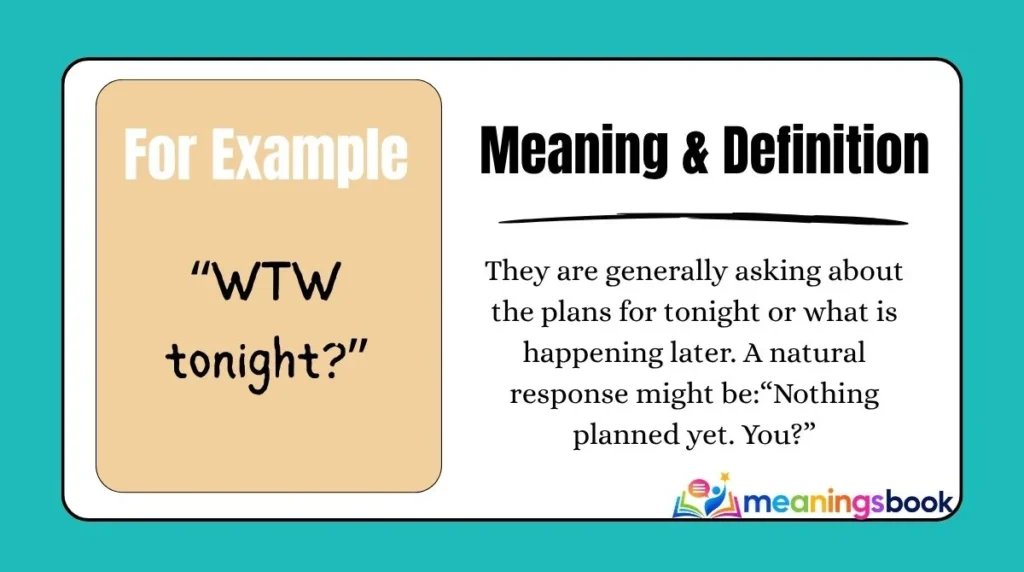
WTW most commonly stands for “What’s the word?” in informal texting and online conversations. Although the literal phrase refers to “the word,” it is generally not a question about vocabulary. Instead, it is a casual way of asking someone what is happening or what they have going on.
For example, if a friend texts:
“WTW tonight?”
They are generally asking about the plans for tonight or what is happening later. A natural response might be:
“Nothing planned yet. You?”
WTW can also be used as a general conversation starter. Someone might send only:
“WTW?”
In that situation, they may simply be asking what is going on, whether there is any news, or what you are up to.
The expression is informal and usually appears between friends, acquaintances, or people who already communicate casually. It is not normally appropriate for formal business correspondence, academic writing, or professional documents.
The exact interpretation can shift slightly depending on the surrounding words. For example, “WTW with you?” can resemble “What’s up with you?” while “WTW for Friday?” may be asking about plans or arrangements for Friday.
It is therefore useful to read the entire message rather than treating the three letters as having only one rigid interpretation. In most everyday texting situations, however, “What’s the word?” is the safest primary interpretation.
Background
The abbreviation WTW developed as part of the broader culture of shortening phrases in digital communication. Text messaging, instant messaging, and social media encourage people to communicate quickly, so familiar expressions are often reduced to a few letters.
WTW is based on the informal phrase “What’s the word?” The phrase itself can be used conversationally to ask for information, news, plans, or an update. Turning it into an abbreviation makes it convenient for fast messaging.
There is not a single clearly documented moment when WTW was officially created or standardized. Like many texting abbreviations, it developed through informal usage rather than through a formal organization or dictionary process. Different online communities can also use the same abbreviation somewhat differently.
Its meaning is easiest to understand when you consider the conversational purpose behind it. When someone asks “What’s the word?” in casual speech, they are often looking for an update: What is happening? What are the plans? Is there anything new? The abbreviated version carries the same general idea.
WTW belongs to the same general family of informal expressions as “WYD” (“What are you doing?”), “WBU” (“What about you?”), and “WYA” (“Where you at?”). However, these abbreviations are not interchangeable in every situation.
Because internet slang changes over time, people can occasionally use WTW with slightly different intentions. The surrounding message remains the best guide. If someone writes “WTW later?” they are probably interested in plans, while a standalone “WTW?” may simply be an invitation to start a conversation.
Usage in Different Contexts
The meaning and tone of WTW can change depending on where and how it is used.
In Chat
In private messages, WTW is generally a relaxed conversation opener. A friend might send “WTW?” to find out what is happening or whether you have plans. It can also be followed by a specific time or activity.
Example:
“WTW after work?”
This likely asks what the plans are after work.
On Social Media
WTW can appear in comments, captions, replies, or direct messages. Someone may use it to ask about upcoming plans or invite further conversation.
For example:
“WTW this weekend?”
The person is likely asking what is happening over the weekend.
In Casual Conversation
Among friends, WTW can be friendly and informal. It may communicate curiosity without sounding particularly serious.
A message such as:
“WTW with you?”
can be understood as asking for an update or checking what someone is doing.
In Professional Settings
WTW is generally not a standard professional abbreviation. Using it in a formal email, report, application, or business document could make the message seem overly casual or unclear.
If you need to communicate professionally, it is better to write the full question, such as “What are the plans?” or “What is the update?”
The main distinction is therefore tone. WTW is most natural when the conversation is informal and the participants already understand casual texting language.
Meaning in Chat, WhatsApp, Instagram, and TikTok
WTW can be used across many popular communication platforms, including WhatsApp, Instagram, TikTok, Messenger, and ordinary text messaging. The underlying idea usually remains the same: asking what is happening, what the plans are, or what someone has to say.
On WhatsApp, a friend might write:
“WTW tonight?”
This could be a casual request for information about the evening’s plans.
On Instagram, WTW may appear in a direct message after someone sees your story:
“WTW later?”
They may be asking whether you have plans later.
On TikTok, it can appear in comments or private messages, particularly when users are communicating casually. The exact interpretation still depends on the surrounding text.
The abbreviation can also be used without a question mark:
“WTW”
In a casual conversation, this can still function as an invitation for the other person to provide an update or start talking.
The best response depends on what the sender appears to be asking. If they seem interested in your plans, tell them what you are doing. If the message appears to be a general check-in, you can respond conversationally.
For example:
WTW?
“Not much, just relaxing. What about you?”
WTW this weekend?
“I’m free Saturday. You got anything planned?”
WTW tonight?
“Nothing yet. Want to do something?”
These examples show why context matters. The same three letters can lead to slightly different responses depending on what follows them.
Meaning in Physics, Medical, and Aircraft Terminology
WTW does not have one universally recognized meaning in everyday physics, medical terminology, or aircraft terminology that should automatically replace its common texting interpretation.
Physics
WTW is not a standard everyday physics abbreviation with a single widely recognized meaning comparable to terms such as velocity, wavelength, or force. If you encounter WTW in a physics document, its meaning would need to be determined from that particular document or field.
Medical Terminology
WTW is not generally recognized as a standard medical abbreviation that should automatically be interpreted one specific way. Medical abbreviations can be highly context-dependent, so unfamiliar abbreviations in clinical material should not be interpreted based solely on texting slang.
Aircraft and Aviation
WTW is not a universally standard aviation expression in the same way as many established aircraft and flight abbreviations. If it appears in an aviation-related document, manual, communication, or technical context, the surrounding material should be checked for the intended definition.
This distinction is important because an abbreviation used in a text message does not necessarily have the same meaning in a specialized field.
If someone sends you “WTW?” in a normal personal conversation, “What’s the word?” is the most useful interpretation. If you encounter WTW in a technical document, however, you should not automatically assume that the writer intended the texting slang.
Common Misconceptions
One common misconception is that WTW always means exactly the same thing in every conversation. In reality, abbreviations can be interpreted according to context.
Another misunderstanding is assuming that WTW is asking about a literal “word.” In ordinary texting, the phrase “What’s the word?” is generally an informal expression for asking what is happening or what someone has going on.
People can also confuse WTW with other short forms, particularly WYD and WYA. These abbreviations have different primary meanings:
- WTW — commonly “What’s the word?”
- WYD — “What are you doing?”
- WYA — “Where you at?”
- WBU — “What about you?”
There can be overlap. Someone using WTW may be interested in what you are doing, even though that is not the literal expansion of the abbreviation.
Another misconception is that WTW is suitable for every type of communication. It is primarily informal. In a professional email, writing “What are the plans?” is much clearer than using an unexplained abbreviation.
Finally, the tone can be misunderstood. WTW is usually casual rather than aggressive or serious. However, tone always depends on the person sending it and the conversation surrounding it.
Similar Terms & Alternatives
Several abbreviations and phrases can serve a similar conversational purpose:
| Term | Common meaning | Typical use |
|---|---|---|
| WTW | What’s the word? | Asking what is happening or what the plans are |
| WYD | What are you doing? | Asking about someone’s current activity |
| WYA | Where you at? | Asking someone’s location |
| WBU | What about you? | Returning a question |
| Wassup / What’s up? | What is happening? | Casual greeting or check-in |
| What’s going on? | Asking for an update | General conversation |
| What are the plans? | Asking about arrangements | Planning or social situations |
| Any plans? | Asking about availability | Casual invitations or scheduling |
These expressions are related but not identical.
For instance, WYD focuses more directly on what someone is currently doing, whereas WTW can be broader and may ask about plans, news, or what is happening.
Similarly, WYA specifically concerns location. If someone asks “WYA?”, responding with your plans instead of your location may not answer their actual question.
Understanding these distinctions helps prevent awkward replies, especially when several abbreviations appear together in the same conversation.
How to Respond to It
The best response to WTW depends on what the sender seems to mean.
If they are simply checking in, you can answer casually:
“Not much, what’s up?”
If they are asking about your plans:
“I’m free tonight. What did you have in mind?”
If they ask about a particular day:
“I haven’t made any plans yet.”
If you are interested in meeting:
“I’m down. What are you thinking?”
If you are busy:
“I’ve already got plans tonight, maybe another day.”
You can also turn the question back to them:
“Nothing much on my end. WTW with you?”
This works particularly well when the original message is simply “WTW?”
If you are unsure what they mean, there is nothing wrong with asking:
“What do you mean by WTW?”
That can be useful when you are speaking with someone who frequently uses different slang or abbreviations.
In most casual situations, you do not need a complicated response. A short answer about what you are doing or what your plans are will usually keep the conversation moving naturally.
Differences from Similar Words
WTW is sometimes confused with other texting abbreviations because many of them are used to start conversations.
WTW vs. WYD:
WTW commonly asks what is happening or what the plans are, while WYD directly asks what someone is doing.
WTW vs. WYA:
WTW is generally about plans, updates, or what is happening. WYA asks where someone is.
WTW vs. WBU:
WTW starts or requests an update. WBU means “What about you?” and normally responds to information someone has already shared.
WTW vs. “What’s up?”:
These can be similar in casual conversation. Both can function as informal check-ins, although WTW literally comes from “What’s the word?”
The tone of all these expressions is generally informal, but the intended question differs. Paying attention to the words surrounding the abbreviation can make the meaning much clearer.
Relevance in Online Conversations & Dating Apps
WTW can be especially useful in informal online conversations because it is short, flexible, and easy to type. Someone may use it when reconnecting with a friend, starting a conversation after seeing a social media post, or trying to find out whether another person is available.
On dating apps, a message such as:
“WTW tonight?”
could be an informal way of asking about your plans or potentially opening the door to making plans together.
However, WTW alone does not necessarily indicate romantic interest. The relationship between the people and the rest of the conversation matter much more. A friend, coworker you know socially, acquaintance, or dating-app match could all use the same abbreviation.
For example:
“WTW this weekend?”
could simply be a question about availability.
If the conversation has already been flirtatious, the same message might be intended as an invitation to meet. Context determines the tone.
When communicating online, it is also important not to assume too much from a short abbreviation. If someone’s intention is unclear, a simple follow-up question can prevent misunderstanding.
In general, WTW is best understood as a casual conversation starter or question about what is happening, what someone has planned, or what is going on.
Frequently Asked Questions
What does WTW mean in text?
WTW most commonly means “What’s the word?” in text messages. It is an informal expression used to ask what is happening, what someone has planned, or whether there is any news. Depending on context, it can be similar to asking “What’s up?” or “What’s going on?”
What does WTW mean in chat?
In chat, WTW usually means “What’s the word?” and is used as a casual way to check in with someone. A person may send “WTW?” when they want to know what is happening or invite you to share your plans. The surrounding conversation can clarify the exact intention.
Is WTW a slang term?
Yes, WTW is commonly used as an informal texting and internet abbreviation. It is associated with casual communication rather than formal writing. Friends and people communicating through messages or social media may use it because it is quicker than writing the complete phrase.
What does WTW mean on social media?
On social media, WTW generally means “What’s the word?” It can be used in comments, direct messages, or casual posts to ask what is happening or what someone’s plans are. The intended meaning can vary slightly depending on the sentence and relationship between the people communicating.
How do you respond to WTW?
You can respond to WTW by sharing what you are doing or what your plans are. For example, you could say, “Not much, what about you?” or “I’m free tonight—what did you have in mind?” If the meaning is unclear, asking the sender what they mean is also perfectly reasonable.
Can WTW have different meanings?
WTW can have different interpretations in different contexts, but “What’s the word?” is its common meaning in casual texting. Specialized industries or individual communities may use abbreviations differently. Therefore, technical or professional contexts should be interpreted using the surrounding material rather than automatically applying texting slang.
Does WTW mean “what’s up”?
WTW can function similarly to “What’s up?” in casual conversation, although its common expansion is “What’s the word?” Both can be used as informal check-ins. The difference is that WTW may also be used specifically to ask about plans, updates, or what is happening.
What does WTW mean from a girl or guy?
WTW has the same basic meaning regardless of whether it comes from a girl or a guy. It usually asks what is happening, what your plans are, or what is going on. The message itself does not automatically indicate flirting or romantic interest; the broader conversation provides the relevant context.
Conclusion
WTW is a common informal abbreviation used in texting and online conversations. Its most widely understood meaning is “What’s the word?”, a casual expression that can ask what is happening, what someone has planned, or whether there is any news. It can work as a simple conversation starter and may appear in text messages, WhatsApp chats, Instagram DMs, TikTok interactions, and other social platforms.
Although WTW is usually straightforward, context still matters. A message such as “WTW?” may be a general check-in, while “WTW tonight?” is more likely to concern plans. It should also not be confused with abbreviations such as WYD or WYA, which ask different questions.
When you receive WTW, a relaxed response about your plans or what you are doing is usually appropriate. If the abbreviation appears in a specialized professional or technical context, do not automatically assume the texting meaning. As with most internet slang, the surrounding conversation is the best guide to interpretation.

I am Ethan Whitmore, an English teacher and vocabulary enthusiast who explains words, phrases, and meanings in text through simple examples to make English easier for everyone.