If you have seen “ISTG” in a text, comment, or social media post, you may have wondered whether it is an abbreviation, slang term, or something more technical.
In everyday online communication, ISTG is usually used to emphasize that someone is being serious, frustrated, surprised, or completely honest. It often appears when a person wants their statement to sound stronger than a sentence would.
You may encounter it in text messages, group chats, Instagram comments, TikTok captions, memes, and casual conversations. People search for the meaning because abbreviations can be context-dependent, especially when they are written without punctuation or explanation.
Understanding the tone behind ISTG is just as useful as knowing its literal expansion. In this guide, you will learn what ISTG means, how people use it in different settings, what it does and does not mean in technical fields, and how you can respond naturally when someone sends it.
Quick Answer
ISTG means “I swear to God” in text. It is a common internet and texting abbreviation used to emphasize that someone is serious, telling the truth, frustrated, or strongly reacting to something. The exact tone depends on context, but it is usually informal and conversational.
Meaning & Definition
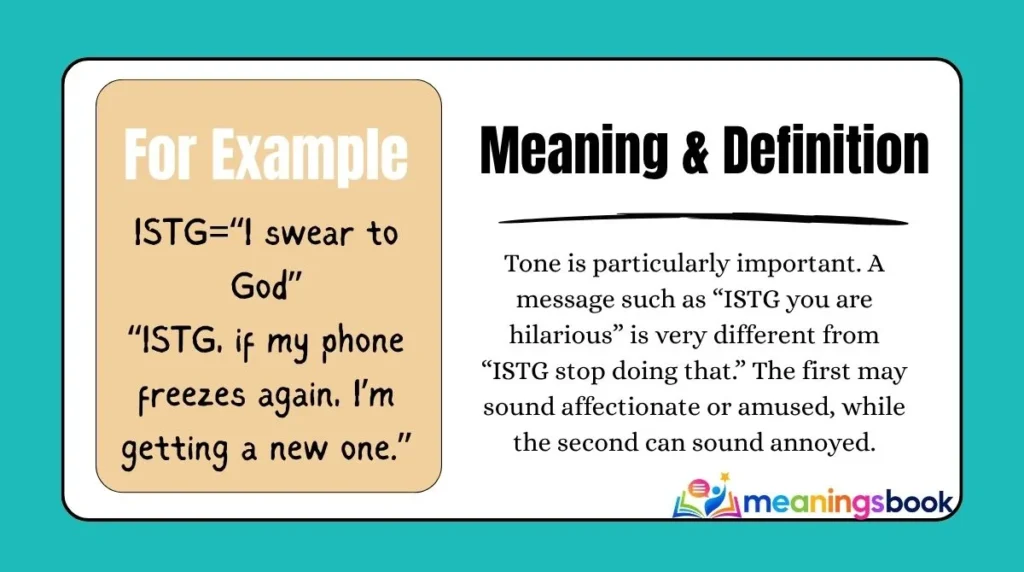
ISTG is an abbreviation for “I swear to God.” It is primarily used in informal digital communication to add emphasis to a statement. When someone writes ISTG, they are generally trying to communicate strong conviction, sincerity, frustration, disbelief, annoyance, or emotional intensity.
For example, someone might write:
“ISTG, I left my keys on the table.”
Here, the person is emphasizing that they genuinely believe or remember leaving the keys there. The abbreviation can make the statement sound more forceful than simply saying, “I left my keys on the table.”
The expression can also introduce a complaint or warning:
“ISTG, if my phone freezes again, I’m getting a new one.”
In this case, the speaker is not necessarily making a literal religious statement. Instead, ISTG functions as an emotional intensifier. It signals that the person is strongly expressing their feelings.
The meaning can change slightly depending on the surrounding words. ISTG may communicate sincerity when someone wants to convince another person that they are telling the truth. It can express irritation when someone has become frustrated. It can also be humorous or exaggerated when used among friends.
Tone is particularly important. A message such as “ISTG you are hilarious” is very different from “ISTG stop doing that.” The first may sound affectionate or amused, while the second can sound annoyed.
ISTG is therefore best understood as informal internet shorthand for emphasizing a statement or emotional reaction. It is common in conversations where people already feel comfortable using abbreviations, slang, and casual language.
Although the words behind the abbreviation contain a religious reference, many people use the expression casually rather than as a formal religious statement. The surrounding conversation usually makes the intended tone clear.
Background
The phrase “I swear to God” is much older than internet slang. People have used forms of the expression in ordinary spoken and written language to emphasize sincerity, frustration, surprise, or a strong promise. ISTG is the abbreviated digital form that developed from the first letters of the words.
There is no single, universally established moment when ISTG was created or first used online. Like many texting abbreviations, it developed within a broader culture of shortening common expressions for faster communication. Early internet communities, instant messaging, texting, forums, and later social media all helped popularize abbreviated language.
Digital communication encouraged people to turn familiar phrases into compact initialisms. Expressions such as “I don’t know,” “be right back,” and “laugh out loud” also became widely recognized through abbreviations. ISTG follows the same general pattern: a familiar phrase is reduced to its initial letters.
The abbreviation became especially useful because it preserves the emotional force of the original expression while taking only four characters to type. Someone can write “ISTG” at the beginning of a message without spelling out the entire phrase.
As social media became more conversational, abbreviations moved between platforms and age groups. A term that might begin in texting or online communities can eventually appear in comments, captions, memes, gaming conversations, and everyday digital speech.
It is important not to invent a precise origin story for ISTG. The exact first person, website, message, or date responsible for the abbreviation is not reliably established. What can be said with confidence is that ISTG represents the initial letters of the established phrase “I swear to God” and is now recognized as informal internet and texting shorthand.
Its popularity also reflects a broader change in online language. Written digital communication often tries to reproduce features of spoken conversation, including emphasis, emotion, exaggeration, and conversational rhythm. ISTG can perform all of those functions in a very short form.
Usage in Different Contexts
The meaning of ISTG remains essentially the same across most casual contexts, but its tone can change significantly depending on who says it and what follows it.
Chat
In private chats, ISTG is often used to emphasize a personal statement.
“ISTG, I thought today was Friday.”
This could communicate genuine confusion or surprise.
It can also express frustration:
“ISTG, this app never works when I need it.”
Here, the abbreviation adds emotional intensity.
Social Media
On platforms such as Instagram, TikTok, X, Facebook, or similar services, ISTG can appear in comments, captions, replies, memes, and posts. Social media users often use it dramatically or humorously.
For example:
“ISTG this is the funniest video I’ve seen all week.”
The phrase does not necessarily mean the person is making a solemn promise. It can simply make the reaction feel stronger and more expressive.
Professional Fields
ISTG is generally not appropriate as standard professional terminology. In a formal email, academic paper, business report, medical document, or official communication, spelling out the intended idea clearly is usually better.
Someone might use ISTG in an informal workplace chat with close colleagues, but that is different from it being a recognized professional abbreviation.
Casual Conversations
Among friends and family, ISTG can be playful, dramatic, annoyed, affectionate, or serious.
“ISTG, you always make me laugh.”
The tone here is likely positive.
By contrast:
“ISTG, please stop sending me spoilers.”
This sounds like a stronger request or warning.
The important point is that ISTG does not automatically indicate anger. It is an emphasis marker, and the emotional meaning comes from the rest of the message.
Meaning in Chat, WhatsApp, Instagram, and TikTok
ISTG is particularly common in informal digital conversations, including messaging applications and social media. The abbreviation is useful because these platforms favor quick, conversational communication.
On WhatsApp, someone might send:
“ISTG I just saw the same person again 😂”
The phrase can emphasize surprise while the emoji makes the message playful.
In a private text conversation, a person might write:
“ISTG I’m not ignoring you. I’ve just been busy.”
Here, ISTG strengthens the person’s attempt to sound sincere.
On Instagram, ISTG can appear in comments or direct messages:
“ISTG your outfit looks amazing.”
The phrase can make a compliment sound more enthusiastic.
On TikTok, it may appear in comments reacting to a video:
“ISTG this is exactly what happens every time.”
TikTok and other short-form platforms often encourage exaggerated reactions, so ISTG can be used humorously as well as seriously.
The abbreviation can also appear in lowercase as istg. Lowercase usage usually does not change the meaning. People often type abbreviations in lowercase because casual digital communication does not always follow formal capitalization rules.
Punctuation can affect the tone, too. “ISTG.” may feel more serious or irritated than “istg 😂,” which is more likely to sound playful.
Another important factor is the relationship between the people communicating. A close friend may use ISTG dramatically without intending offense. Someone you barely know may use the same expression in a way that feels more intense.
Therefore, when interpreting ISTG on WhatsApp, Instagram, TikTok, or another platform, look at the whole message, punctuation, emojis, previous conversation, and relationship between the speakers rather than interpreting the abbreviation in isolation.
Meaning in Physics, Medical, and Aircraft Terminology
For ordinary usage, ISTG is a slang abbreviation rather than a standard technical term in physics, medicine, or aviation.
Physics
ISTG does not have a broadly recognized standard meaning in general physics terminology. If the letters appear in a physics document, they could potentially be part of a specialized notation, an institution-specific abbreviation, a variable, or an unrelated acronym. The surrounding document would be necessary to determine that meaning.
It should not automatically be interpreted as a physics term simply because the letters appear in a technical context.
Medical Terminology
ISTG is not a standard, universally recognized medical abbreviation for “I swear to God.” Medical writing uses many abbreviations, but their meanings depend on established clinical conventions and the specific document.
If ISTG appears in a medical record, research paper, prescription-related document, or healthcare discussion, it should not be assumed to have the texting meaning without checking the surrounding context or the relevant terminology used by that organization.
Aircraft and Aviation Terminology
ISTG is likewise not a standard general aviation term meaning “I swear to God.” Aviation has extensive specialized terminology and abbreviations, and a similar-looking acronym could have a completely different meaning in a particular organization or technical document.
If you encounter ISTG in an aircraft manual, aviation report, training document, or technical system, context is essential.
In short, ISTG is primarily recognized in informal online and texting language as “I swear to God.” A technical document may contain the same letters for an unrelated reason, but that would need to be established from the specific field or source rather than assumed.
Common Misconceptions
One common misconception is that ISTG always means the speaker is angry. That is not true. The abbreviation can express anger, but it can also communicate honesty, surprise, excitement, humor, disbelief, affection, or simple emphasis.
For example:
“ISTG you are so funny.”
This is likely positive and playful.
Meanwhile:
“ISTG, don’t do that again.”
This sounds much more serious or irritated.
Another misunderstanding is treating “I swear to God” as a literal religious statement every time it appears. In modern informal communication, the phrase is frequently used as an intensifier. The speaker may simply be emphasizing what they are saying rather than making a formal religious declaration.
Some readers may also assume that every acronym beginning with “IST” has the same meaning. It does not. Abbreviations must be interpreted according to context.
It is also possible to confuse ISTG with unrelated technical acronyms. The same sequence of letters can potentially appear in specialized documents, organization names, usernames, or internal terminology. In those situations, context takes priority over the common texting definition.
Another misconception is that ISTG is appropriate in every situation. Because it is informal slang, it may sound unsuitable in formal business correspondence, academic writing, official documents, or professional communication.
Finally, people sometimes interpret abbreviations too literally. If someone writes “ISTG this movie is incredible,” the practical meaning is usually closer to “I’m telling you, this movie is incredible” or “I really mean it.” The emotional emphasis matters more than a literal word-for-word interpretation.
Similar Terms & Alternatives
Several abbreviations and expressions can overlap with ISTG because they are used to emphasize sincerity, surprise, frustration, or strong emotion.
- I swear — A shorter version of the same basic expression. It can sound serious or frustrated depending on context.
- Honestly — Signals that the speaker wants to emphasize sincerity without using a swear-based expression.
- For real — Often written as “fr” and used to show agreement, seriousness, or emphasis.
- FR — Short for “for real.” It can mean “seriously,” “I agree,” or “that is genuinely true.”
- NGL — Means “not gonna lie” and introduces an honest or candid statement.
- TBH — Means “to be honest” and is commonly used before a sincere opinion.
- OMG — Means “oh my God” and usually expresses surprise, excitement, shock, or disbelief rather than emphasizing sincerity.
- I promise — A more direct alternative when someone wants to reassure another person that they are telling the truth.
- Seriously — A straightforward alternative that can communicate emphasis without using an abbreviation.
These expressions are not interchangeable in every sentence. “NGL” typically introduces an honest opinion, while ISTG emphasizes the seriousness or intensity of what is being said. “OMG” generally expresses an emotional reaction, whereas ISTG often strengthens a claim or complaint.
Understanding these differences can help you interpret messages more accurately instead of assuming every short internet expression carries the same tone.
How to Respond to It
How you respond to ISTG depends on what the person is trying to communicate. There is no special response that works in every situation.
If someone is emphasizing that they are telling the truth, you could respond:
“Okay, I believe you.”
Or:
“Haha, I know.”
If they are frustrated, acknowledging the frustration may be more appropriate:
“Yeah, I understand. That sounds annoying.”
If they are joking, you can respond casually:
“😂 I know exactly what you mean.”
If ISTG appears as part of a compliment, you might simply accept it:
“Aww, thank you!”
When the message sounds serious, avoid assuming that the person is joking. For example:
“ISTG, I’m not doing that again.”
A reasonable response might be:
“Got it. I understand.”
The best approach is to read the rest of the message first. ISTG itself mainly adds emphasis; the surrounding words tell you what the person actually wants you to understand.
If you are unsure whether the person is angry, you can also respond neutrally:
“Are you serious?”
or:
“Wait, what happened?”
This gives them an opportunity to explain their tone without creating unnecessary conflict.
Differences from Similar Words
ISTG differs from similar internet expressions mainly in purpose and emotional emphasis.
| Expression | Meaning | Typical Function |
|---|---|---|
| ISTG | I swear to God | Emphasizes sincerity, frustration, surprise, or intensity |
| NGL | Not gonna lie | Introduces an honest opinion or admission |
| TBH | To be honest | Signals straightforwardness or honesty |
| FR | For real | Shows seriousness, agreement, or genuine reaction |
| OMG | Oh my God | Expresses surprise, excitement, shock, or disbelief |
| I promise | A promise of sincerity | Reassures someone directly |
| Seriously | Emphasis | Shows that something should be taken seriously |
Consider the difference between these examples:
“NGL, that movie was good.”
The speaker is introducing an honest opinion.
“FR, that movie was good.”
The speaker is emphasizing that they genuinely agree or mean it.
“OMG, that movie was good!”
The speaker is expressing excitement or surprise.
“ISTG, that movie was good.”
The speaker is strongly emphasizing the statement, potentially because someone doubted them or because they feel strongly about it.
These distinctions are not rigid rules. Internet slang changes according to community, age, personality, and context. Still, understanding the usual function of each expression makes online conversations much easier to interpret.
Relevance in Online Conversations & Dating Apps
ISTG can appear naturally in modern online conversations because dating apps, social platforms, and messaging services often encourage informal communication. People may use abbreviations to make messages shorter, more relaxed, humorous, or emotionally expressive.
On a dating app, someone might say:
“ISTG, your profile made me laugh.”
This is likely a playful compliment.
Someone could also write:
“ISTG, we have talked about this three times.”
That version sounds more frustrated and may indicate that the conversation has become tense.
In dating conversations, relationship context matters especially strongly. The same abbreviation can sound flirtatious between two people who are already comfortable with each other but confrontational between people who have just started talking.
For example:
“ISTG you’re too funny 😂”
is likely friendly or flirtatious.
By contrast:
“ISTG, you keep disappearing.”
could signal annoyance about inconsistent communication.
Emojis, punctuation, previous messages, and the person’s usual writing style can provide important clues. A laughing emoji can soften an otherwise intense expression, while a period or repeated use of capital letters may make it feel more serious.
ISTG should therefore not be treated as a hidden dating code with one special romantic meaning. It does not automatically indicate attraction, commitment, anger, or rejection. It simply adds emphasis to whatever statement accompanies it.
If you receive ISTG on a dating app and are unsure how to interpret it, focus on the complete sentence and the ongoing conversation. The abbreviation alone usually cannot tell you exactly how the sender feels.
Frequently Asked Questions
What does ISTG mean in text?
ISTG means “I swear to God” in text messages. It is informal shorthand commonly used to emphasize sincerity, frustration, surprise, or a strong reaction. For example, “ISTG I’m telling the truth” emphasizes that the speaker wants to be believed. The expression can be serious or playful depending on the surrounding conversation.
What does ISTG mean in chat?
In chat, ISTG usually means “I swear to God.” People use it when they want to emphasize something they are saying. It can introduce a serious statement, complaint, promise-like assertion, joke, or emotional reaction. The tone depends on the words around it, as well as punctuation and emojis.
Is ISTG a slang term?
Yes, ISTG is generally considered informal internet and texting slang. It is an abbreviation rather than a formal expression used in standard professional writing. It commonly appears in texts, chats, comments, memes, and social media posts where casual language is expected.
What does ISTG mean on social media?
On social media, ISTG means “I swear to God.” Users often employ it to make reactions sound stronger or more dramatic. It may express amusement, frustration, surprise, disbelief, or sincerity. A comment such as “ISTG this is hilarious” is generally an emphatic reaction rather than a formal statement.
How do you respond to ISTG?
You can respond to ISTG according to the tone of the message. If the person is joking, a humorous response may work; if they are frustrated, acknowledging their feelings may be better. Simple replies such as “I believe you,” “I know 😂,” or “What happened?” can work depending on the situation.
Can ISTG have different meanings?
ISTG normally means “I swear to God” in informal online communication, but the same letters could theoretically represent something else in a specialized organization, document, or technical field. Context is therefore important. In ordinary texting and social media, however, the slang meaning is the overwhelmingly relevant interpretation.
Does ISTG mean someone is angry?
Not necessarily. ISTG can communicate anger or frustration, but it can also express excitement, honesty, surprise, humor, or affection. Compare “ISTG, stop doing that” with “ISTG you are hilarious.” The first sounds annoyed, while the second is likely playful. The surrounding words determine the emotional tone.
Is ISTG appropriate for professional messages?
ISTG is usually best avoided in formal professional communication because it is casual slang. In a business email, report, academic document, or official message, clearer wording such as “I assure you,” “I strongly believe,” or “I am certain” is generally more appropriate.
Conclusion
ISTG is a common informal abbreviation meaning “I swear to God.” In texts, chats, and social media, people use it mainly to add emphasis to what they are saying. It can communicate sincerity, frustration, surprise, excitement, disbelief, humor, or another strong emotional reaction.
The abbreviation is not automatically a sign of anger, and it does not necessarily represent a literal religious statement. In many online conversations, it simply functions as an intensifier that makes a sentence sound stronger or more expressive.
Context is the key to interpreting it correctly. The words that follow ISTG, punctuation, emojis, and the relationship between the people communicating can all influence its tone. It is also primarily informal slang, so it should not automatically be treated as a recognized term in physics, medicine, aviation, or other professional fields.
If you encounter ISTG in a message, read the complete sentence rather than focusing on the abbreviation alone. In everyday texting and online communication, the intended meaning is usually clear from the surrounding conversation.

I am Ethan Whitmore, an English teacher and vocabulary enthusiast who explains words, phrases, and meanings in text through simple examples to make English easier for everyone.