If someone sends you “ion” in a text message, you may wonder whether it is a typo, an abbreviation, or a piece of internet slang. In casual digital communication, “ion” is commonly used as a shortened form of “I don’t.”
It is especially associated with informal texting, social media, and conversational messages where people write words the way they sound. For example, someone might say, “Ion know what you mean,” which means “I don’t know what you mean.”
The expression can seem confusing because “ion” also has an entirely different and well-established meaning in science. In physics and chemistry, an ion is an electrically charged atom or molecule. Therefore, the surrounding words are important when interpreting it.
Understanding the difference between the texting form and the scientific term can help you avoid misunderstanding a message. This guide explains what “ion” means in texting, how people use it online, what it means in other fields, and how you can respond naturally.
Quick Answer
What does ion mean in text? It usually means “I don’t” in informal texting and online conversations. People use “ion” as a casual phonetic shortening, particularly in social media messages and slang-heavy chats. For example, “ion know” means “I don’t know.” In scientific writing, however, ion has a completely different meaning.
Meaning & Definition
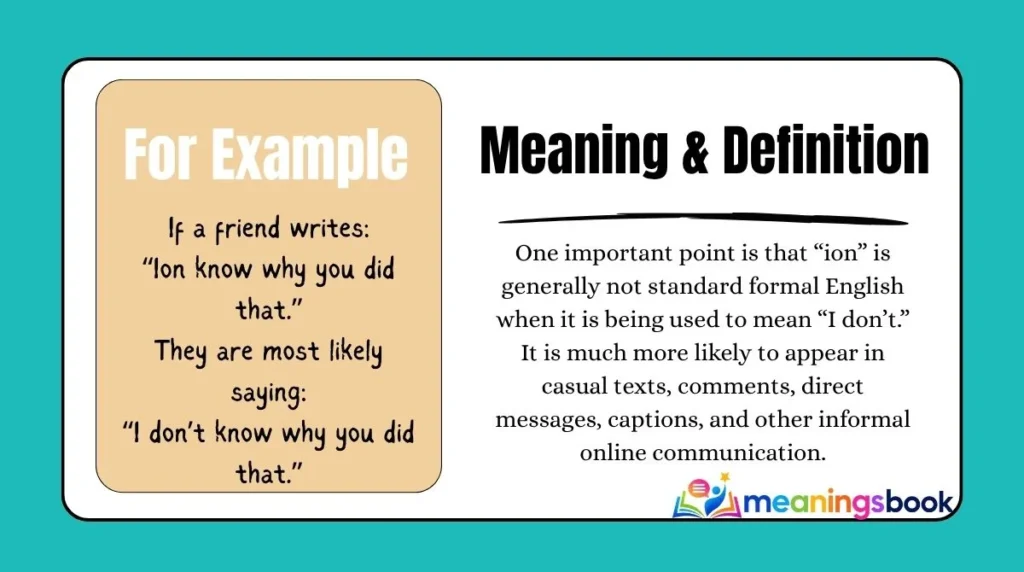
In text messages and online conversations, “ion” commonly means “I don’t.” It is an informal expression created by representing the way the phrase can sound when spoken quickly. Rather than typing the full phrase “I don’t,” some people use “ion” as a shorter, more conversational form.
The most common pattern is “ion + verb.” For example:
- “Ion know” = “I don’t know”
- “Ion want that” = “I don’t want that”
- “Ion think so” = “I don’t think so”
- “Ion care” = “I don’t care”
- “Ion remember” = “I don’t remember”
The exact tone depends on the rest of the message. It can sound relaxed, casual, humorous, dismissive, or simply conversational. The word itself does not automatically indicate a particular emotion.
One important point is that “ion” is generally not standard formal English when it is being used to mean “I don’t.” It is much more likely to appear in casual texts, comments, direct messages, captions, and other informal online communication.
For example, if a friend writes:
“Ion know why you did that.”
They are most likely saying:
“I don’t know why you did that.”
Similarly:
“Ion wanna go.”
means:
“I don’t want to go.”
The spelling is intentional in slang-oriented communication rather than necessarily being a typing mistake. However, context still matters. If the conversation concerns chemistry, physics, batteries, electricity, or another scientific subject, “ion” may be referring to the scientific concept rather than the texting expression.
In short, when “ion” appears in an ordinary personal message, interpreting it as “I don’t” is usually the most natural reading.
Background
The texting use of “ion” is best understood as an example of informal phonetic spelling. In digital conversations, people frequently shorten words, remove sounds, or spell expressions according to how they are pronounced in everyday speech. This makes messages faster and can also communicate a particular conversational style.
It is difficult to assign one precise origin or invention date to this use of “ion.” Informal slang develops organically through speech, communities, music, social interaction, and online communication rather than always having a clearly documented starting point. Therefore, it would be inaccurate to claim that one particular person, website, or platform invented the texting meaning.
The spelling reflects a pronunciation in which the sounds of “I don’t” can be compressed during casual speech. Written internet slang often captures these kinds of shortened pronunciations. Similar processes can be seen in expressions such as “gonna” for “going to” or “wanna” for “want to,” although each expression has its own history and usage patterns.
Social media and messaging have made phonetic and abbreviated writing much more visible. People communicate quickly through short messages, comments, captions, and direct messages, so informal spellings can spread between communities.
It is also important not to confuse the slang use with the scientific word ion, which is much older and unrelated in meaning. The scientific term describes an atom or molecule with an electrical charge. The similarity in spelling is simply a potential source of confusion.
Therefore, the texting meaning should be treated as informal internet language rather than a formal dictionary-style replacement for “I don’t.” Its use depends heavily on the speaker, community, and conversation.
Usage in Different Contexts
The meaning and tone of “ion” can change depending on where you encounter it. Although “I don’t” is the common interpretation in informal digital communication, the surrounding words determine exactly what the person is communicating.
Chat
In private chats, “ion” is often used to make a message sound relaxed and conversational. Someone might write, “Ion know what happened,” simply instead of “I don’t know what happened.” Friends who already communicate informally may use it frequently.
Social Media
On social media, “ion” can appear in comments, captions, replies, and direct messages. It may be used to express disagreement, uncertainty, lack of interest, or simply a statement of what the person does not know or want.
For example:
“Ion see the problem.”
This generally means:
“I don’t see the problem.”
The tone comes from the entire statement rather than from “ion” alone.
Professional Fields
In professional communication, “ion” should be interpreted carefully. If it appears in a casual message between coworkers, it might still mean “I don’t.” However, in technical writing, it can refer to the scientific term ion.
For example, a chemistry document discussing charged particles is clearly using the scientific meaning.
Casual Conversations
In casual conversations, “ion” can function as a direct substitute for “I don’t.” The expression is particularly natural when followed by verbs such as “know,” “want,” “think,” “care,” or “remember.”
Because it is informal, it may not be appropriate for formal emails, academic papers, business reports, or professional documents.
The safest approach is to look at the words around “ion.” If the sentence resembles ordinary conversation, “I don’t” is likely intended. If the subject is chemistry, physics, electricity, or another technical area, the scientific meaning may be intended instead.
Meaning in Chat, WhatsApp, Instagram, and TikTok
Across messaging and social platforms, “ion” is generally used as an informal way to write “I don’t.” The basic meaning remains the same, but the tone can vary depending on the platform and relationship between the people communicating.
On WhatsApp, for example, a friend might write:
“Ion know what time we’re leaving.”
That simply means:
“I don’t know what time we’re leaving.”
On Instagram, it might appear in a comment or direct message:
“Ion understand this trend.”
The intended meaning is usually “I don’t understand this trend.”
On TikTok, the expression can appear in comments, captions, or conversational text:
“Ion even know what I just watched.”
This means:
“I don’t even know what I just watched.”
The expression can also appear alongside other informal spellings and abbreviations. Someone might write:
“Ion wanna argue rn.”
Here, “ion” means “I don’t,” while “wanna” means “want to” and “rn” commonly means “right now.”
These combinations are highly informal. They are designed for quick, conversational communication rather than polished writing.
It is also possible for someone to use “ion” simply because it matches their normal online writing style. Therefore, seeing it in a message does not necessarily mean the sender is being dismissive, rude, or careless.
Context is particularly important when interpreting short messages. For example, “ion care” can sound blunt, while “ion know lol” may sound much more relaxed. The emotional meaning comes from the complete message, punctuation, emojis, and relationship between the people involved.
So, whether you encounter “ion” on WhatsApp, Instagram, TikTok, or another messaging platform, “I don’t” is usually the intended meaning when the conversation is casual.
Meaning in Physics, Medical, and Aircraft Terminology
The word “ion” has a recognized scientific meaning, which is completely different from the informal texting use.
Physics
In physics, an ion is an atom or molecule that has an electrical charge because it has gained or lost electrons. A positively charged ion is called a cation, while a negatively charged ion is called an anion.
For example, sodium can form a positively charged sodium ion after losing an electron.
Therefore, if “ion” appears in a physics lesson or scientific discussion, it should not automatically be interpreted as “I don’t.”
Medical Terminology
“Ion” is not normally a medical abbreviation meaning “I don’t.” However, ions are highly relevant to biology and medicine because electrically charged particles such as sodium, potassium, calcium, and chloride play important roles in biological processes.
Medical or biomedical material may therefore use the word ion in its ordinary scientific sense.
Aircraft or Aviation Terminology
“Ion” does not have a universal standard aviation meaning equivalent to the texting expression “I don’t.” In aviation or aerospace contexts, the word may appear as part of technical terminology involving ionization or ion-related technology, but the surrounding subject is necessary to determine its meaning.
For example, a technical discussion involving electrically charged particles could use “ion” in the scientific sense.
The key distinction is simple:
Texting: “ion” → commonly “I don’t”
Science: “ion” → an electrically charged atom or molecule
Never assume the slang meaning when the conversation clearly concerns a technical subject.
Common Misconceptions
One common misconception is that “ion” is always a typo for something else. In informal texting, it can be intentional slang meaning “I don’t.” The sender may deliberately choose this spelling because it reflects their conversational style.
Another misunderstanding is assuming that everyone who uses “ion” means exactly the same thing. While “I don’t” is the common texting interpretation, slang can vary between communities. Context should always take priority over assumptions.
People may also confuse “ion” with “I own,” “I on,” or other possible interpretations when reading a short message without surrounding context. Usually, the words that follow it make the intended meaning clearer.
For example:
“Ion know.”
is naturally understood as:
“I don’t know.”
But a standalone “ion” without any surrounding words can be ambiguous.
Another major misconception involves the scientific word. Someone familiar with chemistry may immediately think of a charged atom or molecule when they see “ion.” That interpretation is correct in a scientific context but may be completely wrong in a casual text.
It is also inaccurate to assume that using “ion” means someone is uneducated or does not know standard English. Informal spelling is often a deliberate choice used to represent speech, identity, humor, or online communication style.
Finally, “ion” should not automatically be treated as rude. A sentence such as “Ion know” is generally neutral. A sentence such as “Ion care” may sound dismissive because of the phrase itself, not because “ion” is inherently rude.
Similar Terms & Alternatives
Several expressions can appear similar to “ion” or perform a similar function in informal communication.
| Term | Common meaning | Typical use |
|---|---|---|
| ion | I don’t | Informal texting/slang |
| idk | I don’t know | Texting and social media |
| IDC | I don’t care | Casual digital communication |
| I dunno | I don’t know | Informal conversational writing |
| don’t | Do not | Standard English |
| I’m not sure | Expresses uncertainty | Casual or formal communication |
| IDK | I don’t know | Common abbreviation |
The most important difference is that “ion” is a phonetic-style slang spelling, while abbreviations such as “idk” are formed from the initial letters of a phrase.
For example:
“Ion know.”
and
“IDK.”
can communicate roughly the same idea, but they have different stylistic qualities.
“IDK” is widely recognized as an abbreviation for “I don’t know,” while “ion” is more dependent on informal language conventions and context.
Likewise, “don’t” is the standard English contraction of “do not.” Someone writing a formal email would normally choose “I don’t know” rather than “ion know.”
There is also an important distinction between the slang expression and the scientific term. The scientific ion is not an abbreviation at all. It is a technical noun describing a charged atom or molecule.
Therefore, similar-looking forms should not be treated as interchangeable. The subject and sentence structure usually reveal which meaning is intended.
How to Respond to It
How you respond to “ion” depends on what the sender means and the overall tone of the conversation. If it means “I don’t,” you can simply respond to the rest of the sentence rather than commenting on the slang.
For example:
Them: “Ion know what happened.”
You: “No worries. I’ll explain.”
Or:
Them: “Ion wanna go tonight.”
You: “That’s okay. We can go another day.”
If the meaning is unclear, asking for clarification is perfectly reasonable:
“What do you mean?”
If you understand the message but want to keep the conversation casual, you can respond in the same relaxed style.
For example:
“Same, ion know either 😂”
However, you do not need to copy the sender’s slang. A standard response such as “I understand” or “Okay, no problem” works just as well.
If “ion” appears in a technical conversation, respond according to the scientific meaning instead. For example, if someone is discussing ions in a chemistry experiment, asking them about the particle or process would make more sense than interpreting it as “I don’t.”
The best response therefore depends on context, relationship, and tone. When the intended meaning is obvious, there is usually no need to ask what “ion” means.
Differences from Similar Words
The biggest difference is between “ion” as slang and “ion” as a scientific term.
| Expression | Meaning | Tone/context |
|---|---|---|
| ion | Usually “I don’t” in slang | Very informal |
| I don’t | Standard contraction of “I do not” | General communication |
| idk | “I don’t know” | Informal abbreviation |
| I dunno | Informal version of “I don’t know” | Conversational |
| ion | Charged atom or molecule in science | Technical |
Consider these examples:
“Ion know what you mean.”
Here, “ion” means “I don’t.”
But:
“The ion has a positive charge.”
Here, “ion” is the scientific noun.
The difference between “ion” and “idk” is also useful. “Ion” can precede several different verbs:
- “Ion want…”
- “Ion think…”
- “Ion remember…”
- “Ion care…”
“IDK,” on the other hand, specifically means “I don’t know.”
Similarly, “I don’t” is standard English, whereas “ion” is an informal spelling. If you are writing a school assignment, professional email, formal report, or business message, “I don’t” is generally the better choice.
Understanding these distinctions prevents confusion and helps you interpret the word according to the situation rather than relying on the spelling alone.
Relevance in Online Conversations & Dating Apps
In modern online conversations, “ion” can appear naturally in direct messages, comments, group chats, and dating-app conversations. Its meaning is generally the same: “I don’t.” What changes is the social context.
For example, on a dating app, someone might write:
“Ion usually give out my number this fast.”
This generally means:
“I don’t usually give out my number this fast.”
The wording may communicate that the person is making an exception or setting a personal boundary.
Another person might say:
“Ion know if I’m ready for a relationship.”
That expresses uncertainty about their situation. In this case, understanding the complete sentence is more important than the slang itself.
Tone can also change depending on the relationship. Between close friends, “ion know” may feel completely ordinary. Between people who have just met, the same style may seem very casual.
In dating conversations, it is especially important not to overinterpret slang. “Ion” itself does not indicate romantic interest, rejection, anger, attraction, or disinterest. The rest of the message provides that information.
For example:
“Ion know lol, maybe 😭”
has a very different conversational feel from:
“Ion want that.”
The first may communicate uncertainty in a playful way, while the second expresses a clearer preference.
Therefore, when “ion” appears in online dating or social conversations, focus on the complete sentence and surrounding context rather than treating the slang as a hidden message.
Frequently Asked Questions
What does ion mean in text?
In text messages, “ion” commonly means “I don’t.” It is an informal phonetic-style spelling used in casual digital communication. It often appears before verbs, such as “ion know,” “ion want,” or “ion think.” The exact tone depends on the rest of the message, but the expression itself is generally casual rather than formal.
What does ion mean in chat?
In chat, “ion” usually means “I don’t.” For example, “ion know” means “I don’t know,” while “ion care” means “I don’t care.” It is common in informal conversations where people use slang or speech-like spellings. If the chat is about science, however, “ion” may refer to a charged atom or molecule instead.
Is ion a slang term?
Yes, “ion” can be used as an informal slang spelling for “I don’t.” It is mainly found in casual texting, social media, and online conversations. It is not normally appropriate as a replacement for “I don’t” in formal writing. The scientific word “ion,” however, is a standard technical term and has a completely different meaning.
What does ion mean on social media?
On social media, “ion” generally means “I don’t” when it appears in casual slang-based writing. You might see phrases such as “ion know,” “ion want to,” or “ion think so.” The expression can appear in comments, captions, direct messages, and replies. Context is still important because “ion” also has a scientific meaning.
How do you respond to ion in a text?
You should respond to the meaning of the complete sentence rather than to “ion” itself. If someone says, “Ion know,” you could answer, “No problem,” or provide the information they need. If you do not understand the sentence, simply ask for clarification. You do not need to use slang in your response.
Can ion have different meanings?
Yes, “ion” can have different meanings depending on context. In casual texting, it commonly means “I don’t.” In physics and chemistry, an ion is an electrically charged atom or molecule. The words surrounding “ion” usually make the intended meaning clear. A conversation about friends and messages is likely slang, while a science lesson is likely technical.
Is “ion” the same as “IDK”?
No, “ion” and “IDK” are not exactly the same. “Ion” commonly represents “I don’t” and can be followed by different verbs, such as “ion want” or “ion remember.” “IDK” specifically means “I don’t know.” Both are informal, but they are formed and used differently.
Should I use ion in formal writing?
No, “ion” meaning “I don’t” is generally unsuitable for formal writing. In schoolwork, professional emails, reports, applications, and other formal documents, use standard English such as “I don’t.” The slang spelling is better suited to casual texts, social media, and conversations where informal language is expected.
Conclusion
The meaning of “ion” depends heavily on context. In casual texting and online conversations, it commonly serves as an informal spelling of “I don’t.” You may see it in phrases such as “ion know,” “ion want,” or “ion think,” particularly in social media comments, direct messages, and casual chats.
It is important, however, to distinguish this slang use from the scientific term ion, which refers to an electrically charged atom or molecule. Physics, chemistry, and technical discussions are therefore likely to use the word in its scientific sense.
The texting form is informal and should generally be avoided in professional or academic writing. When you encounter it in a message, look at the words around it and consider the overall conversation. In most casual contexts, “I don’t” will make the sentence clear. Ultimately, context, tone, and the subject of the conversation are the best guides for understanding what someone means.

I am Ethan Whitmore, an English teacher and vocabulary enthusiast who explains words, phrases, and meanings in text through simple examples to make English easier for everyone.