If you have received a message ending with “PS” or noticed “PS” in a social media caption, you may wonder what the abbreviation means.
PS is a short expression with a long history, but its meaning in everyday messages is usually straightforward. Most often, it means “postscript,” an extra thought or piece of information added after the main message has already been written.
People commonly encounter PS in emails, letters, text messages, captions, comments, and casual online conversations. It can be used to add something the writer forgot to mention, emphasize a final thought, or introduce a small personal remark.
Because abbreviations can have different meanings in specialized fields, however, the exact interpretation can depend on context. Understanding how PS is being used—and what words or symbols appear around it—usually makes its meaning clear.
Quick Answer
PS meaning in text is usually “postscript,” meaning an additional thought added after the main message. It is most commonly used in texts, emails, letters, captions, and casual chats when someone remembers something they want to mention at the end.
Meaning & Definition
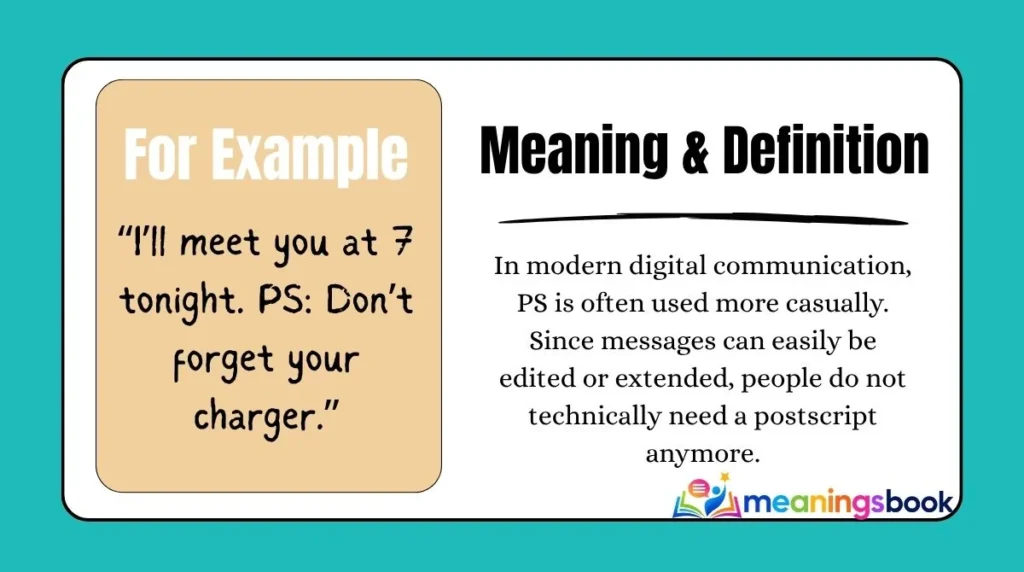
PS most commonly stands for “postscript.” A postscript is an additional remark written after the main body of a message. Traditionally, it was used when a person had already finished a letter but wanted to add one more thought without rewriting the entire letter.
For example:
“I’ll meet you at 7 tonight. PS: Don’t forget your charger.”
The main message is about meeting at 7. The PS adds another piece of information about the charger.
In modern digital communication, PS is often used more casually. Since messages can easily be edited or extended, people do not technically need a postscript anymore. Nevertheless, the expression has remained useful because it gives the final remark a distinctive tone.
A PS can introduce something important, funny, affectionate, unexpected, or simply easy to forget. The meaning is generally not hidden or coded. The surrounding message normally tells you exactly what the writer intends.
The abbreviation is sometimes written as P.S., PS, or p.s. All three can communicate the same idea in ordinary writing. The punctuation is mainly a matter of writing style rather than a change in meaning.
For example:
- “P.S. I really enjoyed talking to you.”
- “PS: Bring your ID.”
- “p.s. Your photo looks great!”
In each case, the writer is adding something after the main message.
It is also important to distinguish PS from other meanings that occur in specialized contexts. A technical document, medical record, scientific paper, or aviation-related message may use “PS” differently. Therefore, the safest interpretation depends on where and how the abbreviation appears.
Background
The word postscript comes from Latin roots associated with something written afterward. Historically, postscripts became familiar through letters and other written correspondence. Someone could finish a letter and then remember another detail, so they would add it after the main text.
The abbreviation P.S. developed as a convenient shortened form of “postscript.” Its traditional function was therefore practical: it allowed writers to append an extra thought without rewriting the entire letter.
The expression survived as communication changed. Printed letters gave way to emails, and emails were joined by text messages, instant messaging, and social media. Even though modern technology makes adding information easy, PS remains recognizable because it has developed a conversational quality.
Today, a postscript does not necessarily mean that the writer genuinely forgot something. Someone may deliberately add a PS because it makes the final remark stand out.
For instance:
“Thanks for helping me today. P.S. You owe me coffee!”
Here, the PS can make the ending playful rather than simply functioning as an afterthought.
Another modern use is emotional emphasis:
“It was really nice seeing you. PS: I missed this.”
The writer could have included the sentence in the main message, but placing it after PS gives it extra attention.
There is no need to assume that every occurrence of “PS” comes from this historical meaning, however. Abbreviations naturally acquire additional meanings in different subjects and communities. PS in ordinary text usually means postscript, but context can change the interpretation.
Usage in Different Contexts
The meaning and tone of PS can vary depending on the communication setting.
Chat
In personal chats, PS usually introduces an additional thought. It may be something the sender remembered after sending or composing the main message.
“I’ll call you later. PS: Tell Sarah I said hi.”
It can also be playful:
“Good luck tomorrow! PS: Try not to be nervous 😂”
Social Media
On social platforms, PS may appear at the end of captions, posts, or comments. Users can use it to add a final observation without changing the structure of the main post.
“Had an amazing day at the beach. PS: The sunset was even better than the photos.”
Here, the PS works almost like a final note to readers.
Professional Communication
In professional writing, P.S. can still mean postscript, although its appropriateness depends on the situation. It may appear in informal business emails or friendly professional communication.
For highly formal documents, reports, contracts, and official correspondence, a clearly labeled note or properly organized section is often more appropriate.
Casual Conversations
Among friends and family, PS can feel natural and relaxed. It may introduce a reminder, joke, compliment, or personal observation.
The important point is that PS does not automatically signal a special emotion. The content following PS determines the tone.
Meaning in Chat, WhatsApp, Instagram, and TikTok
Across messaging and social media platforms, PS generally retains its ordinary meaning of “postscript.” The platform itself does not normally give the abbreviation a separate universal definition.
On WhatsApp, someone might write:
“See you tomorrow! PS: Bring the tickets.”
On Instagram:
“Such a beautiful evening. PS: Swipe to see the funniest picture.”
On TikTok, a creator might put PS in a caption or comment:
“I almost deleted this video. PS: Glad I didn’t.”
In each example, PS introduces an additional remark.
The expression can also make a message feel more personal. Someone might write:
“Thanks for today. PS: I had a really good time with you.”
That final sentence may carry more emotional weight because it is separated from the main message.
However, you should not automatically interpret PS as romantic, flirtatious, sarcastic, or emotional. The abbreviation itself does not establish those meanings.
For example:
“Dinner is at 8. PS: Please bring your umbrella.”
is purely practical.
By contrast:
“Goodnight. PS: You made me smile today.”
has a warmer tone because of the words that follow it.
Social media also encourages informal punctuation and capitalization. Therefore, PS, P.S., p.s., and similar forms may all appear without any meaningful difference.
Meaning in Physics, Medical, and Aircraft Terminology
The abbreviation PS does not have one universal technical meaning across physics, medicine, and aviation. Its interpretation depends on the specific field, document, and surrounding terminology.
Physics
In scientific contexts, ps can be used as an abbreviation for picosecond, a unit of time equal to one trillionth of a second. Notice the lowercase form: scientific notation and capitalization matter.
This is different from the ordinary conversational PS meaning “postscript.”
Therefore, if you see “ps” beside a measurement or scientific value, it may be a unit rather than a messaging abbreviation.
Medical Terminology
In medicine, PS can appear as an abbreviation for different terms depending on the specialty and context. Medical abbreviations are not always universal, and the same letters can represent different concepts.
For that reason, it would be unsafe to assume that every medical occurrence of PS means “postscript.” A medical report should be interpreted using its specific terminology, surrounding information, and professional context.
Aircraft and Aviation Terminology
There is likewise no single universal aviation meaning of PS that should automatically be assumed whenever the letters appear in an aircraft-related context.
Aviation uses many standardized abbreviations, codes, and technical shorthand, but individual documents, operators, systems, and organizations may use abbreviations differently. If PS appears in an aircraft manual, flight document, technical display, or operational record, the surrounding terminology is essential for determining its meaning.
The key distinction is simple: PS in an ordinary message is usually “postscript,” while technical contexts may use PS or ps for entirely different purposes.
Common Misconceptions
One common misconception is that PS always means something romantic or secret. It does not. A postscript is simply an additional remark. The emotional meaning comes from what the person writes after PS.
Another misunderstanding is that PS must mean the writer forgot something. Historically, that was a common reason for using a postscript, but modern users may add one intentionally.
Some people also confuse PS with P.S., assuming the punctuation changes the meaning. In ordinary writing, it generally does not.
Another possible confusion comes from capitalization. PS in a chat may mean postscript, while ps in a scientific measurement can refer to picoseconds. Context and capitalization can therefore matter.
Finally, PS should not automatically be interpreted as “please send,” “personal status,” or another invented phrase simply because those words fit the letters. Unless the context clearly supports another interpretation, postscript is the safest meaning in everyday text.
Similar Terms & Alternatives
Several expressions can perform a similar function to PS:
- P.S. / PS — Adds an extra thought after the main message.
- P.P.S. — Traditionally means “post-postscript,” or another note added after a P.S.
- By the way — Introduces an additional thought, usually within the main conversation.
- One more thing — Signals that the speaker wants to add something.
- Also — Adds another related point without creating a separate postscript.
- Note: — Draws attention to additional information.
- BTW — Short for “by the way,” common in informal digital communication.
These expressions are not completely interchangeable. PS usually has the distinctive feature of appearing after the main message, while “by the way” can occur anywhere in a conversation.
How to Respond to It
You generally do not need to respond specifically to the letters PS. Instead, respond to the information or sentiment contained in the postscript.
If someone writes:
“See you tomorrow. PS: Don’t forget your passport.”
A natural response is:
“Got it—I’ll bring it.”
If the PS is affectionate:
“Had a great time. PS: I really enjoyed talking with you.”
You could respond:
“I enjoyed it too 😊”
If the PS is humorous:
“PS: You still owe me dessert!”
A playful answer could be:
“I haven’t forgotten 😂”
If you are unsure what the sender means, simply ask:
“What do you mean by PS here?”
Usually, though, the sentence following PS makes the intended meaning obvious.
Differences from Similar Words
PS vs. BTW: PS is normally placed after the main message as an additional note. BTW means “by the way” and can introduce an extra thought anywhere in a conversation.
PS vs. P.P.S.: A P.P.S. is traditionally an additional note following a P.S. It is much less common in everyday digital communication.
PS vs. Note: Both can introduce extra information, but “note” often sounds more informational or formal, while PS can feel more personal and conversational.
PS vs. FYI: FYI means “for your information.” It usually introduces information someone wants you to know and does not specifically indicate that the information comes after the main message.
PS vs. BTW in tone: A PS can make a final remark feel deliberately highlighted, while BTW tends to feel like a natural conversational side note.
Relevance in Online Conversations & Dating Apps
On dating apps and in online conversations, PS usually has the same basic meaning: postscript. However, the message following it can affect the emotional tone considerably.
For example:
“It was really nice meeting you. PS: I’d definitely do that again.”
The PS itself is not inherently romantic, but the statement after it may express interest.
Similarly:
“Goodnight! PS: Your dog is adorable.”
could simply be friendly and playful.
Someone might also use PS to add a humorous observation:
“I’m trying to be responsible this weekend. PS: Unless pizza is involved.”
Context matters especially in dating conversations because people often use short messages, emojis, punctuation, and playful language. A PS can make a final comment stand out, but it does not independently reveal whether someone is flirting or expressing romantic interest.
The relationship between the people involved, the preceding conversation, and the actual words after PS are more important than the abbreviation itself.
Frequently Asked Questions
What does PS mean in text?
PS usually means “postscript” in text messages. It introduces an additional thought, reminder, comment, or personal remark placed after the main message. For example, “See you at 6. PS: Bring a jacket” means the writer wants to add the jacket reminder after the main statement.
What does PS mean in chat?
In chat, PS usually means “postscript,” or an extra note added after the main message. It can be practical, funny, friendly, or emotional depending on what follows it. The abbreviation itself does not have a special emotional meaning.
Is PS a slang term?
PS is generally an abbreviation rather than slang. It is a shortened form of “postscript” and has been used in written communication for a long time. People may use it casually in texts, chats, captions, and comments, but that does not make the abbreviation slang.
What does PS mean on social media?
On social media, PS usually means “postscript.” Someone may add it to the end of a caption, comment, or post to introduce an extra observation or final thought. Its meaning can change in specialized communities, so the surrounding content should always be considered.
How do you respond to PS in a message?
Respond to the statement that comes after PS rather than to the abbreviation itself. If it contains a reminder, acknowledge the reminder; if it is a joke, respond naturally to the joke. You usually do not need to mention “PS” in your reply.
Can PS have different meanings?
Yes, PS can have different meanings depending on context. In ordinary writing it commonly means “postscript,” while technical fields may use PS or ps for specialized terms. For example, “ps” can represent picoseconds in scientific contexts. Context and capitalization are therefore important.
Does PS mean something romantic in texting?
PS does not inherently mean something romantic. A romantic or affectionate meaning comes from the words following the abbreviation and the broader conversation. For example, “PS: I miss you” is affectionate because of the message itself, not because PS is a romantic abbreviation.
What is the difference between PS and BTW?
PS usually adds a final thought after the main message, while BTW (“by the way”) introduces an additional thought within the conversation. Both can introduce extra information, but PS has a stronger association with an afterthought or final note.
Conclusion
The most common PS meaning in text is “postscript,” an additional thought written after the main message. The abbreviation originated in traditional written correspondence, where people used it to add something after finishing a letter.
Today, the same idea remains common in emails, text messages, WhatsApp chats, social media captions, comments, and casual conversations.
PS does not automatically indicate romance, humor, sarcasm, or any other particular emotion. The words that follow it determine the tone. Likewise, PS should not always be interpreted as “postscript” in technical environments. Scientific, medical, aviation, and other specialized contexts can use similar letters differently.
When you encounter PS in a normal conversation, the simplest approach is to read the sentence that follows it. In most everyday situations, it is simply a convenient way to say, “Here is one more thing I want to mention.” Context remains the best guide whenever an abbreviation could have more than one interpretation.

I am Ethan Whitmore, an English teacher and vocabulary enthusiast who explains words, phrases, and meanings in text through simple examples to make English easier for everyone.