
If you have received a message containing “LUV,” you may wonder whether it is simply a shorter way to write “love” or whether it has another hidden meaning.
In most everyday texting and online conversations, LUV is an informal spelling of “love.” People commonly use it in text messages, social media comments, captions, direct messages, and casual conversations.
The spelling is especially common when someone wants their message to sound relaxed, friendly, affectionate, or playful. Depending on who sends it and what surrounds it, “luv” can express romantic affection, friendship, appreciation, warmth, or simple friendliness.
People often search for the meaning because abbreviations and slang can change according to context. A message from a romantic partner may carry a different emotional tone from the same word written by a friend. Understanding the surrounding conversation is therefore important when interpreting this informal expression.
Quick Answer
LUV meaning in text is usually an informal or playful spelling of “love.” It is most commonly used in casual chats, texts, and social media to express affection, warmth, appreciation, or friendliness. The exact feeling depends on the relationship between the people communicating and the context of the message.
Meaning & Definition
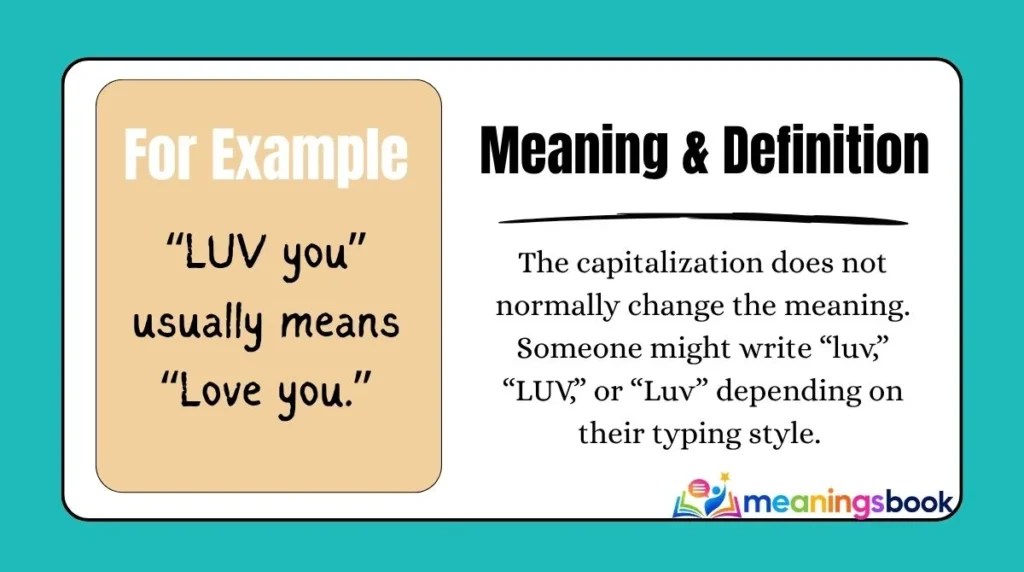
“LUV” generally means “love.” It is not usually an acronym in everyday texting; rather, it is a shortened or stylized spelling that replaces the traditional spelling of the word.
For example:
- “LUV you” usually means “Love you.”
- “Sending luv” means “Sending love.”
- “LUV this!” means “Love this!”
- “Lots of luv” means “Lots of love.”
- “Thanks, luv” can be a warm or affectionate way of saying “Thanks, love.”
The word can communicate several different emotions. It may be romantic when used between partners, affectionate when exchanged between close friends or family members, or simply enthusiastic when someone comments on a photograph, song, outfit, or idea.
The capitalization does not normally change the meaning. Someone might write “luv,” “LUV,” or “Luv” depending on their typing style. “LUV” in all capital letters may simply be used for emphasis or visual style rather than to indicate a different definition.
It is also useful to distinguish luv from a formal abbreviation. In ordinary online communication, people generally do not need to decode individual letters. Instead, they recognize “luv” as a familiar alternative spelling of “love.”
The tone can range from casual to affectionate:
“Luv your new profile pic!”
This is likely an enthusiastic compliment.
“Goodnight, luv ❤️”
This sounds more affectionate and could be romantic, depending on the relationship.
“Thanks for helping me, luv.”
This can be friendly, affectionate, or simply warm.
Therefore, the safest interpretation is that “LUV” represents love or affection, while the surrounding words and relationship determine exactly how strongly it should be interpreted.
Background
The use of “luv” developed from the tendency to represent spoken or informal language through simplified spelling. English speakers have used playful spellings of familiar words in informal communication for a long time, and “luv” fits naturally into that pattern.
Unlike many modern texting abbreviations, such as “LOL” or “BRB,” “luv” is not primarily formed by taking the first letters of several words. It is a phonetic or stylized spelling of love.
This distinction matters. When someone writes “LUV,” it generally does not mean that each letter stands for a separate word. Instead, the writer is choosing a casual spelling of an existing word.
The form became particularly noticeable in informal written communication, including personal messages, greeting cards, popular culture, online communities, and later social media and mobile messaging. Digital communication made this kind of casual spelling especially convenient because people frequently write in a conversational style rather than following formal written-English conventions.
Over time, “luv” became associated with warmth and informality. Some people use it because it feels softer or more playful than the standard spelling “love.” Others use it simply out of habit.
There is no need to assume that every use carries a deep romantic meaning. A person might write “LUV this movie” simply to show strong enthusiasm. Likewise, someone might address a friend as “luv” without suggesting romantic attraction.
The historical development should therefore be understood as informal language usage rather than a single officially established abbreviation with one precise origin. The exact reason an individual chooses “luv” instead of “love” can vary.
In modern communication, the spelling is best understood as part of casual English. Its meaning is familiar enough that most readers interpret it immediately, but its emotional tone remains dependent on context.
Usage in Different Contexts
The meaning and tone of “LUV” can change significantly depending on where it appears.
Chat
In private chats, “luv” commonly expresses affection or friendliness. A close friend might say, “Luv ya!” while a romantic partner might use “luv” as a term of endearment. The surrounding conversation usually makes the intended tone clear.
Social Media
On social platforms, “luv” can express appreciation or enthusiasm rather than personal affection. For example, someone commenting “LUV this look!” is probably saying that they strongly like the person’s appearance or content.
Professional Fields
In professional writing, “luv” is generally considered informal. It would usually be inappropriate in a formal report, business letter, academic paper, or professional announcement unless it appears as part of a quotation, brand name, title, or other specific context.
A colleague writing “Luv the idea!” in an informal workplace chat may simply be using casual language. The same wording in a formal business document would be unusual.
Casual Conversations
Among friends and family, “luv” can be a warm form of expression. It may occur in greetings, goodbyes, congratulations, thanks, or affectionate remarks.
For example:
- “Take care, luv.”
- “Luv you guys!”
- “That was so sweet, luv.”
- “Luv your new haircut.”
The emotional intensity varies widely.
Why Context Matters
The same word can carry different implications depending on who sends it. “Luv” from a romantic partner may be intimate, while “luv” from a friend may be entirely platonic.
Even punctuation can influence the tone. “Luv!” feels enthusiastic, while “luv ❤️” may feel more affectionate. Still, these signals should not be treated as absolute rules.
The most reliable approach is to consider the relationship, the surrounding message, and the person’s usual communication style rather than interpreting the word in isolation.
Meaning in Chat, WhatsApp, Instagram, and TikTok
On messaging and social media platforms, “luv” is usually used in much the same way as “love,” but the informal spelling fits the relaxed style of online communication.
On WhatsApp, people may use “luv” in personal conversations, family groups, or friendly exchanges.
Examples include:
- “Goodnight luv.”
- “Luv you ❤️”
- “Luv this song!”
- “Thanks, luv.”
The first two examples can sound affectionate, while the third expresses enthusiasm about something rather than romantic feelings.
On Instagram, “luv” frequently appears in comments and direct messages. A comment such as “LUV your outfit!” normally means “I love your outfit!” It is generally an expression of admiration rather than a declaration of romantic love.
It can also appear in captions:
“Sending luv to everyone who supported me.”
Here, “luv” communicates appreciation or warmth toward an audience.
TikTok
TikTok users may use “luv” in comments, captions, or messages to express excitement, appreciation, or affection.
For example:
“Luv this trend!”
means that the person really likes the trend.
A comment such as:
“Aww, luv you!”
could be more personal, but its precise meaning depends on the relationship and the style of the conversation.
Private Messages
In direct messages, “luv” can become more personal. If someone repeatedly calls you “luv,” they may simply have a naturally affectionate communication style. Alternatively, they may be deliberately using it as a term of endearment.
Therefore, it is usually unwise to interpret one instance of “luv” as proof of romantic interest.
Emojis and Tone
Emojis can provide additional context. For example:
- “Luv this 😂” — enthusiastic or playful.
- “Luv you ❤️” — affectionate.
- “Thanks luv 😊” — warm and friendly.
- “LUV IT!!!” — strong enthusiasm.
These are tendencies rather than fixed rules. Online language is flexible, and individuals use expressions differently.
Meaning in Physics, Medical, and Aircraft Terminology
“LUV” does not have one universal technical meaning across physics, medicine, and aviation. It is important not to assume that the texting meaning applies automatically to technical material.
Physics
There is no universally standard physics definition of “LUV” that corresponds to the everyday texting expression “love.” If the term appears in a physics paper, equation, diagram, or technical discussion, its meaning would need to be determined from that specific source.
It could potentially be an author-defined abbreviation, notation, variable name, or part of a larger expression. Without context, assigning a specific physics definition would be unreliable.
Medical Terminology
“LUV” is not a standard, universally recognized medical abbreviation meaning “love.” Medical abbreviations can be highly context-dependent, and organizations may use different abbreviations for different concepts.
If “LUV” appears in a medical document, it should therefore be interpreted from the surrounding terminology or the document’s abbreviation list rather than automatically translated as a medical term.
For important medical information, guessing the meaning of an unfamiliar abbreviation can be unsafe.
Aircraft and Aviation
Aviation provides an interesting distinction. LUV is the IATA airport code for Dallas Love Field, an airport in Dallas, Texas. In that specific aviation context, “LUV” is therefore a recognized airport identifier.
That does not mean that “LUV” is a general aviation abbreviation for “love.” If you encounter LUV in a flight, airport, airline, or travel context, the surrounding information is essential.
The Key Difference
In everyday texting:
luv → usually “love”
In technical contexts:
LUV → may have a specialized meaning, identifier, abbreviation, or notation
The safest interpretation always comes from context. A casual text and an aviation itinerary should not automatically be interpreted in the same way.
Common Misconceptions
One common misconception is that “LUV” is always a romantic expression. It is not. Someone can use “luv” with a friend, relative, audience, or even when talking about an object or experience.
For example, “LUV this restaurant” does not normally mean romantic love. It simply means the person likes the restaurant very much.
Another misconception is that capital letters automatically make the expression more serious. “LUV” may be capitalized for emphasis, styling, or personal preference. Capitalization alone does not prove stronger emotion.
People may also mistake “LUV” for a formal acronym. In ordinary texting, it is usually just a casual spelling of “love,” not an abbreviation in which each letter represents a separate word.
A further misunderstanding occurs when people interpret “luv” as evidence of flirting. A single use of the word is not enough to establish romantic interest. Some people naturally use affectionate words with many different people.
Context also matters when the term appears outside casual communication. The aviation code LUV, for example, has a specific function unrelated to texting slang.
Another mistake is assuming that every occurrence must have the same definition. Online language can be ambiguous, and specialized fields can use the same letters differently.
When interpreting an unfamiliar use, consider:
- Who wrote it?
- What were they talking about?
- Is the conversation personal, professional, or technical?
- Do they normally use affectionate language?
- Are there emojis or other words that clarify the tone?
These clues can help distinguish casual affection from enthusiasm, friendliness, or a specialized technical reference.
Similar Terms & Alternatives
Several words and abbreviations can look or feel similar to “luv,” but they are not identical.
Love
Love is the standard English spelling. It can be used in formal, informal, romantic, familial, and general contexts.
Luv
Luv is an informal or stylized spelling of “love.” It tends to sound more casual and conversational.
Love ya
“Love ya” is a relaxed version of “love you.” It is often friendly or affectionate and does not necessarily indicate romance.
XOXO
“XOXO” traditionally represents hugs and kisses. It can express affection, friendliness, or romantic warmth depending on the context.
❤️
A heart emoji can communicate love, affection, appreciation, or approval. Like “luv,” its meaning depends heavily on context.
Babe
“Babe” can be a romantic term of endearment, although some people also use it casually. It usually carries a more personal tone than “luv.”
Hun
“Hun” is an informal form of “honey.” It can be affectionate or friendly and is sometimes used between people who are not romantically involved.
Dear
“Dear” can be affectionate, polite, or formal depending on how it is used. It generally has a broader range of meanings than “luv.”
The important distinction is that “luv” is primarily a spelling variation of “love,” while terms such as “XOXO,” “babe,” and “hun” are separate expressions with their own nuances.
How to Respond to It
How you respond to “luv” should depend on your relationship with the sender and the tone you want to communicate.
If someone says:
“Luv your new photo!”
A simple response could be:
“Thank you! 😊”
If a friend says:
“Take care, luv.”
You might respond:
“You too!”
If a romantic partner writes:
“Luv you ❤️”
A natural response could be:
“Love you too ❤️”
If you are unsure whether the sender is being romantic, you do not have to immediately match their level of affection. A neutral but friendly response is perfectly acceptable.
For example:
- “Aww, thank you!”
- “That’s sweet of you.”
- “Haha, thanks!”
- “You’re so kind.”
- “Much love!”
If you want to return the affection:
- “Luv you too!”
- “Sending love back ❤️”
- “Love ya!”
If you think the message might have a romantic meaning and you genuinely need clarification, you can ask naturally rather than guessing. However, in most everyday conversations, “luv” does not require a complicated response.
The key is to match the tone you are comfortable with. You do not need to use “luv” yourself simply because someone else used it.
Differences from Similar Words
The biggest difference between “luv” and “love” is style rather than basic meaning.
| Expression | Typical meaning | Tone |
|---|---|---|
| Love | Affection, strong liking, or deep emotional attachment | Standard |
| Luv | Informal spelling of love | Casual/playful |
| Love ya | Informal “love you” | Relaxed/affectionate |
| XOXO | Hugs and kisses | Affectionate/playful |
| Babe | Term of endearment | Personal/possibly romantic |
| Hun | Informal “honey” | Warm/friendly |
| ❤️ | Love, affection, appreciation, approval | Highly context-dependent |
“Love” is appropriate in almost any setting where the meaning itself is appropriate. “Luv” is more strongly associated with casual communication.
For instance:
“I love your presentation.”
can be appropriate in a professional conversation.
“I luv your presentation!”
sounds much more informal and may be better suited to a casual workplace chat, friend-to-friend message, or social media comment.
Similarly, “I love you” is a conventional emotional statement, while “luv ya” sounds more relaxed and conversational.
Neither spelling automatically indicates greater or lesser affection. The difference is primarily one of register, personality, and tone.
Relevance in Online Conversations & Dating Apps
“Luv” can appear frequently in informal online conversations because dating apps, social platforms, and messaging services encourage short, conversational communication.
On a dating app, the expression may sometimes contribute to a flirtatious tone. For example:
“Luv your smile 😊”
could be a compliment from someone showing romantic interest.
However, the word alone is not enough to determine someone’s intentions. A person might use “luv” simply because they have a casual or affectionate writing style.
The stage of the relationship also matters. If two people have been flirting for several days and one writes “Luv talking to you,” the phrase may carry a warmer or more intimate tone. If the same expression appears in a public comment, it may simply mean “I really like this.”
Dating-app conversations also contain many other clues. Consider the surrounding messages, whether the person is making personal compliments, how frequently they use affectionate language, and whether their behavior is consistent with the apparent tone.
It is best to avoid treating “luv” as a coded declaration of romantic feelings. Context determines emotional meaning.
On social media, the interpretation is often even broader. “LUV this!” usually means strong approval rather than personal affection. In a private conversation, however, “luv” can function as a term of endearment.
Ultimately, online communication removes many of the vocal and facial cues available in face-to-face conversations. This makes words such as “luv” somewhat flexible. If the meaning genuinely matters, the overall conversation is more informative than the single word.
Frequently Asked Questions
What does LUV mean in text?
LUV usually means “love” in text messages. It is an informal or playful spelling rather than a separate word with a completely different meaning. Depending on context, it can express romantic affection, friendship, appreciation, enthusiasm, or general warmth.
Is LUV a slang term?
Yes, “luv” can be considered informal slang or casual spelling for “love.” It is common in relaxed digital communication but is generally less suitable for formal writing. Its use does not automatically indicate romance because people also use it with friends, family, and online audiences.
What does LUV mean in chat?
In chat, LUV usually means “love” or communicates affection. For example, “LUV you” generally means “Love you,” while “LUV this!” means “I really love or like this.” The relationship between the people chatting helps determine whether the tone is romantic, friendly, or enthusiastic.
What does LUV mean on social media?
On social media, LUV commonly means “love” or strong appreciation. A comment such as “LUV your outfit!” is usually a compliment rather than a romantic statement. Social-media users may choose the spelling because it feels shorter, more playful, or more conversational.
Is LUV always romantic?
No, LUV is not always romantic. Someone may use it with a partner, friend, family member, or even a general audience. It can also describe strong enthusiasm for something, as in “LUV this song.” The surrounding message and relationship provide the best clues.
How should I respond when someone texts “LUV”?
You can respond according to the tone you want to return. A neutral response such as “Thanks!” works in many situations. If the message is affectionate, you could say “Luv you too!” or “That’s sweet.” You do not have to respond romantically if you are unsure about the sender’s intention.
Can LUV have different meanings?
Yes, LUV can have different meanings depending on context. In ordinary texting, it usually represents “love.” In specialized contexts, the same letters may refer to something else. For example, LUV is also an airport code associated with Dallas Love Field, so technical or travel context can change the interpretation.
What is the difference between LUV and LOVE?
The basic meaning is usually the same, but “luv” is more informal and stylized than “love.” “Love” is the standard spelling and works in formal and informal settings, whereas “luv” is especially common in casual texts, social media, personal messages, and playful communication.
Conclusion
The most common LUV meaning in text is simply “love.” It is an informal, stylized spelling that people use to make messages sound casual, warm, playful, or affectionate. Depending on the situation, it can express romantic feelings, friendship, appreciation, enthusiasm, or general kindness.
The surrounding conversation is important. “LUV you ❤️” may sound affectionate, while “LUV this song!” usually expresses enthusiasm. Likewise, “luv” from a close friend does not necessarily have the same meaning as “luv” from a romantic partner.
It is also important to distinguish everyday texting from specialized contexts. “LUV” does not have one universal technical definition in physics or medicine, while in aviation it can function as the IATA airport code for Dallas Love Field.
Ultimately, there is rarely a need to overthink the word itself. Look at who sent it, what they were discussing, and how they normally communicate. In everyday online language, “luv” is most often just a friendly, informal way of writing “love.”

I am Ethan Whitmore, an English teacher and vocabulary enthusiast who explains words, phrases, and meanings in text through simple examples to make English easier for everyone.



