Words can have different meanings depending on where they appear, and understanding an unfamiliar term can help you communicate more clearly. The word metrical is one such term.
People may encounter it while studying English, reading poetry, learning about music, or exploring technical subjects. Someone searching for the metrical meaning may want to understand a definition, identify its use in a sentence, or determine whether it has a special meaning in text messages and online conversations.
In general, metrical is an adjective related to a meter, measurement, or a structured pattern of rhythm. Its most common use is in poetry, where it describes the rhythm and arrangement of stressed and unstressed syllables. It can also describe rhythmic patterns in music and certain systems of measurement.
However, metrical is not generally recognized as a popular texting abbreviation or internet slang term. Understanding its grammatical role and context makes it easier to interpret the word correctly. This guide explains its definition, background, practical uses, related terms, and common misunderstandings.
Quick Answer
Metrical meaning refers to something related to meter, measurement, or a structured rhythmic pattern. The word is most commonly used in poetry to describe the arrangement of stressed and unstressed syllables that creates rhythm. It can also relate to music, measurement systems, and technical descriptions, depending on the context.
Meaning & Definition
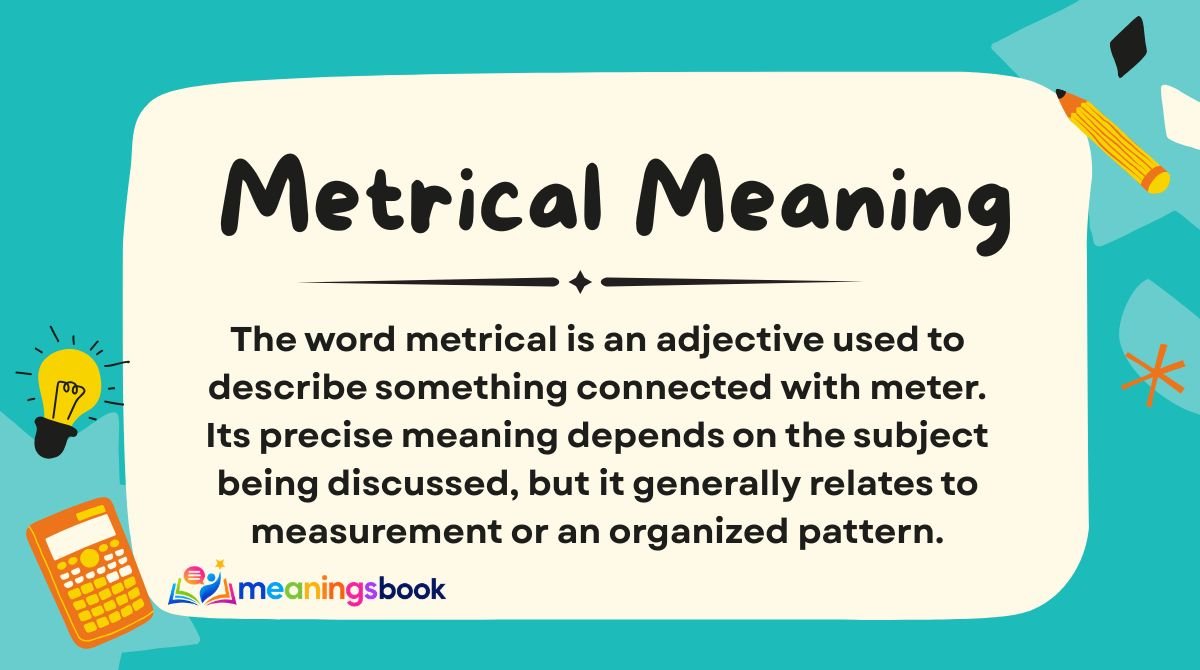
The word metrical is an adjective used to describe something connected with meter. Its precise meaning depends on the subject being discussed, but it generally relates to measurement or an organized pattern.
What does metrical mean?
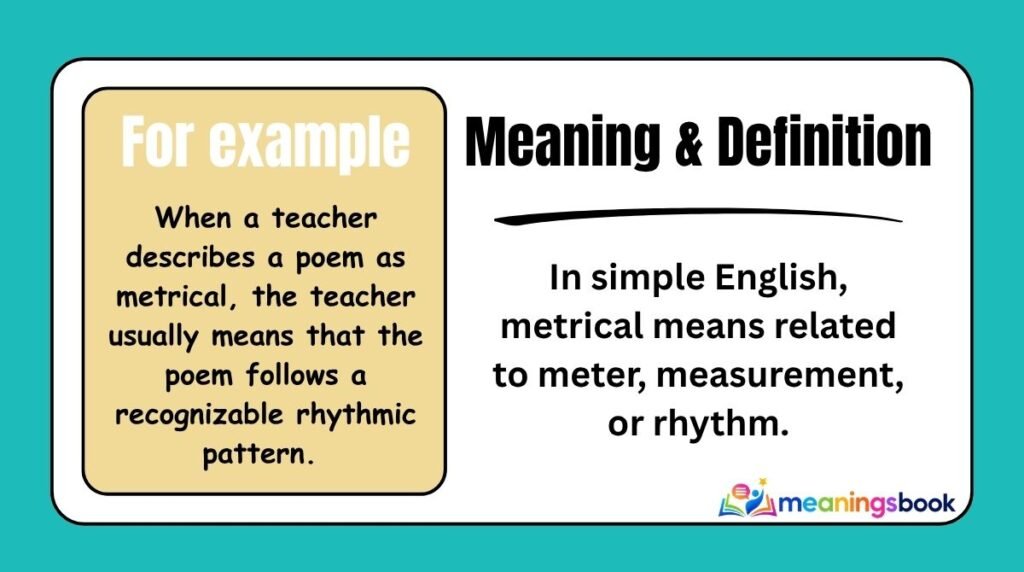
In simple English, metrical means related to meter, measurement, or rhythm.
For example, when a teacher describes a poem as metrical, the teacher usually means that the poem follows a recognizable rhythmic pattern. When the word appears in a technical discussion about measurement, it may refer to a system or method of measuring something.
The word itself does not usually describe an object independently. Instead, it explains the relationship between an object, method, or pattern and the concept of meter.
Metrical meaning in poetry
In poetry, metrical refers to the rhythmic structure created by patterns of stressed and unstressed syllables.
Consider this example:
The sun is shining bright today.
When spoken naturally, the words have a rhythm created by their syllables and stresses. A poet can organize these patterns to create a regular poetic meter.
Common poetic meters include:
- Iambic meter: A pattern that moves from an unstressed syllable to a stressed syllable.
- Trochaic meter: A pattern that moves from a stressed syllable to an unstressed syllable.
- Anapestic meter: A pattern of two unstressed syllables followed by a stressed syllable.
- Dactylic meter: A pattern of one stressed syllable followed by two unstressed syllables.
A poem that follows a recognizable metrical pattern is often called metrical poetry.
Metrical meaning in measurement
The word can also refer to measurement or a measurement system. For example, a discussion of metrical units may concern meters, centimeters, and kilometers.
However, the exact phrase matters. Metric system is the standard expression for the internationally used decimal-based measurement system, while metrical is an adjective whose meaning depends on its surrounding words.
Understanding the sentence is therefore essential when interpreting this term.
Background
The word metrical developed from the broader idea of meter, which has long been associated with measuring quantities and organizing rhythm.
The English word meter has connections to Greek metron, meaning measure. Related words developed in different directions: some refer to measuring physical quantities, while others describe rhythm in poetry and music.
How did the word develop?
The concept of meter has been important in literature since ancient times. Greek and Roman poets used established rhythmic patterns to organize poetic compositions. These patterns were based on arrangements of syllables, syllable length, and other features of language, depending on the poetic tradition.
As literary terminology developed, words such as metrical became useful for describing poetry that follows a particular rhythmic structure.
The term also became associated with measurement. In scientific and everyday contexts, words derived from the same linguistic family can refer to measuring length, quantities, or other properties.
Why does metrical have more than one meaning?
The word has multiple related uses because meter can refer to different concepts.
In poetry, meter concerns the organization of rhythm. In measurement, the broader concept concerns determining quantities according to a standard.
These meanings are related through the general idea of measure or structured organization, but they are not interchangeable in every sentence.
For example:
- Metrical analysis in literature examines a poem’s rhythmic structure.
- Metrical units may refer to units associated with measurement.
- Metrical pattern in a poem refers to the organization of poetic rhythm.
Is the exact origin of every use known?
The broad linguistic connection between metrical, meter, and the Greek concept of measure is established. However, the development of each specialized use is a separate historical question.
It is best not to assume that every modern technical use developed directly from a particular ancient practice. The safest interpretation comes from the word’s established meaning in the relevant field.
Today, metrical remains a standard English adjective used in literary discussions, music-related contexts, and some technical descriptions.
Usage in Different Contexts
The meaning of metrical can change slightly depending on the subject. Recognizing the context helps prevent incorrect interpretations.
1. In academic writing
Students may encounter the term in English literature, linguistics, or poetry lessons.
Example:
“The students studied the metrical structure of the poem.”
This means the students examined the poem’s rhythmic organization, including its patterns of stress and syllables.
2. In music
Meter in music refers to the organization of beats into recurring groups. The adjective metrical may describe patterns associated with this organization.
Example:
“The composition has a clear metrical pattern.”
This suggests that the music follows a recognizable organization of beats or rhythmic units.
3. In measurement
In technical or mathematical discussions, metrical may refer to measurement-related concepts.
Example:
“The researcher recorded the data using metrical units.”
The intended meaning would depend on the technical context and the particular units being discussed. In many everyday situations, metric units would be the more familiar expression.
4. In everyday conversation
People may use the word while discussing a poem, song, school assignment, or technical subject.
Example:
“Can you explain the metrical pattern in this verse?”
The speaker is asking for an explanation of how the verse’s rhythm is organized.
5. In casual online discussions
Someone discussing literature on social media might write:
“I love the metrical flow of this poem.”
Here, metrical flow refers to the poem’s rhythm and the way its words sound when read aloud.
The word is less common in casual conversations than simpler expressions such as rhythm, pattern, or meter.
Meaning in Chat, WhatsApp, Instagram, and TikTok
The word metrical does not have a widely established, universal meaning as a texting abbreviation on WhatsApp, Instagram, TikTok, or other messaging platforms.
When someone uses it online, the ordinary English meaning is generally the best starting point.
Metrical meaning in chat
In a message, the word may refer to poetry, music, rhythm, or measurement.
Example:
Person A: “What do you think about this poem?”
Person B: “Its metrical structure is interesting.”
Person B is commenting on the poem’s rhythm rather than using a special texting code.
Metrical meaning on WhatsApp
On WhatsApp, the interpretation depends on the conversation.
For example:
“Please explain the metrical pattern before class.”
This is likely an academic message about poetry or literature.
If a friend sends the word without any explanation, you should not automatically assume it is slang or an abbreviation.
Metrical meaning on Instagram
On Instagram, the term might appear in a caption about poetry, songwriting, or literary analysis.
Example:
“Exploring the metrical beauty of classic poetry.”
This describes an interest in poetic rhythm and structure.
Metrical meaning on TikTok
A TikTok creator might use the word in an educational video about poetry, rap, songwriting, or language.
For example, a creator could explain how a verse follows a regular metrical pattern.
In this context, the word relates to rhythm and the arrangement of syllables or beats.
What if someone sends only “metrical”?
If someone sends only this word, the intended meaning is unclear without more information. They may be discussing a school topic, asking about vocabulary, or referring to a technical subject.
A simple response would be:
“What do you mean by metrical? Are you talking about poetry or measurement?”
This avoids guessing a meaning that the sender may not intend.
Meaning in Physics, Medical, and Aircraft Terminology
The word metrical can appear in technical writing, but it does not automatically have a special meaning in every scientific or professional field.
Metrical meaning in physics
In physics, metrical is not one universal technical term with a single definition across all topics.
However, it can appear in mathematical physics and relativity in expressions such as metric tensor and spacetime metric. These concepts describe mathematical structures used to define distances, intervals, and geometric relationships.
The related word metric is more standard in these expressions. A reader should interpret metrical according to the particular technical phrase rather than assuming it means poetic rhythm.
For example, a reference to a metric in spacetime geometry has a mathematical meaning, not a literary one.
Metrical meaning in medical terminology
Metrical is not a widely recognized standalone medical abbreviation or a general medical diagnosis.
Medical professionals use measurement-related terminology when discussing body measurements, laboratory values, clinical observations, and other quantitative information. However, the appearance of metrical does not by itself identify a medical condition or procedure.
If you encounter this word in a medical report, the surrounding sentence is necessary to determine its intended meaning. It may be part of a longer technical expression or an unusual wording choice.
Do not interpret an unfamiliar medical term as a diagnosis without checking the complete phrase with an appropriate healthcare professional.
Metrical meaning in aircraft and aviation terminology
Metrical is not a standard standalone aviation abbreviation with one universally accepted meaning.
Aviation uses specific terminology for aircraft dimensions, altitude, speed, distance, navigation, and measurement units. Some aviation contexts use metric units, while others use different unit conventions depending on the measurement and applicable procedures.
For example, a technical discussion may mention metric measurements of an aircraft component. That does not establish metrical as a special aviation code.
If the word appears in an aircraft manual, maintenance document, or flight-related message, examine the complete sentence and the technical context before assigning it a meaning.
Key point: In physics, medicine, and aviation, do not invent a specialized definition for metrical. Use the established meaning of the complete technical expression.
Common Misconceptions
Several misunderstandings can arise when people encounter the word metrical without knowing its context.
Misconception 1: Metrical is internet slang
Metrical is an established English adjective, not a widely recognized texting abbreviation.
It may appear in online conversations, but its ordinary meaning generally remains connected to meter, measurement, or rhythm.
Misconception 2: Metrical always means poetry
Poetry is one of the most familiar contexts for the word, but it is not the only one. The term may also appear in music-related discussions and technical descriptions involving measurement or mathematical structure.
The surrounding words determine the intended interpretation.
Misconception 3: Metrical and metric always mean exactly the same thing
These words are related, but they are not interchangeable in every sentence.
Metrical commonly describes a relationship to meter or rhythm, especially in literature. Metric is commonly used for a measurement system, a quantitative standard, or a mathematical structure.
For example, metrical poetry is a natural literary expression, while metric system is the usual name for a measurement system.
Misconception 4: Metrical is an abbreviation for a medical condition
There is no general basis for interpreting the word as a medical diagnosis or abbreviation on its own. A specific medical document may use specialized terminology, but the complete expression must be examined.
Misconception 5: Every unfamiliar word in a text has a hidden meaning
Not every unusual word is slang, coded language, or a secret message. Someone might simply be using formal vocabulary, discussing a school assignment, or referring to a technical topic.
When the meaning is unclear, asking for clarification is more reliable than guessing.
Similar Terms & Alternatives
Several words are related to metrical or may be confused with it. Understanding their differences makes interpretation easier.
| Term | Meaning | Common context |
|---|---|---|
| Metric | Relating to measurement, a quantitative standard, or a mathematical metric | Science, business, mathematics |
| Meter | A unit of length or a rhythmic structure | Measurement, poetry, music |
| Rhythm | A pattern of sounds, movements, or beats | Music, speech, poetry |
| Metre | British spelling of the unit of length; also used for poetic rhythm | British English, literature |
| Measurement | The process of determining a quantity or size | Science, daily life |
| Prosody | The rhythm, stress, intonation, and related sound features of speech or poetry | Linguistics, poetry |
| Verse | A line or section of poetry; sometimes a unit in a song | Literature, music |
| Pattern | A repeated or organized arrangement | General use, mathematics, design |
Which alternative should you use?
The best alternative depends on what you want to express.
- Use rhythm when discussing how something sounds or moves.
- Use meter when referring to a structured poetic rhythm or a unit of length.
- Use metric when discussing measurement standards or quantitative indicators.
- Use prosody when discussing broader patterns of stress, intonation, and rhythm in language.
- Use metrical when you specifically need an adjective describing something related to meter.
For example, instead of saying, “The poem has a metrical quality,” you could say, “The poem has a clear rhythm.” Both expressions may communicate a similar idea, but the second is easier for general readers to understand.
How to Respond to It
If someone uses metrical in a message, your response should depend on the surrounding conversation.
Because the word is not a widely recognized texting abbreviation, there is no single standard response.
When someone uses it in a school discussion
You can respond by asking for an explanation or discussing the topic.
Examples:
- “Can you explain the metrical pattern?”
- “Are you referring to the rhythm of the poem?”
- “I understand the basic idea, but can you give an example?”
When someone sends it without context
Ask a simple clarification question.
Examples:
- “What do you mean by metrical?”
- “Do you mean poetic rhythm or measurement?”
- “Can you explain what you’re referring to?”
These responses are useful because they do not assume an incorrect meaning.
When someone uses it in a social media comment
If the discussion concerns a poem, song, or educational post, you can respond naturally.
Examples:
- “Yes, the rhythm makes the verse more engaging.”
- “That’s an interesting point about the poem’s structure.”
- “I like how the syllables flow together.”
When someone uses it in a professional conversation
A precise response is preferable.
Examples:
- “Could you clarify which metrical system you mean?”
- “Are you referring to the rhythmic pattern or the measurement method?”
- “Please share the full technical context so I can interpret the term accurately.”
Should you respond casually or formally?
Match the tone of the conversation. Use simple language with friends, ask for clarification in unfamiliar discussions, and use precise terminology in academic or professional settings.
The goal is to understand the sender’s intended meaning rather than to force the word into a slang interpretation.
Differences from Similar Words
Although metrical, metric, meter, and rhythm are related, they serve different grammatical and semantic purposes.
Metrical vs. metric
Metrical usually means relating to meter, particularly poetic rhythm, although it can have other measurement-related uses.
Metric commonly refers to measurement standards, numerical indicators, or mathematical structures.
Examples:
- “The poem follows a metrical pattern.”
- “The company tracks a performance metric.”
The first sentence describes poetic rhythm. The second refers to a measure used to evaluate performance.
Metrical vs. meter
Metrical is an adjective, while meter is a noun in its common literary and measurement uses.
Examples:
- “The poem has a regular meter.”
- “The poem has a metrical structure.”
Both sentences relate to poetic rhythm, but the grammatical construction differs.
Metrical vs. rhythm
Rhythm refers to the pattern of sounds, stresses, movements, or beats. Metrical describes something associated with meter or a structured rhythmic arrangement.
A poem can have rhythm without following a regular metrical pattern. This is an important distinction because free verse, for example, can have rhythm without using a consistent traditional meter.
Metrical vs. measurement
Measurement is the process of determining the size, amount, or extent of something. Metrical is an adjective that may describe a measurement-related system or concept.
For example, “The measurement was accurate” describes the result or process of measuring. “The poem has a metrical structure” describes its rhythmic organization.
Choosing the correct term makes writing clearer and helps readers understand whether you are discussing rhythm, quantities, or a mathematical concept.
Relevance in Online Conversations & Dating Apps
The word metrical has no widely established romantic, flirtatious, or dating-specific meaning. If it appears in a dating-app message, its interpretation depends on the conversation.
Metrical meaning in dating chats
Someone might use the word while discussing poetry, songwriting, education, or a shared interest in language.
For example:
Person A: “I enjoy writing poems in my free time.”
Person B: “Do you prefer metrical poetry or free verse?”
In this exchange, metrical refers to poetry with an organized rhythmic structure. It does not imply flirting by itself.
Metrical on dating apps
On dating platforms, people sometimes discuss hobbies, creative writing, music, and books when getting to know one another. The word might appear naturally in these conversations.
For example:
“I love the metrical flow of song lyrics.”
This communicates an interest in the rhythm of language and songwriting.
Whether the conversation is romantic depends on the surrounding messages, tone, and relationship between the people.
Can metrical be a secret romantic code?
There is no widely established evidence that metrical functions as a universal romantic code or a standard dating abbreviation.
If someone sends the word unexpectedly, avoid assuming it is a flirtatious hint, an insult, or a hidden message. It could be a typo, a vocabulary question, or a reference to a particular subject.
How should you interpret it?
Use the conversation as your guide.
- If you are discussing poetry, it probably refers to rhythm or meter.
- If you are discussing science or measurement, it may have a technical meaning.
- If it appears without context, ask the sender to clarify.
- If the sender is flirting, interpret the overall conversation rather than treating this individual word as proof of romantic interest.
Context is more reliable than unsupported assumptions about online slang.
Frequently Asked Questions
1. What does metrical mean in simple English?
Metrical means related to meter, measurement, or a structured rhythm. In poetry, it usually describes the arrangement of stressed and unstressed syllables. In other contexts, it may relate to measurement or mathematical structure. The surrounding sentence helps determine which meaning is intended.
2. What does metrical mean in text messages?
In text messages, metrical generally retains its ordinary English meaning. It may refer to poetic rhythm, a song’s structure, or a measurement-related topic. It is not a widely recognized texting abbreviation, so you should consider the conversation before interpreting it.
3. Is metrical a slang word?
No, metrical is an established English adjective rather than a common slang term. It is frequently associated with poetry and rhythmic structure, although it can also be used in measurement-related or technical contexts. Online use does not automatically give it a special slang meaning.
4. What does metrical mean in poetry?
In poetry, metrical describes a rhythmic structure created by organized patterns of syllable stress and, in some traditions, syllable length. Poets may use different metrical patterns to establish rhythm, support the sound of a poem, or create a particular literary effect.
5. Is metrical the same as metric?
No, the words are related but have different common uses. Metrical often describes poetic rhythm or something associated with meter, while metric commonly refers to measurement systems, quantitative indicators, and mathematical structures. Their exact meanings depend on the sentence.
6. What is the difference between metrical poetry and free verse?
Metrical poetry follows an identifiable pattern of meter, although the degree of regularity can vary. Free verse does not rely on a consistent traditional metrical pattern. However, free verse can still use rhythm, repetition, sound patterns, and deliberate arrangements of words.
7. Does metrical have a medical or aviation meaning?
Metrical is not a universal medical or aviation abbreviation with one standard definition. It may appear in technical descriptions involving measurement or other specialized concepts, but the intended meaning depends on the complete expression. Always check the relevant technical context instead of assuming a specialized definition.
8. How can I understand metrical when someone sends it online?
Start by considering what you were discussing before the word appeared. A conversation about poems or songs suggests a rhythmic meaning, while a technical discussion may suggest measurement. If the context does not make the meaning clear, ask the sender what they mean rather than guessing.
Conclusion
Understanding the metrical meaning is straightforward once you recognize that the word relates to meter, measurement, or structured rhythm.
Its most familiar use is in poetry, where it describes the organization of syllables and stresses that gives a poem a recognizable rhythmic pattern. The term can also appear in discussions of music, measurement, and technical subjects.
Metrical is not generally used as a popular texting abbreviation, and it does not have a universally accepted romantic, medical, or aviation-specific meaning. When the word appears in WhatsApp messages, Instagram captions, TikTok videos, or dating-app conversations, its interpretation depends on the subject being discussed.
Remember the distinction between metrical, metric, meter, and rhythm. These words are related, but they do not always mean the same thing. If you encounter the term without enough context, ask for clarification. Understanding the surrounding sentence is the most reliable way to identify its intended meaning and use the word correctly.

I am Ethan Whitmore, an English teacher and vocabulary enthusiast who explains words, phrases, and meanings in text through simple examples to make English easier for everyone.