Short abbreviations can make online conversations faster, but they can also make a message confusing when you do not know what the letters represent.
JP is one example because its meaning can change depending on the conversation, the people involved, and the platform where it appears. In some informal texting contexts, JP can be used to mean “just playing,” usually when someone wants to clarify that they were joking or teasing.
However, JP is not a universal abbreviation with one fixed meaning. It can also refer to other things in different contexts, including a person’s initials, a country or language-related abbreviation, or terminology used in professional settings.
This is why people often search for the meaning of JP when they encounter it in a text, comment, social media post, or private message. Understanding the surrounding words is the best way to determine what the sender intended.
This guide explains the common interpretations, possible confusion, and appropriate ways to respond.
Quick Answer
JP meaning in text commonly refers to “just playing” in some informal conversations, meaning the person is joking or teasing rather than being serious. However, JP does not have one universal texting definition. Its meaning can depend on context, and it may also represent initials, a name, or an abbreviation used in another field.
Meaning & Definition
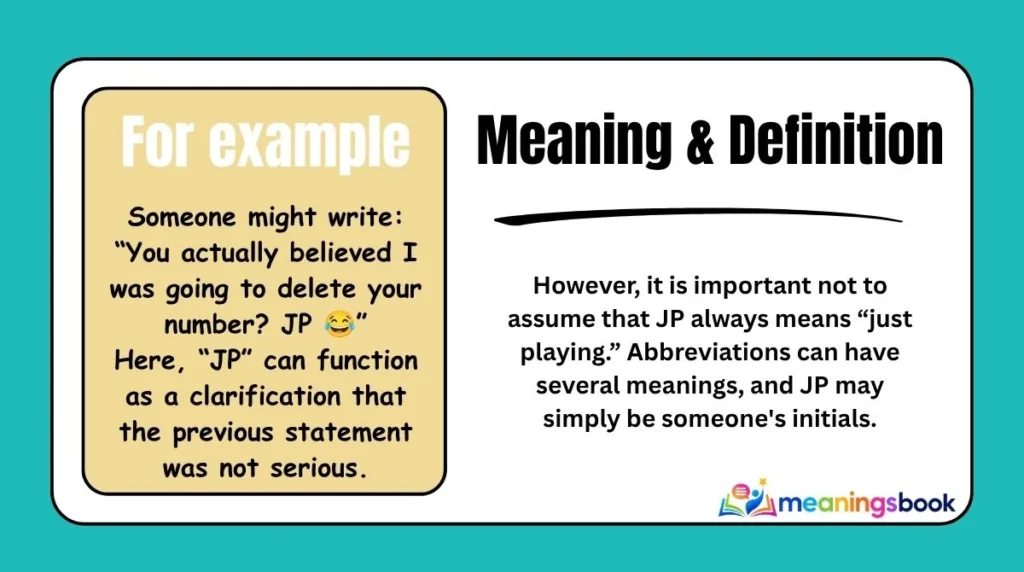
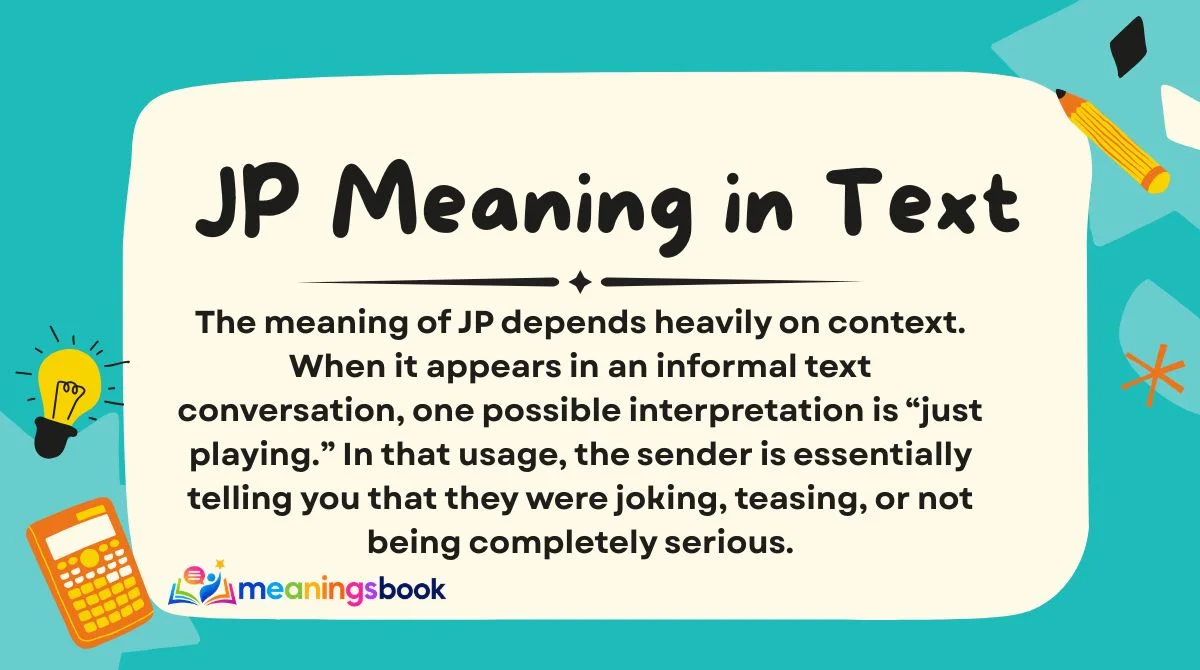
The meaning of JP depends heavily on context. When it appears in an informal text conversation, one possible interpretation is “just playing.” In that usage, the sender is essentially telling you that they were joking, teasing, or not being completely serious.
For example, someone might write:
“You actually believed I was going to delete your number? JP 😂”
Here, “JP” can function as a clarification that the previous statement was not serious.
Another example could be:
“I’m never talking to you again. JP, you know I’m kidding.”
In this type of conversation, the abbreviation helps soften a statement that could otherwise sound serious.
However, it is important not to assume that JP always means “just playing.” Abbreviations can have several meanings, and JP may simply be someone’s initials. For example, a person named James Parker might be referred to as JP by friends or coworkers.
It can also appear as a short form associated with Japan or Japanese in certain contexts. The exact interpretation depends on how the abbreviation is being used and what information surrounds it.
The safest approach is therefore to read the complete sentence and consider the relationship between the people communicating. If the conversation is playful and JP appears immediately after a joke, “just playing” may be a reasonable interpretation. If the conversation concerns a person’s name, a workplace, a country, or a technical subject, another meaning may be intended.
In short, JP is a context-dependent abbreviation, rather than a texting expression with one guaranteed definition.
Background
There is no single universally established origin for JP as an informal texting abbreviation meaning “just playing.” Informal internet language develops organically, with people shortening phrases to make digital conversations quicker and more casual.
Texting abbreviations became particularly useful when people communicated through systems where typing was slower or less convenient than it is today. As online communication evolved, users began creating shortened expressions for common phrases, reactions, and conversational signals.
Expressions such as “just playing” can be shortened because the surrounding conversation often makes the intended meaning understandable. When a person makes an obviously exaggerated statement and then adds a short clarification, the abbreviation can signal that the statement should not be taken literally.
However, the development of JP should not be treated as having one definite historical source. Different communities may use the same two letters independently, and an abbreviation can acquire different meanings over time.
This is especially important with very short combinations of letters. Unlike a distinctive slang word, “JP” contains only two letters and can naturally function as initials, a label, a shortened name, or an abbreviation unrelated to texting slang.
For example, in one conversation, JP could refer to a friend whose initials are J.P. In another, it could be associated with Japan or Japanese. In an informal exchange, the same letters could potentially be used to mean “just playing.”
Therefore, there is no reliable reason to claim that every use of JP originated from one particular website, social-media community, or individual. The meaning must be determined from usage.
The modern internet has made this type of ambiguity even more common because people communicate across different countries, age groups, professions, and online communities. An abbreviation familiar to one group may be unfamiliar to another.
Usage in Different Contexts
JP in Chat
In casual chat, JP may be interpreted as “just playing” when it follows a joke, tease, prank-like statement, or exaggerated comment.
For example:
“You’re officially banned from my house 😂 JP.”
The sender is likely signaling that the statement is not serious.
However, if someone simply sends:
“JP”
with no surrounding information, there is not enough context to confidently identify the intended meaning.
JP on Social Media
On social media, JP can have several interpretations. A person may use it as initials, part of a username, or an abbreviation understood within a particular community.
If it appears after a humorous statement, “just playing” may be possible. If it appears in a profile, username, caption, or discussion about a person, it may instead refer to someone’s initials.
Social-media posts also frequently omit context, making short abbreviations more difficult to interpret.
JP in Professional Fields
In professional communication, JP should not automatically be interpreted as texting slang. It may be an abbreviation specific to an organization, document, job title, publication, country, technical term, or person’s initials.
Professional writing usually provides additional context, so the surrounding words should guide interpretation.
If you receive “JP” in a workplace document and its meaning is unclear, asking the writer is safer than assuming it means “just playing.”
JP in Casual Conversations
Among friends, abbreviations can be highly personal. Two people may use JP as an inside abbreviation that would make sense only to them.
For this reason, context is especially important in casual conversations. The same letters may mean something completely different between two groups of friends.
Meaning in Chat, WhatsApp, Instagram, and TikTok
The interpretation of JP can vary across messaging and social-media platforms because people use abbreviations according to their own communication habits.
On WhatsApp, JP may appear in a casual exchange after teasing or joking. For example:
“I told everyone your secret. JP 😂”
If the preceding message clearly establishes a joke, the sender may be using JP to indicate that they were only playing around.
But WhatsApp users can also use JP as someone’s initials or another personal abbreviation. Therefore, the platform itself does not guarantee a particular meaning.
On Instagram, JP may appear in comments, direct messages, captions, usernames, or profile descriptions. A comment such as “JP 😂” may have a different meaning from “JP” appearing as part of someone’s name.
Instagram also contains international communities, so abbreviations may have meanings influenced by different languages and cultures.
TikTok
TikTok conversations frequently use short expressions, slang, and community-specific language. JP can therefore be interpreted according to the particular conversation or creator community.
If a creator uses JP repeatedly in captions or comments, the surrounding content may reveal what they mean. A single occurrence without context is much harder to interpret reliably.
Examples
Here are a few examples where context matters:
Example 1 — joking:
“You’re my least favorite person today. JP 😂”
Possible meaning: “Just playing.”
Example 2 — initials:
“JP will send the files later.”
Possible meaning: JP is someone’s initials or shortened name.
Example 3 — unclear context:
“JP”
Possible meanings: several possibilities exist, and more context is needed.
The important point is that WhatsApp, Instagram, and TikTok do not give JP one universal definition. The conversation determines the likely meaning.
Meaning in Physics, Medical, and Aircraft Terminology
JP in Physics
JP does not have one universally recognized standard meaning in physics that can safely be assumed whenever the abbreviation appears. Physics uses many abbreviations, symbols, and specialized terms, and their definitions depend on the particular subject, textbook, paper, or equation.
Therefore, if JP appears in a physics context, the surrounding material should be checked rather than interpreting it as “just playing.”
JP in Medical Terminology
JP is not a single universal medical abbreviation with one meaning across all medical contexts. Healthcare terminology contains many abbreviations, and some can have different meanings depending on the specialty or institution.
If you encounter JP in a medical document, prescription-related material, clinical note, or healthcare discussion, it is better to use the surrounding terminology or ask a qualified professional for clarification.
A medical abbreviation should never be interpreted solely from its texting meaning.
JP in Aircraft or Aviation Terminology
JP does not have one universally applicable aviation meaning that should automatically be assumed in every aircraft-related conversation.
Aviation uses standardized terminology, codes, identifiers, and abbreviations. A two-letter combination can have a specific meaning in one aviation system while meaning something else in another context.
Consequently, if JP appears in an aviation document or technical discussion, its meaning should be established from that specific source or terminology system.
The Key Distinction
The main lesson is simple: informal texting meaning and technical meaning are not interchangeable. If JP appears in a casual message after a joke, “just playing” may make sense. If it appears in a technical document, a different interpretation may be required.
Common Misconceptions
One common misconception is that JP always means “just playing.” That interpretation may fit certain informal conversations, but it is not guaranteed.
Another mistake is assuming that every two-letter abbreviation found online is standardized slang. Internet language is often inconsistent. Different communities can create different abbreviations, and individuals may use initials or private shorthand.
A second misconception is that the platform determines the meaning. Seeing JP on WhatsApp, Instagram, or TikTok does not automatically give it a fixed definition. The same abbreviation can appear on all three platforms while referring to different things.
People may also confuse JP with other short expressions. Because the abbreviation contains only two letters, it can be mistaken for initials, a geographic abbreviation, or another shorthand expression.
Another issue occurs when people interpret an abbreviation without reading the previous message. If someone writes:
“I’m deleting your number. JP.”
the surrounding sentence provides an important clue. Without it, “JP” alone is ambiguous.
Finally, people sometimes assume that a slang interpretation applies in professional or technical writing. It is safer to treat technical contexts separately. A medical, aviation, academic, or workplace abbreviation should be interpreted according to that field rather than automatically using an internet-slang definition.
Similar Terms & Alternatives
Several expressions can serve a similar conversational purpose when someone wants to indicate that they were joking or teasing.
“Just kidding” or “JK”
JK commonly means “just kidding.” It is often used after a statement that was not intended seriously.
Example:
“I’m blocking you. JK 😂”
“Just joking”
“Just joking” directly communicates that the previous statement was intended as humor.
“Just playing”
“Just playing” is another way to explain that someone was teasing or not being serious. JP may be used as shorthand for this phrase in some informal conversations.
“Kidding”
Simply writing “kidding” can clarify that a previous statement was humorous.
“LOL”
“LOL” generally communicates laughter or amusement. It does not necessarily mean that the preceding statement was a joke, so it is not an exact replacement for “just playing.”
“I’m joking”
This is the clearest option when there is a risk that the other person might misunderstand the message.
These expressions are not perfectly interchangeable. Their tone can vary, and some are more widely recognized than others.
How to Respond to It
Your response to JP should depend on what the sender appears to mean.
If the person seems to be using JP as “just playing,” you can respond casually:
“Haha, I knew you were joking.”
Or:
“You got me 😂”
If the statement was confusing, you can ask:
“What do you mean by JP?”
If you think JP refers to someone’s initials, you could simply continue the conversation without treating it as slang.
When the meaning is unclear, asking for clarification is usually the best approach. There is no need to force an interpretation based only on two letters.
Possible responses
If you understand the joke:
“Haha, okay 😂”
If you want to play along:
“Very funny 😭”
If you’re unsure:
“JP means what here?”
If you think they mean “just playing”:
“Lol, I figured you were just playing.”
If the message sounds serious:
“Wait, are you serious or joking?”
The best response is one that matches the tone of the conversation rather than treating JP as having one guaranteed meaning.
Differences from Similar Words
The biggest difference between JP and similar abbreviations is certainty of interpretation.
| Term | Common interpretation | Typical tone |
|---|---|---|
| JP | Can mean “just playing” in some informal contexts, but is context-dependent | Casual |
| JK | “Just kidding” | Casual, humorous |
| LOL | Laughing or finding something funny | Informal |
| LMAO | Stronger expression of laughter | Very informal |
| Kidding | The speaker is joking | Casual |
| Joking | The statement is not meant literally | Casual |
| IDK | “I don’t know” | Neutral/informal |
JP is different from JK because JK is much more directly associated with “just kidding” in texting, whereas JP can have multiple interpretations.
JP is also different from LOL. If someone writes “LOL,” they are generally expressing amusement. If someone uses JP as “just playing,” they are clarifying the intention behind a previous statement.
Similarly, “kidding” is an ordinary English word that can be understood without knowing an abbreviation. JP is shorter but more ambiguous.
When clarity matters, spelling out the intended phrase is usually better than relying on a short abbreviation.
Relevance in Online Conversations & Dating Apps
Short abbreviations can become especially important in online conversations because people often communicate without facial expressions, voice tone, or body language. A sentence that sounds playful in person can appear serious when written.
On dating apps, for example, someone might make a teasing statement and then use JP to indicate that they are not being serious. The meaning can therefore depend strongly on the tone of the conversation and the relationship between the two people.
Consider:
“Okay, I’m removing you from my matches. JP 😂”
If the conversation has been playful, the abbreviation may be intended to soften the joke.
However, dating conversations also involve people who may not share the same slang vocabulary. One person may recognize JP while another may not. Misunderstandings can therefore happen easily.
The same principle applies to social-media DMs and new online friendships. If you do not know someone well, a short abbreviation may be harder to interpret because you have less information about their communication style.
Dating-app users should also avoid assuming that an ambiguous abbreviation reveals a person’s feelings. JP alone does not prove that someone is flirting, rejecting, teasing, or being sarcastic. The entire conversation provides the better clue.
In online communication, context, tone, punctuation, emojis, and the preceding message can all help determine what the sender intended.
Frequently Asked Questions
What does JP mean in text?
JP can mean “just playing” in some informal texting conversations, especially when someone has just made a joke or teasing statement. However, JP is not universally defined that way. It can also represent initials, a name, or another abbreviation. Always consider the surrounding message before deciding what the sender means.
What does JP mean in chat?
In chat, JP may be used to mean “just playing,” particularly when someone wants to clarify that they were joking or teasing. For example, a person may make an exaggerated statement and then add JP. However, if the abbreviation appears without context, its intended meaning may be unclear.
Is JP a slang term?
JP can function as informal slang when it is used to mean “just playing,” but it is not exclusively a slang expression. The same letters can represent initials or other abbreviations. Therefore, whether JP is slang depends on how the sender is using it in the particular conversation.
What does JP mean on social media?
On social media, JP can have different meanings depending on where it appears. In a humorous conversation, it may mean “just playing.” In a username, caption, or discussion about a person, it may represent initials or another identifier. The platform itself does not establish one universal definition.
How do you respond to JP in a text?
If JP appears after an obvious joke, you can respond casually with something like “Haha, I knew you were joking” or “You got me.” If you cannot determine what JP means, simply ask, “What do you mean by JP?” Clarification is better than guessing when the context is unclear.
Can JP have different meanings?
Yes, JP can have different meanings. In some informal messages it may mean “just playing,” while elsewhere it can represent someone’s initials, a name, or another abbreviation. Because the letters are very short and widely usable, the surrounding words and subject of the conversation are important for interpretation.
Does JP mean “just playing” or “just kidding”?
JP may be used to mean “just playing,” while JK is more commonly associated with “just kidding.” Both can indicate that a previous statement was not serious, but they are not necessarily interchangeable in every conversation. If someone uses JP, the context should determine whether that interpretation makes sense.
What should I do if I don’t understand JP?
If you do not understand JP, ask the sender directly rather than assuming its meaning. A simple message such as “What does JP mean here?” is enough. This is especially useful in professional, technical, medical, or unfamiliar conversations where interpreting an abbreviation incorrectly could cause confusion.
Conclusion
JP is a context-dependent abbreviation that can mean “just playing” in some informal text and chat conversations. When used this way, it generally signals that the sender was joking, teasing, or not being completely serious. However, JP does not have one universal meaning across every conversation or platform. It can also represent initials, a name, or another abbreviation depending on the situation.
The surrounding message is therefore the most important clue. If JP follows a playful or exaggerated statement, “just playing” may be a reasonable interpretation. If it appears in a username, professional document, technical discussion, or conversation about a person, another meaning may be intended.
When you are unsure, asking for clarification is the safest approach. Understanding short internet abbreviations is less about memorizing one fixed definition and more about recognizing how people use them in context. This approach helps prevent misunderstandings in texting, social media, casual conversations, and online relationships.

I am Ethan Whitmore, an English teacher and vocabulary enthusiast who explains words, phrases, and meanings in text through simple examples to make English easier for everyone.