
If you have received a text containing “ISTG,” you may have wondered whether it is serious, humorous, angry, or simply another internet abbreviation.
ISTG is a common piece of online slang that appears in text messages, social media comments, group chats, and casual conversations.
Because it is short and strongly expressive, its meaning can sometimes depend on the situation and the relationship between the people communicating.
People often search for the meaning of ISTG after seeing it in a message without understanding the emotion behind it.
The abbreviation is especially common when someone wants to emphasize that they are being truthful, express frustration, or make a strong statement. Understanding the phrase behind the letters makes it much easier to interpret the speaker’s intention.
Once you know what ISTG stands for, its use in everyday digital conversations becomes relatively straightforward.
Quick Answer
ISTG meaning in text is “I swear to God.” It is commonly used in chats, text messages, and social media to strongly emphasize that someone is telling the truth, making a serious statement, or expressing frustration. Depending on context, ISTG can sound sincere, annoyed, dramatic, humorous, or emphatic.
Meaning & Definition
ISTG stands for “I swear to God.” It is an informal abbreviation used primarily in digital communication. The expression comes from the longer phrase “I swear to God,” which people use to emphasize the seriousness or truthfulness of what they are saying.
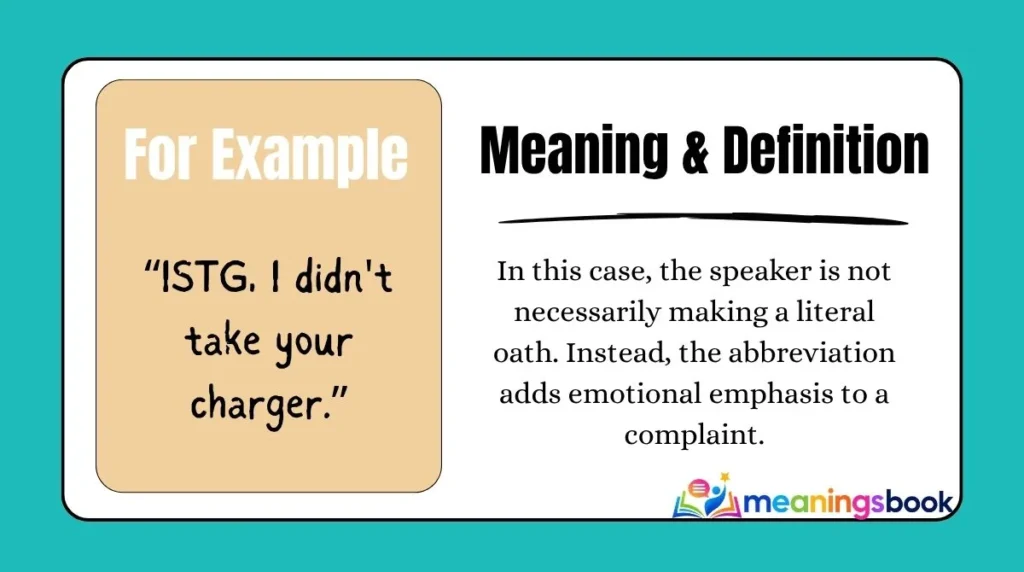
In a text conversation, someone might write “ISTG” before or after a statement when they want the other person to believe them. For example:
“ISTG, I didn’t take your charger.”
Here, the person is strongly insisting that they did not take the charger.
ISTG can also communicate frustration. Someone might say:
“ISTG, this computer never works when I need it.”
In this case, the speaker is not necessarily making a literal oath. Instead, the abbreviation adds emotional emphasis to a complaint.
The tone can therefore range from sincere to dramatic. A friend might use ISTG jokingly when describing something ridiculous, while another person might use it seriously when defending themselves.
The expression does not automatically mean that the speaker is angry. Context matters. Punctuation, surrounding words, capitalization, and the relationship between the people involved can all affect how ISTG sounds.
For example, “istg 😂 you are impossible” may be playful, while “ISTG, stop doing that” can sound much more serious or irritated.
ISTG is generally considered informal internet slang, so it is most appropriate in casual communication rather than formal writing. Its main function is emphasis: it tells the reader that the following statement should be taken seriously, strongly, or emotionally.
Background
ISTG developed as a shortened form of the expression “I swear to God.” Like many internet abbreviations, it became useful because digital communication encourages people to communicate quickly while still expressing emotion.
There is no need to assume that ISTG itself originated from a particular website, app, or single online community. The underlying phrase existed in spoken language long before the abbreviation became common in texting. Digital users simply shortened the expression into four letters that could be typed quickly.
The exact history of when ISTG became widespread as an abbreviation is difficult to establish with certainty, so it is better not to assign it a specific inventor or precise origin without reliable historical evidence. Its development fits the broader pattern of online shorthand such as LOL, OMG, TBH, and IDK.
The important difference is that ISTG is not merely a way to save typing. It also preserves the emotional force of the original expression. Writing “ISTG” can make a statement feel more emphatic than simply saying “I really mean it.”
Over time, people have also used the abbreviation humorously. Online communication often exaggerates emotions for entertainment, so ISTG can appear in situations that are not genuinely serious.
For example:
“ISTG this cat knows when I’m trying to sleep.”
The speaker probably is not making a formal oath. They are using the phrase playfully to emphasize how strongly they feel about the situation.
Capitalization also varies. ISTG, istg, and occasionally Istg can all represent the same abbreviation. Lowercase usage is particularly common in casual texting, while uppercase letters can sometimes make the expression look more emphatic.
Thus, its background is best understood as the evolution of a familiar emphatic phrase into convenient digital shorthand.
Usage in Different Contexts
The meaning of ISTG remains essentially the same across most casual settings, but its tone can change significantly depending on context.
In Chat
In private chats, ISTG is often used to emphasize honesty, frustration, surprise, or a strong reaction.
“ISTG I sent it yesterday.”
This suggests the person strongly insists that they sent something.
It can also introduce an emotional reaction:
“ISTG that was the funniest thing I’ve seen all week.”
Here, the expression is enthusiastic rather than angry.
On Social Media
ISTG frequently appears in comments, captions, replies, and posts. Social media users may use it to make reactions sound more dramatic or entertaining.
“ISTG people will argue about literally anything.”
The speaker is emphasizing their frustration or amusement.
In Casual Conversations
Friends and family members may use ISTG when joking, complaining, defending themselves, or emphasizing a point. The abbreviation is generally understood as informal and conversational.
In Professional Fields
ISTG is not normally appropriate for formal professional communication. In a workplace email, report, academic paper, business proposal, or official document, writing “I swear to God” or “ISTG” would generally sound too informal.
A professional writer would normally express certainty or emphasis more directly, such as “I can confirm,” “I assure you,” or “I strongly believe,” depending on the intended meaning.
The abbreviation is therefore primarily associated with casual digital communication. Its interpretation depends less on a specialized definition and more on the speaker’s emotional intent.
Meaning in Chat, WhatsApp, Instagram, and TikTok
ISTG can appear on virtually any platform where informal conversations take place. The basic meaning remains “I swear to God,” but people often use it as an emotional intensifier rather than a literal oath.
On WhatsApp, someone might use it when defending themselves:
“ISTG, I wasn’t ignoring you. I was sleeping.”
On Instagram, it may appear in comments or direct messages:
“ISTG this outfit looks amazing.”
Here, the phrase strengthens the compliment.
On TikTok, ISTG can be used in captions, comments, or replies, particularly when someone wants to exaggerate a reaction for humor:
“ISTG this sound gets stuck in my head every time.”
The abbreviation can also appear without a complete sentence:
“ISTG 😭”
In that situation, the surrounding conversation is especially important. The person may be expressing disbelief, frustration, amusement, or exasperation.
Another important point is capitalization. “ISTG” can look more forceful than “istg,” but capitalization does not create a different dictionary meaning. It is simply one way users convey emphasis.
The emoji used alongside the abbreviation can also change its emotional feel. For example, crying or laughing emojis may signal that the statement is exaggerated or humorous, while an angry emoji can make the expression sound more frustrated.
Because messaging platforms do not provide vocal tone or facial expressions, abbreviations such as ISTG often help users communicate emotion efficiently.
The safest interpretation is therefore to first identify what the person is reacting to. If they are defending themselves, ISTG likely emphasizes sincerity. If they are complaining, it probably emphasizes frustration. If they are joking, it may simply make the joke more dramatic.
Meaning in Physics, Medical, and Aircraft Terminology
ISTG does not have a standard, widely recognized meaning in basic physics, general medical terminology, or ordinary aircraft/aviation terminology that corresponds to its common texting meaning.
Physics
In physics, ISTG is not a standard abbreviation that generally means “I swear to God.” Scientific writing uses specialized symbols, abbreviations, and terminology, but the internet-slang interpretation does not belong to standard physics vocabulary.
If ISTG appears in a physics document, its meaning would need to be determined from that particular document’s terminology or abbreviation list rather than assumed to be texting slang.
Medical Terminology
ISTG is likewise not a standard general medical abbreviation for “I swear to God.” Medical abbreviations can vary between institutions and specialties, so an unfamiliar abbreviation in a clinical document should always be interpreted from its specific context.
It would be inappropriate to invent a medical definition simply because the letters could potentially represent other words.
Aircraft and Aviation
ISTG is not a standard everyday aviation abbreviation with the texting meaning discussed in this article. Aviation has its own extensive system of technical abbreviations and codes, and an abbreviation encountered in an aviation document should be checked against the relevant terminology for that context.
Therefore, if you encounter ISTG in a casual message, “I swear to God” is the natural interpretation. If you see the same letters in a specialized technical document, do not automatically assume the slang meaning.
Common Misconceptions
One common misconception is that ISTG always means the person is angry. That is not necessarily true. Although the abbreviation can express frustration, it can also communicate sincerity, excitement, humor, disbelief, or exaggeration.
For example:
“ISTG you’re the best friend ever.”
This is positive rather than angry.
Another misunderstanding is assuming that ISTG always represents a literal religious oath. In everyday online communication, many people use it as an established expression of emphasis. The speaker may simply mean “I really mean this” or “I seriously promise.”
People may also confuse ISTG with other abbreviations beginning with “I.” However, ISTG has a specific common expansion: “I swear to God.”
A further misconception is that capitalization changes the definition. “ISTG” and “istg” generally mean the same thing. Capital letters may make the message appear more emphatic, but they do not create a separate meaning.
Context is particularly important. Consider:
“istg 😂”
and:
“ISTG. Don’t do that again.”
The same abbreviation appears in both messages, but the emotional tone is very different. The first may be humorous or exaggerated, while the second can indicate genuine frustration.
Finally, people sometimes assume that every unfamiliar abbreviation has a specialized technical meaning. In most casual conversations, ISTG is simply internet shorthand. When it appears in a technical or professional document, however, context should be checked before assigning a meaning.
Similar Terms & Alternatives
Several expressions can perform a similar function to ISTG because they emphasize sincerity, certainty, or strong emotion.
“I swear”
This is the closest everyday alternative. It can be used without the religious reference found in the longer expression.
“Seriously”
This can emphasize that someone is not joking.
“Seriously, I didn’t do it.”
“I promise”
This focuses more directly on reassurance or commitment.
“I promise I wasn’t ignoring you.”
“For real”
This informal expression emphasizes sincerity.
“For real, that was amazing.”
“Honestly”
This can introduce a sincere opinion or statement.
“Honestly, I didn’t expect that.”
“I’m telling you”
This emphasizes that the speaker wants to be believed.
“I’m telling you, that’s exactly what happened.”
“No joke”
This indicates that something is genuine rather than exaggerated or humorous.
These alternatives are not perfect replacements in every situation. ISTG can carry a stronger emotional or dramatic tone, especially when someone is frustrated. The best alternative depends on whether the speaker wants to communicate honesty, reassurance, irritation, excitement, or emphasis.
How to Respond to It
How you respond to ISTG depends on what the other person is trying to communicate. First, look at the rest of the message rather than treating the abbreviation as automatically angry or serious.
If someone uses ISTG to assure you of something, you can respond naturally:
“Okay, I believe you.”
Or:
“Alright, fair enough 😂”
If the person is frustrated, an understanding response may work better:
“I know, that sounds really annoying.”
If they use ISTG jokingly, you can match the playful tone:
“😂 I know exactly what you mean.”
If you are unsure what they mean, there is nothing wrong with asking:
“Wait, are you serious?”
You can also respond directly to the actual statement rather than the abbreviation itself. For example, if someone writes:
“ISTG I didn’t eat your food.”
You might simply say:
“Okay, I won’t blame you then.”
The key is to interpret the surrounding message. ISTG tells you that the speaker is emphasizing something, but it does not always tell you exactly why they are emphasizing it.
Differences from Similar Words
| Expression | Main purpose | Typical tone |
|---|---|---|
| ISTG | Strong emphasis or insistence | Informal, emotional |
| I swear | Emphasize truth or sincerity | Casual, serious |
| I promise | Reassure or commit | Sincere, reassuring |
| Seriously | Emphasize that something is genuine | Direct |
| For real | Stress honesty or reality | Casual |
| Honestly | Introduce a sincere statement | Conversational |
| No joke | Emphasize that something is genuine | Informal |
The biggest difference between ISTG and “I promise” is the type of emphasis. ISTG can be used for frustration, disbelief, humor, or strong insistence, while “I promise” is more specifically associated with reassurance or commitment.
Similarly, “seriously” does not necessarily suggest that the speaker is making an oath-like statement. It simply emphasizes that they want their words taken seriously.
“ISTG” is also more internet-oriented because its abbreviated form is particularly common in texting and social media.
Relevance in Online Conversations & Dating Apps
ISTG can appear naturally in online friendships, social media conversations, group chats, and dating-app messages. In these environments, people often use abbreviations to make conversations quicker and more expressive.
On dating apps, the abbreviation can have different emotional effects depending on the relationship between the two people. Someone might write:
“ISTG your profile made me laugh.”
This can sound playful and enthusiastic.
Another person might say:
“ISTG you disappeared for two days 😂.”
Depending on the relationship, this could be teasing, flirtatious, or mildly annoyed.
The surrounding conversation is crucial. A person you barely know may use ISTG casually, while someone you have been talking to regularly may use it as part of an established joking style.
ISTG can also soften or intensify a message depending on emojis and punctuation. Lowercase “istg 😂” often feels casual, while “ISTG!” may appear much more forceful.
Because online communication lacks vocal tone, misunderstandings are possible. If you receive an ISTG message that seems unusually serious, look at the words around it before deciding how the person feels.
In most cases, however, ISTG simply signals strong emphasis. It does not automatically indicate anger, conflict, romance, or seriousness. The relationship, conversation history, punctuation, and surrounding language all contribute to the final interpretation.
Frequently Asked Questions
What does ISTG mean in text?
ISTG means “I swear to God” in text messages. People commonly use it to emphasize that they are telling the truth, making a strong statement, expressing frustration, or reacting dramatically to something. The exact tone depends on the surrounding message, so ISTG can be serious, playful, annoyed, excited, or humorous.
What does ISTG mean in chat?
In chat, ISTG means “I swear to God.” It is usually used as informal emphasis. Someone may type it when they want you to believe them, when they are frustrated, or when they want to make a reaction sound stronger. For example, “ISTG I didn’t do it” emphasizes that the speaker is insisting on their innocence.
Is ISTG a slang term?
Yes, ISTG is generally considered informal internet slang or texting shorthand. It is an abbreviated form of “I swear to God” and is most common in casual digital communication. It is generally unsuitable for formal reports, academic writing, professional correspondence, or other situations where standard language is expected.
What does ISTG mean on social media?
On social media, ISTG means “I swear to God” and is commonly used to emphasize a reaction or statement. It may appear in comments, captions, replies, or direct messages. Social media users frequently use it humorously or dramatically, so it does not necessarily mean that the person is genuinely angry or making a literal oath.
How should you respond to ISTG?
You should respond according to the context of the message rather than the abbreviation alone. If someone is reassuring you, you can say, “Okay, I believe you.” If they are joking, you can respond playfully. If they sound frustrated, acknowledging their concern may be better. When uncertain, simply asking whether they are serious can prevent misunderstandings.
Can ISTG have different meanings?
In ordinary texting and social media, ISTG most commonly means “I swear to God.” However, abbreviations can occasionally have specialized meanings in particular organizations, documents, or technical contexts. If you encounter ISTG outside casual communication, check the surrounding material rather than automatically applying the slang definition.
Does ISTG mean someone is angry?
No, ISTG does not automatically mean someone is angry. It is primarily an expression of emphasis and can communicate sincerity, frustration, excitement, disbelief, humor, or exaggeration. The tone depends on the complete message. “ISTG 😂” may be playful, while “ISTG, stop” may indicate genuine irritation.
Is ISTG appropriate for professional messages?
ISTG is generally not appropriate for formal professional communication because it is informal internet slang. In workplace or academic settings, clearer expressions such as “I can confirm,” “I assure you,” or “I strongly believe” are usually more suitable. Whether it is acceptable in an informal workplace chat depends on the culture and relationship between the participants.
Conclusion
ISTG means “I swear to God,” and it is primarily used as informal texting and internet slang. People use it to emphasize honesty, make a strong statement, express frustration, or add dramatic or humorous energy to a conversation. Its meaning is usually straightforward, but its tone depends heavily on context.
In texts, WhatsApp messages, Instagram comments, TikTok discussions, group chats, and dating-app conversations, ISTG can sound serious or playful depending on the surrounding words, punctuation, emojis, and relationship between the speakers. It is not normally a standard term in physics, medical terminology, or aviation.
The most important thing to remember is that ISTG does not automatically indicate anger or a literal oath. In many online conversations, it simply means that the person wants to strongly emphasize what they are saying. Looking at the complete message will usually reveal the intended emotion and make the abbreviation easy to understand.

I am Ethan Whitmore, an English teacher and vocabulary enthusiast who explains words, phrases, and meanings in text through simple examples to make English easier for everyone.



