If someone sends you “IDM” in a text message, comment, or direct message, the meaning may not be immediately obvious. In everyday online conversations, abbreviations are often used to make messages faster, shorter, and more casual.
IDM is one of those abbreviations that commonly appears in texting and social media, especially when someone is responding to a suggestion, request, or question. In most casual conversations, IDM means “I don’t mind.”
It usually communicates that the person has no strong preference and is comfortable with the option being discussed. For example, if someone asks, “Do you want to meet at 6 or 7?” a reply such as “IDM” can mean that either time is acceptable.
However, abbreviations can sometimes have different meanings depending on the setting. Understanding the surrounding conversation is therefore important before interpreting the term. This guide explains what IDM means, how people use it, and how to respond naturally.
Quick Answer
IDM meaning in text is usually “I don’t mind.” It is commonly used in chats and messages to say that someone has no particular preference or is comfortable with a choice. For example, if someone asks, “Where should we go?” replying “IDM” can mean that you are happy to let the other person decide.
Meaning & Definition
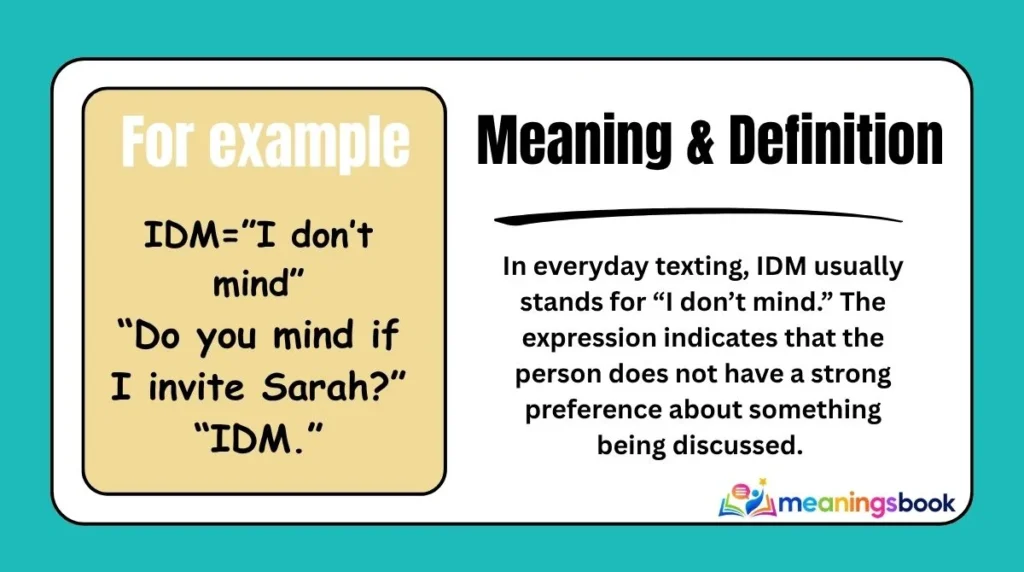
In everyday texting, IDM usually stands for “I don’t mind.” The expression indicates that the person does not have a strong preference about something being discussed. It can be used when someone is willing to accept different options or does not consider the choice particularly important.
For example:
- “Should we watch a movie or play a game?”
- “IDM.”
Here, the response means that either option is fine.
The phrase can also be used when someone asks about a particular action or arrangement:
“Do you mind if I invite Sarah?”
“IDM.”
In this situation, the person is generally saying that they do not object.
The tone of IDM is usually casual, neutral, and relaxed. It is particularly common in short conversations where participants already understand the context. Because it is an abbreviation, it tends to fit informal communication better than formal writing.
The exact interpretation can depend on what comes immediately before it. “IDM” may communicate genuine flexibility, mild indifference, or simply a willingness to let another person choose. For example, “IDM, you choose” clearly indicates that the speaker is leaving the decision to someone else.
It is also worth remembering that an abbreviation is not always interpreted correctly without context. Someone unfamiliar with texting abbreviations may not know what IDM means, while another reader may recognize it immediately.
In most ordinary text conversations, however, “I don’t mind” is the primary interpretation. If the conversation involves a choice, invitation, preference, or permission, IDM generally means that the speaker is comfortable with the situation and does not have a strong objection.
Background
The expression “I don’t mind” existed long before internet slang and texting abbreviations became popular. IDM is simply a shortened form that fits the broader habit of reducing common phrases to a few letters in digital communication.
There is no need to assume that IDM originated from a particular social-media platform or from a specific person. Shortened expressions became increasingly useful as people began communicating through text messages, instant messaging services, online forums, and social platforms where quick replies were convenient.
The abbreviation follows a familiar pattern in internet language: users take the initial letters of a frequently used phrase and turn them into a compact expression. Similar patterns can be seen in many other texting abbreviations, although each abbreviation has to be interpreted according to context.
IDM is especially straightforward because its letters correspond naturally to I + D + M, the initial letters of “I Don’t Mind.”
Its popularity is also connected to the conversational nature of the phrase. “I don’t mind” is something people say frequently when discussing plans, preferences, invitations, food, entertainment, schedules, or other everyday decisions. Turning it into IDM makes it possible to communicate the same general idea quickly.
However, there is not necessarily one universal meaning for the three letters in every environment. IDM can also appear as an abbreviation or name in specialized contexts, including technology and organizations. That does not change the ordinary texting meaning, but it is a reminder that context matters.
When someone uses IDM in a personal chat without any technical or professional context, the safest interpretation is normally “I don’t mind.” If the surrounding conversation is about a specialized subject, the abbreviation may need to be interpreted differently.
Therefore, it is better to understand IDM as a context-dependent abbreviation whose common informal texting meaning is “I don’t mind,” rather than assuming that every appearance of the letters has exactly the same definition.
Usage in Different Contexts
Chat
In private chats, IDM is commonly used when someone wants to indicate that they are flexible about a decision.
For example:
“Pizza or burgers?”
“IDM.”
The response suggests that either choice is acceptable.
It can also appear in discussions about schedules:
“Can we meet tomorrow instead?”
“IDM.”
Here, the speaker is indicating that they do not object to the proposed change.
Social Media
On social media, IDM can appear in comments, direct messages, replies, or group conversations. Its meaning is usually similar to its meaning in private texting. A person may use it when responding to a suggestion or expressing that they have no strong preference.
Because social-media conversations are often informal, abbreviations such as IDM can be understood without the full phrase being written.
Professional Fields
In professional environments, caution is useful. IDM does not have one universal professional definition. Different industries, organizations, technical systems, or documents can use the same initials for unrelated concepts.
If IDM appears in an email, report, software interface, academic document, or industry-specific discussion, the surrounding terminology should be examined before assuming it means “I don’t mind.”
In ordinary workplace messaging, however, someone may still use IDM informally with the familiar meaning “I don’t mind,” particularly when chatting with colleagues.
Casual Conversations
Casual conversations are one of the most natural settings for IDM. Friends may use it when discussing plans, food, entertainment, travel, meeting times, or other everyday choices.
For instance:
“You want coffee or tea?”
“IDM, you pick.”
The phrase communicates flexibility without requiring a long response.
Overall, the context and relationship between the speakers determine whether IDM sounds natural, neutral, or overly informal.
Meaning in Chat, WhatsApp, Instagram, and TikTok
IDM can be used across many digital communication platforms because its meaning is based on the phrase “I don’t mind,” not on one particular app.
On WhatsApp, IDM may appear in one-to-one conversations or group chats. A person might use it when discussing plans:
“Should we leave at 8?”
“IDM.”
This generally means the person has no objection to the proposed time.
On Instagram, IDM can appear in direct messages or casual comments. Someone might use it when responding to a suggestion, invitation, or question.
For example:
“Do you want to go with us?”
“IDM.”
The meaning is generally that the person is fine with the suggestion.
TikTok
TikTok conversations can be fast and informal, so abbreviations may appear in comments or messages. If IDM is used in response to a question involving a preference, it can usually be understood as “I don’t mind.”
For example:
“Which version should I post?”
“IDM, both are good.”
In this example, the person is saying that either version is acceptable.
General Chatting
The important point is that IDM does not normally acquire a completely different meaning simply because it appears on WhatsApp, Instagram, or TikTok. The surrounding conversation is more important than the platform.
If the message concerns a choice, request, invitation, or preference, “I don’t mind” is usually the intended meaning.
Because abbreviations can sometimes be ambiguous, a person can ask for clarification if the context does not make the meaning clear.
Meaning in Physics, Medical, and Aircraft Terminology
IDM does not have one universally recognized meaning in physics, medicine, and aviation that should automatically replace its ordinary texting interpretation.
Physics
There is no standard general physics definition of IDM that should be assumed whenever the abbreviation appears. If IDM occurs in a physics paper, textbook, equation, laboratory document, or technical discussion, its meaning would need to be determined from that specific material.
Therefore, it would be inaccurate to invent a physics definition simply because the letters appear in a technical context.
Medical Terminology
IDM is not a universal standalone medical term with one meaning that applies across all medical communication. Medical abbreviations can vary between specialties, institutions, and documents, so context is particularly important.
If you encounter IDM in a medical report or healthcare-related message, you should rely on the surrounding terminology or the source’s abbreviation list rather than automatically interpreting it as “I don’t mind.”
For medical information, unfamiliar abbreviations should be clarified with an appropriate healthcare professional when their meaning could affect understanding.
Aircraft or Aviation Terminology
IDM does not have one universally applicable aviation meaning that can safely be assumed from the letters alone. Aviation terminology is highly context-specific, and abbreviations can refer to systems, procedures, organizations, or technical concepts.
If IDM appears in an aircraft manual, aviation document, flight-related system, or technical discussion, its specific definition should be established from that document or terminology system.
The key distinction is simple: in ordinary texting, IDM commonly means “I don’t mind,” while specialized fields may use the same letters differently. The setting determines which interpretation makes sense.
Common Misconceptions
One common misconception is that IDM always has the same meaning everywhere. In casual texting, “I don’t mind” is the most likely interpretation, but abbreviations can have different meanings in specialized environments.
Another misunderstanding involves the tone of the phrase. Some readers may interpret “IDM” as rude, dismissive, or uninterested because it is so short. Usually, however, it simply expresses flexibility. The tone depends heavily on the surrounding conversation.
For example:
“Where do you want to eat?”
“IDM.”
This can mean, “I’m okay with whatever you choose.”
However, there is a subtle difference between not having a preference and being enthusiastic. Saying “IDM” does not necessarily mean that the person strongly likes every option. It usually means that they do not care enough to choose between them or are comfortable allowing someone else to decide.
Another misconception is that IDM is always an appropriate replacement for “I don’t mind” in formal communication. It is generally an informal abbreviation, so spelling out the phrase is usually clearer in formal documents.
People may also confuse IDM with other abbreviations beginning with “ID.” The correct interpretation should come from the complete message rather than from the letters alone.
Finally, readers sometimes assume that an abbreviation must have a special slang meaning simply because it appears online. In the case of IDM, the most common casual interpretation is quite literal: “I don’t mind.”
Similar Terms & Alternatives
Several expressions can communicate an idea similar to IDM, although their tone and exact meaning can differ.
“I don’t care”
This can sometimes communicate a similar lack of preference, but it may sound stronger or harsher than “I don’t mind.” Depending on the situation, “I don’t care” can suggest disinterest rather than simple flexibility.
“Either is fine”
This is a clear alternative when someone is choosing between two options. It explicitly communicates that both choices are acceptable.
“Up to you”
This means the speaker is allowing the other person to make the decision. It can be similar to IDM when the speaker genuinely has no preference.
“Whatever works”
This usually means the speaker is flexible about arrangements, schedules, or plans.
“I’m good with either”
This is a friendly way to say that both choices are acceptable.
“No preference”
This is more neutral and can work in situations where the speaker wants to clearly state that they do not favor one option.
“Fine by me”
This indicates acceptance of a proposal or choice.
These alternatives are not perfect synonyms in every situation. “IDM” generally communicates that the speaker does not object or does not have a strong preference, while expressions such as “up to you” specifically hand the decision to another person.
How to Respond to It
If someone sends you “IDM,” your best response depends on what you asked them.
If you gave them two options and they said IDM, you can simply choose one:
“Okay, let’s go with 7 PM.”
If you want to confirm that they genuinely have no preference, you could say:
“So either one works for you?”
If you are discussing a plan, you might respond:
“Cool, I’ll decide then.”
If the person has said IDM to an invitation, you can move the conversation forward:
“Great, I’ll send you the details.”
You do not always need to respond with another abbreviation. A normal conversational reply is perfectly natural.
If the meaning is unclear because there is no obvious context, asking is also reasonable:
“By IDM, do you mean you don’t mind?”
This is particularly useful if the conversation is important or if the abbreviation could have a specialized meaning.
The tone of your response should also match the relationship. With a close friend, something as simple as “Cool 👍” may be enough. In a more formal conversation, you may want to use a complete sentence.
One important point is that IDM is not necessarily an invitation to stop talking. If someone says “IDM,” they may simply be giving you permission to choose. You can continue the conversation naturally by making the decision or asking a follow-up question.
Differences from Similar Words
Understanding the difference between IDM and related expressions can help prevent miscommunication.
| Expression | General meaning | Typical tone |
|---|---|---|
| IDM | I don’t mind; I have no strong preference | Casual, neutral |
| I don’t care | The choice does not matter to me | Can sound blunt |
| Up to you | You can make the decision | Casual, flexible |
| Either is fine | Both options are acceptable | Clear, neutral |
| Whatever | Any option may be acceptable | Can sound dismissive |
| Fine by me | I accept the suggestion | Casual, agreeable |
| No preference | I do not favor one option | Neutral, direct |
The biggest difference is often tone rather than basic meaning.
For example, “IDM” and “I don’t care” may both appear to communicate indifference, but they can feel different to the recipient. “I don’t mind” generally sounds less negative because it communicates acceptance rather than a lack of concern.
Similarly, “up to you” places the responsibility for the decision on the other person. IDM does not always explicitly do that, although it can have that practical effect in a conversation.
“Whatever” is another expression that requires caution. It can mean that the speaker genuinely accepts any choice, but it can also sound annoyed or dismissive depending on the situation.
Therefore, when interpreting IDM, consider not only the dictionary-style meaning but also the conversation, relationship, and tone surrounding it.
Relevance in Online Conversations & Dating Apps
IDM can appear in modern online conversations whenever people discuss choices, plans, invitations, or preferences. This includes social media, direct messages, group chats, dating apps, and other forms of casual digital communication.
On dating apps, someone might use IDM while discussing a meeting location or activity:
“Coffee or dinner?”
“IDM, what do you prefer?”
In this case, IDM generally means the person is comfortable with either option and is inviting the other person to choose.
The relationship between the speakers can affect how the message feels. Between close friends, “IDM” may sound completely natural and relaxed. Between two people who have just started talking, the same short response could feel slightly detached if there is little surrounding context.
However, it is important not to overinterpret a short abbreviation. A person saying IDM does not automatically mean they are uninterested, bored, or emotionally distant. They may simply have no preference.
At the same time, repeated one-word or abbreviated responses can sometimes make a conversation feel less engaged. That conclusion should be based on the person’s overall communication pattern rather than on IDM alone.
On dating platforms especially, context matters. If someone asks, “Would you rather meet Friday or Saturday?” and receives “IDM,” the most straightforward interpretation is that either day works. If someone sends IDM in response to a more emotional or personal question, the intended meaning may require closer attention to the conversation.
In general, IDM is best understood as a flexible, context-dependent expression rather than a hidden emotional signal.
Frequently Asked Questions
What does IDM mean in text?
IDM usually means “I don’t mind” in text messages. It tells the other person that the speaker has no strong preference or does not object to the option being discussed. For example, if someone asks whether you prefer one restaurant or another, replying “IDM” generally means that either choice is acceptable.
What does IDM mean in chat?
In chat, IDM generally means “I don’t mind.” It is often used as a quick response to questions about plans, choices, schedules, or preferences. Someone might say “IDM” when they are happy for the other person to choose. Its exact tone depends on the surrounding conversation.
Is IDM a slang term?
IDM is best described as an informal texting abbreviation rather than a specialized slang word. It is a shortened form of “I don’t mind” and is most natural in casual digital communication. Because it is informal, spelling out the full phrase may be preferable in formal or professional writing.
How do you respond to IDM?
You can respond to IDM by making the decision, confirming that the person has no preference, or continuing the conversation. For example, if someone says “IDM” after you offer two meeting times, you could reply, “Okay, let’s do 7.” If the context is unclear, you can simply ask what they mean.
What does IDM mean on social media?
On social media, IDM usually has the same casual meaning: “I don’t mind.” It may appear in comments, direct messages, or group discussions when someone is responding to a suggestion or choice. The platform itself usually does not change the meaning; the surrounding conversation provides the necessary context.
Can IDM have different meanings?
Yes, IDM can have different meanings in specialized contexts, although “I don’t mind” is the common interpretation in casual texting. Technical, professional, organizational, or industry-specific documents may use the same letters differently. When the context is specialized, the surrounding material should be checked before deciding what IDM means.
Does IDM mean someone is uninterested?
Not necessarily. IDM usually means that the person has no strong preference or does not object to something. A short reply may sometimes feel less enthusiastic than a detailed response, but IDM alone does not prove that someone is uninterested. The overall conversation is more useful for understanding their level of engagement.
What does IDM mean in a dating conversation?
In a dating conversation, IDM generally means “I don’t mind” when the discussion involves a choice or plan. For example, if someone asks whether you prefer coffee or dinner and you respond “IDM,” you are saying that either option works. The phrase does not automatically indicate romantic interest or disinterest.
Conclusion
IDM is a common informal abbreviation used in digital conversations, and its most familiar texting meaning is “I don’t mind.” People typically use it when they have no strong preference, do not object to a suggestion, or are comfortable allowing someone else to make a choice.
It can appear in private chats, group messages, social-media conversations, and dating-app discussions. Although the basic meaning is straightforward, the tone can vary depending on the surrounding conversation and the relationship between the people communicating. IDM should not automatically be interpreted as boredom, rejection, or lack of interest simply because it is short.
At the same time, the abbreviation can have specialized meanings in professional or technical contexts, so context remains important. When you see IDM in an ordinary casual message about a choice or suggestion, “I don’t mind” is generally the most sensible interpretation.
Understanding the surrounding conversation will help you determine the intended meaning with greater confidence.

I am Ethan Whitmore, an English teacher and vocabulary enthusiast who explains words, phrases, and meanings in text through simple examples to make English easier for everyone.