
If someone sends you “IMY” in a text, you may wonder whether it is simply a casual abbreviation or carries a more personal message. In most everyday digital conversations, IMY means “I miss you.”
People use it when they want to tell someone that they are thinking about them and feel their absence. You may see it in text messages, private chats, social media comments, captions, or messages between friends, family members, partners, and other people who have an emotional connection.
Because texting language often uses short forms, understanding an abbreviation can depend on both its letters and the situation in which it appears. Searching for the meaning is especially common when someone receives IMY unexpectedly or is unsure how warmly to interpret it.
Learning the basic meaning is easy, but understanding its tone requires looking at the relationship, surrounding words, and overall conversation.
Quick Answer
IMY meaning in text is usually “I miss you.” It is a common texting abbreviation used in chats, messages, and social media to express that someone is missed or that the sender is thinking about them. The tone can be friendly, affectionate, romantic, or emotional depending on the relationship and context.
Meaning & Definition
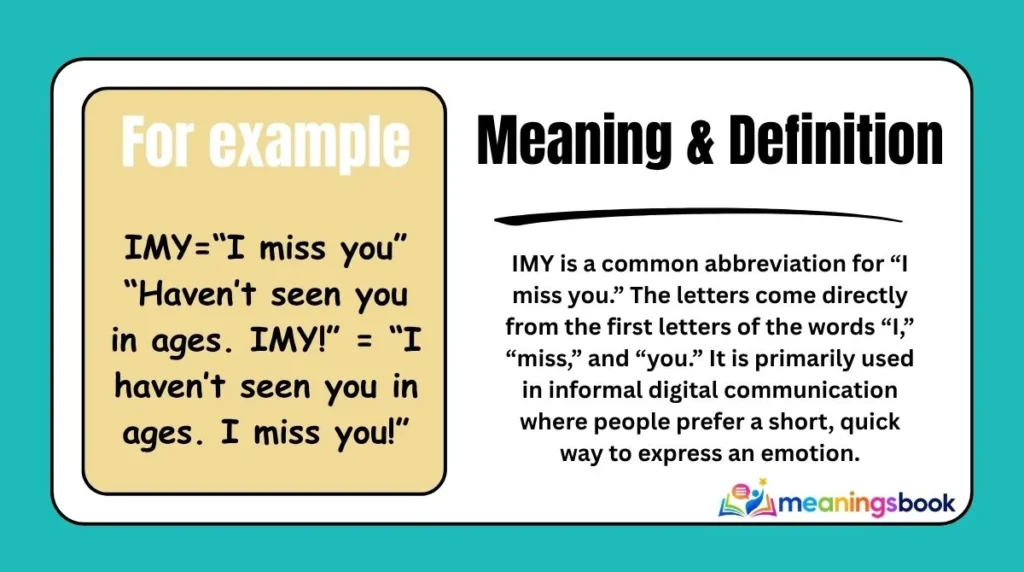
IMY is a common abbreviation for “I miss you.” The letters come directly from the first letters of the words “I,” “miss,” and “you.” It is primarily used in informal digital communication where people prefer a short, quick way to express an emotion.
When someone writes “IMY,” they are generally saying that they have noticed the other person’s absence and would like them to be around. It can communicate affection, nostalgia, loneliness, or simply the feeling that someone has not been seen or spoken to recently.
For example:
- “IMY” = “I miss you.”
- “IMY so much” = “I miss you so much.”
- “Haven’t seen you in ages. IMY!” = “I haven’t seen you in ages. I miss you!”
- “IMY too” = “I miss you too.”
The meaning itself is straightforward, but the emotional intensity can vary. A close friend might send “IMY” after moving away, while a romantic partner might use it to express affection during time apart. Family members may also use it when they have not seen each other for a while.
It is also possible for the phrase to be used lightly. Friends sometimes say “IMY” simply because they have not talked recently. Therefore, receiving the abbreviation does not automatically mean that the sender has romantic feelings.
The surrounding conversation is important. If the message appears alongside affectionate language such as “love you,” “wish you were here,” or “can’t wait to see you,” the message may feel more intimate. If it appears after a casual discussion between friends, it may simply express friendship and familiarity.
In most ordinary texting situations, however, there is no complicated hidden definition. IMY means “I miss you.” The main question is not what the abbreviation stands for, but what emotional tone the sender intends.
Background
IMY developed as part of the broader culture of abbreviated digital communication. Texting and online messaging encourage people to communicate quickly, and short expressions can save time while still conveying familiar ideas. Abbreviations such as IMY fit naturally into this style because the intended phrase is easy for the recipient to reconstruct from the letters.
There is not a single well-established origin story that should be treated as the definitive invention of IMY. Rather than attributing it to a particular person, website, or exact date without reliable evidence, it is more accurate to understand it as part of the general development of informal texting shorthand.
The phrase “I miss you” itself is much older than digital communication. What changed with texting was the way people represented the phrase. Instead of typing all three words, users could shorten it to three letters. Once this style became familiar, abbreviations such as IMY became convenient in personal messages.
Digital shorthand is especially common when the meaning is already understood between the participants. Someone who frequently communicates with a friend or partner may not need to spell out a familiar expression every time. A short message such as “IMY” can therefore carry the same basic emotional meaning as the complete sentence.
The abbreviation also fits naturally with other informal expressions. Someone might write:
- “IMY ❤️”
- “IMY guys!”
- “IMY already”
- “IMY, when are you coming back?”
- “IMY too!”
These examples demonstrate that the abbreviation does not require a particular grammatical structure. It can stand alone or be included in a longer sentence.
It is important not to confuse the history of the abbreviation with the history of internet slang in general. IMY is best understood as a straightforward shortening of a familiar phrase rather than as a specialized technical term.
Its continued use also reflects a larger feature of online communication: people often combine efficiency with emotion. A three-letter abbreviation can be quick to type while still expressing something personal.
Usage in Different Contexts
The meaning of IMY generally stays consistent across contexts, but the tone and emotional significance can change depending on who uses it and why.
In Chat
In private chat, IMY usually communicates that the sender misses the recipient. A friend who has moved to another city might write, “IMY, we need to hang out soon.” In a romantic conversation, “IMY” may be more intimate and could mean that the person wants to be physically or emotionally closer.
On Social Media
On social platforms, IMY can appear in comments, direct messages, captions, or replies. A person might comment “IMY!” under a friend’s post after not seeing them for a long time. In this setting, the expression is often friendly and casual.
In Professional Communication
IMY is generally not appropriate for formal professional communication unless the workplace conversation is extremely informal and the relationship makes that style natural. Business emails, official documents, applications, reports, and formal workplace messages would normally use the complete phrase if the sentiment were relevant at all.
If a colleague sends “IMY” in a personal or informal workplace chat, it should usually be interpreted according to the relationship rather than as professional terminology.
In Casual Conversations
Among friends and relatives, IMY can be very natural. It may communicate genuine emotional attachment without necessarily being romantic. For example, two longtime friends who have not spoken for several weeks could exchange “IMY” without either person intending anything beyond friendship.
Tone Matters
The same abbreviation can feel different depending on punctuation, emojis, timing, and surrounding words.
“IMY” may sound warm and sincere.
“IMY ❤️” can feel more affectionate.
“IMY guys!” can clearly address a group of friends.
“IMY too” is normally a direct reciprocal response.
Therefore, the abbreviation provides the basic meaning, while context supplies the emotional detail.
Meaning in Chat, WhatsApp, Instagram, and TikTok
Across messaging and social media platforms, IMY generally retains the same meaning: “I miss you.” The platform does not normally change the fundamental definition of the abbreviation.
On WhatsApp, IMY can be used in one-to-one chats or group conversations. A person might send it after being away from friends or family:
“The trip was great, but IMY.”
A simple reply could be:
“IMY too! Come visit soon.”
WhatsApp conversations are often personal, so the expression can range from friendly to romantic depending on the people involved.
On Instagram, IMY might appear in direct messages, comments, or replies to stories. A friend responding to an old photo could write “IMY!” to show that they miss the person or the time represented by the picture.
The public nature of a comment can also make the message feel more casual than a private direct message.
TikTok
On TikTok, users may use IMY in comments or direct messages. It can appear under videos involving friends, memories, reunions, travel, or emotional moments. For example, someone might comment “IMY bestie” on a friend’s post.
In these situations, the abbreviation usually communicates affection or familiarity rather than a technical meaning.
Text Messages
Traditional SMS and modern messaging apps use IMY in essentially the same way. It is especially useful when someone wants to express an emotional thought quickly.
Examples include:
- “IMY. Hope you’re doing okay.”
- “IMY so much!”
- “IMY, bestie.”
- “IMY too. We should catch up.”
- “Just saw our old photos. IMY.”
The important point is that the platform does not normally create a separate definition for IMY. Whether it appears on WhatsApp, Instagram, TikTok, or in a standard text message, the ordinary interpretation remains “I miss you.”
Meaning in Physics, Medical, and Aircraft Terminology
IMY is primarily an informal communication abbreviation, not a widely recognized standard term in the major technical fields listed below.
Physics
IMY does not have a commonly recognized, standard meaning in general physics terminology comparable to established symbols, units, or commonly used technical abbreviations. If IMY appears in a physics-related document, its meaning would need to be determined from that specific document or context rather than automatically interpreted as a standard physics term.
Medical Terminology
IMY is not a standard everyday medical abbreviation for a common diagnosis, procedure, body part, or medical concept. Medical abbreviations can vary between institutions and specialties, so an unfamiliar abbreviation in a medical document should not be interpreted solely from internet slang.
If you encounter IMY in a medical record or professional healthcare setting, the surrounding documentation or the healthcare professional should be used to establish its intended meaning.
Aircraft and Aviation Terminology
IMY is also not a commonly recognized general aviation abbreviation with the ordinary meaning of “I miss you.” Aviation uses many specialized abbreviations and codes, and their meanings depend heavily on the particular system or document.
Therefore, if you see IMY in an aircraft-related context, do not automatically assume it means “I miss you.” It could potentially be an organization-specific, location-specific, identification, or other specialized code, but such a meaning should not be invented without contextual evidence.
The Key Distinction
The important distinction is between informal texting language and technical terminology. In a personal message, IMY almost certainly points toward “I miss you.” In a scientific, medical, or aviation document, the same letters should be interpreted only after checking the relevant context.
Common Misconceptions
One common misconception is that IMY always indicates romantic interest. It does not. “I miss you” can be romantic, but it can also be completely platonic. Friends, siblings, relatives, and other close people can use the abbreviation naturally.
Another misunderstanding is that every three-letter abbreviation has a secret or alternative slang definition. With IMY, the ordinary interpretation is quite direct. In most personal conversations, there is no need to search for a hidden meaning.
People can also confuse IMY with related expressions such as ILY, which normally means “I love you.” Although the two can appear together, they communicate different ideas. Someone can miss another person without saying that they love them.
Another potential misunderstanding concerns the strength of the statement. “IMY” does not automatically mean that the sender is deeply distressed or emotionally dependent. The phrase simply communicates missing someone, while the seriousness depends on context.
Tone can also be misread in text because written messages do not always show facial expression or vocal emphasis. “IMY” from a longtime friend may be playful or affectionate, whereas the same message from an ex-partner could carry more emotional significance.
Finally, people sometimes assume that an abbreviation must have the same meaning everywhere. That is not always true. A slang abbreviation in a text should not automatically be treated as a technical abbreviation in a professional document.
The safest approach is simple: look at the surrounding conversation, the relationship between the people, and the situation in which IMY appears.
Similar Terms & Alternatives
Several abbreviations and expressions are closely related to IMY. Understanding their differences can make online conversations easier to interpret.
I Miss You
This is the full form of IMY. It carries the same basic meaning but sounds more complete and may feel slightly more deliberate than the abbreviation.
ILY
ILY commonly means “I love you.” It expresses love rather than simply missing someone’s presence. The two abbreviations can be used together, but they are not interchangeable.
IMU
IMU can sometimes be used informally to represent “I miss you,” but it is much less straightforward and less universally recognized than IMY. Context is especially important if someone uses it.
Miss You
“Miss you” is the natural shortened version of the full phrase without using an acronym. It can sound casual, warm, or affectionate.
Miss U
“Miss U” uses a letter or sound-based shortening rather than an acronym. It communicates essentially the same idea as “I miss you.”
Thinking of You
This phrase is related but not identical. Someone can be thinking of another person without specifically saying that they miss them. It can therefore sound slightly broader and sometimes less emotionally direct.
Wish You Were Here
This expression often communicates a stronger desire for someone’s presence. It can be used when someone is somewhere enjoyable, important, or emotionally meaningful and wishes another person could be there.
The best interpretation depends on the exact expression and relationship. IMY is specifically centered on missing someone’s presence, while related phrases can express love, affection, remembrance, or a desire for companionship.
How to Respond to It
How you respond to IMY depends mainly on how you feel about the sender and the tone of the conversation. You do not need to give a complicated response.
If you miss the person too, a natural reply is:
“IMY too!”
If you want to sound warmer:
“I miss you too. Hopefully we can see each other soon.”
For a close friend, you could say:
“Aww, IMY too! We need to catch up.”
For a romantic partner:
“I miss you too ❤️ I can’t wait to see you.”
If you are unsure about the sender’s intention, you can keep the response friendly without making assumptions:
“Aww, that’s sweet. Hope you’re doing well!”
If you do not share the same feelings, you can respond politely:
“It’s nice hearing from you. Hope everything is going well.”
There is no requirement to respond with “IMY too” simply because someone sent IMY. Your response should reflect your own feelings and the relationship.
If the message comes unexpectedly from someone you have not spoken to in a long time, the surrounding conversation can help clarify why they sent it. You might answer:
“It’s been a while! What made you think of me?”
That response keeps the conversation open while allowing the sender to explain.
The main rule is to match the tone without pretending to feel something you do not. IMY can be warm and emotional, but your response does not have to be equally intense.
Differences from Similar Words
| Expression | Meaning | Typical Tone |
|---|---|---|
| IMY | I miss you | Casual, affectionate |
| I miss you | Direct statement of missing someone | Personal, clear |
| ILY | I love you | More explicitly loving |
| Miss u | Informal version of “miss you” | Very casual |
| Thinking of you | You are on my mind | Warm, broader |
| Wish you were here | Desire for someone’s presence | Affectionate or nostalgic |
| Can’t wait to see you | Excitement about meeting again | Positive, anticipatory |
The most important difference is between missing someone and loving someone. IMY communicates absence and longing for someone’s presence; it does not automatically declare romantic love.
For example, a friend might say:
“IMY! We haven’t hung out in forever.”
A romantic partner might say:
“IMY. I can’t wait to see you.”
Both use the same abbreviation, but the surrounding language changes the emotional tone.
Likewise, “thinking of you” is not necessarily the same as “I miss you.” Someone can think about a friend, family member, or acquaintance without feeling that their absence is especially painful.
“Wish you were here” can also be stronger in a particular situation because it explicitly expresses a desire for someone to be physically present.
Understanding these differences prevents overinterpretation. When you see IMY by itself, the safest reading is simply “I miss you.” Any romantic, emotional, nostalgic, or friendly nuance should come from the surrounding context rather than from the abbreviation alone.
Relevance in Online Conversations & Dating Apps
IMY can have particular significance in online conversations because digital relationships often involve periods when people cannot see each other in person. Friends living in different cities, long-distance partners, former classmates, online friends, and people who recently stopped talking may all use the abbreviation.
On dating apps, the interpretation can depend strongly on the stage of the relationship. If two people have been talking romantically and one sends “IMY,” it may be an affectionate way of expressing growing attachment or a desire to meet. If they have only exchanged a few messages, however, the same phrase may feel unusually personal.
Timing also matters. Someone who sends IMY after a date may be expressing that they enjoyed the person’s company and already want to see them again. Someone who sends it after several days of silence may be trying to reconnect.
In established relationships, IMY can be routine and affectionate. Partners may send it during work, travel, or other periods when they are apart.
Among friends, it can be equally natural. A person might comment “IMY” on a friend’s post after moving away or reconnecting after a long period.
Dating and social media also create situations where tone can be ambiguous. A short message lacks the facial expressions and vocal cues available in face-to-face conversation. Emojis, punctuation, previous conversations, and relationship history can therefore provide useful clues.
For example:
- “IMY ❤️” may sound strongly affectionate.
- “IMY bestie!” is more clearly friendship-oriented.
- “IMY, when are you coming back?” emphasizes wanting to see someone again.
- “Randomly thought of you. IMY!” can be warm and nostalgic.
Ultimately, IMY does not establish a relationship status by itself. Context determines whether the expression is friendly, romantic, nostalgic, or simply affectionate.
Frequently Asked Questions
What does IMY mean in text?
IMY usually means “I miss you” in text messages. It is an informal abbreviation used to tell someone that you miss their presence or have been thinking about them. Friends, family members, partners, and other close people can use it, so the abbreviation does not automatically indicate romantic feelings.
What does IMY mean in chat?
In chat, IMY generally means “I miss you.” Someone may send it after not talking for a while, being separated from you, or remembering a shared experience. The tone can be friendly, affectionate, or romantic depending on the relationship and the other messages surrounding it.
Is IMY a slang term?
IMY is best described as an informal texting abbreviation rather than a traditional slang word. It shortens the phrase “I miss you” for quick digital communication. It is most appropriate in casual messages, social media conversations, and personal chats rather than formal writing.
How do you respond to IMY?
You can respond to IMY according to your feelings and relationship with the sender. If you miss them too, “IMY too!” is the simplest response. You could also say, “I miss you too,” “Aww, I miss you too,” or “Hopefully we can see each other soon.” A polite response works if you do not share the same feeling.
What does IMY mean on social media?
On social media, IMY usually means “I miss you.” It can appear in comments, direct messages, captions, or replies. Friends may use it when they have not seen each other recently, while romantic partners may use it affectionately. The platform itself does not normally change the abbreviation’s basic meaning.
Can IMY have different meanings?
IMY can theoretically have different meanings in specialized contexts, but “I miss you” is the ordinary meaning in personal digital communication. If the letters appear in a technical, medical, aviation, or organizational document, they should be interpreted from that specific context rather than assuming they refer to texting slang.
Does IMY mean I love you?
No, IMY normally means “I miss you,” not “I love you.” The common abbreviation for “I love you” is ILY. Although someone may use both expressions in the same conversation, they communicate different ideas. Missing someone can be affectionate or romantic, but it does not automatically mean the sender is declaring love.
Is IMY romantic?
IMY can be romantic, but it is not automatically romantic. A partner may use it affectionately, but friends and family members can use the same abbreviation naturally. To determine the intended tone, consider the relationship, previous messages, emojis, and the circumstances in which the message was sent.
Conclusion
IMY is a simple and widely understandable texting abbreviation that normally means “I miss you.” It is used in personal digital communication to express that someone is missed, remembered, or emotionally wanted nearby. Friends, family members, romantic partners, and other close people can all use it, so the abbreviation alone does not establish romantic interest.
You may encounter IMY in text messages, WhatsApp conversations, Instagram comments or direct messages, TikTok interactions, and other informal online spaces. Its basic meaning remains consistent across these platforms, while its emotional tone can change according to the relationship and surrounding conversation.
It is also important not to treat IMY as a standard physics, medical, or aviation term without specific contextual evidence. If you receive the abbreviation, the simplest interpretation is usually the correct one: the person is saying that they miss you. The best response depends on your relationship, your feelings, and the tone of the conversation.

I am Ethan Whitmore, an English teacher and vocabulary enthusiast who explains words, phrases, and meanings in text through simple examples to make English easier for everyone.



