If you have received a message containing “HRU,” you may wonder what these three letters mean. This short abbreviation is commonly used in texting, online chats, social media comments, and casual conversations where people want to communicate quickly.
Like many internet abbreviations, HRU saves time by turning a familiar question into a few letters.
The abbreviation is especially common when someone is starting a conversation, checking on another person, or continuing a friendly exchange. You might see it after a greeting, following a previous conversation, or as a simple way to show interest in how someone is doing.
Understanding HRU is straightforward once you know its standard meaning. However, the tone can vary depending on who sends it and the surrounding conversation.
A friend may use it casually, while someone you are getting to know may use it as an easy conversation starter. The following sections explain its meaning, usage, context, and appropriate responses.
Quick Answer
HRU meaning in text is “How are you?” It is a common texting abbreviation used in chats, social media messages, and casual online conversations to ask about someone’s well-being. Depending on the context, it can be a friendly greeting, a quick check-in, or a simple way to start or continue a conversation.
Meaning & Definition
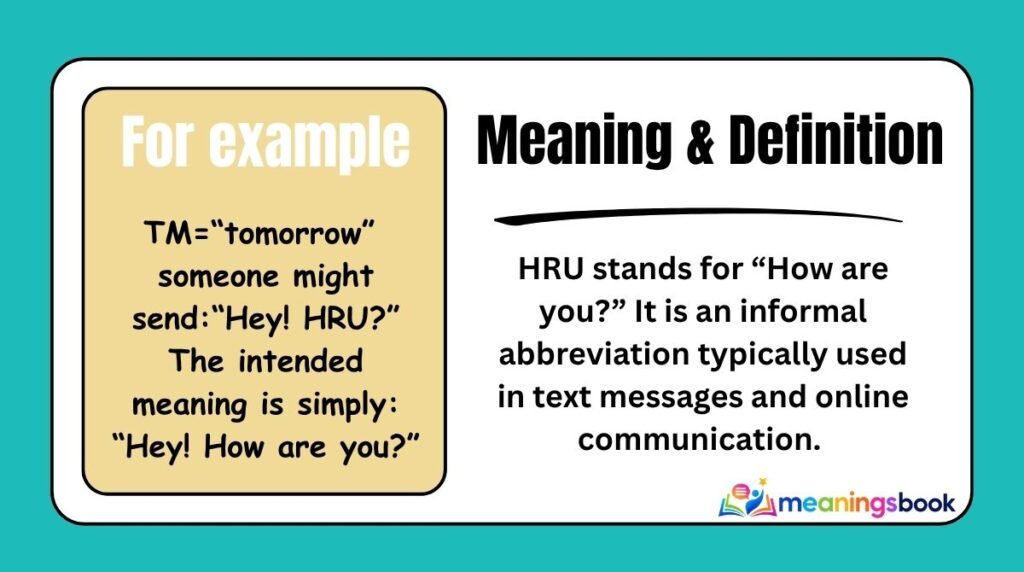
HRU stands for “How are you?” It is an informal abbreviation typically used in text messages and online communication. Instead of typing the complete question, a person can use three letters to ask how someone is feeling or doing.
The phrase is generally friendly and conversational. For example, someone might send:
“Hey! HRU?”
The intended meaning is simply:
“Hey! How are you?”
The abbreviation does not usually change the basic meaning of the original phrase. It mainly makes the message shorter and faster to type.
What does HRU communicate?
The exact intention depends on the conversation. In many cases, it can communicate:
- A friendly greeting
- A quick check-in
- Interest in someone’s well-being
- An attempt to start a conversation
- A casual follow-up after saying hello
For instance, a friend might write “HRU?” after several days without talking. Someone who has just started chatting with you might also use it as an easy opening question.
The tone is usually informal. It is much more appropriate for texting, messaging, and casual online conversations than for formal business communication.
It is also possible for the question to be purely conversational. Someone asking “HRU?” may simply be saying hello rather than expressing concern about a serious problem.
The best way to understand the tone is to consider the surrounding messages and your relationship with the sender. “HRU?” from a close friend can feel relaxed and familiar, while the same abbreviation from a new online contact may simply be a polite conversation opener.
In short, HRU is a compact way of asking another person how they are doing.
Background
HRU developed as part of the broader culture of abbreviated online communication. People have long shortened common phrases in text messages, instant messaging, chat rooms, and other forms of digital communication to make conversations faster and more convenient.
There is no single well-established individual or event that can be identified as the definitive origin of HRU. Its development fits into the wider evolution of texting shorthand, where frequently used expressions are reduced to letters or compact combinations.
The abbreviation is particularly easy to understand because the letters correspond closely to the sounds or initial parts of the words:
- H = How
- R = are
- U = you
Here, “R” represents “are” and “U” represents “you,” following a style of text shorthand that became familiar in informal digital communication.
Similar abbreviations became popular because early text-based communication encouraged users to type quickly and economically. Even as modern smartphones made typing easier, many of these expressions remained part of internet language because they had become recognizable and convenient.
HRU belongs to the same general family of casual abbreviations as expressions such as “WYD” for “What are you doing?” and “HBU” for “How about you?”
Its meaning is generally stable, so there is little ambiguity when it appears in an ordinary conversation. However, the purpose behind the question can vary. It might be a genuine check-in, a greeting, or simply a conversation starter.
Because HRU is informal shorthand, it is best understood as part of conversational internet language rather than formal English. Someone writing a professional email would normally type “How are you?” instead of using HRU.
Usage in Different Contexts
The meaning of HRU remains “How are you?” across most informal contexts, but its conversational purpose can change.
In Chat
In private chats, HRU is often used as a quick greeting or check-in.
Example:
“Hey, HRU?”
This could simply mean that the sender wants to begin talking.
It can also appear later in a conversation:
“I heard you had a busy day. HRU now?”
In this case, the abbreviation functions more clearly as a check-in.
On Social Media
People may use HRU in direct messages, comments, or informal interactions on social platforms. The same basic meaning applies, although the level of familiarity depends on the relationship between the users.
A person who follows your account might message:
“Hey, HRU?”
This may be an attempt to start a conversation rather than a reference to anything specific.
In Professional Fields
HRU is not a standard formal business expression. In professional communication, spelling out “How are you?” is generally clearer and more appropriate.
A coworker might casually send HRU through an informal workplace chat, but the abbreviation should not automatically be treated as professional terminology.
In Casual Conversations
Among friends, family members, classmates, or other familiar contacts, HRU can feel natural and relaxed.
For example:
“Morning! HRU?”
The sender is usually just asking how you are doing.
Overall, context affects the tone and intention, but not normally the underlying definition.
Meaning in Chat, WhatsApp, Instagram, and TikTok
HRU can appear across many platforms where users communicate through short messages. Its meaning generally stays the same: “How are you?”
On WhatsApp, HRU may appear in one-to-one chats or group conversations.
Example:
“Hey, long time! HRU?”
A natural response could be:
“I’m good! How about you?”
On Instagram, someone may use HRU in a direct message after following you, replying to a story, or starting a new conversation.
Example:
“Hey, HRU? Loved your story btw.”
Here, HRU is simply a friendly opener before the person continues with another topic.
TikTok
TikTok users may use the abbreviation in direct messages or comments when interacting casually.
Example:
“Heyy HRU?”
The extra letters or informal spelling can make the message feel more relaxed, but HRU still means “How are you?”
General Texting
In ordinary SMS or messaging apps, HRU is particularly straightforward.
Example:
“HRU today?”
This means:
“How are you today?”
It is worth remembering that not every person uses abbreviations in the same way. Some people prefer complete sentences, while others regularly use internet shorthand. Therefore, seeing HRU usually signals an informal communication style rather than a special platform-specific meaning.
Meaning in Physics, Medical, and Aircraft Terminology
HRU does not have the standard meaning “How are you?” in physics, medicine, or aviation. The familiar texting interpretation belongs to informal digital communication.
Physics
HRU is not a standard fundamental physics abbreviation with the meaning “How are you?” It should not be interpreted as a physics term simply because it appears in technical material.
Medical Terminology
HRU is not a standard medical definition for “How are you?” Medical abbreviations can be highly context-dependent, and specialized documents may contain abbreviations that overlap with ordinary language. Therefore, an unexplained HRU in a medical document should be interpreted from the specific document or institution rather than automatically assuming the texting meaning.
Aircraft and Aviation
HRU is likewise not the ordinary aviation interpretation of “How are you?” Aviation uses many specialized abbreviations and codes, so a technical occurrence should be checked against the relevant aviation context.
The key distinction is simple:
In casual texting, HRU normally means “How are you?” In technical material, do not automatically apply the texting definition.
If the abbreviation appears in a specialized document, its surrounding terminology is more important than its everyday texting meaning.
Common Misconceptions
One common misconception is that HRU has a complicated hidden meaning. In ordinary texting, it generally does not. It is simply a shortened form of “How are you?”
Another misunderstanding is that HRU necessarily indicates romantic interest. It does not. Friends, relatives, classmates, coworkers, acquaintances, and strangers can all use the abbreviation.
For example:
“Hey HRU?”
could be completely friendly and ordinary.
The relationship and surrounding conversation determine whether the message has a more personal tone.
People may also confuse HRU with other texting abbreviations. Since many abbreviations use letters rather than complete words, unfamiliar combinations can look similar at first.
Another misconception is that the abbreviation is appropriate everywhere. HRU is informal, so using it in a formal letter, academic paper, official document, or professional email may sound overly casual.
Finally, some users assume that abbreviations always have one universal interpretation. In most ordinary conversations, HRU has a clear meaning, but technical contexts can contain unrelated abbreviations. Context should always take priority when the surrounding material is specialized.
Similar Terms & Alternatives
Several abbreviations and phrases can appear alongside HRU or serve a similar conversational purpose.
| Term | Meaning | Typical use |
|---|---|---|
| HRU | How are you? | Casual texting and chats |
| HBU | How about you? | Asking the same question back |
| WYD | What are you doing? | Asking what someone is currently doing |
| HOW R U | How are you? | Informal text shorthand |
| How are you? | Full version of HRU | General conversation |
| How’s it going? | Asking how someone is doing | Casual conversation |
| How have you been? | Asking about someone’s recent well-being | Often used after some time apart |
| You good? | Asking whether someone is okay | Casual check-in |
The closest direct alternative is simply “How are you?” because it expresses exactly the same basic question.
HBU is different because it normally means “How about you?” It is often used after someone has answered a question:
“I’m good. HBU?”
Here, HBU asks the other person to answer the same question.
Understanding these distinctions helps prevent confusion when several texting abbreviations appear in the same conversation.
How to Respond to It
When someone sends “HRU?”, the simplest response is to answer how you are doing and, if appropriate, ask about them in return.
Friendly response
“I’m good! HBU?”
Casual response
“Doing pretty well, you?”
Positive response
“I’m great, thanks! How are you?”
Busy but okay
“A little busy today, but I’m good. HBU?”
If you are not feeling well
“Not the best today, honestly.”
You do not have to use an abbreviation just because the other person did. A complete sentence is perfectly natural.
If the sender is someone you do not know well, a neutral answer can keep the conversation comfortable:
“I’m doing well, thanks. How about you?”
If you want to continue the conversation, you can add a question or mention what you are doing:
“I’m good! Just relaxing after work. What are you up to?”
The appropriate response depends mainly on your relationship with the sender and how much conversation you want to have.
Differences from Similar Words
HRU is easy to distinguish from similar texting expressions once their purposes are understood.
HRU vs. HBU
HRU means “How are you?”
HBU means “How about you?”
For example:
Person A: “I’m doing great. HBU?”
HBU refers back to something Person A has already discussed.
HRU vs. WYD
WYD means “What are you doing?”
It asks about someone’s current activity, whereas HRU asks about their general condition or well-being.
Compare:
“HRU?” = How are you?
“WYD?” = What are you doing?
HRU vs. “You good?”
Both can be used as informal check-ins, but “You good?” can sometimes suggest that the sender noticed something unusual or wants to know whether there is a problem.
HRU is usually more general and can function simply as a greeting.
HRU vs. “How have you been?”
“How have you been?” often suggests that some time has passed since the people last spoke. HRU is shorter and can be used at almost any point in a casual conversation.
The main difference is therefore not just wording but context, tone, and conversational purpose.
Relevance in Online Conversations & Dating Apps
HRU is relevant to modern online communication because short abbreviations make casual conversations quick and easy. On messaging platforms and social media, people frequently use compact expressions when beginning or maintaining conversations.
On dating apps, HRU can appear as a simple opening message. For example:
“Hey, HRU?”
By itself, this does not establish romantic interest. It may simply be an attempt to start talking. The meaning of the abbreviation remains “How are you?” while the broader purpose depends on the conversation.
If the message appears after a longer exchange, it may function as a personal check-in:
“You mentioned having a rough day yesterday. HRU now?”
That context gives the question a more caring purpose.
The relationship between the people also matters. A close friend using HRU may sound familiar, while an unfamiliar person using the same abbreviation may simply be making casual conversation.
On dating platforms, it is useful not to assign additional meaning to the abbreviation itself. Look at the surrounding messages, the questions being asked, and how the conversation develops.
In general, HRU is a conversation-opening or check-in phrase, not an abbreviation that inherently signals flirting, friendship, concern, or romantic interest.
Frequently Asked Questions
What does HRU mean in text?
HRU means “How are you?” in ordinary texting and online conversations. It is an informal abbreviation used to ask how someone is doing. People commonly send it as a greeting, a quick check-in, or a way to begin a conversation. The exact tone depends on the relationship between the people and the surrounding messages.
What does HRU mean in chat?
In chat, HRU usually means “How are you?” It is commonly used in informal conversations between friends, acquaintances, online contacts, and other people communicating casually. For example, “Hey, HRU?” simply means “Hey, how are you?” It is generally a conversational abbreviation rather than a formal expression.
Is HRU a slang term?
HRU is best described as informal texting shorthand or an abbreviation rather than traditional slang. It shortens the phrase “How are you?” for quick digital communication. You may encounter it in text messages, private chats, social media messages, and other casual online conversations.
How do you respond to HRU?
You can respond to HRU by simply saying how you are doing. For example, “I’m good, thanks!” or “Doing well, how about you?” works naturally. If you want to continue the conversation, you can add another question, such as “What are you up to?” You do not need to use abbreviations in your reply.
What does HRU mean on social media?
On social media, HRU generally means “How are you?” It can appear in direct messages, comments, or casual interactions. Someone might use it after greeting you, replying to a post, or beginning a new conversation. Its basic meaning normally stays the same regardless of the social platform.
Can HRU have different meanings?
HRU can potentially appear as an abbreviation for something else in a specialized context, but in ordinary texting it means “How are you?” If you encounter HRU in a technical, professional, medical, or aviation document, you should use the surrounding context to determine whether it has a specialized meaning.
Does HRU mean someone likes you?
HRU by itself does not mean that someone romantically likes you. It simply means “How are you?” A person may use it to start a conversation, check in, or greet someone. If romantic interest is relevant, it would have to be understood from the broader conversation rather than from HRU alone.
What is the difference between HRU and HBU?
HRU means “How are you?”, while HBU means “How about you?” HRU is generally used to ask the initial question about someone’s well-being. HBU is commonly used after someone has answered, inviting the other person to give their own answer. They can therefore appear together in the same conversation.
Conclusion
HRU is a simple and widely understandable piece of informal texting shorthand. In ordinary messages and online conversations, HRU means “How are you?” People use it to greet someone, check on their well-being, or open a casual conversation.
The abbreviation can appear in text messages, chats, social media interactions, and dating-app conversations. Its basic definition normally stays the same, although its conversational purpose can vary depending on the relationship and surrounding messages. A friend may use it as a relaxed greeting, while another person may use it as a conversation starter or genuine check-in.
HRU should generally be treated as informal rather than professional language. In specialized fields such as medicine, physics, or aviation, context should be checked before assuming that the texting meaning applies.
When you receive “HRU?”, a simple response such as “I’m good, how about you?” is usually enough. Understanding the context helps you interpret the tone naturally.

I am Ethan Whitmore, an English teacher and vocabulary enthusiast who explains words, phrases, and meanings in text through simple examples to make English easier for everyone.