
Texting and social media are full of short forms that make conversations faster, but abbreviations can sometimes be confusing when their meanings are not obvious. One abbreviation you may encounter is GTS.
It can appear in text messages, group chats, comments, captions, memes, and casual online conversations. Depending on the situation, the person using it may be talking about sleep, searching for information, or expressing another idea.
This is why people often search for the GTS meaning in text after receiving a message containing the abbreviation. Unlike some internet slang with only one widely accepted definition, GTS can have more than one interpretation.
The surrounding words, the relationship between the people chatting, and the platform being used can all help determine what the writer intended.
Understanding the context is therefore more useful than automatically assigning one meaning to every occurrence of GTS. The sections below explain its common interpretations and how to respond naturally.
Quick Answer
GTS meaning in text usually refers to “go to sleep” or “going to sleep,” especially in casual chats. However, GTS can have other meanings depending on context, including a suggestion to search for information online. The surrounding message is important because the same three letters can communicate different ideas in texting, social media, and other online conversations.
Meaning & Definition
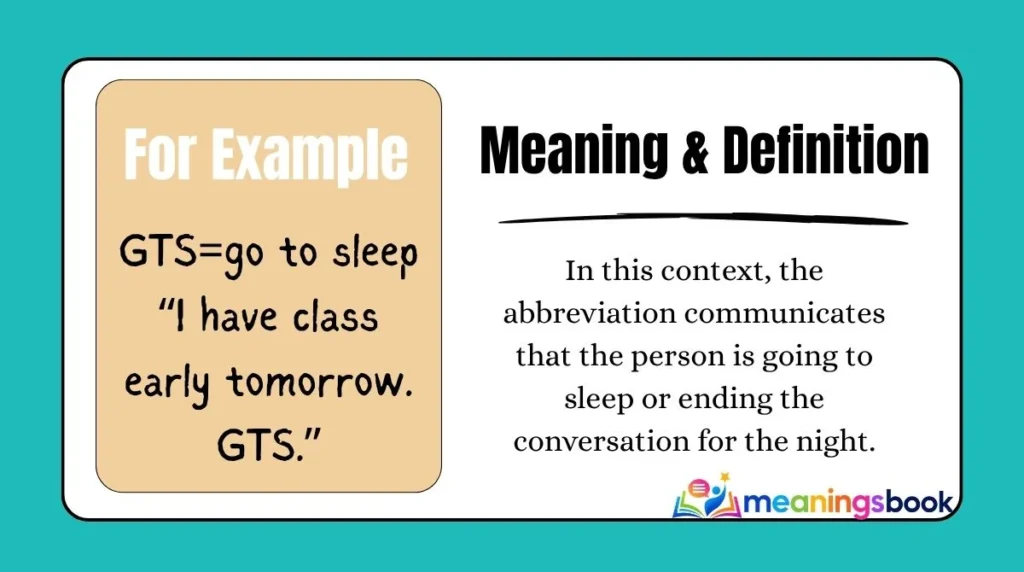
In casual texting, GTS most commonly refers to “go to sleep” or “going to sleep.” People may use it when telling someone that they should sleep, saying that they are heading to bed, or joking about being tired.
For example:
“I have class early tomorrow. GTS.”
Here, the intended idea is likely that the person should go to sleep.
A person might also write:
“I’m GTS now, talk tomorrow.”
In this context, the abbreviation communicates that the person is going to sleep or ending the conversation for the night.
However, GTS is not limited to sleep-related conversations. Another online interpretation is “Google that” or the more informal and sometimes profane expression “Google that stuff.” This usage tells someone to search for information themselves. The exact wording behind the abbreviation can vary by community and conversation.
For example:
“What does that word mean?”
“GTS 😂”
The second person may be jokingly telling the first person to look it up online.
Because of these different possibilities, the safest way to understand GTS is to examine the sentence around it. If the conversation is about bedtime, tiredness, or ending a late-night chat, “go to sleep” is a natural interpretation. If someone asks a factual question and receives GTS as a response, a search-related meaning may be intended.
Tone matters as well. GTS can be neutral, playful, teasing, or slightly dismissive. A friend saying “GTS” may simply be joking, while the same abbreviation from someone you barely know could sound blunt.
Therefore, there is no single interpretation that works in every conversation. Context gives the abbreviation its practical meaning.
Background
The exact origin of GTS as internet shorthand is not firmly established in one universally documented source or event. Like many texting abbreviations, it developed within informal digital communication where people shortened familiar phrases to save time and characters.
Texting culture encouraged abbreviations because users wanted to communicate quickly, particularly on phones and early messaging services where typing could be slower or less convenient. As online communities developed, the same abbreviation could acquire different meanings among different groups.
This helps explain why GTS can be confusing today. Digital slang does not always follow the same rules as formal language. An abbreviation may begin with one common interpretation and later be reused for another phrase. Communities can also create their own conventions.
The sleep-related use of GTS fits naturally into a broader collection of bedtime expressions used in informal communication. People commonly shorten phrases such as “go to sleep,” “going to sleep,” or similar statements when chatting with friends. The abbreviation can make the message feel quick and casual.
The search-related interpretation developed from another common internet behavior: telling someone to search for an answer online. In casual conversations, abbreviations can be used humorously to express this idea without writing the complete phrase.
It is important not to treat either interpretation as a proven single origin for the abbreviation itself. There is no need to assign GTS to one specific website, person, platform, or date without reliable evidence.
The most useful approach is therefore practical rather than historical: understand the major interpretations, then use the surrounding conversation to determine which one makes sense.
Over time, social media and messaging platforms have also made abbreviations more visible. A term that was once familiar mainly to one online community can spread to people with very different backgrounds. As a result, users increasingly encounter abbreviations whose meanings are not immediately obvious.
That is one reason searches for terms such as GTS remain common. The abbreviation is short, flexible, and context-dependent.
Usage in Different Contexts
GTS in Chat
In private messages, GTS can be used when someone is tired or preparing to sleep.
“I’m exhausted. GTS now.”
Here, the meaning is related to going to sleep.
It can also be used playfully between friends:
“You’re still awake? GTS!”
The tone could be teasing rather than commanding.
GTS on Social Media
On social platforms, the meaning depends heavily on the surrounding post or comment. A user discussing being awake late at night may use GTS as a reference to sleep. In another discussion, someone may use it to suggest that another person search for information online.
Short comments are particularly dependent on context because they often contain very little surrounding information.
GTS in Professional Fields
GTS should not automatically be treated as universal professional terminology. Businesses, technical organizations, universities, and industries may use the same initials for their own names, systems, processes, or concepts.
If GTS appears in a professional document, email, report, technical manual, or workplace system, its meaning should be determined from that specific field and document rather than assumed to be internet slang.
GTS in Casual Conversations
Among friends, GTS can be informal and humorous. Someone might use it to tell another person to get some sleep, especially when the conversation is happening late at night.
In another casual exchange, it may be used to tell someone to search for an answer. The tone can range from friendly joking to mild sarcasm.
The important point is that GTS does not have one fixed meaning across every context. The words immediately before and after it, the topic being discussed, and the relationship between the speakers are useful clues.
Meaning in Chat, WhatsApp, Instagram, and TikTok
GTS can appear naturally across messaging and social media platforms, but the platform itself does not necessarily give the abbreviation a completely different definition.
On WhatsApp, GTS may appear in one-to-one conversations or group chats. A person discussing being tired might write:
“Okay, GTS. Goodnight!”
In this case, the intended meaning is clearly connected with going to sleep.
A friend could also send:
“Bro, GTS 😂”
Depending on the previous messages, this could be a playful way of saying that the other person needs to stop staying awake.
Instagram comments and direct messages often use short slang expressions. If someone posts about staying awake all night, a comment containing GTS may relate to sleep.
However, Instagram conversations can also involve jokes, arguments, questions, and informational discussions. If someone responds to a question with GTS, a search-related interpretation may be more appropriate.
TikTok
TikTok encourages fast-moving slang, captions, comments, and inside jokes. GTS can therefore be encountered without much explanation.
For example, a comment under a late-night video might use GTS to refer to sleeping. In a different comment section, someone could use it as a humorous instruction to search for something independently.
General Messaging
The best way to interpret GTS on any platform is to read the entire exchange. Do not decide its meaning from the abbreviation alone.
For example:
“It’s 3 a.m. and you’re still texting me. GTS.”
This strongly points toward a sleep-related meaning.
By contrast:
“You seriously don’t know what that is? GTS.”
This may be telling someone to search online.
The difference comes from context, not from the letters themselves.
Meaning in Physics, Medical, and Aircraft Terminology
GTS does not have one universally recognized general meaning in physics, medicine, or aviation that should automatically replace its common texting interpretation.
Physics
In general physics communication, GTS is not a standard everyday abbreviation with one universally accepted definition. A specialized textbook, research paper, laboratory, or institution could define GTS for a particular concept, system, or quantity.
Therefore, seeing GTS in a physics-related document does not provide enough information to assign a meaning automatically. The document’s terminology or abbreviation list should be checked.
Medical Terminology
GTS is likewise not a single universal medical abbreviation that can safely be interpreted without context. Medical writing contains many abbreviations, and the same initials can sometimes refer to different terms across specialties or organizations.
For medical information, guessing the meaning of an unfamiliar abbreviation can be risky. The surrounding sentence, specialty, report, or official abbreviation list should be used instead.
Aircraft and Aviation Terminology
Aviation also contains numerous technical abbreviations and codes, but GTS should not automatically be interpreted as one specific universal aviation term.
An aviation manual, flight document, technical record, or communication may define abbreviations according to its particular system or organization. If GTS appears in such material, the relevant aviation documentation should take priority over internet slang.
The key distinction is simple: GTS in a casual text is likely to be informal slang, while GTS in a specialized technical document must be interpreted from that document’s own context. It is better to acknowledge uncertainty than to invent a technical definition.
Common Misconceptions
One common misconception is that GTS always means “go to sleep.” This is often a reasonable interpretation in casual texting, but it is not the only possible one.
Another misunderstanding occurs when people assume that GTS always means “Google that” or a related search instruction. That interpretation can make sense when someone is being told to look something up, but it does not fit every conversation.
Confusing GTS With GTG
GTS and GTG look similar but are different abbreviations.
GTG commonly means “got to go” or “gotta go.” It is usually used when someone needs to leave a conversation.
GTS, when used in a sleep-related context, points toward sleeping instead.
For example:
“I’m late for work. GTG.”
means the person has to leave.
Meanwhile:
“I’m exhausted. GTS.”
can refer to going to sleep.
Assuming Capital Letters Guarantee One Meaning
The fact that someone writes GTS in capital letters does not prove which definition they intend. Capitalization is common with abbreviations and does not resolve the context by itself.
Treating Slang as Formal Terminology
GTS is often encountered in informal communication. It should not automatically be treated as an official term in medicine, physics, aviation, business, or another specialized field.
When the setting changes, the interpretation may change too.
Similar Terms & Alternatives
Several abbreviations and expressions can appear similar to GTS or serve a related purpose.
| Term | Common meaning | Typical use |
|---|---|---|
| GTS | Go to sleep / going to sleep; sometimes a search-related expression | Casual texting and online conversation |
| GTG | Got to go / gotta go | Ending or leaving a conversation |
| GN | Good night | Ending a conversation before sleeping |
| G’night | Good night | Casual bedtime message |
| BRB | Be right back | Temporarily leaving a conversation |
| TTYL | Talk to you later | Ending a conversation temporarily |
| Google it | Search for information online | Telling someone to find an answer |
| Go to bed | Sleep or prepare to sleep | Direct bedtime expression |
These alternatives are not interchangeable in every situation.
For example, GN is normally a friendly farewell connected with nighttime, while GTS may function more like an instruction or statement about sleeping.
Similarly, GTG concerns leaving, not necessarily sleeping. Someone can say “GTG” at noon, while “GTS” in a bedtime conversation may specifically relate to sleep.
Understanding these distinctions can prevent unnecessary confusion.
How to Respond to It
The best response to GTS depends on what the sender appears to mean.
If someone is telling you to sleep, a playful response could be:
“Okay 😂 Goodnight!”
Or:
“I know, I know. I’m going.”
If you are actually tired, you could simply say:
“Yeah, I’m heading to bed.”
If you think the person means something else, asking for clarification is perfectly natural:
“GTS? What do you mean?”
If the conversation suggests that they are telling you to search for something, you could respond:
“Lol, I’ll look it up.”
Or:
“Fair enough, searching now.”
When GTS Sounds Playful
Friends may use GTS as a joke when someone stays online too late.
“You’ve been awake all night. GTS 😂”
A humorous response could be:
“Five more minutes!”
When GTS Sounds Blunt
If the sender is not close to you, GTS could feel abrupt. In that situation, the best response may be to clarify rather than assume the tone.
“Do you mean go to sleep?”
This is especially useful when the conversation does not provide enough clues.
The key is not to overthink the abbreviation. If the meaning is obvious from context, answer naturally. If it is unclear, a short clarification question can prevent misunderstanding.
Differences from Similar Words
The meaning of GTS becomes clearer when compared with related expressions.
GTS vs. GTG
GTS can refer to going to sleep, while GTG usually means “got to go” or “gotta go.”
“GTS” is therefore associated with sleep in a context where that interpretation is intended. “GTG” generally indicates that someone needs to leave.
GTS vs. GN
GN means “good night.” It is usually a farewell or nighttime greeting.
GTS can be more action-oriented when used for “go to sleep.” Someone might tell a friend “GTS” because they think the friend should sleep, whereas “GN” usually functions as a goodnight farewell.
GTS vs. TTYL
TTYL means “talk to you later.” It does not specifically refer to sleeping.
Someone might say “TTYL” because they are busy, going somewhere, or simply ending a conversation temporarily. GTS, when sleep-related, gives a more specific reason or instruction.
GTS vs. “Go to Bed”
“Go to bed” communicates a similar idea to the sleep-related interpretation of GTS, but it is a complete phrase and can sound more direct.
GTS is shorter and more typical of casual digital communication.
GTS vs. “Google It”
When GTS is being used in a search-related way, it overlaps with expressions such as “Google it” or “look it up.” However, the intended tone can vary from helpful to sarcastic.
For this reason, the surrounding conversation is especially important.
Relevance in Online Conversations & Dating Apps
Short abbreviations such as GTS are common in modern online conversations because people often communicate quickly through messages, comments, and short replies.
On dating apps, GTS may appear when two people are chatting late at night. For example:
“I should probably GTS. I have work tomorrow.”
Here, the context makes the sleep-related meaning easy to understand.
A person might also say:
“You’re still awake? GTS 😂”
This could be playful, especially after a long conversation.
However, online dating conversations can involve people who have different communication styles. One person may understand GTS immediately while another may have never encountered the abbreviation.
That makes tone particularly important. A short message such as “GTS” can feel playful between two people who already joke with each other, but it could sound dismissive if sent without context.
If someone receives GTS in a dating conversation and is unsure about the intended meaning, there is nothing wrong with asking. A simple response such as “GTS means go to sleep?” can resolve the uncertainty without creating an awkward situation.
The relationship between the speakers matters as much as the platform. Friends may use abbreviations freely because they already understand each other’s humor. New acquaintances may need more context.
The same principle applies to comments and direct messages on social platforms. Internet slang changes quickly, and not everyone uses the same vocabulary.
Ultimately, GTS is best understood as a context-dependent abbreviation rather than a word with one guaranteed definition. In a late-night conversation about tiredness, a sleep-related interpretation is natural. In a discussion about finding information, a search-related interpretation may fit better.
Frequently Asked Questions
What does GTS mean in text?
GTS in text commonly means “go to sleep” or “going to sleep.” It is usually found in informal conversations, especially when people are talking about being tired, staying awake late, or ending a conversation for the night. Depending on context, GTS can also have a search-related meaning, so the surrounding message should always be considered.
What does GTS mean in chat?
In chat, GTS often refers to going to sleep. A friend might use it when telling someone to get some rest or when saying they are heading to bed. However, chat abbreviations can have multiple meanings, and GTS may also tell someone to search for information. The previous messages usually make the intended interpretation clearer.
Is GTS a slang term?
GTS can function as internet slang in casual texting and online conversations. It is not necessarily a formal abbreviation, and its meaning can change according to context. In everyday digital communication, the sleep-related interpretation is particularly relevant when the conversation involves bedtime, tiredness, or staying awake.
What does GTS mean on social media?
On social media, GTS can mean “go to sleep” or a related sleep expression. It may appear in comments, direct messages, captions, or casual replies. Some users also use GTS in a search-related sense. Because social media conversations are often short, reading the surrounding comment or post is important before deciding which meaning applies.
How do you respond to GTS?
You can respond based on what the sender appears to mean. If GTS means “go to sleep,” you could say, “Okay, goodnight,” or “Yeah, I’m heading to bed.” If the abbreviation seems unclear, simply ask, “What do you mean by GTS?” Clarifying is better than assuming the wrong interpretation.
Can GTS have different meanings?
Yes, GTS can have different meanings depending on context. In casual texting, it may refer to going to sleep, while in some online exchanges it can be used as a suggestion to search for information. Specialized fields may also use the same initials for their own terminology. Context is therefore essential.
What is the difference between GTS and GTG?
GTS and GTG usually communicate different ideas. GTS can refer to going to sleep, while GTG commonly means “got to go” or “gotta go.” GTG is normally about leaving a conversation or situation, whereas the sleep-related use of GTS specifically points toward sleeping or bedtime.
Does GTS mean “good to see”?
GTS is not reliably understood as “good to see” in ordinary texting. If someone uses the abbreviation in a conversation, do not automatically assign that meaning without supporting context. The more relevant interpretations are determined by the surrounding discussion, particularly whether the conversation concerns sleeping or searching for information.
Conclusion
GTS is a short internet abbreviation whose meaning depends strongly on context. In casual texting, its most recognizable use can refer to “go to sleep” or “going to sleep,” particularly when people are discussing tiredness, bedtime, or ending a late-night conversation.
Another possible online interpretation relates to searching for information, which is why assuming one definition in every situation can lead to confusion.
The surrounding words, the platform, the tone of the conversation, and the relationship between the people involved can all provide useful clues. GTS should also not automatically be treated as a standard technical abbreviation in physics, medicine, aviation, or other professional fields.
If you receive a message containing GTS and the meaning is unclear, the simplest solution is to consider the conversation first or ask the sender directly. Internet abbreviations are designed to make communication quicker, but context remains the key to understanding them correctly.

I am Ethan Whitmore, an English teacher and vocabulary enthusiast who explains words, phrases, and meanings in text through simple examples to make English easier for everyone.



