
If someone sends you “hm” in a text message, you may wonder whether they are thinking, confused, uninterested, or simply acknowledging what you said. Unlike many internet abbreviations, hm does not always have one fixed definition.
Its meaning usually depends on the conversation, the punctuation, and the tone of the person using it. In everyday texting, “hm” is commonly used as a written form of a thoughtful sound, similar to “hmm.”
Someone may type it when considering an idea, showing uncertainty, reacting cautiously, or deciding what to say next. It can also be a short response that signals mild interest without giving a detailed answer.
People encounter it in text messages, chats, comments, social media conversations, and sometimes dating-app messages. Understanding the surrounding conversation is therefore important because the same two letters can communicate curiosity in one situation and hesitation or skepticism in another.
Quick Answer
HM meaning in text usually expresses “hmm,” showing that someone is thinking, considering something, uncertain, or reacting cautiously. It is most commonly used in casual chats and text messages. Depending on context and tone, “hm” can indicate curiosity, hesitation, mild doubt, or simply that the person is processing what you said.
Meaning & Definition
The most common meaning of hm in texting is a written expression similar to “hmm.” People use it when they want to show that they are thinking about something or processing information. It is not necessarily an abbreviation with a single expanded phrase. Instead, it functions more like a conversational sound represented through text.
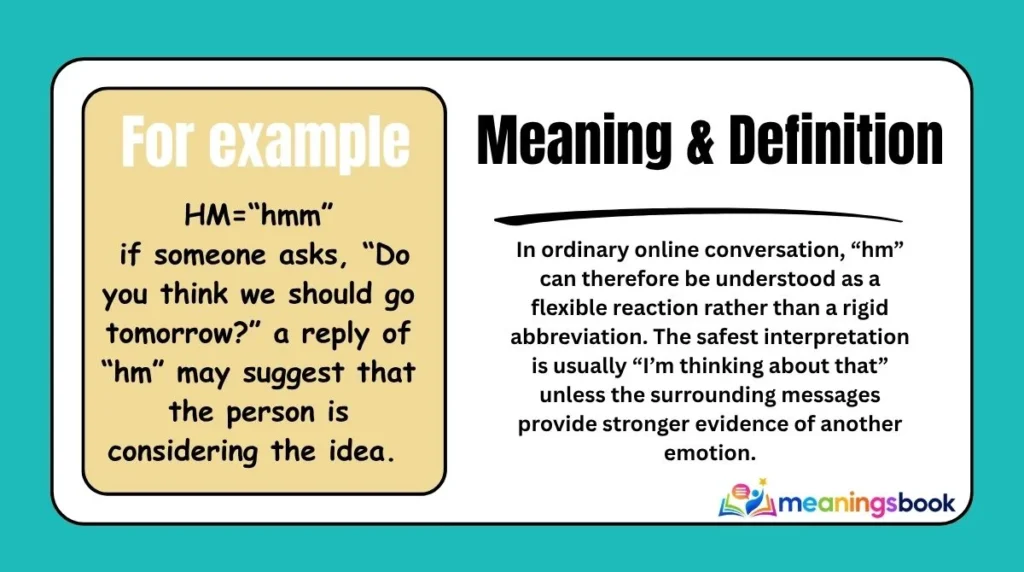
For example, if someone asks, “Do you think we should go tomorrow?” a reply of “hm” may suggest that the person is considering the idea. They might be interested but not ready to give an immediate yes or no.
The expression can also communicate uncertainty. If someone says, “I heard the meeting was moved to Friday,” replying “hm” could show that you are thinking about whether that information is correct.
Tone matters greatly. A friendly conversation might make “hm” sound thoughtful or curious:
“Hm, that actually sounds interesting.”
A short response without punctuation can feel more distant:
“hm”
In that situation, the recipient may interpret it as hesitation, uncertainty, or a lack of enthusiasm.
The number of letters can also affect the impression. “Hmm” often feels more expressive and deliberate than “hm.” Similarly, “hmmm” may suggest extended thought, suspicion, playful teasing, or uncertainty depending on the conversation.
It is important not to assume that “hm” automatically means something negative. A person might simply be taking a moment to think. Text communication removes facial expressions, voice tone, and pauses, so short expressions can carry several possible emotional meanings.
In ordinary online conversation, “hm” can therefore be understood as a flexible reaction rather than a rigid abbreviation. The safest interpretation is usually “I’m thinking about that” unless the surrounding messages provide stronger evidence of another emotion.
Background
The expression hm is best understood as a written representation of a sound people make when thinking or reacting. Sounds such as “hmm,” “hm,” “uh,” and “oh” have long been used in spoken conversation to express pauses, reactions, uncertainty, or thought. Text messaging provides a way to represent some of these conversational sounds using letters.
There is no single universally accepted origin that can be confidently assigned to the texting form hm. It is more accurate to describe it as part of a broader tradition of representing speech sounds in writing rather than claiming that it was created by a particular website, social platform, or online community.
As digital communication became more conversational, people increasingly began writing expressions that imitate natural speech. Instead of sending a complete sentence such as “I need to think about that,” someone can type “hm” and communicate a similar idea much more quickly.
The form is especially useful because texting often involves short, informal responses. People do not always want to explain every reaction in full. A brief “hm” can communicate that they noticed a message and are considering it.
Over time, variations such as hmm, hmmm, and hmmmm became common ways to add different shades of expression. These versions do not have strict grammatical rules. Their interpretation is shaped by context, punctuation, the relationship between the speakers, and the subject being discussed.
For instance, “Hm, maybe” can sound thoughtful and neutral, while “Hm…” may suggest hesitation or doubt. “Hmmm 😂” could be playful, while “hm?” might indicate confusion or a request for clarification.
This flexibility explains why people sometimes search for the meaning of “hm” after receiving it. Unlike a fixed acronym, the expression communicates an attitude or reaction rather than one precise definition.
Therefore, it is better to understand hm as a conversational text expression than as an abbreviation that always expands into the same words.
Usage in Different Contexts
The meaning of hm can change depending on where and how it appears. Although the basic idea of thinking or reacting remains common, the emotional tone may differ considerably.
In Chat
In private chats, “hm” commonly indicates that someone is thinking about a message. It may be a temporary pause before giving a more complete response.
Example:
“Would you rather meet Saturday or Sunday?”
“Hm, Sunday might be better.”
Here, the expression signals consideration rather than rejection.
On Social Media
On social platforms, “hm” may appear in comments, direct messages, or replies. A user might use it to show curiosity, skepticism, or mild surprise.
For example:
“Hm, I never thought about it that way.”
This generally indicates that the person is reconsidering an idea.
A comment such as:
“Hm…”
can be more ambiguous. It might express doubt, suspicion, or simply thoughtful observation.
In Professional Communication
The expression is less appropriate in formal professional writing. In a workplace email, a client message, or an official document, writing only “hm” may appear vague, informal, or dismissive.
In casual workplace chats, however, colleagues may still use it when discussing ideas.
For example:
“Hm, we could probably move the meeting to Thursday.”
Even there, a clearer sentence is usually preferable when precision matters.
In Casual Conversations
Among friends, “hm” can be highly flexible. It may mean “let me think,” “interesting,” “I’m not sure,” or “I see.”
The relationship between the people matters. Friends who regularly joke with each other may use “hm” playfully, while strangers may interpret the same message as uncertainty or disinterest.
Tone Is the Key
The surrounding words often reveal the intended meaning. Compare:
- “Hm, that makes sense.” — thoughtful agreement.
- “Hm, I’m not sure.” — uncertainty.
- “Hm…” — possible hesitation or doubt.
- “Hm?” — possible confusion or request for clarification.
- “Hmmm 😂” — potentially playful or teasing.
Thus, there is no reliable way to interpret “hm” without considering the conversation around it.
Meaning in Chat, WhatsApp, Instagram, and TikTok
On messaging and social media platforms, hm generally works as an informal reaction rather than a technical abbreviation. The platform itself usually does not give the expression a special meaning. WhatsApp, Instagram, TikTok, and ordinary text messaging can all contain similar uses.
HM in WhatsApp
On WhatsApp, “hm” may appear as a quick response when someone is thinking about what another person said.
For example:
Person A: “I think we should postpone the trip.”
Person B: “Hm, maybe you’re right.”
Here, the sender is considering the suggestion.
If someone sends only:
“hm”
the message becomes more dependent on context. It could mean that they are thinking, unsure, or waiting to see what you say next.
HM on Instagram
On Instagram, the expression may appear in direct messages or comments. Someone might use it when reacting to a photo, opinion, story, or conversation.
For example:
“Hm, I didn’t expect that.”
This can show surprise or reconsideration.
In comments, a standalone “hm…” can sometimes look skeptical. However, it does not automatically mean criticism.
HM on TikTok
TikTok conversations often use short, expressive messages, so “hm” may function as a quick reaction to a video or discussion. A user could type it to indicate that something made them think or that they are not completely convinced.
The meaning still depends on the surrounding content. A humorous video may make “hm” playful, while a controversial statement may make it sound doubtful.
HM in Ordinary Text Messages
In regular SMS or messaging apps, “hm” is commonly used as a conversational pause.
For example:
“Hm, let me think about it.”
In this sentence, the meaning is very clear: the speaker needs a moment to consider the matter.
The important point is that hm does not automatically mean yes, no, agreement, disagreement, or anger. It is primarily a reaction whose precise meaning comes from context.
Meaning in Physics, Medical, and Aircraft Terminology
The letters HM can appear as abbreviations in specialized fields, but there is no single universal technical definition that applies across physics, medicine, and aviation.
HM in Physics
“HM” does not have one universally standard meaning in general physics that should automatically be assumed whenever the letters appear. Specialized textbooks, research papers, equations, laboratories, or subfields may use letter combinations as symbols or abbreviations, but their meanings depend on the specific context.
Therefore, seeing “HM” in a physics-related document does not automatically establish one particular definition.
HM in Medical Terminology
Medical writing contains many abbreviations, and HM can potentially appear in specialized records or terminology. However, medical abbreviations can be ambiguous, and their meanings depend on the medical specialty, document, institution, and surrounding terms.
For that reason, “HM” should not be assigned one medical definition without context. In healthcare communication, relying on an unexplained abbreviation can create confusion, so the surrounding text is essential.
If you encounter “HM” in a medical report, prescription-related document, or clinical material, it is better to determine its meaning from the document’s terminology or ask an appropriate healthcare professional rather than assuming it means the texting expression.
HM in Aircraft or Aviation Terminology
There is also no single universal aviation meaning of HM that should automatically replace its ordinary conversational meaning. Aviation uses many standardized abbreviations and codes, but individual letter combinations can have different meanings depending on the system or document involved.
Aviation manuals, flight operations documents, technical records, and communication systems may use abbreviations according to their own conventions.
Therefore, if “HM” appears in an aviation context, it should be interpreted using the relevant aviation terminology rather than automatically reading it as “hmm.”
The key distinction is simple: in casual texting, “hm” is usually a conversational reaction; in a technical document, the surrounding field determines whether HM is a specialized abbreviation or symbol.
Common Misconceptions
One common misconception is that hm always means “yes” or agreement. It does not. A person may use it while considering an idea without agreeing with it.
Another misunderstanding is that “hm” always means the sender is annoyed. Although a short “hm” can sometimes sound cold or skeptical, irritation is only one possible interpretation. The same expression can simply indicate thoughtfulness.
Some people also assume that hm and hmm are completely different expressions. In casual texting, they are often variations of the same general reaction. The longer spelling can simply make the pause or emotion feel more pronounced.
Punctuation can also create confusion. Compare:
- “hm” — neutral or ambiguous.
- “hm?” — may indicate confusion or questioning.
- “hm…” — may suggest hesitation or doubt.
- “Hmm, okay.” — often sounds more reflective.
- “Hmmm 😂” — may be playful.
Another misconception is that “HM” must always be an acronym because it contains two letters. In many conversations, it is not an acronym at all. It is simply a written representation of a sound or conversational reaction.
People can also confuse “hm” with unrelated abbreviations used in specialized areas. Capitalization alone does not necessarily establish a technical meaning. For example, someone writing “HM” in a casual chat may still simply mean “hm” or “hmm.”
The best approach is therefore to avoid interpreting the expression in isolation. Look at what was said immediately before it, whether punctuation was used, and how the person normally communicates.
If the message affects an important conversation and the intended tone is unclear, asking a simple follow-up question is more reliable than guessing.
Similar Terms & Alternatives
Several expressions can perform a role similar to hm in online conversation, but they are not always identical.
“Hmm”
“Hmm” is probably the closest alternative. It usually expresses thought, hesitation, consideration, or uncertainty.
Example:
“Hmm, I need to think about that.”
“Hmmm”
The extended form can make the reaction feel more deliberate or expressive. Depending on context, it may sound playful, doubtful, suspicious, or thoughtful.
“Uh”
“Uh” often represents hesitation or uncertainty, especially when someone is searching for words.
Example:
“Uh, I’m not sure.”
It can therefore overlap with “hm” but often feels more like spoken hesitation.
“Oh”
“Oh” usually signals realization, surprise, or acknowledgment rather than extended thought.
Example:
“Oh, I understand now.”
“I see”
“I see” is a clearer verbal response. It commonly indicates that someone understands or has received information.
“Let me think”
This is a direct alternative when someone genuinely needs time to consider something.
“Not sure”
This is more explicit than “hm.” Instead of making the recipient interpret the reaction, it directly communicates uncertainty.
“Interesting”
“Interesting” can show that someone is considering or reacting to an idea, but it can also sound neutral, enthusiastic, or skeptical depending on tone.
The important difference is that hm is deliberately vague, while alternatives such as “not sure” or “let me think” communicate the intended reaction more clearly.
How to Respond to It
The best response to hm depends on what you think the sender is communicating.
If it seems like they are thinking, you can give them time:
“Take your time.”
If you think they are uncertain, you can invite them to explain:
“What are you thinking?”
If the message seems confused, clarify what you meant:
“I mean that we could go tomorrow instead.”
If you suspect they are not convinced, you can ask directly:
“You don’t seem convinced. What do you think?”
If the conversation is casual, you can respond playfully:
“That ‘hm’ sounds suspicious 😂”
You can also simply continue the conversation if the context makes the meaning obvious.
For example:
Them: “Hm.”
You: “Want me to explain?”
This gives the person an easy opportunity to clarify without creating unnecessary tension.
If you receive “hm” from someone you are dating or talking to romantically, avoid immediately assuming that they are losing interest. Their message could simply mean that they are considering what you said.
The safest strategy is to judge the expression alongside the person’s other messages. If they continue asking questions and engaging with you, “hm” is unlikely to mean complete disinterest. If they repeatedly send very short responses and stop contributing to the conversation, the overall communication pattern may matter more than the individual word.
Differences from Similar Words
The difference between hm, hmm, okay, oh, and not sure is mainly one of tone and clarity.
| Expression | Common function | Typical impression |
|---|---|---|
| hm | Thinking or reacting | Brief and ambiguous |
| hmm | Thinking or considering | More expressive |
| hmmm | Extended reaction | More deliberate or emotional |
| okay | Acknowledgment | Acceptance or understanding |
| oh | Reaction or realization | Surprise or recognition |
| not sure | Expressing uncertainty | Direct and clear |
| I see | Showing understanding | Clear acknowledgment |
| let me think | Requesting time | Explicitly thoughtful |
“HM” is especially different from “okay.” If someone replies “okay,” they are generally acknowledging what you said. If they reply “hm,” they may still be deciding how they feel about it.
It is also different from “no.” “Hm” does not automatically reject an idea.
Likewise, “hm” is less direct than “I don’t know.” Someone who writes “I don’t know” clearly communicates uncertainty, while “hm” leaves the recipient to infer the exact reaction.
The punctuation can further change the tone. “Hm?” may function like a question, while “Hm…” can suggest a longer pause or uncertainty.
Because digital conversations lack voice tone, readers often assign emotional meaning based on very small details. This is why one person’s neutral “hm” can be interpreted by another person as annoyed or uninterested.
When in doubt, consider the complete message rather than analyzing the two letters alone.
Relevance in Online Conversations & Dating Apps
In modern online conversations, hm is useful because people often communicate through very short messages. It can appear in private chats, social-media direct messages, dating apps, group conversations, and comment sections.
On dating apps, the interpretation can be particularly sensitive. If someone responds to a message with “hm,” it may mean they are thinking about what you said, unsure how to respond, mildly curious, or unconvinced. It does not automatically indicate romantic interest or rejection.
For example:
You: “Would you want to grab coffee sometime?”
Them: “Hm, maybe.”
This suggests that the person is considering the suggestion, but “maybe” makes it clear that there is not yet a firm commitment.
In another situation:
You: “I think pineapple belongs on pizza.”
Them: “Hmm…”
The reaction could be playful disagreement rather than serious conflict.
The relationship between the people also affects interpretation. A close friend may send “hm” casually without intending any negative tone. Someone you have just met may use the same message in a more cautious way.
Timing and surrounding messages matter as well. If “hm” is followed by a detailed response, it probably represents a moment of thought. If it is followed by silence, it may be harder to determine the sender’s intention.
Online communication encourages people to interpret short responses emotionally, but doing so too quickly can lead to misunderstandings.
When the meaning matters, the best solution is often simple clarification. A message such as “What do you mean?”, “What are you thinking?”, or “Is that a yes or a no?” can remove ambiguity.
Ultimately, “hm” is a flexible conversational signal. Context, punctuation, relationship, and the rest of the conversation all help determine what the sender intended.
Frequently Asked Questions
What does HM mean in text?
HM usually means “hmm” in text and shows that someone is thinking, considering something, or reacting with uncertainty. It can also communicate curiosity, hesitation, mild doubt, or a thoughtful pause. The exact meaning depends on the conversation and punctuation, so a standalone “hm” should not automatically be interpreted as agreement, disagreement, or annoyance.
What does HM mean in chat?
In chat, HM commonly represents a thoughtful or hesitant reaction. Someone may type it when they are deciding what to say, considering an idea, or unsure about something. For example, “Hm, maybe” indicates that the person is thinking about the suggestion. A message such as “Hm…” may sound more uncertain or skeptical.
Is HM a slang term?
HM can be considered an informal texting expression rather than traditional slang with one fixed definition. It commonly represents the sound “hmm” in casual digital communication. People use it in messages and online conversations to show thought, hesitation, curiosity, or uncertainty. It is informal and is generally less suitable for formal professional writing.
How do you respond to HM in a text?
You can respond to HM by asking what the person is thinking or giving them more information. For example, you could say, “What are you thinking?” or “Want me to explain?” If the conversation is clearly casual, you might respond playfully. The best response depends on whether their “hm” appears thoughtful, uncertain, confused, or skeptical.
What does HM mean on social media?
On social media, HM usually works as a short reaction meaning something like “hmm.” It can express thought, uncertainty, curiosity, surprise, or mild skepticism. Its meaning can vary between comments and private messages. Looking at the post, previous messages, punctuation, and the person’s usual communication style can help determine the intended tone.
Can HM have different meanings?
Yes, HM can have different meanings depending on context. In casual texting, it commonly represents “hmm” and signals thought or hesitation. In specialized documents, however, the letters may function as an abbreviation or symbol whose meaning is determined by that particular field. Therefore, context is essential whenever “HM” appears outside ordinary conversation.
Does HM mean someone is angry?
HM does not automatically mean that someone is angry. A short “hm” can sound cold or doubtful in some conversations, but it can also be completely neutral and simply indicate that the person is thinking. Look at the rest of the conversation before assuming a negative emotion. Punctuation and the sender’s usual texting style can also provide clues.
What does HM mean from a girl or guy in texting?
HM has no special universal meaning based on whether the sender is a girl or a guy. Either person may use it to express thought, uncertainty, curiosity, or hesitation. If it appears in a romantic conversation, the surrounding messages are more important than the sender’s gender. Avoid treating “hm” alone as definite evidence of attraction or rejection.
Conclusion
The HM meaning in text is most commonly connected with “hmm,” a conversational expression used to show that someone is thinking, considering an idea, or reacting with uncertainty. Depending on context, it can also suggest curiosity, hesitation, mild skepticism, surprise, or a thoughtful pause. The expression does not automatically indicate agreement, anger, rejection, or disinterest.
One reason “hm” can be confusing is that text communication does not include voice tone or facial expressions. Punctuation, spelling variations, and the surrounding conversation can therefore change how the message feels. “Hm,” “Hmm,” “Hm?” and “Hm…” may each create slightly different impressions.
In casual chats, WhatsApp messages, social media, and dating conversations, the safest approach is to interpret the expression alongside the rest of the interaction. If its meaning remains unclear, asking what the person means is better than making an assumption. Context ultimately determines what this short but flexible expression communicates.

I am Ethan Whitmore, an English teacher and vocabulary enthusiast who explains words, phrases, and meanings in text through simple examples to make English easier for everyone.



