
If someone sends you “WTW” in a text message, you may wonder what they are asking or trying to say. Short abbreviations like this are common in texting, social media comments, direct messages, and casual online conversations because they make communication faster and more informal.
The meaning of an abbreviation can also depend on the surrounding conversation, so understanding the context is important.
WTW is especially common when someone wants to know another person’s plans or is suggesting that they spend time together.
It can be used between friends, acquaintances, romantic interests, or people chatting casually online. Because the abbreviation is short and can look unfamiliar to someone who has not encountered it before, many people search for its meaning after receiving it in a message.
Understanding the usual interpretation of WTW makes these conversations much easier to follow and helps you respond naturally without overthinking the message.
Quick Answer
WTW meaning in text is usually “What’s the word?”, a casual way of asking what is happening, what the plans are, or whether someone wants to hang out. It is commonly used in texting, Snapchat, Instagram, TikTok, and other informal online conversations. Depending on context, it can function similarly to “What’s up?” or “What are you doing?”
Meaning & Definition
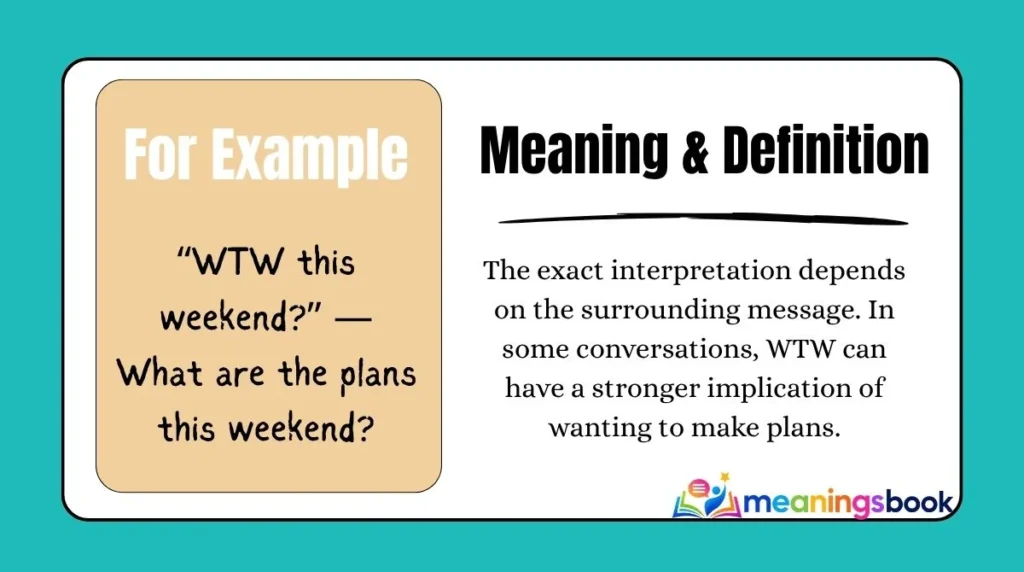
WTW most commonly means “What’s the word?” in text and online conversations. Although the phrase may sound unusual when interpreted literally, it is generally a casual expression asking about someone’s plans, activities, or current situation.
For example, if a friend texts:
“WTW tonight?”
They are probably asking something like:
“What are the plans tonight?”
or:
“What’s happening tonight?”
The abbreviation can also be used as a general way of opening a conversation. Someone might simply send “WTW?” to find out what you are doing or whether anything interesting is happening.
The exact interpretation depends on the surrounding message. In some conversations, WTW can have a stronger implication of wanting to make plans. If someone you regularly hang out with says “WTW?” they may be asking whether you are available to meet.
The expression is generally informal. It is much more appropriate for texting, social media, and casual messaging than for formal business communication.
Examples
- “WTW?” — What are you up to? / What’s happening?
- “WTW this weekend?” — What are the plans this weekend?
- “WTW later?” — Are you doing anything later?
- “WTW, you free?” — What’s happening? Are you available?
In everyday use, the phrase does not necessarily require a complicated answer. A simple response about your plans is usually enough.
Background
The exact origin of WTW as an internet abbreviation is not clearly established, so it is best not to attribute it to a specific person, website, or single moment without reliable evidence.
The abbreviation follows a broader pattern common in digital communication: people shorten familiar phrases to make texting quicker and more convenient. Expressions such as “What’s up?” and “What are you doing?” have long been used as casual conversation starters, and abbreviated forms developed naturally within fast-paced messaging environments.
WTW is particularly suited to informal conversations because “What’s the word?” can communicate several closely related ideas. Depending on the situation, the sender may be asking what is going on, what someone is planning, or whether there is an opportunity to meet.
As texting and social media became more conversational, abbreviations became a normal part of online language. Users often rely on context rather than complete sentences, and WTW fits that style.
It is also worth remembering that internet abbreviations are not always standardized. A particular person or community can assign a different meaning to the same letters. Therefore, while “What’s the word?” is a common interpretation of WTW, the surrounding conversation should always be considered before deciding exactly what the sender means.
Usage in Different Contexts
The way WTW is interpreted can vary slightly depending on where it appears.
In Chat
In a private chat, WTW often asks about plans or activities. A friend might send “WTW?” because they want to know what you are doing or whether you have plans.
On Social Media
WTW can appear in comments, direct messages, captions, or replies. It usually keeps the conversation casual and may be used to start a conversation or suggest making plans.
In Casual Conversations
Among friends, WTW can be a quick way to ask what is happening. The tone is usually relaxed rather than serious.
In Professional Communication
WTW is generally not appropriate for formal professional communication unless everyone involved already uses informal abbreviations. In a workplace email or formal message, writing “What are the plans?” or “What is the update?” would usually be clearer.
In Conversations About Plans
When followed by a time or day, WTW is more likely to relate directly to plans:
- “WTW Friday?”
- “WTW tonight?”
- “WTW this weekend?”
In these examples, the sender is probably looking for information about what is planned or whether you are available.
Meaning in Chat, WhatsApp, Instagram, and TikTok
WTW can be used across many popular messaging and social platforms, including WhatsApp, Instagram, TikTok, Snapchat, and ordinary text messaging.
On WhatsApp, a person may use WTW to ask a friend what they are doing or whether they want to make plans. For example:
“WTW tonight?”
On Instagram, it can appear in direct messages or comments. Someone who wants to start a casual conversation might simply write:
“WTW?”
On TikTok, the abbreviation may appear in comments or private messages, particularly when users are communicating informally.
The platform itself usually does not change the basic meaning. The conversation surrounding the abbreviation matters more than whether it appears on WhatsApp, Instagram, TikTok, or another service.
Tone can also vary according to punctuation. “WTW?” sounds like a straightforward question, while “WTW 👀” could feel more playful or suggest that the sender is interested in what is happening. However, emojis add personal context rather than changing the standard meaning of the abbreviation.
If you receive WTW from someone you know well, consider your recent conversation. If you were discussing weekend plans, the sender is probably asking about those plans. If you have not spoken recently, they may simply be opening a conversation.
Meaning in Physics, Medical, and Aircraft Terminology
WTW does not have one universally recognized standard meaning in ordinary physics, medical terminology, or aircraft terminology that should automatically be assumed when you see the abbreviation.
Physics
WTW is not a standard everyday abbreviation for a fundamental physics concept. If it appears in a physics document, its meaning would need to be determined from the specific source or field.
Medical Terminology
WTW should not automatically be interpreted as a standard medical term. Medical abbreviations can be highly specialized, and unfamiliar abbreviations should be interpreted using the specific clinical or professional context rather than internet slang.
Aircraft and Aviation
WTW is not a universally recognizable aviation abbreviation that should be assumed in a casual conversation. Aviation documents use many specialized abbreviations, so a WTW appearing in technical material would require context.
This distinction is important because an abbreviation that is common in texting does not necessarily have the same meaning in a technical profession. When WTW appears in a normal text or social-media message, “What’s the word?” is the most useful interpretation to consider first.
Common Misconceptions
One common mistake is assuming that every occurrence of WTW has exactly the same meaning. Internet abbreviations are highly dependent on context, and different communities can use the same letters differently.
Another misconception is that WTW is always asking “What are you doing?” While that can be a reasonable interpretation in casual conversation, the underlying phrase is generally “What’s the word?” The practical meaning can overlap with questions about plans, activities, or what is happening.
People may also confuse WTW with other abbreviations that contain similar letters. For example, WYD commonly means “What are you doing?” while WTW generally carries the idea of asking what is happening or what the plans are.
A further misunderstanding occurs when someone interprets WTW as formal language. It is primarily casual shorthand. If you receive it in a message, there is usually no need to treat it as a serious or technical expression.
Finally, punctuation and surrounding words can influence tone. “WTW?” and “WTW tonight?” may have similar meanings, but the second clearly focuses on plans for a particular time.
Similar Terms & Alternatives
Several expressions can serve a similar conversational purpose:
| Term | Common meaning | Typical use |
|---|---|---|
| WTW | What’s the word? | Asking what is happening or what the plans are |
| WYD | What are you doing? | Asking about someone’s current activity |
| WYA | Where you at? | Asking someone’s location |
| WBU | What about you? | Returning a question |
| WYU | What you up to? | Asking about someone’s activities |
| HBU | How about you? | Asking for the other person’s response |
| Wassup / Sup | What’s up? | Casual conversation starter |
These alternatives are not exact replacements in every situation. For instance, “WYD?” focuses more directly on what someone is currently doing, whereas “WTW?” can be broader and may ask about plans or what is going on.
Understanding these differences can help you interpret the sender’s intention instead of translating each abbreviation word-for-word.
How to Respond to It
The best response depends on what you think the sender is asking. If WTW means “What’s the word?” in the sense of asking about your plans, you can simply tell them what you are doing.
If You Have Plans
- “Nothing much, probably staying home.”
- “I’m going out later.”
- “I’m free tonight. What’s up?”
If You Want to Hang Out
- “I’m free. You trying to do something?”
- “Not much. Wanna hang out?”
- “I’m down. What did you have in mind?”
If You Are Unsure
You can ask for clarification:
- “What do you mean?”
- “You asking what I’m doing?”
- “What’s up?”
If You Are Interested in the Person
In a more personal conversation, a playful response can keep things going:
- “Depends… what are you planning?”
- “Nothing yet. You got something in mind?”
There is no special response required. Since WTW is casual slang, a casual answer is usually the most natural choice.
Differences from Similar Words
WTW and WYD are among the abbreviations most likely to be confused.
WTW — “What’s the word?”
This is broader. It can ask what is happening, what the plans are, or what someone has in mind.
WYD — “What are you doing?”
This is more direct and normally asks about someone’s current activity.
For example:
- “WTW tonight?” → What are the plans tonight?
- “WYD tonight?” → What are you doing tonight?
The distinction can be subtle because both questions may lead to the same conversation.
WTW can also resemble “What’s up?” in practical use. Both can open a casual conversation, but they are not literally the same phrase.
The tone of WTW is generally informal and conversational. It can sound friendly, relaxed, curious, or slightly suggestive of making plans depending on who sends it and what came before it.
Relevance in Online Conversations & Dating Apps
WTW can be particularly useful in informal online conversations because it is short and leaves room for the other person to explain what they are doing or planning.
On dating apps, someone might use “WTW?” as an easy conversation starter. They could be asking what you are up to, what your plans are, or whether you are interested in meeting. The meaning depends heavily on the previous messages.
For example:
“WTW this weekend?”
This may simply mean:
“What are your plans this weekend?”
But if the conversation has already included discussion about meeting, it could be an indirect way of asking whether you are available for a date.
The relationship between the people matters, too. A close friend may use WTW casually, while someone you have just matched with could be using it as an opening to explore whether you are interested in talking or meeting.
It is therefore better to interpret the whole message and conversation rather than assuming that the abbreviation itself carries a romantic meaning. WTW is not inherently a dating term. It is simply casual shorthand that can appear in romantic, friendly, or ordinary social conversations.
Frequently Asked Questions
What does WTW mean in text?
WTW usually means “What’s the word?” in text messages. It is a casual expression used to ask what is happening, what someone is doing, or what the plans are. For example, “WTW tonight?” can mean “What are the plans tonight?” The exact interpretation depends on the surrounding conversation.
What does WTW mean in chat?
In chat, WTW commonly means “What’s the word?” and functions as an informal question about what is happening or what someone has planned. A person might send “WTW?” simply to start a conversation or find out whether you are available to do something.
Is WTW a slang term?
Yes, WTW is commonly used as informal texting and internet slang. It is mainly found in casual conversations rather than formal writing. Its meaning is usually understood from context, and “What’s the word?” is the common interpretation when it appears in ordinary texting.
What does WTW mean on social media?
On social media, WTW usually means “What’s the word?” It can be used in direct messages, comments, or casual conversations to ask what is happening or what someone has planned. Depending on the conversation, it can be similar in practical meaning to “What’s up?” or “What are you doing?”
How should you respond to WTW?
You can respond to WTW by sharing what you are doing or asking what the sender has in mind. For example, you could say, “Not much, what’s up?” or “I’m free tonight. What did you have planned?” If the context is unclear, simply asking “What do you mean?” is also fine.
Can WTW have different meanings?
WTW can have different meanings in different contexts, but “What’s the word?” is the common interpretation in casual texting. If the abbreviation appears in a technical document, workplace material, or specialized setting, it should not automatically be interpreted as internet slang. The surrounding words and subject matter provide the necessary context.
Does WTW mean “what are you doing”?
WTW can sometimes be interpreted as asking what someone is doing, especially when used casually. However, its common expansion is “What’s the word?” The practical meaning may overlap with “What are you doing?” when someone is asking about your current plans or activities.
What does WTW mean from a girl or guy?
WTW does not have a different standard meaning based on whether a girl or guy sends it. It usually means “What’s the word?” and can simply be a casual question about what is happening or what you are doing. In a dating conversation, the context may make it an invitation to continue talking or discuss plans.
Conclusion
WTW is a common piece of informal texting shorthand that usually means “What’s the word?” In everyday conversations, it can be used to ask what is happening, what someone is doing, or what plans are being made.
You may encounter it in text messages, WhatsApp chats, Instagram DMs, TikTok conversations, and other social-media interactions.
Although the basic meaning is fairly straightforward, the exact intention can change with context. A friend asking “WTW tonight?” may simply want to know your plans, while someone on a dating app may be using the same expression to start a conversation or explore the possibility of meeting.
WTW is generally casual rather than professional, and it should not automatically be treated as a technical abbreviation in fields such as physics, medicine, or aviation. When in doubt, look at the surrounding message and relationship between the people involved. Context usually provides the clearest answer.

I am Ethan Whitmore, an English teacher and vocabulary enthusiast who explains words, phrases, and meanings in text through simple examples to make English easier for everyone.



