If you have received a message containing “FR,” you may wonder whether it has a special meaning or is simply another internet abbreviation.
In most everyday texting, FR means “for real.” People use it to show that they are being serious, agreeing strongly with something, or emphasizing that they genuinely mean what they are saying.
The abbreviation appears frequently in text messages, group chats, comments, memes, Instagram posts, TikTok conversations, and other informal online communication.
It can sometimes be written alone, such as “FR?” or “FR,” or combined with other words, such as “fr tho” or “fr fr.”
Understanding the surrounding conversation is important because abbreviations can have different meanings in specialized fields.
While “FR” is commonly understood as “for real” in casual online communication, its interpretation can change in technical, professional, or industry-specific settings.
Quick Answer
FR meaning in text is usually “for real.” It is commonly used in chats and social media to express sincerity, strong agreement, or disbelief. For example, “That movie was amazing fr” means “That movie was amazing, for real.” The exact tone depends on the surrounding message and conversation.
Meaning & Definition
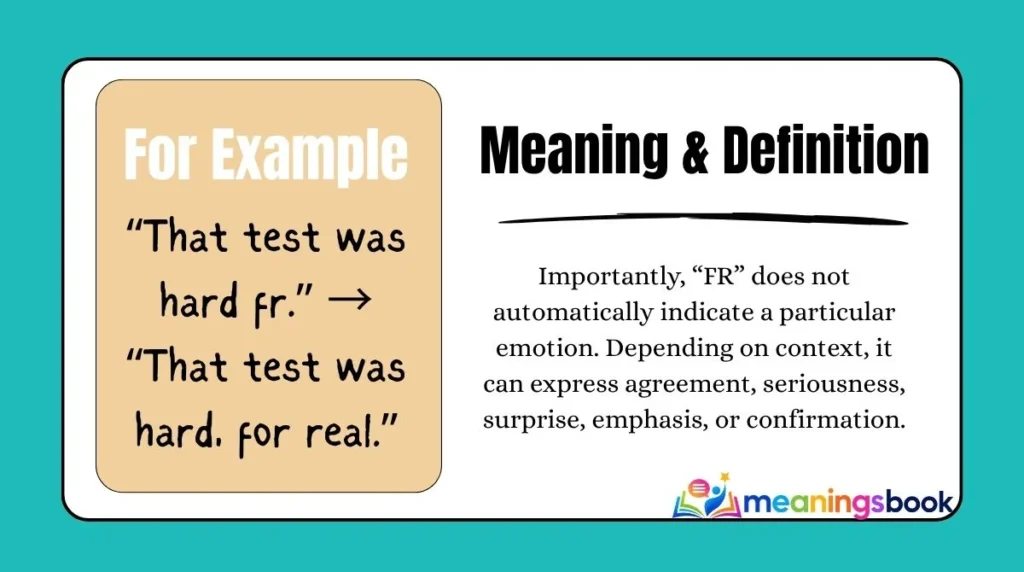
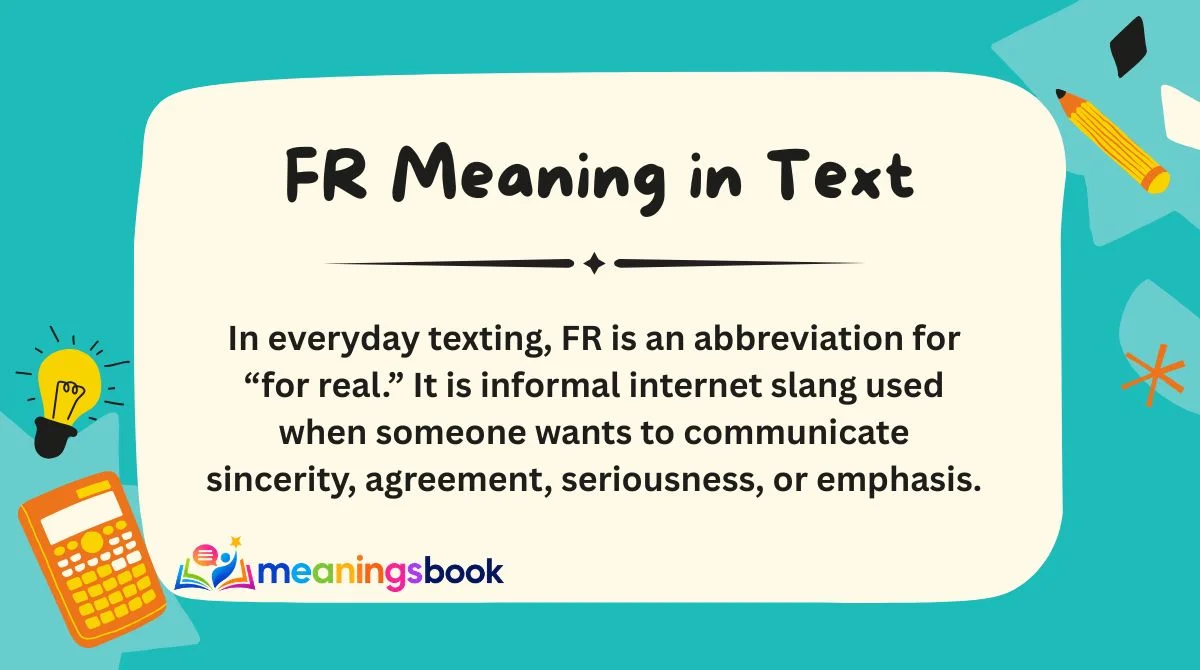
In everyday texting, FR is an abbreviation for “for real.” It is informal internet slang used when someone wants to communicate sincerity, agreement, seriousness, or emphasis.
The simplest way to understand it is to imagine that the writer has added “seriously” or “I genuinely mean that” to the sentence.
For example:
- “That test was hard fr.” → “That test was hard, for real.”
- “FR?” → “For real?” or “Are you serious?”
- “You’re right fr.” → “You’re genuinely right.”
- “FR, I didn’t know that.” → “Seriously, I didn’t know that.”
The meaning can shift slightly according to punctuation and placement.
When someone writes “FR” by itself, it can be a reaction. If someone tells you something surprising and you answer “FR?”, you may be asking whether they are serious.
When it appears at the end of a sentence, such as “That was funny fr,” it usually strengthens the statement.
The abbreviation is especially common in casual digital communication because short forms make conversations faster. People often type in lowercase as well, so “fr” and “FR” generally mean the same thing in this context.
Another variation is “fr fr,” which means “for real, for real.” It is normally used for extra emphasis. Someone saying “I’m tired fr fr” is strongly emphasizing that they are genuinely tired.
Importantly, “FR” does not automatically indicate a particular emotion. Depending on context, it can express agreement, seriousness, surprise, emphasis, or confirmation.
Background
“FR” developed as a shortened form of the phrase “for real,” rather than as a completely separate word with its own independent definition. Like many internet abbreviations, it became useful because online conversations favor quick, compact expressions.
There is no single universally established moment or individual that can be credited with creating “FR” as internet slang. Shortening common phrases into initials has long been a feature of informal digital communication. As texting, online forums, social networks, and messaging platforms became more conversational, abbreviations such as “FR” became easier to recognize within particular communities.
The phrase “for real” itself is much older than the abbreviation. In ordinary English, “for real” can mean genuinely, seriously, or actually. The texting form simply compresses the phrase into two letters.
Over time, “FR” became particularly recognizable in social-media-style communication. It works well in short comments and rapid conversations because the reader can usually understand the intended phrase from context.
The development of related expressions also helped establish its online usage. “FR?” can function as a question, while “fr” can be used as emphasis. “Fr fr” intensifies the expression even further.
It is worth distinguishing the history of the phrase from the history of the abbreviation. The phrase “for real” has existed independently in English, while the exact history of when “FR” became widespread as a texting abbreviation is less certain. Therefore, it would be inaccurate to claim a specific website, person, or year as the definitive origin without reliable evidence.
Today, “FR” is best understood as informal digital shorthand rather than formal English. Its popularity is strongest in casual communication, particularly among people accustomed to texting, memes, social media, and internet slang.
Usage in Different Contexts
The meaning and tone of “FR” depend heavily on where it appears. Although “for real” is the dominant meaning in casual online communication, people may use the abbreviation in several different ways.
Chat
In private or group chats, “FR” often signals agreement or sincerity.
Example:
“I could sleep for 12 hours.”
“FR.”
Here, the response means something like “For real” or “I completely agree.”
It can also be a question:
“He really said that?”
“FR?”
In that situation, “FR?” means “For real?” or “Seriously?”
Social Media
On social platforms, “FR” is frequently used in comments, captions, replies, and short reactions.
For example:
“This is the best song ever fr.”
The writer is emphasizing that they genuinely believe the song is excellent.
A comment such as:
“FR 😭”
may communicate strong agreement with something funny, relatable, surprising, or emotionally intense.
Professional Fields
“FR” should be treated more carefully in professional communication. In a workplace email, report, academic paper, or formal document, the abbreviation may be unclear or may have a field-specific meaning.
If someone writes “FR” in a professional setting, do not automatically assume it means “for real.” Look at the surrounding terminology and the subject of the discussion.
Casual Conversations
In ordinary informal conversation, “FR” almost always carries the familiar internet-slang sense when used as a standalone reaction or alongside casual language.
The important distinction is context. The same two letters can represent slang in one conversation and a technical abbreviation in another.
Meaning in Chat, WhatsApp, Instagram, and TikTok
On messaging and social-media platforms, “FR” generally means “for real.” This applies to informal conversations on platforms such as WhatsApp, Instagram, TikTok, and similar services.
On WhatsApp, a person might reply:
“FR 😂”
after a friend makes a relatable comment. The response generally means “Seriously” or “I know, right?”
On Instagram, someone might comment:
“This outfit is perfect fr.”
The “fr” emphasizes genuine approval.
On TikTok, “fr” commonly appears in comments and replies:
“Fr this is exactly what happened to me.”
Here, the writer is saying that the statement or video is genuinely relatable.
The abbreviation can also appear in combinations such as:
- fr — for real
- FR? — for real?
- fr fr — for real, strongly emphasizing sincerity
- fr tho — for real though
- but fr — but seriously / genuinely
Capitalization usually does not change the meaning. “FR,” “Fr,” and “fr” can all mean “for real” in casual messaging.
Tone can change, however. A simple “fr” may sound relaxed, while “FR??” may express surprise or disbelief. Similarly, “FR 😭” can communicate humorous agreement or emotional emphasis.
Because social media is highly contextual, emojis, punctuation, previous messages, and the relationship between the people involved can all influence how the abbreviation should be interpreted.
Meaning in Physics, Medical, and Aircraft Terminology
“FR” does not have one universal technical meaning across physics, medicine, and aviation. This is important because technical abbreviations are often defined by a particular field, organization, document, or system.
Physics
There is no single universal physics definition of “FR” that should automatically replace the everyday meaning “for real.” In physics and engineering-related material, the letters may occur as shorthand for a specific term depending on the subject.
For example, technical documents may use abbreviations connected with frequency, response, force, or other concepts. The exact expansion must be determined from the document’s terminology rather than guessed from the two letters alone.
Medical Terminology
In medical documentation, “FR” can appear as an abbreviation in certain contexts, but it does not have one universally applicable medical meaning. Medical abbreviations can vary between specialties and institutions.
Therefore, if “FR” appears on a medical document, prescription-related material, clinical note, or report, it should be interpreted according to that document’s terminology rather than assuming it means “for real.”
Aircraft and Aviation Terminology
Similarly, “FR” is not a universal aviation term with one fixed meaning. Aviation documents, flight operations, airlines, aircraft systems, and regulatory materials can use different abbreviations.
In aviation, guessing the meaning of an abbreviation can be particularly problematic because technical terminology is highly context-dependent. The surrounding document, abbreviation list, or official terminology should be used to determine its meaning.
In short, “FR” has a clear common meaning in casual texting but does not have one universal meaning across technical disciplines.
Common Misconceptions
One common misunderstanding is assuming that “FR” always means “for real.” In casual texting, that is usually correct, but abbreviations can have different meanings in professional and technical contexts.
Another misconception is that “FR?” and “FR” mean exactly the same thing. They are closely related but can perform different functions.
- “FR?” usually asks for confirmation: “For real?”
- “FR.” often expresses agreement or emphasis: “For real.”
- “fr fr” adds stronger emphasis: “For real, for real.”
People may also confuse “FR” with other abbreviations because many two-letter combinations have multiple interpretations.
The tone can also be misunderstood. Someone replying “FR” may not be dismissing you. They may simply be agreeing strongly with what you said.
Likewise, “FR?” does not necessarily mean the person doubts you. It can simply express surprise and ask whether your statement is genuine.
Another misconception is that lowercase and uppercase versions have different definitions. In ordinary texting, fr, FR, and Fr generally carry the same slang meaning. Capitalization is often a matter of typing style or emphasis.
Finally, context matters more than the letters themselves. If “FR” appears in a casual meme conversation, “for real” is a natural interpretation. If it appears in a technical report, a different interpretation may be appropriate.
Similar Terms & Alternatives
Several expressions can be confused with or used similarly to “FR.”
“For real”
This is the complete phrase represented by FR. It is clearer than the abbreviation and can be used in both speech and writing.
“Seriously”
“Seriously” can often replace “for real” when FR is being used to emphasize sincerity.
Example:
“That was difficult, fr.”
can become:
“That was seriously difficult.”
“Honestly”
“Honestly” can have a similar function when someone is emphasizing their genuine opinion.
“Honestly, that was amazing.”
The tone is slightly different, but both can communicate sincerity.
“IKR”
“IKR” means “I know, right?” It usually expresses agreement, particularly when responding to a relatable observation.
“TBH”
“TBH” means “to be honest.” It introduces or emphasizes an honest opinion.
“No cap”
“No cap” is informal slang meaning that someone is telling the truth or not exaggerating. It can overlap with the sincerity expressed by “for real,” although it is a different expression.
“FRFR”
“FRFR” is simply a more compressed version of “for real, for real.” It adds emphasis to the original abbreviation.
These expressions are related, but they are not interchangeable in every sentence. Tone and context determine which one sounds most natural.
How to Respond to It
If someone sends you “FR”, the best response depends on what they mean in the conversation.
If they are agreeing with you, you can simply continue the conversation.
Example:
You: “This week went by so fast.”
Them: “FR.”
You: “Seriously, I don’t know where the time went.”
If someone sends “FR?”, they may be asking whether you are serious.
Example:
Them: “You actually met him?”
You: “Yeah, FR.”
You can also respond casually with:
- “Yeah, seriously.”
- “I know, right?”
- “Exactly.”
- “Honestly, yes.”
- “Yep 😂”
- “For real!”
- “No joke.”
If you are unsure what the person means, asking for clarification is perfectly reasonable:
“FR as in for real?”
In most casual conversations, however, the surrounding messages make the intended meaning obvious.
The key is to match the other person’s tone. A casual abbreviation usually does not require a formal response. If the conversation is playful, a short response or emoji may be enough. If the message involves an important claim, responding clearly is better than relying on another abbreviation.
Differences from Similar Words
Although “FR,” “seriously,” “honestly,” and “no cap” can overlap, they are not identical.
| Expression | Basic meaning | Typical tone |
|---|---|---|
| FR | For real | Casual, internet slang |
| For real | Genuinely / seriously | Informal, conversational |
| Seriously | Without joking / genuinely | More general |
| Honestly | Speaking truthfully | Conversational |
| IKR | I know, right? | Agreement |
| TBH | To be honest | Informal honesty |
| No cap | No lie / not exaggerating | Strong internet slang |
| FRFR | For real, for real | Extra emphasis |
The main difference is that FR is an abbreviation, while several of these alternatives are complete words or different expressions.
“FR?” is also different from “Seriously?” in tone. Both can ask whether something is true, but “FR?” has a distinctly casual texting style.
Likewise, “FR” and “IKR” can both indicate agreement, but “IKR” specifically carries the idea of “I know, right?” while “FR” more broadly means “for real.”
Relevance in Online Conversations & Dating Apps
“FR” can appear naturally in modern online conversations, including dating apps, direct messages, comments, and social-media interactions.
On a dating app, someone might write:
“You actually like hiking? FR?”
Here, “FR?” means “Really?” or “Seriously?” The person is expressing surprise or asking for confirmation.
Someone might also say:
“Your music taste is good fr.”
In this case, “fr” emphasizes that the compliment is genuine.
The relationship between the people matters. Between close friends, “FR” may be used casually and frequently. Between people who have just met, it may simply function as a quick reaction or expression of interest.
Dating conversations also rely heavily on tone. A message such as “FR?” could sound playful, surprised, skeptical, or curious depending on the previous messages and emojis.
For example:
“You’d really travel across the country for a concert?”
“FR?”
This could be genuine surprise rather than disbelief.
Because text removes facial expressions and vocal tone, punctuation and surrounding wording become important. “FR 😂” feels different from “FR??” and different again from “FR.” Understanding the larger conversation is therefore more reliable than interpreting the abbreviation in isolation.
Frequently Asked Questions
What does FR mean in text?
FR usually means “for real” in text messages. It is an informal abbreviation used to express sincerity, agreement, seriousness, or emphasis. For example, “That was hilarious fr” means “That was genuinely hilarious.” If someone writes “FR?” instead, they may be asking “For real?” or “Are you serious?”
What does FR mean in chat?
In chat, FR usually means “for real.” Someone may use it to agree with another person, emphasize a statement, or ask whether something is genuinely true. A reply such as “FR” often means “I completely agree,” while “FR?” commonly means “Really?” or “Are you serious?”
Is FR a slang term?
Yes, FR is commonly used as informal internet slang. It is a shortened form of the phrase “for real” and is particularly common in texting, social-media comments, direct messages, and casual online conversations. It is generally inappropriate to assume that the slang meaning applies automatically in formal or technical documents.
What does FR mean on social media?
On social media, FR generally means “for real.” People use it in comments, captions, replies, and messages to show agreement or emphasize that they genuinely mean something. Expressions such as “fr,” “FR,” and “fr fr” are common informal variations, with “fr fr” providing stronger emphasis.
What does FR mean on WhatsApp?
On WhatsApp, FR usually means “for real.” A person might reply “FR” when they strongly agree with you or say “FR?” when they are surprised and want confirmation. The surrounding conversation determines whether it functions as agreement, emphasis, or a question.
What does FRFR mean?
FRFR means “for real, for real.” It is an intensified version of FR and is used when someone wants to emphasize sincerity or strong agreement. For example, “I need a vacation frfr” means the person is strongly emphasizing that they genuinely need a vacation.
How do you respond to FR in a text?
You can respond naturally according to the context. If someone uses “FR” to agree with you, you might say “Exactly,” “I know, right?” or continue the conversation. If they write “FR?” because they are asking whether you are serious, answer directly with something like “Yeah, seriously” or “Yep, I mean it.”
Can FR have different meanings?
Yes, FR can have different meanings outside casual texting. In online slang, “for real” is the dominant interpretation, but technical, professional, medical, aviation, and other specialized contexts may use the same letters differently. When the abbreviation appears in a specialized document, its surrounding terminology should be checked before assigning a meaning.
Conclusion
FR usually means “for real” when it appears in a text, chat, comment, or casual social-media conversation. It can communicate genuine agreement, sincerity, emphasis, surprise, or a request for confirmation. The exact tone depends on how it is written and what was said before it.
“FR?” generally functions as a question such as “For real?” or “Are you serious?”, while “FR” can be a short way of saying “I agree” or “Seriously.” “FRFR” adds even more emphasis.
The abbreviation is especially common on messaging and social-media platforms, where short informal expressions are convenient. However, FR should not automatically be interpreted as “for real” in professional or technical material. Specialized fields may use the same letters for different purposes.
Ultimately, context is the most reliable way to understand FR. Look at the conversation, punctuation, surrounding words, and relationship between the people communicating before deciding exactly what the abbreviation means.

I am Ethan Whitmore, an English teacher and vocabulary enthusiast who explains words, phrases, and meanings in text through simple examples to make English easier for everyone.