When someone sends “CYA” in a text message, chat, or social media conversation, its meaning is usually much simpler than it may first appear.
Short abbreviations are common in digital communication because they let people express familiar phrases quickly, especially when conversations move fast. CYA is one of those informal expressions that can sound confusing if you have not seen it before.
People may encounter it in text messages, group chats, comments, gaming conversations, or casual online discussions. In most everyday situations, it is a shortened form of “see ya,” meaning “see you” or “see you later.”
Depending on the conversation, it can be a friendly way to end a chat or tell someone that you expect to talk or meet again. Understanding the surrounding message, relationship, and tone can help you determine exactly how the sender intends it.
Quick Answer
CYA meaning in text is usually “see ya,” a casual way of saying “see you” or “see you later.” It is most commonly used in texts, chats, and social media when someone is ending a conversation. The expression is informal, friendly, and generally suggests that the person expects to communicate again.
Meaning & Definition
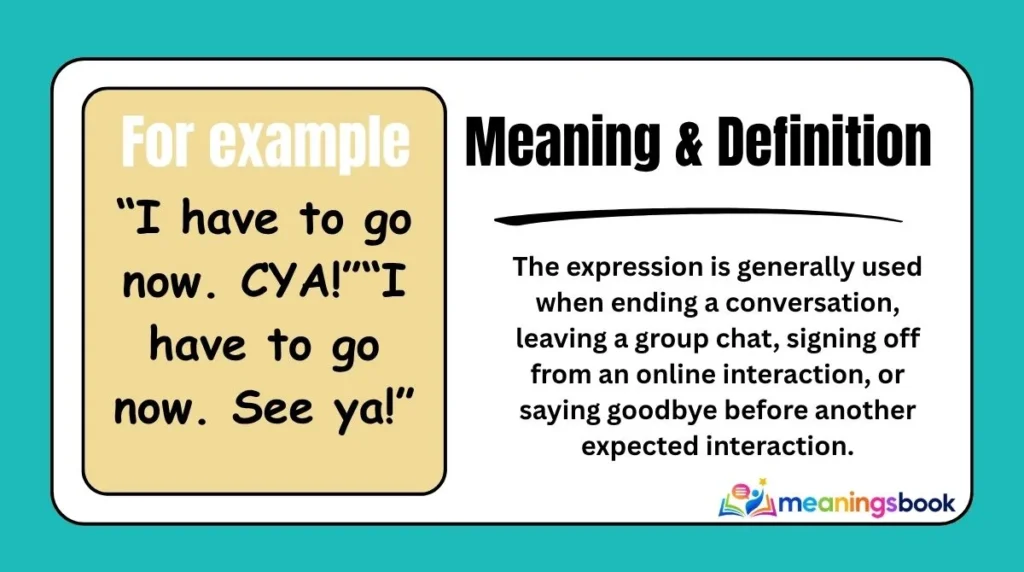
CYA most commonly means “see ya,” an informal version of “see you.” The word “ya” is a casual spelling of “you,” so the abbreviation represents the sound of the phrase rather than a formal abbreviation based on its individual letters.
For example, if someone says:
“I have to go now. CYA!”
they are essentially saying:
“I have to go now. See ya!”
The expression is generally used when ending a conversation, leaving a group chat, signing off from an online interaction, or saying goodbye before another expected interaction.
The tone is usually relaxed and friendly. It does not normally carry a serious or formal meaning. Someone might use it with a friend, classmate, coworker they know casually, gaming partner, or another person with whom informal communication is appropriate.
CYA can also appear after a short conversation:
Person 1: “I’ll send you the details tomorrow.”
Person 2: “Sounds good. CYA!”
Here, CYA simply signals the end of the interaction.
Context can influence its tone. In a warm conversation, it may sound cheerful or friendly. In a very short exchange, it can function as a quick goodbye without expressing much emotion. If someone writes “CYA later,” the meaning is even more clearly connected to “see you later.”
It is also useful to distinguish CYA from expressions that merely happen to use the same letters. In ordinary texting, “CYA” is most commonly understood as “see ya,” but abbreviations can have different meanings in specialized settings. Therefore, the surrounding conversation should always be considered before interpreting it.
Background
The expression behind CYA is the informal phrase “see ya,” which itself is a conversational variation of “see you.” Unlike technical abbreviations that originate from professional terminology, this expression developed from ordinary spoken language.
“See ya” is a casual way of saying goodbye while implying that the people involved may communicate or meet again. As informal digital communication became more common, people began shortening everyday phrases to make messages faster and easier to type. CYA fits naturally into that style because its letters roughly represent the sounds of “see ya.”
There is no need to assume a complicated technical origin for the expression. Its meaning is closely connected to ordinary conversational English.
Texting culture has encouraged many shortened expressions, including forms such as “CU” for “see you” and “CYA” for “see ya.” These expressions are particularly suited to informal communication because they preserve the basic idea while requiring fewer characters.
The exact point at which CYA became widespread as an internet or texting abbreviation is not always clear, so it would be misleading to assign it a specific origin without reliable evidence. What can be said confidently is that the abbreviation follows a broader pattern of shortening familiar spoken expressions for written digital communication.
Today, CYA is generally recognizable as a casual farewell. It can appear in private messages, online chats, gaming conversations, social media interactions, and other informal settings.
Its continued use depends heavily on communication style. Some people prefer complete phrases such as “see you later,” while others naturally use abbreviations such as CYA. Younger and older users may also have different preferences for texting shorthand, so familiarity with the expression can vary.
Usage in Different Contexts
In Chat
In online chats, CYA is commonly used when someone is leaving the conversation. It may appear as a standalone message or at the end of a longer sentence.
Example:
“Got to finish my work. CYA!”
The intended meaning is simply “I have to go. See you later.”
On Social Media
On social platforms, CYA may appear in comments, direct messages, or conversations between people who already communicate casually. It can be used when someone is leaving an online discussion or ending a private conversation.
For example:
“I’m heading offline now, CYA!”
This communicates a casual goodbye.
In Professional Fields
CYA should not automatically be interpreted as “see ya” in every professional environment. In some workplace contexts, CYA can also be an abbreviation for a completely different phrase, particularly “cover your ass,” an informal expression meaning to protect yourself by keeping records, documentation, or evidence of what happened.
That meaning is substantially different from “see ya.” In a professional message, the surrounding words are therefore especially important.
For example, “CYA before you leave” could mean “see ya” if the conversation is casual, while “Make sure you CYA with the documentation” could have a different workplace interpretation.
In Casual Conversations
Among friends, CYA is usually straightforward. It often means “see ya,” “see you,” or “see you later.”
Its tone is normally relaxed rather than formal. It can also be playful when combined with emojis or other casual expressions.
Example:
“Okay, I’m off 😂 CYA!”
The emoji and wording make the friendly goodbye especially clear.
Meaning in Chat, WhatsApp, Instagram, and TikTok
Across messaging and social media platforms, CYA generally keeps the same casual meaning: “see ya.” The platform itself usually does not change the basic interpretation.
In WhatsApp messages, someone might use CYA when ending a conversation:
“I’ll message you when I get home. CYA!”
This normally means “I’ll talk to you later.”
On Instagram, CYA may appear in direct messages or comments. A person might write it after discussing plans, responding to a friend, or ending a conversation.
“I have to go now, CYA!”
The expression works as a short, informal farewell.
TikTok
TikTok users may use CYA in direct messages, comments, or conversations surrounding videos. As with other social platforms, it usually communicates a quick goodbye when the context is informal.
General Chat
In gaming chats, group messages, and other online conversations, CYA can be particularly convenient because users often prefer short messages.
For example:
“Match starts in ten. I’m grabbing food, CYA.”
Here, the writer is simply leaving temporarily and expects to return or communicate again.
The tone can vary slightly depending on punctuation and surrounding language. “CYA!” can feel energetic or friendly, while “cya” may feel more casual or low-key. Capitalization does not fundamentally change the meaning.
It is also possible for people to use “CYA” jokingly or playfully. The context determines whether it feels warm, neutral, or simply practical.
Meaning in Physics, Medical, and Aircraft Terminology
CYA does not have one universal standard meaning in physics, medicine, or aviation that should automatically replace its common texting interpretation.
Physics
CYA is not a standard general-purpose physics term with a commonly recognized meaning comparable to established scientific abbreviations. If it appears in a physics-related document, its meaning would need to be determined from that specific document or field.
Medical Terminology
CYA is not a universal medical abbreviation that should automatically be interpreted in every healthcare context. Medical abbreviations can be highly context-dependent, and using an informal texting interpretation in a clinical document would be inappropriate without checking the surrounding terminology.
Aircraft and Aviation
CYA is likewise not something that should automatically be treated as a universal aviation term. Aviation uses many specialized abbreviations, and a particular organization, document, or operational context could assign abbreviations specific meanings.
Therefore, if you encounter CYA in a scientific, medical, or aviation document, do not automatically assume it means “see ya.” The surrounding terminology and source should determine its meaning.
In ordinary texting, however, “see ya” remains the most straightforward interpretation when the conversation is clearly casual.
Common Misconceptions
One common misconception is that CYA always means “see ya.” While that is the usual interpretation in casual texting, abbreviations can have different meanings in specialized or workplace contexts.
Another misunderstanding is that CYA necessarily means “see you tomorrow.” It does not. CYA is simply a casual goodbye and does not specify exactly when the people will communicate again.
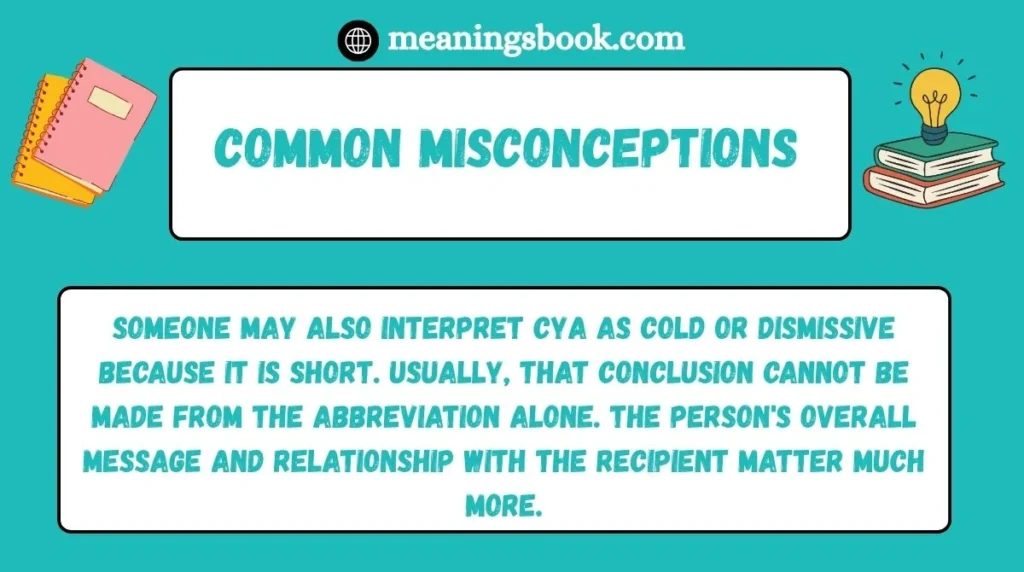
Someone may also interpret CYA as cold or dismissive because it is short. Usually, that conclusion cannot be made from the abbreviation alone. The person’s overall message and relationship with the recipient matter much more.
For example:
“Thanks for helping! CYA 😊”
sounds friendly.
By contrast:
“Whatever. CYA.”
could sound irritated or dismissive because of the surrounding wording.
The abbreviation itself has not necessarily changed meaning; the tone comes from the broader message.
Another possible confusion is between CYA meaning “see ya” and CYA as an informal workplace expression related to protecting oneself. These are different uses and should not be treated as interchangeable.
The safest approach is to examine the words around CYA. If someone is ending a casual conversation, “see ya” is probably intended. If the discussion involves workplace documentation, responsibility, compliance, or protecting oneself from blame, another interpretation may be more appropriate.
Similar Terms & Alternatives
Several expressions can communicate a similar idea to CYA.
“See ya”
This is the phrase represented by CYA and is often the closest equivalent.
“See you”
A more complete version of the same basic farewell. It is still casual but slightly less abbreviated.
“See you later”
This is useful when you want to suggest another conversation or meeting later.
“CU”
CU is another informal texting abbreviation associated with “see you.”
“Later”
“Later” can function as a short goodbye without explicitly saying “see you.”
“Bye”
This is a straightforward farewell and works in both casual and many everyday situations.
“Catch you later”
This is a friendly informal expression with a similar conversational function.
“Talk later”
This emphasizes that another conversation is expected rather than simply expressing a goodbye.
Although these alternatives overlap, their tone is not identical. “Bye” is more direct, “see you later” is clearer, and “CYA” is especially abbreviated and casual.
How to Respond to It
If someone sends CYA to you in a casual conversation, you usually do not need a complicated response. A simple goodbye is enough.
Here are several natural replies:
- “CYA!”
- “See ya later!”
- “Later!”
- “Bye, talk soon!”
- “See you!”
- “Take care!”
If you want to sound friendly, you could say:
“CYA! Have a good one 😊”
If you expect to speak with the person soon:
“CYA, talk later!”
If the conversation is ending because someone has to leave:
“No worries, CYA!”
The best response depends on the relationship and tone of the conversation. With a close friend, a very short response may feel perfectly natural. With someone you do not know well, “See you later” or “Take care” may sound clearer and more conventional.
If you are unsure whether CYA means “see ya” or another abbreviation, look at the surrounding message before replying. If necessary, you can simply ask what they meant.
Differences from Similar Words
| Expression | Typical meaning | Tone |
|---|---|---|
| CYA | See ya / see you | Very casual |
| See ya | See you | Casual |
| See you | Goodbye / see you again | Casual to neutral |
| See you later | Goodbye with an implication of later contact | Friendly |
| CU | See you | Informal/texting |
| Bye | Goodbye | Neutral and direct |
| Later | Goodbye / see you later | Casual |
| Take care | Friendly farewell | Warm and polite |
| Talk later | Continue the conversation later | Casual and specific |
The major difference is usually style rather than basic intent. CYA is shorter and more informal than “see you.” “Take care” adds a warmer sentiment, while “talk later” specifically suggests another conversation.
There is also an important contextual difference when CYA appears outside casual communication. In certain workplace settings, CYA may be used as an abbreviation for an expression about protecting oneself through documentation or caution. Therefore, context is essential.
Relevance in Online Conversations & Dating Apps
CYA can appear naturally in online conversations, including direct messages and dating-app chats, particularly when people are communicating casually.
On a dating app, someone might say:
“I have an early morning tomorrow. CYA!”
In that situation, the most likely meaning is simply “see ya” or “see you later.” It does not automatically indicate rejection, disinterest, or romantic interest.
Tone becomes particularly important in dating conversations because short messages can be interpreted emotionally. A person who says “CYA 😊” may sound friendly, while “CYA” after a tense exchange might feel more abrupt. The surrounding conversation provides more information than the abbreviation itself.
If someone ends a dating-app conversation with CYA, it is usually best not to overanalyze the abbreviation. Look at whether they previously suggested talking again, made plans, or continued engaging with you.
On social media, the same principle applies. CYA is generally just a convenient farewell. It may indicate that someone is leaving a conversation, going offline, or ending an interaction.
The relationship between the people also matters. Friends may use CYA freely, coworkers may use it only in casual communication, and strangers may prefer clearer phrases.
In all of these situations, context is more reliable than the abbreviation alone.
Frequently Asked Questions
What does CYA mean in text?
CYA usually means “see ya,” an informal way to say “see you” or “see you later.” It is commonly used when someone is ending a casual text conversation, group chat, or online interaction. The expression is generally friendly and informal, although the surrounding message can influence its tone.
What does CYA mean in chat?
In casual chat, CYA usually means “see ya.” Someone may send it when they are leaving the conversation, going offline, or saying goodbye. For example, “I have to go, CYA!” simply means “I have to go, see you later.”
Is CYA a slang term?
Yes, CYA can be considered informal texting slang when it is used to mean “see ya.” It is not a formal expression and is most appropriate for casual digital communication. The abbreviation can have other meanings in certain professional contexts, so its meaning should always be interpreted from the surrounding conversation.
What does CYA mean on social media?
On social media, CYA generally means “see ya” and functions as a quick, casual goodbye. It may appear in direct messages, comments, group conversations, or other informal interactions. The platform does not normally change its meaning; the context determines whether the farewell sounds friendly, neutral, or abrupt.
How do you respond to CYA?
You can respond to CYA with another casual farewell, such as “CYA,” “See ya,” “Later,” “See you soon,” or “Take care.” If you want to keep the conversation warm, you can add something like “Have a good day!” The appropriate response depends on your relationship with the sender and the tone of the conversation.
Can CYA have different meanings?
Yes, CYA can have different meanings depending on context. In ordinary texting, it most commonly means “see ya.” In some workplace situations, however, CYA can represent an informal expression related to protecting oneself through documentation or caution. Therefore, the surrounding words are important when interpreting the abbreviation.
Does CYA mean see you later?
CYA can mean “see you later” in casual conversation, although its closest literal interpretation is “see ya.” It does not necessarily promise that the people will meet at a particular time. It is simply a relaxed way of ending a conversation while implying another interaction may happen.
Is CYA rude in a text message?
CYA is not inherently rude. It is normally a casual and friendly goodbye. However, it can seem abrupt if it appears in a tense conversation or is used without any other friendly wording. The sender’s relationship with you, the surrounding messages, punctuation, and overall tone are more important than the abbreviation itself.
Conclusion
CYA is most commonly a casual abbreviation for “see ya,” meaning “see you” or “see you later.” It is especially common in informal texts, chats, social media messages, gaming conversations, and other relaxed digital interactions.
The expression is generally used as a quick farewell and does not normally carry a complicated meaning. However, abbreviations can be context-dependent, so CYA should not automatically be interpreted the same way in every setting.
In professional or specialized environments, it may represent something entirely different, making the surrounding language important. When you receive CYA in a casual conversation, a simple response such as “See ya,” “Later,” or “Take care” is usually appropriate.
Ultimately, understanding the tone and context of the conversation gives you the clearest interpretation. If CYA appears as a casual sign-off, it is most likely just a friendly, shortened way of saying goodbye.

I am Ethan Whitmore, an English teacher and vocabulary enthusiast who explains words, phrases, and meanings in text through simple examples to make English easier for everyone.