Have you ever heard someone describe a job, award, position, or possession as highly desirable? They might use the word coveted to explain why something is especially wanted by many people.
Understanding the coveted meaning can help you interpret conversations, articles, social media posts, and professional discussions more accurately.
The word coveted commonly describes something that people strongly desire, admire, or hope to obtain. It often suggests that the thing being discussed is valuable, attractive, prestigious, or difficult to acquire.
For example, a company might offer a coveted position, a student might receive a coveted scholarship, or an athlete might win a coveted trophy.
Although the word is frequently used in formal writing, it also appears in everyday conversations and online content. Its meaning can vary slightly depending on the situation, but its central idea remains the same: something is greatly desired by someone.
In this guide, you will learn its definition, origin, common uses, synonyms, differences from similar words, and examples that show how to use it naturally.
Quick Answer
Coveted means greatly desired or strongly wanted by someone. It is commonly used to describe something valuable, attractive, prestigious, or difficult to obtain, such as a dream job, a popular award, a scholarship, or a luxury item. For example, a coveted position is a job that many people want because it offers desirable benefits or recognition.
Meaning & Definition
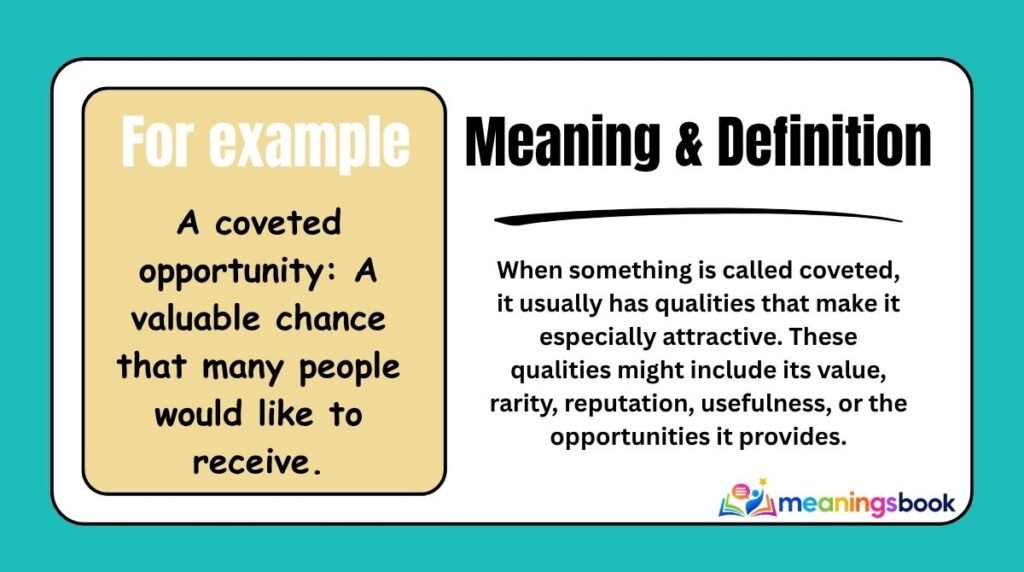
The word coveted is the past tense and past participle of the verb covet. It describes something that a person or group wants very much.
When something is called coveted, it usually has qualities that make it especially attractive. These qualities might include its value, rarity, reputation, usefulness, or the opportunities it provides.
For example, a coveted job may offer a high salary, career growth, and professional recognition. A coveted award may represent years of hard work and achievement. A coveted property might be located in a desirable neighborhood or have features that are difficult to find elsewhere.
Simple Definition
In simple English, coveted means wanted very much, especially because something is valuable, special, or desirable.
Here are some examples:
- A coveted award: An award that many people hope to win.
- A coveted position: A job or role that many people want.
- A coveted item: An object that people strongly desire to own.
- A coveted opportunity: A valuable chance that many people would like to receive.
- A coveted title: A title that people consider important or prestigious.
How to Understand the Word
The word often suggests competition or strong interest. If hundreds of people apply for one position, that position may be described as coveted because many applicants want it.
However, something does not need to be expensive or famous to be coveted. A student might consider a particular scholarship coveted because it would help pay for education. A collector might desire a rare book that has little value to other people.
The word describes how desirable something is to the people who want it. It does not automatically mean that everyone values it or that the object is objectively the best.
Example Sentences
- She received a coveted scholarship to study abroad.
- The player won the coveted championship trophy.
- This company is offering a coveted position in its research department.
- He finally purchased the coveted watch he had wanted for years.
- The award is highly coveted among young filmmakers.
In each sentence, coveted communicates that something is especially desirable to the people interested in it.
Background
The word coveted comes from the verb covet, which has a long history in English. The verb entered English through Anglo-French and Old French forms related to expressing a strong desire for something.
The broader word family is associated with wanting, longing for, or desiring something that belongs to someone else or that a person wishes to possess. Over time, the word became established in everyday English and formal writing.
How Its Meaning Developed
The word covet has historically carried a stronger meaning than simply liking something. It can suggest an intense desire to possess something, particularly when the desired object belongs to another person.
For example, someone who admires a friend’s new car may simply appreciate its design. Someone who covets that car strongly wants to own it.
The adjective coveted developed as a convenient way to describe things that attract this kind of desire. In modern English, it is widely used to describe desirable opportunities, honors, possessions, and achievements.
Traditional and Modern Usage
In traditional religious and moral discussions, covet often has a negative association because it can refer to an excessive desire for something belonging to another person.
In contemporary writing, however, coveted frequently has a neutral or positive meaning. A coveted scholarship, for instance, is generally considered a good opportunity rather than something morally questionable.
The tone depends on the context. A writer may describe a coveted prize positively because it represents achievement, while describing someone’s coveted wealth negatively if the sentence emphasizes envy or greed.
Why the Word Remains Useful
English speakers often use coveted because it communicates more than ordinary interest. Saying that a position is desirable explains that people like it. Calling it coveted suggests that it is particularly sought after.
This makes the word useful in journalism, business writing, entertainment news, education, sports, and product descriptions.
The historical connection to strong desire remains part of the word’s meaning, even though modern usage often focuses on the attractiveness or prestige of the thing being discussed.
Usage in Different Contexts
The meaning of coveted stays relatively consistent across different situations, but the reason something is desirable can change.
1. In Everyday Conversations
People can use coveted to describe possessions, opportunities, or experiences they really want.
Example:
“That concert ticket is highly coveted.”
This means that many people want the ticket, perhaps because the artist is popular or seats are limited.
Another example:
“She finally got her coveted vacation.”
This suggests that she had wanted the vacation for a long time.
The word is more polished than everyday expressions such as “really wanted” or “highly desired.”
2. In Professional Settings
In workplaces, coveted often describes positions, promotions, awards, and professional opportunities.
Examples:
- He earned a coveted leadership role.
- She received a coveted industry award.
- The company is known for its coveted internship program.
In these situations, the word suggests professional value, competition, recognition, or career benefits.
3. In Education
Students may compete for coveted scholarships, university placements, research opportunities, and academic awards.
For example:
“Only a small number of students received the coveted scholarship.”
The sentence communicates that the scholarship was highly desirable and that receiving it was a notable achievement.
4. In Entertainment and Sports
The word is common in discussions about celebrities, films, competitions, and athletic achievements.
Examples:
- The actor won a coveted film award.
- The team lifted the coveted championship trophy.
- The singer received a coveted invitation to perform at the event.
It often emphasizes prestige or the importance of an achievement.
5. In Shopping and Collecting
Products can be coveted because they are rare, fashionable, expensive, useful, or associated with a popular brand.
For example:
“Collectors are searching for a coveted limited-edition watch.”
This suggests that the watch attracts strong interest among collectors.
The word is therefore flexible enough to describe both material possessions and achievements.
Meaning in Chat, WhatsApp, Instagram, and TikTok
The word coveted does not have a separate standard slang definition on messaging or social media platforms. Its ordinary English meaning generally applies online as well.
Coveted Meaning in Chat
In a chat message, coveted usually means that something is highly desired or especially attractive.
Example:
“That internship is so coveted!”
Meaning: Many people want that internship because it offers valuable experience or other benefits.
Another example:
“You got the coveted invitation!”
Meaning: You received an invitation that people particularly wanted.
The exact reason for the interest depends on the conversation.
Coveted Meaning on WhatsApp
On WhatsApp, someone might use the word while discussing a job offer, a new purchase, a personal achievement, or an opportunity.
Example:
Friend: “I got selected for the program!”
You: “Congratulations! That’s a coveted opportunity.”
This response recognizes that the opportunity is valuable or highly desirable.
In casual conversations, people may prefer simpler expressions such as “That’s amazing!” or “Everyone wants that opportunity!”
Coveted Meaning on Instagram
On Instagram, the word may appear in captions, product descriptions, fashion posts, travel content, or achievement announcements.
Examples:
- “Finally got my coveted designer bag.”
- “Celebrating a coveted industry award.”
- “The most coveted pieces from our new collection.”
These statements communicate strong desire, prestige, or popularity. A business may also use the word as promotional language to make a product sound exclusive or desirable.
Coveted Meaning on TikTok
TikTok creators might use coveted when discussing trending products, rare collectibles, awards, or popular opportunities.
For example:
“Here’s how I got the coveted item everyone is looking for.”
This means that the creator obtained something that many people want.
However, the word itself does not automatically mean that an item is viral, rare, or expensive. Those details must come from the surrounding content.
Is It Common Internet Slang?
No. Coveted is a standard English word rather than a platform-specific abbreviation or slang term. Its online meaning is essentially the same as its dictionary meaning.
Meaning in Physics, Medical, and Aircraft Terminology
The word coveted is an ordinary English adjective, not a standard technical term in physics, medicine, or aviation.
Understanding this distinction helps prevent confusion when the word appears in technical articles or professional discussions.
Coveted Meaning in Physics
In standard physics terminology, coveted does not have a recognized specialized definition.
Physics uses technical terms to describe concepts such as energy, force, momentum, acceleration, and electric charge. The word coveted does not ordinarily identify a physical quantity, law, formula, or scientific process.
However, it may appear in a general sentence about scientific recognition.
Example:
“The researcher received a coveted physics award.”
Here, coveted means highly desired or prestigious. It describes the award rather than a physical concept.
Coveted Meaning in Medical Terminology
Coveted is not a standard medical diagnosis, anatomical term, treatment, or clinical abbreviation.
It may appear in healthcare-related writing when describing a desirable opportunity or achievement.
Example:
“She secured a coveted place in a competitive medical residency program.”
The word refers to the desirability of the position. It does not describe a medical condition or procedure.
If you encounter the word in a medical report, the complete sentence should be considered before interpreting its significance.
Coveted Meaning in Aircraft and Aviation Terminology
In standard aviation terminology, coveted does not have a recognized technical meaning related to aircraft systems, flight operations, navigation, or aerodynamics.
It may be used in an article about aviation careers, aircraft collections, or industry awards.
Example:
“The pilot earned a coveted position with the airline.”
This means that the position was highly desirable.
The word does not itself indicate an aircraft component, flight status, or aviation procedure.
Important Distinction
In all three fields, the ordinary meaning remains the same: strongly desired or highly sought after. Any technical significance would need to come from the surrounding terminology, not from the word coveted itself.
Common Misconceptions
Several misunderstandings can arise when people encounter the word coveted.
1. Thinking It Means Expensive
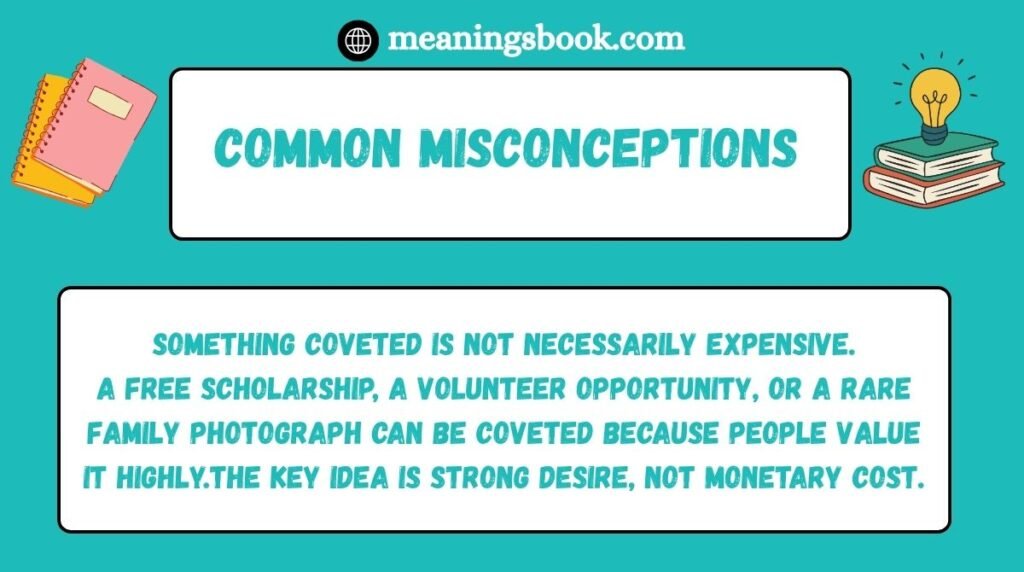
Something coveted is not necessarily expensive.
A free scholarship, a volunteer opportunity, or a rare family photograph can be coveted because people value it highly.
The key idea is strong desire, not monetary cost.
2. Assuming It Always Means Jealousy
The word is related to the idea of desire, but it does not always express jealousy or envy.
For example, “She won a coveted award” is usually a positive statement about her achievement.
The sentence does not necessarily suggest that she envies someone else or that others are jealous of her.
3. Confusing It With Covet
Covet is the base verb, while coveted is its past-tense or past-participle form and is commonly used as an adjective.
Examples:
- “Many collectors covet the rare coin.”
- “The rare coin is coveted by collectors.”
The first sentence describes what collectors desire. The second describes the coin as highly desirable.
4. Assuming It Means Exclusive
A coveted item may be exclusive, but the two words are not identical.
A product can be widely available and still be coveted because it is popular. An exclusive product is restricted or available only to a limited group or through particular conditions.
5. Mistaking It for Internet Slang
Coveted is not an abbreviation such as “BRB” or “LOL.” It is a regular English word that can be used in online messages, captions, and comments.
6. Assuming Everyone Wants the Same Thing
Something described as coveted is highly desired by a relevant person or group. It does not mean every person in the world wants it.
A coveted gaming collectible may interest gamers but have little appeal to someone who does not play games.
Similar Terms and Alternatives
Several English words have meanings close to coveted. However, each word carries a slightly different emphasis.
1. Desired
Desired means wanted or wished for.
Example: “She received the desired result.”
This is a broad, neutral alternative. It does not necessarily imply intense competition or prestige.
2. Sought-After
Sought-after describes something that many people actively want.
Example: “He is a sought-after designer.”
This is one of the closest alternatives to coveted, particularly when describing popular people, products, or opportunities.
3. Highly Prized
Highly prized means greatly valued or considered especially important.
Example: “The collection contains several highly prized paintings.”
It emphasizes value and appreciation more than the act of wanting something.
4. Desirable
Desirable means attractive or worth having.
Example: “The company offers desirable employee benefits.”
This word describes qualities that make something appealing without necessarily implying strong competition.
5. Wanted
Wanted means that someone wishes to have or obtain something.
Example: “The job is wanted by many applicants.”
It is simple and conversational but may sound less polished than coveted.
6. Prestigious
Prestigious means respected and admired because of reputation, status, or achievement.
Example: “She attended a prestigious university.”
A prestigious institution may offer coveted opportunities, but prestigious focuses on reputation rather than desire.
7. Longed-For
Longed-for describes something a person has wanted deeply, often for a long time.
Example: “They finally purchased their longed-for home.”
This expression emphasizes personal emotion and the length of the desire.
8. Cherished
Cherished means loved, treasured, or held dear.
Example: “The family kept a cherished photograph.”
Unlike coveted, it emphasizes affection and emotional attachment rather than wanting to acquire something.
How to Respond to It
If someone uses coveted in a message, your response should depend on what they are describing and why they mentioned it.
The word itself does not require a particular reply. You can respond naturally by congratulating the person, asking a question, or acknowledging the value of the opportunity.
When Someone Gets a Coveted Job
Message: “I finally got the coveted position!”
Possible responses:
- “Congratulations! You worked hard for this.”
- “That’s amazing! I’m really happy for you.”
- “You deserve this opportunity. Best of luck!”
- “That’s a huge achievement. Congratulations!”
When Someone Shares a Coveted Item
Message: “I finally bought the coveted watch I’ve wanted for years.”
Possible responses:
- “That’s awesome! Enjoy your new watch.”
- “Congratulations! It must feel great to finally get it.”
- “Nice! What made you choose that model?”
When Someone Mentions a Coveted Award
Message: “Our team won the coveted award.”
Possible responses:
- “Congratulations to the entire team!”
- “That’s a fantastic achievement.”
- “Well deserved! Your hard work paid off.”
When You Do Not Understand the Context
You can politely ask for clarification:
- “What makes it so coveted?”
- “Why is that opportunity so popular?”
- “Do you mean that many people want it?”
These responses are appropriate in both professional and casual conversations.
Should You Use the Word in Your Reply?
You can use coveted if it fits the situation, but it is not necessary to repeat the same word.
For example, if a friend gets a coveted scholarship, saying “That’s an amazing opportunity!” sounds natural and communicates the same general idea.
Differences from Similar Words
Although coveted shares meaning with several English words, the distinctions are useful when choosing the right expression.
| Word | Main meaning | Typical emphasis |
|---|---|---|
| Coveted | Strongly desired | Intense interest or desirability |
| Desired | Wanted | General preference |
| Sought-after | Actively wanted by many | Popularity or demand |
| Prestigious | Highly respected | Reputation and status |
| Exclusive | Restricted to a limited group | Access or availability |
| Valuable | Worth a great deal or highly useful | Monetary, practical, or personal worth |
| Enviable | Likely to make others feel envy | Attractive circumstances or advantages |
| Cherished | Deeply loved or treasured | Emotional attachment |
Coveted vs. Desired
Coveted usually suggests a stronger level of desire than desired.
For example, a desired job is one that someone wants. A coveted job is especially attractive, often because many people want it or because it offers exceptional benefits.
Coveted vs. Sought-After
These expressions are very similar. Both can describe something that attracts considerable interest.
However, sought-after often emphasizes active demand or popularity, while coveted can place more emphasis on the intensity of desire or the perceived value of the object.
Coveted vs. Prestigious
A prestigious award has a respected reputation. A coveted award is one that people strongly want to win.
An award can be both prestigious and coveted, but the terms describe different qualities.
Coveted vs. Exclusive
An exclusive opportunity is limited in access or availability. A coveted opportunity is strongly desired.
For example, a public scholarship may be coveted because many students want it, even if it is not exclusive to a private group.
Coveted vs. Enviable
An enviable achievement may make other people wish they had the same success. A coveted achievement is one that people strongly want to obtain.
The meanings overlap, but enviable focuses more on how others might view someone’s circumstances.
Choosing the correct word depends on whether you want to emphasize desire, popularity, status, scarcity, or admiration.
Relevance in Online Conversations and Dating Apps
Although coveted is not dating slang, it can appear in discussions about relationships, attraction, social status, and personal preferences.
The meaning depends on the sentence and the relationship between the people communicating.
In Online Conversations
Someone might describe a particular opportunity, product, or experience as coveted in a social media comment.
For example:
“That invitation is coveted by everyone in our group.”
This means that the invitation is highly desirable among the people being discussed.
Another example:
“You got the coveted front-row seat!”
Here, the word emphasizes how attractive the seat is to fans or event attendees.
On Dating Apps
On a dating app, coveted might appear in a profile, message, or discussion about dating preferences.
For example:
“Everyone seems to want the coveted weekend dinner reservation.”
In this sentence, the word describes a popular reservation rather than a romantic feeling.
Someone might also jokingly refer to themselves as a “coveted bachelor” or a “coveted date.” This is a playful, context-dependent use suggesting that they believe other people would like to date them. It is not a fixed slang definition.
Does It Mean Someone Has a Crush on You?
No. The word coveted does not automatically mean romantic attraction.
If someone says that you have a coveted position, they are probably talking about your role or achievement. If they describe you as a coveted date, they may be suggesting that you are desirable as a romantic partner, possibly in a humorous or flirtatious way.
The surrounding words and the relationship between the people involved determine the intended meaning.
How to Interpret It Correctly
When you encounter coveted in an online message, consider three things:
- The object of desire: Is the person discussing a job, product, award, opportunity, or individual?
- The tone: Does the message sound serious, complimentary, promotional, or playful?
- The relationship: Is the conversation professional, friendly, romantic, or casual?
These clues will usually help you understand what the sender means without assuming that the word carries a hidden or secret message.
Frequently Asked Questions
1. What does coveted mean in simple English?
Coveted means wanted very much. It describes something that people strongly desire because they consider it valuable, attractive, special, or prestigious. For example, a coveted job is a position that many people hope to obtain because of its benefits, reputation, or career opportunities.
2. What does coveted mean in text messages?
In text messages, coveted usually means highly desired or strongly wanted. Someone might describe a popular concert ticket, an exciting job offer, or a special invitation as coveted. It is not a specific texting abbreviation or slang expression; it has the same basic meaning as in standard English.
3. Is coveted a slang word?
No, coveted is a standard English word, not internet slang. It is the past-tense and past-participle form of covet and is commonly used as an adjective. People may use it in casual messages, captions, or comments, but it does not have a separate meaning unique to social media.
4. What is an example of something coveted?
A competitive scholarship is an example of something coveted because many students want the opportunity to receive financial support for their education. Other examples include a prestigious award, a popular job, a rare collectible, or a championship trophy. What makes something coveted depends on the people who value it.
5. What is the difference between coveted and sought-after?
Both words describe something that people want. Coveted often emphasizes strong desire or perceived value, while sought-after commonly emphasizes demand or popularity. For example, a coveted award is strongly desired by people hoping to win it, while a sought-after professional may be in high demand among employers.
6. Does coveted have a negative meaning?
No, coveted is not inherently negative. It is often used positively to describe desirable achievements, opportunities, and possessions. However, because it is related to strong desire, it can appear in negative contexts involving greed or envy. The surrounding sentence determines whether the word sounds positive, negative, or neutral.
7. What does coveted mean on Instagram or TikTok?
On Instagram and TikTok, coveted means highly desired or especially sought after. It may describe a trending product, a rare collectible, an award, or an opportunity that attracts considerable interest. The word does not automatically mean something is viral, exclusive, or expensive; those qualities depend on the context.
8. What is another word for coveted?
Common alternatives include sought-after, desired, highly prized, and desirable. The best choice depends on the intended meaning. Use sought-after for popularity or demand, highly prized for value, and desirable for attractiveness. Coveted is especially useful when you want to emphasize that something is strongly wanted.
Conclusion
Understanding the coveted meaning helps you recognize how English speakers describe things that people strongly desire. The word commonly refers to valuable possessions, attractive opportunities, prestigious positions, awards, and achievements that many people hope to obtain.
Although coveted is related to the verb covet, its modern usage is not necessarily negative. It can describe a positive achievement, a popular product, or an opportunity that represents success. Its exact tone depends on the surrounding sentence and the reason something is desirable.
The word is also used in professional writing, everyday conversations, social media posts, and online discussions. However, it is not a special texting abbreviation or a recognized technical term in physics, medicine, or aviation.
When interpreting the word, focus on what is being described and who wants it. Remembering the simple definition—strongly desired or highly sought after—will help you understand and use coveted accurately in different situations.

I am Ethan Whitmore, an English teacher and vocabulary enthusiast who explains words, phrases, and meanings in text through simple examples to make English easier for everyone.