If someone sends you a message containing “WTM,” you may wonder what they are trying to say. Texting abbreviations are popular because they let people communicate quickly, but the same combination of letters can sometimes have more than one meaning.
WTM is a good example because its interpretation depends heavily on the conversation, the people involved, and the platform being used.
In casual texting, WTM can commonly mean “what’s the matter?” when someone is asking what is wrong or whether something is bothering you.
In other online conversations, especially among people discussing plans, WTM can mean “what’s the move?”, essentially asking what the plan is or what everyone is doing next.
The surrounding words usually make the intended meaning clear. Understanding the context is therefore more useful than assuming that WTM always has one fixed definition.
This guide explains its meanings in text messages, chats, social media, professional communication, dating conversations, and other settings.
Quick Answer
What does WTM mean in text? WTM most commonly means “what’s the matter?” in casual messages, asking what is wrong or what happened. In some slang-heavy conversations, it can also mean “what’s the move?”, asking about plans or what to do next. The surrounding conversation usually tells you which meaning is intended.
Meaning & Definition
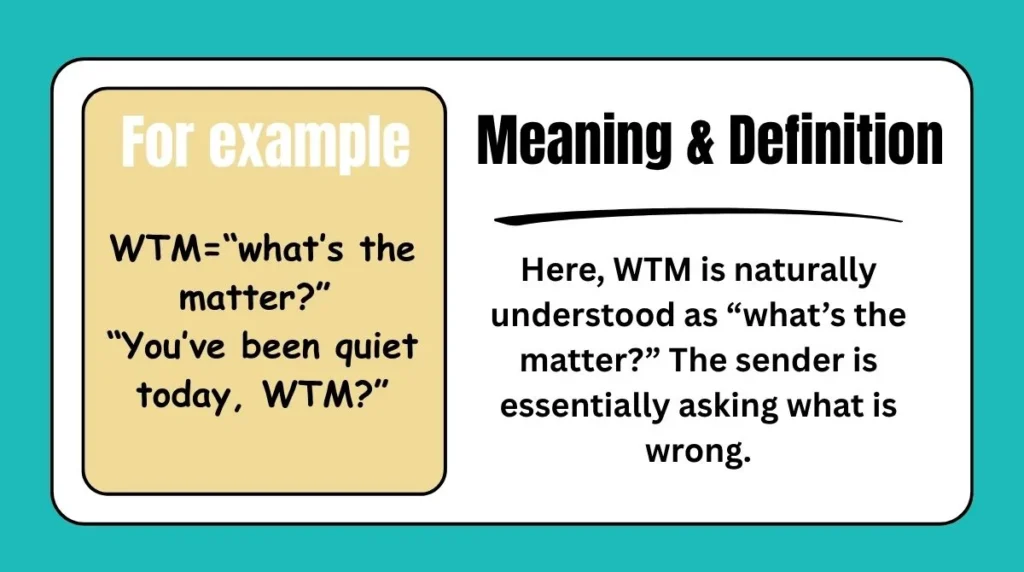
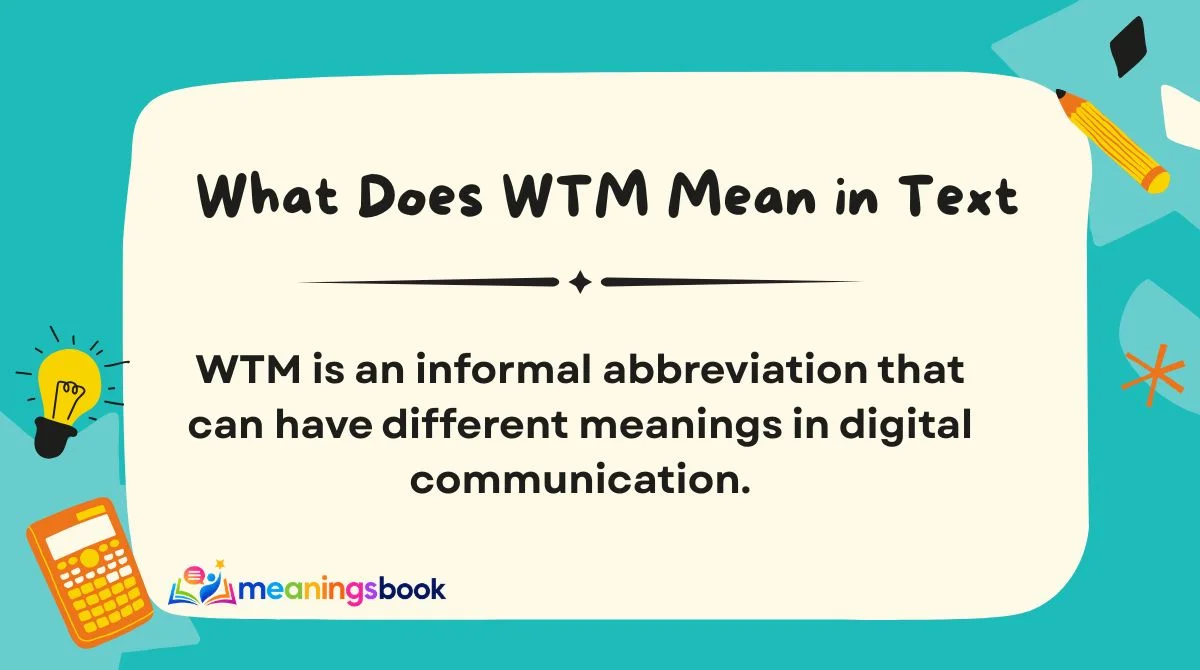
WTM is an informal abbreviation that can have different meanings in digital communication. When it appears in a personal text or casual chat, one common interpretation is “what’s the matter?” In this use, the sender is asking whether something is wrong, whether you are upset, or whether there is a problem.
For example, if someone notices that you have suddenly become quiet, they might send:
“You’ve been quiet today, WTM?”
Here, WTM is naturally understood as “what’s the matter?” The sender is essentially asking what is wrong.
Another increasingly familiar interpretation is “what’s the move?” This version is more closely associated with informal internet slang and social conversations. It is usually a way of asking about plans, activities, or the next thing people intend to do.
For example:
“It’s Friday night. WTM?”
In this context, the person is asking something like, “What’s the move?” or “What are we doing?”
The two meanings have noticeably different purposes. “What’s the matter?” focuses on a problem, emotion, or unusual situation, while “what’s the move?” focuses on plans or an upcoming activity.
WTM should therefore not automatically be expanded into one phrase every time you see it. Look at the words before and after the abbreviation and consider what the conversation is about.
Tone can also help. If someone sends WTM after you say that you are feeling bad, the first meaning is much more likely. If friends are discussing where to go that evening, “what’s the move?” may make much more sense.
In simple terms, WTM is a context-dependent texting abbreviation. Its meaning comes from the conversation rather than from the three letters alone.
Background
WTM does not have one clearly established origin that explains every use of the abbreviation. Like many texting abbreviations, it can be formed simply by taking the first letters of a familiar phrase. Because several English expressions can produce the same initials, different communities may use WTM in different ways.
The abbreviation “WTM” does not need a special invention or a single creator to become useful. Text-based communication naturally encourages shorter expressions, particularly when people are typing quickly on phones or communicating through social platforms. Over time, abbreviations can develop independently in different online communities.
The “what’s the matter?” interpretation follows a familiar pattern found in informal messaging. People frequently shorten phrases in text conversations to save time or create a conversational style that feels relaxed. In this sense, WTM functions similarly to many other initial-based abbreviations used in everyday digital communication.
The “what’s the move?” interpretation comes from a different conversational idea. “What’s the move?” is an informal expression used to ask what the plan is, what people are doing, or what should happen next. Turning it into WTM makes it suitable for quick messages and social posts.
It is important not to claim that one meaning is the historical source of the other without reliable evidence. The abbreviation can be encountered with different interpretations, and usage varies by social group and context.
Another reason WTM can be confusing is that online language changes quickly. A phrase that is common in one group may be unfamiliar to another. Someone who mainly uses WTM to mean “what’s the matter?” might be surprised when another person uses it to mean “what’s the move?”
Therefore, rather than treating WTM as having one universal definition, it is more accurate to view it as a context-dependent abbreviation used in informal digital communication. Its intended meaning is usually revealed by the subject of the conversation.
Usage in Different Contexts
WTM in Chat
In one-on-one chats, WTM can be used when someone wants to know what is wrong. If you tell a friend that something unusual happened, they may reply with WTM to ask for more information.
For example:
“I’m not feeling great today.”
“WTM?”
Here, the likely meaning is “What’s the matter?”
However, if the conversation is about making plans, the same abbreviation can have another meaning:
“Everyone is free tonight. WTM?”
Here, the sender may be asking, “What’s the move?”
WTM on Social Media
On social media, WTM can appear in comments, captions, replies, or direct messages. When people are discussing an event, outing, or weekend plans, the “what’s the move?” interpretation can fit naturally.
The meaning may also depend on the community using the term. Social media language is highly informal, and abbreviations can spread between groups without everyone using them identically.
WTM in Professional Communication
WTM should be treated carefully in professional communication. Unlike universally understood business abbreviations, it does not have one standard informal meaning that every workplace reader will automatically recognize.
If you receive WTM in a workplace message, do not immediately assume it means “what’s the matter?” or “what’s the move?” The sender may be using an organization-specific abbreviation or referring to a named organization, event, system, or industry term.
When clarity matters, spelling out the intended phrase is usually better.
For example, instead of writing “WTM?” to a colleague, a person could write “What’s the matter?” or “What’s the plan?” depending on what they mean.
WTM in Casual Conversations
Casual conversations are where WTM is most likely to appear as an informal abbreviation. Friends and acquaintances may use it because they already understand each other’s communication style.
The best way to interpret it is to examine the immediate topic. If the discussion concerns feelings, problems, or unusual behavior, “what’s the matter?” is a strong possibility. If the conversation concerns plans, activities, or going somewhere, “what’s the move?” may be intended.
Meaning in Chat, WhatsApp, Instagram, and TikTok
WTM can appear across many messaging and social media platforms, including WhatsApp, Instagram, TikTok, Snapchat, and ordinary SMS conversations. The platform itself usually does not determine the meaning. The conversation does.
On WhatsApp, WTM may appear in private messages or group chats.
For example:
“You seem upset. WTM?”
This likely means “What’s the matter?”
In a group planning a night out:
“Everyone’s ready. WTM?”
This may mean “What’s the move?”
Because WhatsApp conversations often involve people who know each other personally, tone and previous messages can make the intended meaning relatively easy to identify.
On Instagram, WTM may appear in direct messages, comments, or replies. If someone responds to a personal story with “WTM?”, they may be asking what is wrong, depending on what the story says.
If friends are discussing an event or meeting up, it can instead refer to the plan.
TikTok
TikTok has a constantly changing vocabulary of abbreviations and slang. WTM can be used in comments, direct messages, captions, or conversations connected to a video.
For instance, a person discussing weekend plans might write “WTM?” to ask what everyone is doing. However, if someone posts about having a difficult day and another person replies “WTM?”, the intended meaning may be “What’s the matter?”
Why Context Matters
The same abbreviation can therefore produce two completely different interpretations:
- WTM = What’s the matter? → What is wrong?
- WTM = What’s the move? → What is the plan?
If you are uncertain, look at the conversation immediately before the message. You can also ask the sender directly rather than guessing.
Meaning in Physics, Medical, and Aircraft Terminology
WTM does not have one universally recognized standard meaning in ordinary physics, medical terminology, or aircraft terminology that should automatically be assumed whenever the abbreviation appears.
WTM in Physics
WTM is not a standard, universally recognized physics abbreviation with one fixed definition comparable to established symbols and terms used throughout physics. If you encounter WTM in a physics paper, textbook, lecture, or technical document, its meaning would need to be determined from that specific document.
Technical authors sometimes define abbreviations for their own work, so a specialized use is possible without being a general physics meaning.
WTM in Medical Terminology
WTM should not automatically be interpreted as a standard medical term. Medical abbreviations can be highly context-sensitive, and institutions may use internal abbreviations that are not universal.
If WTM appears on medical paperwork, in a clinical message, or alongside other medical terminology, the safest approach is to check the surrounding documentation or ask a qualified professional rather than applying a texting definition.
WTM in Aircraft or Aviation Terminology
There is likewise no single everyday aviation definition of WTM that should automatically replace its texting meanings. Aviation uses many highly specific abbreviations, and some organizations or technical documents may define their own terminology.
If WTM occurs in an aircraft manual, flight-related document, aviation database, or professional communication, it should be interpreted according to that document’s terminology.
The key point is simple: do not take a casual texting abbreviation and assume it is a formal technical abbreviation. If WTM appears in a specialized field, the source’s own definitions and context should determine its meaning.
Common Misconceptions
One of the biggest misconceptions about WTM is that it always means one specific phrase. In reality, its interpretation can vary.
Misconception 1: WTM Always Means “What’s the Matter?”
This is a common interpretation, especially in personal conversations, but it is not the only possible one. When people are making plans, WTM may mean “what’s the move?”
Misconception 2: WTM Always Means “What’s the Move?”
The opposite assumption can cause confusion too. If someone is asking about a problem or your emotional state, “what’s the matter?” may be the intended phrase.
Misconception 3: WTM Is Always Slang
WTM can function as informal internet shorthand, but seeing three letters together does not automatically make them slang. Abbreviations can have specialized meanings in organizations, industries, events, or documents.
Misconception 4: The Platform Determines the Meaning
WhatsApp, Instagram, TikTok, and other platforms do not give WTM one official definition. A person can use the same abbreviation differently on each platform.
Misconception 5: You Should Guess Instead of Asking
If the surrounding conversation does not provide enough information, asking “What do you mean by WTM?” is perfectly reasonable. A short clarification can prevent a completely incorrect response.
The safest interpretation is therefore based on context, tone, topic, and relationship rather than the abbreviation alone.
Similar Terms & Alternatives
Several abbreviations and expressions can overlap with the ideas conveyed by WTM.
What’s the Matter?
This is the full phrase commonly represented by WTM in personal conversations. It asks about a problem, concern, or change in someone’s mood.
What’s the Move?
This is another possible expansion of WTM. It asks about plans, activities, or what people should do next.
WYD
WYD commonly means “What are you doing?” It is usually a direct question about someone’s current activity, although it can also be used as an invitation to start a conversation or make plans.
WYA
WYA means “Where you at?” and is generally used to ask someone’s location or whereabouts.
WBU
WBU means “What about you?” It is generally used to return a question to the other person.
WYO
WYO can be used informally to mean “What you on?” or “What are you on?” depending on the community and context. It may ask what someone is doing or what they are currently involved in.
What’s Up?
“What’s up?” is a broader conversational expression. Depending on context, it can mean “How are you?”, “What are you doing?”, or “What is happening?”
These expressions are related because they are all used to keep casual conversations moving, but they should not be treated as interchangeable in every situation.
How to Respond to It
Your response to WTM should depend on what the sender appears to mean.
If WTM Means “What’s the Matter?”
If someone is checking on you, you could respond:
“Nothing serious, I’m just tired.”
Or:
“I’m okay. Just had a rough day.”
If something genuinely is wrong, you might say:
“I’m dealing with a few things right now, but I’ll be okay.”
If WTM Means “What’s the Move?”
If someone is asking about plans, you could respond:
“Let’s grab food tonight.”
Or:
“Not sure yet. What are you thinking?”
Another casual response might be:
“I’m free after 8. What’s the plan?”
If You Cannot Tell What They Mean
You do not need to guess. A simple clarification works:
“WTM as in what’s the matter or what’s the move?”
Or:
“What do you mean by WTM?”
This is especially useful when the message is very short and there is not enough context to determine the intended meaning.
Differences from Similar Words
The difference between WTM and similar expressions becomes clearer when you focus on the question being asked.
| Expression | Common meaning | Main purpose |
|---|---|---|
| WTM | What’s the matter? | Ask what is wrong |
| WTM | What’s the move? | Ask about plans |
| WYD | What are you doing? | Ask about someone’s activity |
| WYA | Where you at? | Ask someone’s location |
| WBU | What about you? | Return a question |
| What’s up? | What is happening/how are you? | General check-in |
The most important distinction is between the two common interpretations of WTM itself.
When WTM means “what’s the matter?”, the tone is generally concerned or inquisitive. Someone may be checking on your mood or asking why something appears wrong.
When WTM means “what’s the move?”, the tone is usually more social and action-oriented. Someone wants to know what everyone is planning to do.
For example:
“You don’t seem like yourself today. WTM?”
This sounds like “What’s the matter?”
Compare that with:
“We’re all free tonight. WTM?”
This sounds like “What’s the move?”
The wording around the abbreviation provides the strongest clue. A question about emotions or a problem points toward the first meaning, while a question about activities or plans points toward the second.
Relevance in Online Conversations & Dating Apps
WTM can be particularly useful in fast-moving online conversations because short abbreviations allow people to communicate casually without typing full sentences.
On dating apps, the intended meaning depends heavily on the conversation. If two people are discussing plans for a date, WTM may be used to ask what they should do or where they should go. In that setting, “what’s the move?” can be a natural interpretation.
For example:
“I’m free Saturday. WTM?”
The person may be asking what the plan should be.
On the other hand, if a dating conversation involves someone becoming distant or suddenly changing their tone, WTM might be interpreted as “what’s the matter?”
The relationship between the two people also matters. Close friends may use abbreviations without explanation because they share a communication style. Someone you have only recently met may use WTM in a way that is less obvious.
Dating conversations can also contain short messages with little context, which makes abbreviations more difficult to interpret. If someone simply sends “WTM?” without any preceding discussion, there may not be enough information to determine the intended meaning confidently.
In that situation, a clarification is better than assuming. A response such as “What do you mean?” keeps the conversation natural and avoids misunderstanding.
Overall, WTM fits the informal, fast-paced style of online communication. Its meaning is shaped by the topic, relationship, tone, and immediate context. This is why the same three letters can communicate concern in one conversation and excitement about plans in another.
Frequently Asked Questions
What does WTM mean in text?
WTM commonly means “what’s the matter?” in personal text messages, especially when someone is asking what is wrong. It can also mean “what’s the move?” when people are discussing plans or deciding what to do. The surrounding conversation is the best way to determine which meaning the sender intended.
What does WTM mean in chat?
In chat, WTM can mean either “what’s the matter?” or “what’s the move?” If the conversation concerns someone’s mood, a problem, or something unusual, the first meaning is likely. If people are discussing plans, activities, or going somewhere, the second meaning may fit better.
Is WTM a slang term?
WTM can be used as informal texting shorthand or internet slang, particularly when it represents “what’s the move?” It can also be simple abbreviation-based shorthand for “what’s the matter?” Because its meaning varies, it is best understood as a context-dependent informal abbreviation rather than a word with one fixed definition.
How do you respond to WTM?
Respond to WTM according to the context. If the person means “what’s the matter?”, explain briefly what is wrong or tell them you are okay. If they mean “what’s the move?”, answer with your plans or suggest an activity. If you cannot determine the meaning, simply ask what they mean.
What does WTM mean on social media?
On social media, WTM can mean “what’s the matter?” or “what’s the move?” The latter can be especially relevant when people are discussing plans or activities. However, there is no universal social-media rule that gives WTM only one meaning. The post, comment, or conversation should be considered before interpreting it.
Can WTM have different meanings?
Yes, WTM can have different meanings depending on context. Two common informal interpretations are “what’s the matter?” and “what’s the move?” These meanings are easy to distinguish when the surrounding conversation is clear. If the message is simply “WTM?” with no context, asking the sender for clarification may be the safest choice.
What does WTM mean from a guy or girl?
WTM does not have a different inherent meaning based on whether a guy or girl sends it. The interpretation depends on the conversation. A person asking about your mood may mean “what’s the matter?”, while someone discussing plans may mean “what’s the move?” Gender does not determine the abbreviation’s definition.
What does WTM mean in a dating conversation?
In dating conversations, WTM may refer to “what’s the move?” when someone is asking about plans for a date or meeting. It can also mean “what’s the matter?” if the conversation is about someone’s behavior or feelings. Look at the messages immediately before it to identify the intended meaning.
Conclusion
WTM is a short, context-dependent abbreviation that can mean different things in modern digital conversations. One common interpretation is “what’s the matter?”, which is generally used when someone wants to know what is wrong or whether something is bothering you.
Another common informal interpretation is “what’s the move?”, which asks about plans, activities, or what should happen next.The distinction is usually easy to make when you consider the conversation surrounding the abbreviation.
A discussion about emotions, problems, or unusual behavior points toward “what’s the matter?” while a conversation about going out, meeting friends, or making plans points toward “what’s the move?”
WTM can appear in text messages, WhatsApp chats, Instagram conversations, TikTok comments, social media interactions, and dating-app messages. It should not automatically be treated as a standard technical term in physics, medicine, or aviation.
Ultimately, context is the key to understanding WTM. When the meaning is unclear, asking the sender what they mean is often the simplest and most accurate response.

I am Ethan Whitmore, an English teacher and vocabulary enthusiast who explains words, phrases, and meanings in text through simple examples to make English easier for everyone.