If someone sends you “SMH” in a text message, comment, or social media conversation, they are usually expressing disbelief, disappointment, annoyance, or mild frustration.
This abbreviation is common in informal digital communication, especially when someone thinks another person has done something foolish, surprising, or difficult to understand.
Because internet slang changes quickly, it is natural to wonder what a short expression like this means. You may encounter SMH in text messages, WhatsApp chats, Instagram comments, TikTok captions, online discussions, gaming conversations, and dating-app messages.
Understanding the expression is not only about knowing what the letters stand for. Its exact tone depends on the situation and the relationship between the people communicating.
In some cases, SMH can sound critical; in others, it is simply a playful reaction between friends.
The good news is that its primary meaning is straightforward.
Quick Answer
What does SMH mean in text? SMH means “shaking my head.” It is commonly used in texting and online conversations to express disbelief, disappointment, annoyance, or amusement about something someone said or did. Depending on the context, it can be serious, sarcastic, or playful.
Meaning & Definition
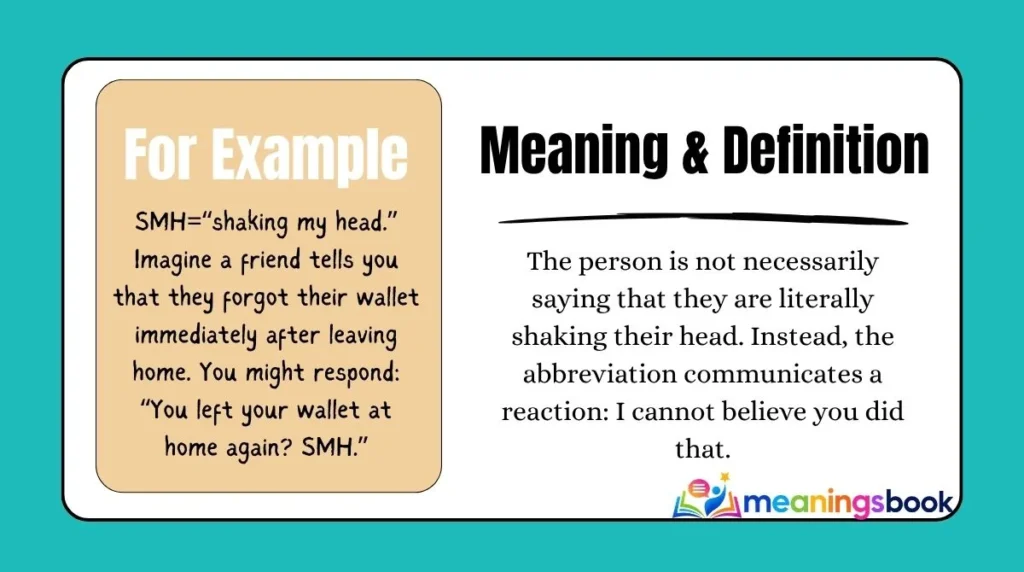
SMH is an abbreviation for “shaking my head.” In everyday communication, it usually represents the imagined action of shaking your head because something seems foolish, frustrating, disappointing, surprising, or unbelievable.
For example, imagine a friend tells you that they forgot their wallet immediately after leaving home. You might respond:
“You left your wallet at home again? SMH.”
The person is not necessarily saying that they are literally shaking their head. Instead, the abbreviation communicates a reaction: I cannot believe you did that.
The expression can carry several related emotions:
- Disbelief: “You actually did that? SMH.”
- Disappointment: “He knew the deadline was today and still waited until the last minute. SMH.”
- Frustration: “They changed the schedule again. SMH.”
- Amusement: “You really tried to microwave that? SMH 😂”
- Mild criticism: “SMH, you should have checked before sending it.”
The tone is usually informal. It is much more natural in a casual message than in formal business writing.
SMH also does not automatically mean that the sender is extremely angry. In many conversations, it is a relatively mild reaction. Emojis, punctuation, and surrounding words can make the expression sound more humorous, sarcastic, annoyed, or serious.
For example, “SMH 😂” often feels playful, while “SMH. This is unacceptable.” sounds considerably more serious.
Background
The expression SMH developed as part of the broader growth of internet and text-message shorthand. Digital communication encouraged people to use shorter expressions that could quickly communicate reactions, emotions, and ideas.
The phrase “shaking my head” itself is older than the abbreviation. People have long used head-shaking as a nonverbal reaction to disbelief, disappointment, disagreement, or frustration. SMH essentially turns that physical gesture into a compact written expression.
There is no need to assume that SMH originated from one specific website, person, or social-media platform. Its exact earliest origin as an abbreviation is not always clearly documented, and claims assigning it to a single source should therefore be treated cautiously.
As texting, instant messaging, forums, and social networks became increasingly popular, abbreviations such as SMH became convenient ways to communicate reactions without writing an entire sentence.
Its popularity is also connected to the nature of online conversation. Facial expressions and body language are largely absent from text-based communication, so abbreviations can help communicate emotional reactions.
SMH became especially recognizable alongside other internet shorthand such as LOL, OMG, IDK, and TBH. These expressions allow people to convey a reaction quickly while keeping conversations casual.
Today, SMH is widely understood in informal online communication. However, familiarity can vary according to age, community, platform, and personal experience with internet slang.
Usage in Different Contexts
Although SMH has a consistent basic meaning, its emotional tone changes according to context.
Chat
In private chats, SMH often responds directly to something another person has said or done.
Example:
“I forgot my headphones on the bus.”
“SMH 😂”
Here, the sender may be teasing rather than genuinely criticizing the person.
Social Media
On social platforms, SMH can appear in comments, captions, replies, and discussions. A person may use it when reacting to an unusual opinion, surprising event, mistake, or frustrating situation.
For example:
“People are still arguing about this? SMH.”
The abbreviation expresses the writer’s reaction without requiring a long explanation.
Professional Fields
SMH is not generally considered formal professional language. It might occasionally appear in an informal workplace chat between colleagues who are comfortable using internet slang, but it would usually be inappropriate in a formal report, business proposal, official email, or professional document.
Instead of writing:
“SMH, the meeting was moved again.”
a professional message might say:
“The meeting has been rescheduled again.”
Casual Conversations
Among friends and acquaintances, SMH is often playful. It can communicate gentle teasing rather than serious disapproval.
The relationship between the people matters. A close friend may use SMH affectionately, while the same abbreviation from a stranger could sound dismissive or judgmental.
Meaning in Chat, WhatsApp, Instagram, and TikTok
SMH has essentially the same core meaning across messaging and social-media platforms: “shaking my head.” The platform does not normally give the abbreviation a completely different definition.
In WhatsApp, someone might write:
“You forgot your keys again? SMH.”
On Instagram, it might appear in a comment:
“SMH, people believe everything they see online.”
On TikTok, users may use it as a reaction to a funny, surprising, awkward, or frustrating video:
“SMH 😂 how did that even happen?”
The surrounding content is important. A person may use SMH jokingly after a friend makes an obviously silly mistake.
Examples of different tones
Playful:
“You ate the whole pizza without me? SMH 😂”
Frustrated:
“SMH, they canceled the event at the last minute.”
Disappointed:
“You promised you’d be there. SMH.”
Surprised:
“SMH, I can’t believe he actually said that.”
The abbreviation may also appear in lowercase as “smh.” Capitalization generally does not change its meaning.
You may occasionally see variations such as “smh my head.” This is technically redundant because the word head is already represented by the H in SMH, but people sometimes use the phrase anyway for emphasis or humor.
Meaning in Physics, Medical, and Aircraft Terminology
In the context of texting and internet slang, SMH means “shaking my head.” However, abbreviations can have unrelated meanings in specialized fields.
Physics
SMH is not a standard, universally recognized physics term with the same meaning as the texting abbreviation. Specialized publications may use abbreviations for particular concepts, but their meanings depend on the specific source or subject.
Therefore, you should not automatically interpret SMH as “shaking my head” when reading a technical physics document.
Medical Terminology
SMH is not a standard medical diagnosis or universally accepted medical term meaning “shaking my head.” Medical abbreviations can vary between institutions and specialties, so an abbreviation found in medical material should always be interpreted according to its documented context.
If you encounter SMH in medical records or professional medical material, the surrounding text is necessary before determining what it means.
Aircraft and Aviation Terminology
SMH does not have a standard aviation meaning that replaces its common internet-slang definition. Aviation uses many specialized abbreviations and codes, so an abbreviation appearing in an aviation document should be interpreted according to that specific technical context.
In ordinary texting, however, SMH overwhelmingly refers to “shaking my head.”
Common Misconceptions
One common misunderstanding is that SMH always indicates anger. It does not. The expression can communicate anything from mild amusement to genuine frustration.
For example:
“You seriously wore two different shoes today? SMH 😂”
This is probably playful.
Compare that with:
“SMH. You ignored every warning we gave you.”
That version sounds more critical.
Another misconception is that the sender must literally be shaking their head. Usually, they are not describing an actual physical action. They are using the phrase metaphorically to communicate a reaction.
People may also mistakenly assume that every occurrence of the letters “SMH” online means “shaking my head.” In specialized contexts, abbreviations can have different meanings. Context should always take priority.
Finally, SMH is sometimes confused with expressions that communicate laughter or surprise. While it can accompany humor, its central idea is a reaction of disbelief, disapproval, frustration, or astonishment rather than laughter itself.
Similar Terms & Alternatives
Several abbreviations and expressions can appear alongside SMH.
| Term | Common meaning | Typical tone |
|---|---|---|
| SMH | Shaking my head | Disbelief, frustration, disappointment |
| LOL | Laughing out loud | Amusement |
| OMG | Oh my God / Oh my gosh | Surprise or excitement |
| WTF | Strong expression of disbelief or confusion | Much stronger and potentially offensive |
| IDK | I don’t know | Uncertainty |
| TBH | To be honest | Directness or honesty |
| Facepalm | Reaction to something foolish or frustrating | Embarrassment or disbelief |
| Seriously? | Direct questioning of surprising behavior | Disbelief or annoyance |
SMH is particularly close to “facepalm.” Both can communicate frustration or disbelief, but they are not identical. “Facepalm” suggests putting a hand over one’s face because something is ridiculous or embarrassing, while SMH specifically evokes shaking one’s head.
How to Respond to It
There is no single correct response to SMH. Your reply should match the tone of the conversation.
If the person is joking, you can respond playfully:
“😂 I know, I know.”
Or:
“Don’t judge me!”
If they seem genuinely frustrated, you can acknowledge what happened:
“Yeah, that was definitely my mistake.”
If you are unsure what they mean, you can simply ask:
“Why the SMH? 😂”
If you disagree with their reaction, you could explain yourself:
“I get why it looks bad, but there’s more to the story.”
You also do not necessarily need to respond to SMH. Sometimes it functions more like an emotional reaction than a request for an answer.
The best response depends on the relationship, the surrounding messages, and whether the sender appears amused, annoyed, disappointed, or surprised.
Differences from Similar Words
SMH is different from LOL because the two expressions communicate different primary reactions. LOL indicates laughter or amusement, whereas SMH indicates disbelief, frustration, disappointment, or a similar reaction.
SMH is also different from OMG. OMG primarily communicates surprise, shock, excitement, or strong emotion. Someone could use both together, but they do not mean the same thing.
WTF can communicate confusion or disbelief, but it is considerably stronger and can be vulgar or offensive. SMH is generally milder.
Facepalm is another close alternative. It describes a reaction associated with embarrassment, frustration, or disbelief. SMH focuses more directly on the idea of shaking one’s head.
Tone is also important. “SMH” from a close friend may be affectionate teasing, while the same expression from someone you barely know may feel judgmental.
Relevance in Online Conversations & Dating Apps
SMH remains useful in modern online communication because it lets people communicate an emotional reaction with only three letters.
On social media, it can be used to react to posts, comments, news, jokes, arguments, or surprising behavior. In private messages, it can be a quick response to something a friend says.
Dating apps can introduce another layer of interpretation. If someone writes:
“You said you love pizza but you’ve never tried this place? SMH 😂”
the expression is probably playful teasing.
But if someone says:
“SMH, you really think that’s okay?”
the tone may be more critical.
When interpreting SMH on a dating app, look at the surrounding conversation. Emojis, punctuation, previous messages, and the relationship between the two people can make a significant difference.
A laughing emoji may soften the expression, while a short sentence followed by a period can make it sound more serious.
Ultimately, SMH is usually not a complete statement by itself. It is a reaction, and the situation around it tells you what kind of reaction the sender intends.
Frequently Asked Questions
What does SMH mean in text?
SMH means “shaking my head” in text messages. People use it to express disbelief, disappointment, frustration, annoyance, or sometimes playful amusement. The exact tone depends on the situation. For example, a friend might send “SMH 😂” after you make a silly mistake as a form of teasing rather than serious criticism.
What does SMH mean in chat?
In chat, SMH usually means “shaking my head.” It is a quick reaction to something that seems foolish, surprising, frustrating, or difficult to believe. Friends may use it jokingly, while someone who is genuinely annoyed may use it to show disapproval.
Is SMH a slang term?
Yes, SMH is internet and texting slang. It is an informal abbreviation rather than a phrase normally used in formal writing. You are most likely to encounter it in text messages, social-media comments, online chats, forums, and other casual digital conversations.
What does SMH mean on social media?
On social media, SMH generally means “shaking my head.” Users commonly write it when reacting to something they consider ridiculous, disappointing, surprising, or frustrating. Its tone can range from humorous and playful to genuinely critical, depending on the post and surrounding conversation.
How do you respond to SMH?
You can respond to SMH according to its tone. If it is playful, try “😂 I know!” or “Don’t judge me!” If the sender is genuinely upset, acknowledging the issue may be better, such as “Yeah, that was my mistake.” If you are unsure, ask what they mean.
Can SMH have different meanings?
SMH has a well-established meaning in casual online communication: “shaking my head.” However, abbreviations can have different meanings in specialized fields or organizations. If you see SMH in a technical, medical, or professional document, do not automatically assume it has the internet-slang meaning.
Does SMH always mean someone is angry?
No, SMH does not always mean anger. It can express mild disbelief, disappointment, amusement, surprise, or playful teasing. An emoji such as 😂 can make the expression feel humorous, while serious wording around SMH can make it sound more critical.
What is the difference between SMH and LOL?
SMH and LOL express different reactions. SMH means “shaking my head” and commonly communicates disbelief, frustration, or disappointment. LOL means “laughing out loud” and communicates amusement. They can appear together, but their basic meanings are different.
Conclusion
SMH is a common piece of internet and texting slang that means “shaking my head.” People use it when they want to express disbelief, disappointment, frustration, annoyance, surprise, or playful criticism without writing a longer sentence.
Its meaning is generally easy to recognize in casual communication, but its tone depends heavily on context. A message such as “SMH 😂” may be friendly teasing, while “SMH. I can’t believe you did that.” may communicate genuine disappointment.
You can encounter the abbreviation in text messages, WhatsApp conversations, Instagram comments, TikTok discussions, dating apps, and other informal online spaces. It is not normally appropriate for formal professional writing.
Most importantly, do not assume that every occurrence of the letters SMH has the same meaning. Specialized fields can use abbreviations differently, so technical contexts should be interpreted from their surrounding information. In ordinary digital conversation, however, “shaking my head” is the standard meaning.

I am Ethan Whitmore, an English teacher and vocabulary enthusiast who explains words, phrases, and meanings in text through simple examples to make English easier for everyone.