If you have received a message containing “PMO,” you may have wondered what the person actually meant.
Like many internet abbreviations, PMO can have different meanings depending on the sentence, platform, and relationship between the people communicating.
In casual texting and social media, it is often used as a short way to express frustration or annoyance, while in other conversations it can be used as an abbreviation for “put me on,” usually when someone is asking another person to introduce them to something interesting or useful.
Outside informal communication, PMO can also stand for established terms in professional settings, so the surrounding context matters.
People commonly search for this abbreviation because a short message such as “PMO” or “that pmo” can be difficult to interpret without knowing the slang. Understanding the common meanings and recognizing the clues around the abbreviation makes it much easier to understand what the sender intended.
Quick Answer
PMO meaning in text usually depends on context, but in casual online conversations it commonly means “pisses me off,” expressing annoyance or frustration. It can also mean “put me on,” especially when someone wants a recommendation, introduction, or information about something. The surrounding sentence and conversation usually make the intended meaning clear.
Meaning & Definition
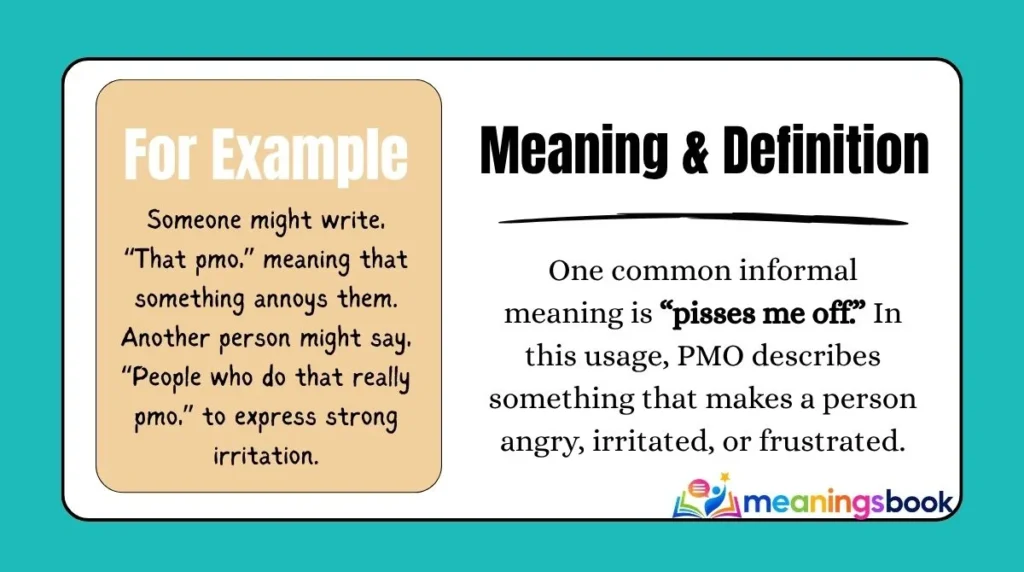
PMO is an abbreviation that can represent more than one phrase in texting and online communication. Its meaning cannot always be determined simply by looking at the three letters because different communities use the same abbreviation in different ways.
One common informal meaning is “pisses me off.” In this usage, PMO describes something that makes a person angry, irritated, or frustrated. For example, someone might write, “That pmo,” meaning that something annoys them. Another person might say, “People who do that really pmo,” to express strong irritation.
A second common slang meaning is “put me on.” Here, the abbreviation is generally used when someone wants another person to introduce them to something or give them information. For example, “PMO to some good music” can mean “Put me on to some good music.” In other words, the person is asking for recommendations or asking someone to show them something they may enjoy.
The difference between these meanings is usually obvious from the words around PMO. If the message discusses something annoying, frustrating, or upsetting, “pisses me off” is a likely interpretation. If the message involves music, movies, clothes, restaurants, creators, games, or other recommendations, “put me on” may make more sense.
PMO may also appear in formal or professional contexts with completely different meanings. For example, in business and project-management discussions, PMO commonly refers to a Project Management Office. That is not normally what someone means when they use PMO in casual texting.
Capitalization does not always solve the problem because people frequently type abbreviations in lowercase online. Therefore, “PMO,” “pmo,” and similar forms may refer to the same slang expression.
The safest approach is to interpret PMO according to the sentence rather than assuming that it has only one definition. If the message is unclear, a simple question such as “What do you mean by PMO here?” can quickly resolve the ambiguity.
Background
The history of PMO is difficult to reduce to one single origin because the abbreviation has been used for different expressions in different environments. Its informal meanings developed through shortened digital communication, while its professional meanings come from established organizational terminology. Because several phrases can be represented by the same letters, there is no single universal history for every use of PMO.
Texting and social media have encouraged people to shorten common expressions. Users often remove vowels, shorten phrases, or turn several words into a few recognizable letters. This style of communication is especially common in fast-moving conversations, comments, group chats, and social platforms where people want to communicate quickly.
The slang meaning “pisses me off” fits this pattern because it compresses an emotionally expressive phrase into three letters. In informal conversation, people may use it to react to an annoying situation without writing the complete expression.
The phrase “put me on” also lends itself to abbreviation. In casual speech, “put me on to” can mean introducing someone to something new, particularly music, entertainment, fashion, food, online creators, or other interests. Digital users often shorten familiar phrases when the meaning can be understood from context.
The professional meaning of PMO developed separately. In project-oriented organizations, Project Management Office is an established term describing a function or organizational unit that can provide standards, processes, coordination, governance, or support for projects. This meaning should not automatically be transferred into casual messages.
Because these uses developed in different communication environments, PMO does not have one meaning that applies everywhere. A project manager seeing “PMO” in a work document may naturally understand it as Project Management Office. A teenager seeing “pmo” in a social-media comment may understand it as slang.
There is also no reliable reason to assume that every appearance of PMO comes from one particular website, platform, or individual. Internet slang changes organically, and users frequently create, adapt, and popularize abbreviations within different communities.
For this reason, it is more accurate to describe PMO as a context-dependent abbreviation rather than claim that it has one definitive origin. Its intended meaning is best identified by examining the surrounding words, the subject of the conversation, and the type of relationship between the people communicating.
Usage in Different Contexts
In Chat
In private chats, PMO is often informal and highly dependent on the conversation. When someone is complaining about an event, person, behavior, or situation, PMO may mean “pisses me off.”
For example:
“When my phone keeps freezing, it pmo.”
The intended idea is frustration or annoyance.
In another conversation, the same letters can mean “put me on.”
“PMO to some good shows.”
Here, the person is requesting recommendations.
On Social Media
Social media comments often contain shortened slang because users communicate quickly and casually. PMO may appear in reactions, captions, comments, direct messages, or replies.
A comment such as “That pmo” can express annoyance, while “PMO to this artist” may ask someone to recommend or introduce the artist.
The platform itself does not determine the meaning. The words surrounding the abbreviation are more important.
In Professional Communication
In a workplace, PMO frequently has a formal meaning: Project Management Office. A company might discuss “the PMO,” “PMO processes,” or “PMO standards” in connection with project management.
This is very different from slang. A sentence such as “Send the report to the PMO” is unlikely to mean “pisses me off.”
In Casual Conversations
Among friends, PMO can move between meanings depending on the subject. Someone talking about an irritating situation may use it as an expression of frustration. Someone discussing music or entertainment may use it as a request for recommendations.
This makes context particularly important.
Contextual Clues
You can often identify the intended meaning by looking for clues:
- Anger or frustration: likely “pisses me off.”
- Recommendations or introductions: likely “put me on.”
- Projects or corporate work: likely “Project Management Office.”
- Unclear one-word message: ask the sender what they mean.
The key point is that PMO should not be interpreted mechanically. The same abbreviation can carry very different meanings across different conversations.
Meaning in Chat, WhatsApp, Instagram, and TikTok
PMO can appear naturally across messaging and social-media platforms because users on these platforms frequently use abbreviations and slang. However, the platform itself does not give PMO a fixed definition. WhatsApp, Instagram, TikTok, and ordinary text messages can all contain multiple interpretations.
On WhatsApp, friends might use PMO during a casual conversation. If someone is complaining about a problem, “pmo” may express irritation. If friends are exchanging recommendations, “PMO” can mean “put me on.”
For example:
“PMO to some good restaurants near here.”
The speaker is asking for suggestions.
On Instagram, PMO can appear in comments or direct messages. A person might respond “that pmo” when reacting negatively to something. Alternatively, they might ask someone to “PMO” to an account, artist, clothing brand, or other discovery.
On TikTok, the abbreviation can occur in comments, captions, replies, or private messages. TikTok’s highly conversational environment encourages shortened expressions, but there is still no universal rule that PMO always means one particular thing.
Consider these examples:
“This update pmo.”
This most naturally communicates annoyance.
“PMO to more songs like this.”
This is more naturally understood as a request for recommendations.
“Can you PMO to that creator?”
This suggests that the person wants to be introduced to or shown the creator.
The surrounding wording provides the strongest clue. If PMO is followed by “to” and the subject is something the person might discover—such as a song, artist, movie, game, product, or creator—“put me on” becomes a strong possibility.
If PMO appears after a complaint, however, “pisses me off” is more likely.
It is also important to remember that online slang is flexible. People may use abbreviations differently from one friend group to another. A sender may even use PMO in a personal way that is not obvious to outsiders.
When the intended meaning is uncertain, the simplest response is to ask. A quick “PMO as in what?” is often enough to clarify the abbreviation without making the conversation awkward.
Meaning in Physics, Medical, and Aircraft Terminology
PMO does not have one universal standard meaning in physics, medicine, or aviation that should automatically be assumed whenever the abbreviation appears.
Physics
There is no single broadly recognized physics definition of PMO that can safely be presented as the standard meaning of the abbreviation in every physics context. Technical fields frequently use abbreviations that are defined locally within a textbook, paper, laboratory, institution, or specialized subfield.
Therefore, seeing PMO in a physics document is not enough to determine its meaning. The surrounding equation, terminology, or document-specific abbreviation list would be needed.
Medical Terminology
PMO can appear as an abbreviation in healthcare or medical documentation, but medical abbreviations can be highly context-dependent. A medical abbreviation should not be assigned a meaning simply because the same letters have a popular interpretation online.
There is no reason to assume that a casual texting definition such as “pisses me off” or “put me on” applies to medical documentation. Likewise, a reader should not invent a medical definition when the surrounding clinical context does not establish one.
If PMO appears in a medical record, report, prescription-related document, or clinical communication, the safest approach is to rely on the terminology used in that specific setting and, when necessary, ask a qualified professional for clarification.
Aircraft and Aviation Terminology
PMO is not a universally applicable aviation abbreviation with one meaning that can be assumed in every aircraft-related conversation. Aviation organizations and technical documents can use specialized abbreviations, but their definitions depend on the particular document or operational environment.
Consequently, PMO in an aviation document should be interpreted from its local context rather than from internet slang.
Why Context Matters in Technical Fields
The important distinction is between general slang and field-specific abbreviations. In a TikTok comment, PMO may be casual slang. In a business document, it may mean Project Management Office. In a technical document, it may have a specialized meaning defined by that particular source.
There is no reliable basis for claiming one universal PMO definition across all three technical fields. When accuracy matters, especially in medical, aviation, or technical communication, the surrounding terminology should take priority over assumptions based on social media.
Common Misconceptions
One of the biggest misconceptions about PMO is that it always means “pisses me off.” This is a common slang interpretation, but it is not the only one. The same abbreviation can mean “put me on” in recommendation-oriented conversations and “Project Management Office” in professional settings.
Another common mistake is assuming that the capitalization determines the meaning. While capitalization can sometimes provide a clue, online users are inconsistent about whether they type abbreviations in uppercase or lowercase. “PMO” and “pmo” can therefore appear in similar contexts.
People also sometimes interpret PMO as “put me on” whenever they see it followed by “to.” That is often a useful clue, but context should still be considered. Slang is flexible, and individual users may have different habits.
A further misconception is that every abbreviation found online has one official definition. Internet slang does not work that way. Abbreviations can evolve, spread through different communities, and develop multiple meanings.
Another issue occurs when people confuse slang PMO with professional PMO. Someone working in project management may use PMO as an ordinary workplace abbreviation. Someone reading the same letters in a casual text may interpret them completely differently.
The best way to avoid these misunderstandings is to read the complete sentence.
Compare:
“This traffic pmo.”
The emotional context strongly suggests frustration.
Now compare:
“PMO to some good podcasts.”
The recommendation context strongly suggests “put me on.”
And:
“The PMO approved the project process.”
The workplace context strongly suggests “Project Management Office.”
These examples show why the abbreviation itself is not enough. The topic, grammar, surrounding words, and communication setting all contribute to its meaning.
When there is still uncertainty, asking for clarification is better than confidently choosing the wrong definition. A short question can prevent a misunderstanding, particularly when the message involves an important decision or a professional setting.
Similar Terms & Alternatives
Several expressions can be confused with PMO, especially because online communication uses many short abbreviations.
Pissed Me Off / Pisses Me Off
This is the closest match when PMO is being used to express annoyance. The exact grammatical form can vary in casual writing, but the underlying idea is frustration or anger.
Example:
“That whole situation pmo.”
Put Me On
This is another major interpretation of PMO. It usually asks someone to introduce the speaker to something, recommend something, or help them discover something.
Example:
“PMO to some new artists.”
IDK
IDK means “I don’t know.” It is not a synonym for PMO, but both are common texting abbreviations.
IMO
IMO means “in my opinion.” It can look visually similar to PMO because both are three-letter abbreviations, but their meanings are unrelated.
TBH
TBH means “to be honest.” It is often used when someone wants to give a direct opinion or personal reaction.
FR
FR commonly means “for real.” It can reinforce agreement, seriousness, or emphasis in casual conversation.
LMK
LMK means “let me know.” It is often used when asking someone to provide information or respond later.
Project Management Office
In professional settings, Project Management Office is a formal interpretation of PMO rather than slang. It is especially relevant when the conversation concerns projects, project standards, governance, scheduling, reporting, or organizational processes.
The important distinction is that similar-looking abbreviations are not interchangeable. If you see PMO in a message, determine what the conversation is about before replacing it with another expression.
How to Respond to It
The best response to PMO depends on which meaning the sender intended. If you understand the context, you can respond naturally without asking for clarification.
If PMO Means “Pisses Me Off”
If someone uses PMO to express frustration, you can respond by acknowledging their feelings or asking what happened.
Examples:
“Yeah, I get why that would annoy you.”
“What happened?”
“That sounds frustrating.”
“Honestly, I’d be annoyed too.”
You do not need to treat PMO as a request. It may simply be an emotional reaction.
If PMO Means “Put Me On”
If someone asks you to “PMO” to something, they are generally asking for a recommendation or introduction.
You might reply:
“Sure, check out this artist.”
“I got you. Try this one.”
“You should definitely watch this.”
“Here are a few songs you might like.”
The response can be as simple as providing the recommendation.
If You Are Unsure
When the message is too short to interpret confidently, ask directly:
“PMO meaning what here?”
“Do you mean put me on or something else?”
“What do you mean by PMO?”
This is especially useful when the abbreviation appears by itself.
If It Is a Professional Context
If someone uses PMO in a workplace conversation, look at the subject first. If the discussion involves project management, a PMO may refer to a Project Management Office. In that situation, respond according to the professional topic rather than interpreting it as social-media slang.
The most effective response is therefore not based on the letters alone. Understand the context first, then match your reply to the intended meaning.
Differences from Similar Words
PMO is particularly interesting because two of its common informal meanings can produce completely different tones.
| Expression | Likely meaning | Typical tone | Common setting |
|---|---|---|---|
| PMO | Pisses me off | Frustrated or annoyed | Texts, chats, social media |
| PMO | Put me on | Curious or requesting recommendations | Chats, comments, social media |
| PMO | Project Management Office | Professional and organizational | Workplace, project management |
| IMO | In my opinion | Personal or conversational | Texting, social media |
| TBH | To be honest | Direct or candid | Casual conversation |
| IDK | I don’t know | Uncertain or neutral | Texting and chat |
| LMK | Let me know | Requesting information | Texting, work, casual chat |
| FR | For real | Emphatic or agreeing | Social media and chat |
The key difference between the two major slang interpretations is emotional purpose.
When PMO means “pisses me off,” the sender is expressing an emotional reaction. They are usually describing something that has irritated them.
When PMO means “put me on,” the sender is asking for something. They may want a recommendation, introduction, suggestion, or discovery.
For example:
“That comment pmo.”
This communicates annoyance.
But:
“PMO to some good movies.”
This communicates curiosity and asks for recommendations.
Professional PMO is different again. In a project-management discussion, it may refer to an organizational function rather than slang.
This is why replacing PMO with a single definition in every conversation can create confusion. A reader should first identify whether the message is emotional, conversational, or professional.
Relevance in Online Conversations & Dating Apps
PMO can appear in modern online conversations because dating apps, social platforms, and messaging services rely heavily on short, informal communication. However, there is no single dating-app meaning that applies every time.
If someone is complaining about a dating experience, PMO may express frustration. For example, a person might say that a particular behavior “pmo,” meaning that it annoys them.
On the other hand, someone discussing music, restaurants, travel destinations, fashion, movies, or hobbies might use PMO to mean “put me on.” A dating conversation could therefore include something like:
“You like that artist? PMO to some of their best songs.”
In that situation, the person is asking for recommendations.
Context can become even more important when communicating with someone you have just met. Friends may already understand each other’s slang habits, while new matches may interpret an abbreviation differently.
Tone also matters. A phrase such as “that pmo” can sound strongly negative if the reader interprets it as “pisses me off.” If the sender actually intended a different meaning, misunderstanding can easily occur.
Dating-app conversations often move quickly, and people may use abbreviations without explaining them. If PMO appears in a message and the surrounding conversation does not make the meaning obvious, clarification is completely reasonable.
A simple response such as:
“Wait, what does PMO mean here?”
can prevent unnecessary confusion.
The same principle applies to Instagram DMs, TikTok messages, group chats, gaming communities, and ordinary texting. PMO is best interpreted by considering the topic, sentence structure, emotional tone, and relationship between the people communicating.
Frequently Asked Questions
What does PMO mean in text?
PMO commonly means “pisses me off” in casual texting, especially when someone is expressing annoyance or frustration. It can also mean “put me on,” usually when someone is asking for a recommendation or introduction to something. The sentence and surrounding conversation are the best clues for determining which meaning the sender intended.
What does PMO mean in chat?
In chat, PMO can mean “pisses me off” or “put me on.” If the conversation is about something irritating, the first meaning is more likely. If someone is asking for music, movies, creators, products, or other recommendations, “put me on” is a stronger interpretation. Professional chats may use PMO differently.
Is PMO a slang term?
Yes, PMO is commonly used as internet and texting slang, particularly for “pisses me off” and “put me on.” However, PMO is not exclusively slang. In professional conversations, especially those involving project management, it can refer to a Project Management Office.
What does PMO mean on social media?
On social media, PMO commonly expresses frustration when used in a complaint, but it can also mean “put me on” when someone wants recommendations or an introduction to something. A comment such as “that pmo” has a different likely meaning from “PMO to some good songs.”
How do you respond to PMO?
Respond according to the intended meaning. If PMO means “pisses me off,” you can acknowledge the person’s frustration or ask what happened. If it means “put me on,” give them a recommendation or suggestion. If the context is unclear, simply ask what they mean.
Can PMO have different meanings?
Yes, PMO can have several meanings depending on context. In informal online communication, the two important slang interpretations are “pisses me off” and “put me on.” In professional environments, PMO can also mean Project Management Office. The subject of the conversation usually reveals which interpretation is appropriate.
What does PMO mean on TikTok?
On TikTok, PMO may be used as slang for “pisses me off” when someone is reacting negatively to something. It can also mean “put me on” when a user wants recommendations, such as songs, creators, shows, or other content. TikTok does not give the abbreviation one fixed meaning.
What does PMO mean from a guy or girl in a text?
The meaning does not depend on whether the sender is a guy or girl. PMO is interpreted primarily from context. If the person is complaining, it may mean “pisses me off.” If they are asking you to recommend or introduce them to something, it may mean “put me on.” The surrounding words matter more than the sender’s gender.
Conclusion
PMO is a context-dependent abbreviation that can mean different things in different conversations. In casual texting and social media, two especially important meanings are “pisses me off” and “put me on.”
The first expresses frustration or annoyance, while the second usually asks someone for a recommendation, introduction, or suggestion. In professional environments, PMO can instead refer to a Project Management Office, showing why it is risky to assume that every appearance has the same definition.
Physics, medical, and aviation contexts may also contain specialized abbreviations, but PMO should not be assigned an invented technical meaning without supporting context. When you encounter PMO, look at the sentence, topic, tone, and platform before deciding what it means.
If those clues are not enough, asking the sender for clarification is the simplest and most accurate solution. Context ultimately determines which interpretation makes sense.

I am Ethan Whitmore, an English teacher and vocabulary enthusiast who explains words, phrases, and meanings in text through simple examples to make English easier for everyone.