
Short abbreviations can make texting faster, but they can also make a simple message surprisingly confusing. One example is “FN,” which can have different meanings depending on the conversation, the people involved, and the surrounding words.
You may see it in text messages, social media comments, group chats, gaming conversations, or casual online discussions. In some situations, it is used as a shortened form of an informal or profane intensifier, while in others it can mean something completely different, such as “for now.”
Because abbreviations are often written without punctuation or explanation, readers may wonder what the sender intended. Searching for the meaning of FN is therefore common, especially when the abbreviation appears in an unfamiliar message.
The safest way to understand it is to examine the sentence around it and consider the relationship between the people communicating. This guide explains the common interpretations, contexts, related meanings, and practical ways to respond.
Quick Answer
FN Meaning in Text most commonly depends on context, but in casual messaging it can be used as a shortened form of a profanity such as “f***ing” for emphasis. In other conversations, FN may mean “for now” or represent another context-specific abbreviation. Always read the surrounding sentence before deciding what the sender means.
Meaning & Definition
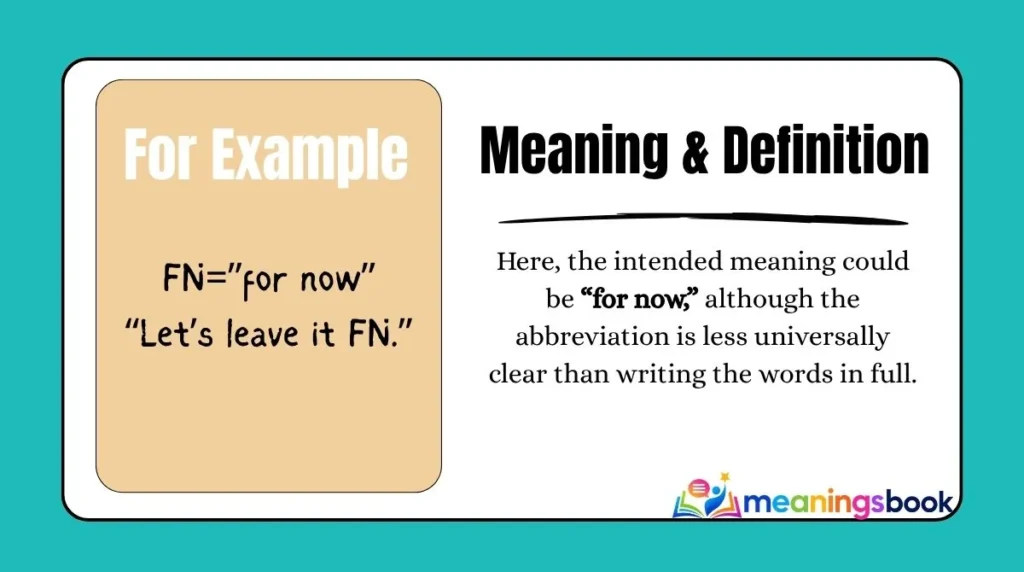
“FN” does not have one universal meaning in texting. Its interpretation depends heavily on how it appears in a sentence. In informal online communication, some people use FN as a shortened form of “f*ing,”** particularly when they want to emphasize an emotion, description, or reaction. Because this usage represents profanity, the exact meaning is often inferred from the surrounding words rather than stated openly.
For example, someone might write:
“That was FN amazing.”
In this kind of sentence, the abbreviation functions as an intensifier. The sender is expressing that something was extremely or exceptionally amazing. The same abbreviation can appear in angry, excited, humorous, or frustrated messages.
Another possible interpretation is “for now.” This meaning is especially plausible when the sentence concerns a temporary situation or decision. For example:
“Let’s leave it FN.”
Here, the intended meaning could be “for now,” although the abbreviation is less universally clear than writing the words in full.
FN can also represent completely different terms in specialized subjects. Abbreviations are not standardized across every industry, so a technical document, workplace message, academic discussion, or professional conversation may use FN for a field-specific expression.
The key point is that FN should not automatically be assigned one definition whenever it appears in a message. Look at the words before and after it, the topic being discussed, and the communication style of the sender. If the meaning remains unclear, asking the person directly is usually the most reliable approach.
Background
The exact development of FN as a texting abbreviation is difficult to establish with certainty because informal abbreviations often develop organically among different online communities. Unlike formal abbreviations created by organizations or technical institutions, slang used in chats and social media can emerge through convenience, shortening, censorship avoidance, typing habits, or community-specific conventions.
In casual digital communication, people frequently shorten words to save time or fit the fast rhythm of texting. Profane expressions are also sometimes abbreviated because users want to soften their appearance, avoid writing the complete word, or communicate an emotion without spelling everything out. This helps explain why a two-letter combination such as FN can acquire an informal meaning in some conversations.
However, not every use of FN comes from internet slang. The letters have long been capable of representing different phrases in professional, academic, technical, and organizational settings. Consequently, it would be inaccurate to claim that one particular slang interpretation is the historical origin of every use.
The meaning “for now” is another example of ordinary language being compressed into a short form. Digital communication encourages people to omit unnecessary words, especially when the intended meaning is obvious to the participants.
Because FN can have multiple meanings, there is no single confirmed origin that explains every modern use. Its interpretation is better understood as context-dependent. A message between close friends may use FN as casual slang, while the same letters in a technical document could represent an entirely unrelated term.
This is why context is more important than trying to memorize one fixed definition. The surrounding sentence usually provides the strongest clue about what the sender intended.
Usage in Different Contexts
Chat
In private chats, FN may function as informal slang, especially when people are communicating quickly. If it appears next to an adjective or emotional reaction, it may be acting as an intensifier. However, if the conversation involves plans, timing, or temporary decisions, “for now” may make more sense.
Social Media
On social media, abbreviations often spread through particular communities. FN may appear in comments, captions, replies, or direct messages. A user who regularly shortens words may use it casually, while another person may use the same letters with a completely different meaning.
For example, a comment such as “FN hilarious” may suggest an emphatic slang interpretation. By contrast, “We’ll keep this FN” could potentially refer to “for now,” depending on the wider conversation.
Professional Fields
Professional communication requires additional caution. FN may be an abbreviation for a technical term, department-specific phrase, document label, or other specialized expression. Employees should not assume that a workplace abbreviation has the same meaning as internet slang.
If FN appears in an official report, email, research paper, or technical discussion, examine the surrounding terminology before interpreting it as slang.
Casual Conversations
Among friends, people often understand abbreviations through shared habits. Tone can also provide clues. A joking message may use FN for emphasis, whereas a practical conversation may use it in a more literal abbreviated form.
The important rule is simple: the context determines the meaning. The same two letters can communicate different ideas in different situations.
Meaning in Chat, WhatsApp, Instagram, and TikTok
FN can appear across many online platforms because people often carry their personal texting habits from one app to another. WhatsApp conversations, Instagram comments, TikTok replies, Snapchat messages, and other social platforms all encourage short, informal communication.
On WhatsApp, FN may be used in a quick conversation between friends. If the message is emotional or strongly descriptive, the abbreviation could function as a shortened profanity for emphasis.
On Instagram, the meaning may depend on whether FN appears in a direct message, comment, caption, or reply. Social-media comments are often brief, so users sometimes rely on abbreviations that their audience is expected to understand.
On TikTok, abbreviations can be especially dependent on community language. A creator’s audience may understand a particular shorthand immediately, while another viewer may find it confusing. The surrounding video or comment thread can provide useful context.
Consider these examples:
- “That movie was FN good.” — likely an emphatic informal expression.
- “I’ll decide FN.” — could potentially mean “for now,” depending on the conversation.
- “What does FN mean here?” — the sender is asking for clarification rather than using FN as slang.
These examples demonstrate why there is no universal translation for the abbreviation. FN is best interpreted by examining the complete message rather than the two letters alone.
If the sender is a friend, their usual vocabulary can also help. If the message comes from a stranger or an unfamiliar online account, it is better to avoid assuming a potentially offensive meaning without sufficient context.
Meaning in Physics, Medical, and Aircraft Terminology
FN can have specialized meanings outside everyday texting, so context becomes particularly important in technical subjects.
Physics
In physics, FN can refer to Fowler–Nordheim-related terminology, particularly in discussions of field emission, where electrons can be emitted from a material under a strong electric field. In this context, FN is technical rather than internet slang.
Therefore, seeing “FN” in a physics paper or discussion should not automatically lead you to interpret it as a texting abbreviation.
Medical Terminology
In medicine, FN can appear as an abbreviation for different terms depending on the specialty and documentation system. One recognized example is febrile neutropenia, a condition involving fever in a person with an abnormally low neutrophil count. Medical abbreviations can be highly context-dependent, however, and abbreviations should not be interpreted without considering the clinical setting.
A medical record, research paper, prescription-related document, or clinical conversation may therefore use FN differently from casual messaging.
Aircraft or Aviation Terminology
In aviation, FN may appear in organization-specific, operational, or identification contexts, but it does not have one universal everyday aviation meaning that should automatically be applied whenever the letters appear. Airline, airport, flight-operation, and technical systems can use abbreviations or codes according to their own conventions.
For this reason, if FN appears in an aircraft-related document, flight record, or aviation message, the surrounding terminology and the relevant organization’s documentation should determine its meaning.
The broader lesson is important: an abbreviation used in science or a professional field may have nothing to do with its meaning in texting.
Common Misconceptions
One of the biggest misconceptions about FN is that it always means one specific slang phrase. That assumption can easily lead to misunderstandings.
First, FN does not have a single universal meaning in text messages. The intended definition depends on the sentence and the communication context.
Second, some people assume FN always represents profanity. While that can be a common informal interpretation in certain messages, it is not appropriate to apply it automatically. A message about plans, deadlines, or temporary arrangements may use FN differently.
Third, readers may confuse FN with similar abbreviations such as “FW,” “FR,” “FYI,” or “FNF.” These combinations can look similar when messages are written quickly, but their meanings can be entirely different.
Another misconception is that every abbreviation found online is standardized. Internet slang frequently varies between communities, age groups, countries, and social circles. A shorthand that is obvious to one group may be unfamiliar to another.
Finally, punctuation and capitalization do not always solve the problem. FN written in uppercase may simply reflect how the abbreviation is normally typed rather than signal a special definition.
When you encounter FN, ask yourself three questions:
- What is the sentence about?
- Is the sender using casual slang or technical language?
- Does one interpretation make grammatical and contextual sense?
These simple checks can prevent most misunderstandings.
Similar Terms & Alternatives
Several abbreviations can be confused with FN, particularly when messages are short or typed quickly.
- FR — commonly means “for real” in informal online conversations and is often used to express agreement or sincerity.
- FW — can have several meanings, including “forward” or “f*** with” in certain informal contexts, so the sentence matters.
- FYI — commonly means “for your information” and is usually more informational than emotional.
- FNF — can represent different phrases depending on the context and should not automatically be interpreted as FN.
- FF — may mean different things online, including “forfeit,” “fast forward,” or other community-specific expressions.
- ATM — commonly means “at the moment” in casual texting, although it has other meanings in different contexts.
- RN — commonly means “right now” in messages and social media.
- TBH — means “to be honest” and is often used before an opinion or candid statement.
These alternatives demonstrate why abbreviation recognition requires context. Two abbreviations may share a letter but have completely different meanings.
If FN is being used as a profanity-based intensifier, ordinary words such as “really,” “extremely,” “seriously,” or “very” may communicate a similar idea without profanity. If FN means “for now,” the clearest alternative is simply to write “for now.”
How to Respond to It
How you respond to FN depends on what the sender intended and how well you know the person.
If the meaning is obvious, you can simply continue the conversation normally. For example, if someone says:
“That was FN funny!”
You might respond:
“I know, right? 😂”
If you suspect FN means “for now,” you can acknowledge the temporary arrangement:
“Okay, we’ll leave it like that for now.”
If you are genuinely unsure, there is nothing wrong with asking:
“What do you mean by FN here?”
or:
“Do you mean ‘for now’?”
If the abbreviation appears to represent profanity and you prefer cleaner language, you do not have to copy the sender’s wording. You can respond naturally without using the same expression.
For professional conversations, clarification is even more appropriate. If FN appears in an email, report, or workplace message and its meaning is unclear, ask the sender rather than guessing.
The best response is therefore based on context, relationship, and tone. A playful abbreviation between friends may not require any explanation, while an unclear abbreviation in an important conversation deserves clarification.
Differences from Similar Words
The meaning of FN can change significantly depending on which interpretation is intended.
| Term | Likely meaning | Typical tone | Common setting |
|---|---|---|---|
| FN | Context-dependent; may be slang or “for now” | Informal | Texting, social media |
| FR | For real | Casual/emphatic | Chats, comments |
| RN | Right now | Casual | Texts, social media |
| FYI | For your information | Neutral/informational | Work and casual messages |
| TBH | To be honest | Conversational | Social media, chats |
| ATM | At the moment | Casual | Texting |
| Really | Strong emphasis | Neutral | General communication |
| For now | Temporarily/currently | Neutral | General communication |
The most important distinction is that FN is more ambiguous than many common texting abbreviations. “RN,” for example, usually has a predictable meaning in casual messaging. FN requires more attention to the surrounding sentence.
There is also a difference in tone. When FN is being used as a shortened profanity, it can sound strongly informal and sometimes aggressive or emotional. “Really” or “extremely” can express emphasis without that potentially offensive tone.
When FN means “for now,” its tone is much more neutral. The message may simply describe a temporary decision or situation.
Relevance in Online Conversations & Dating Apps
FN can occasionally appear in modern online conversations, including dating-app chats, because people often communicate with abbreviations when they are trying to keep messages short and casual.
On dating apps, context is particularly important because people may be communicating with strangers whose vocabulary and communication style are unfamiliar. If someone writes FN in an emotional statement, it could function as an informal intensifier. If the conversation concerns plans or decisions, “for now” may be more plausible.
For example, a person might write:
“I’m staying here FN.”
In that situation, “for now” could fit naturally.
A different message such as:
“That photo is FN amazing.”
could suggest an emphatic slang interpretation.
Dating conversations also involve tone and relationship dynamics. An abbreviation that sounds funny or friendly between established friends may seem confusing, overly casual, or even inappropriate when used by someone you have just met.
If you encounter FN in a dating conversation and cannot determine the intended meaning, a simple clarification is usually better than guessing. Misinterpreting a slang abbreviation can change the perceived tone of an entire message.
Ultimately, FN is not a dating-specific abbreviation. Its appearance on dating apps is mainly a result of the broader use of short, informal digital language. The safest interpretation comes from the sentence, the conversation topic, and the sender’s usual communication style.
Frequently Asked Questions
What does FN mean in text?
FN can have several meanings in text, depending on context. In informal messaging, it may be a shortened form of a profanity used for emphasis. In other conversations, it can mean “for now.” Because FN is ambiguous, the surrounding sentence should be considered before choosing an interpretation.
What does FN mean in chat?
In chat, FN is often an informal abbreviation whose meaning depends on the conversation. It may be used as an emphatic slang expression or, in some situations, as shorthand for “for now.” If the sentence does not make the intended meaning obvious, asking the sender is the safest way to clarify it.
Is FN a slang term?
FN can function as slang in casual online communication, particularly when it is used as a shortened form of a profane expression. However, FN is not exclusively slang. It can also represent ordinary phrases or specialized terminology, so its classification depends on how and where it is being used.
What does FN mean on social media?
On social media, FN may have an informal slang meaning, but it can also mean something else depending on the post or comment. A phrase expressing strong emotion may suggest an emphatic slang interpretation, while a discussion about temporary plans may support “for now.” Context is essential.
Can FN have different meanings?
Yes, FN can have different meanings. In casual messages it may represent slang or “for now,” while specialized fields can use the same letters for technical terms. This is why interpreting an abbreviation solely from its letters can be unreliable. The topic, sentence structure, and communication setting provide important clues.
How should I respond to FN in a message?
You should respond according to the apparent meaning of FN. If the meaning is clear, continue the conversation normally. If you think it means “for now,” respond to the temporary situation. If you are uncertain, simply ask, “What do you mean by FN here?” Clarification is better than guessing.
Does FN mean “for now” in texting?
FN can mean “for now” in some texting contexts, particularly when the sentence describes a temporary decision or situation. However, it is not the only possible interpretation. If the surrounding message does not clearly indicate a temporary meaning, consider other interpretations before assuming that is what the sender intended.
Does FN have a meaning in professional or technical language?
Yes, FN can represent specialized terminology in professional or technical contexts. For example, it can occur in physics-related discussions involving Fowler–Nordheim concepts and in medical contexts such as febrile neutropenia. Technical meanings should be determined from the subject area rather than from ordinary texting slang.
Conclusion
FN is a short abbreviation with no single meaning that applies to every conversation. In casual texting and social media, it may be used as an informal abbreviation for a profanity-based intensifier, while another possible everyday interpretation is “for now.”
Outside casual communication, the same letters can represent specialized terminology in fields such as physics or medicine. This makes context especially important when interpreting the abbreviation.
Look at the complete sentence, the subject of the conversation, and the sender’s communication style before deciding what FN means. If the intended meaning remains uncertain, asking for clarification is usually the simplest solution.
You should also consider tone: a profanity-based interpretation can sound highly informal, while “for now” is generally neutral. Whether you encounter FN in a text, WhatsApp message, Instagram comment, TikTok conversation, workplace discussion, or dating-app chat, the surrounding context provides the most reliable clue to its intended meaning.

I am Ethan Whitmore, an English teacher and vocabulary enthusiast who explains words, phrases, and meanings in text through simple examples to make English easier for everyone.



