
If someone sends you a message asking, “What’s your ETA?” or simply writes “ETA?”, they are usually asking when you expect to arrive. ETA is a widely used abbreviation for Estimated Time of Arrival.
It is common in everyday texting, group chats, workplace communication, travel conversations, delivery updates, and online discussions. Because the abbreviation is short and can appear without any explanation, people sometimes search for its meaning when they first encounter it.
You may see ETA when a friend is waiting for you, when someone is tracking a delivery, or when coworkers need to know when a task, person, or event is expected to be completed or available. In casual conversation, it often functions as a quick way to ask about timing.
Understanding the surrounding message is important because the exact thing being discussed can vary. In most ordinary text conversations, however, ETA relates to an expected arrival time rather than a complicated piece of slang.
Quick Answer
ETA meaning in text is “Estimated Time of Arrival.” People most commonly use ETA in chats and messages to ask when someone or something is expected to arrive. For example, “What’s your ETA?” means “What time do you expect to arrive?” It is commonly used with friends, coworkers, deliveries, travel plans, and appointments.
Meaning & Definition
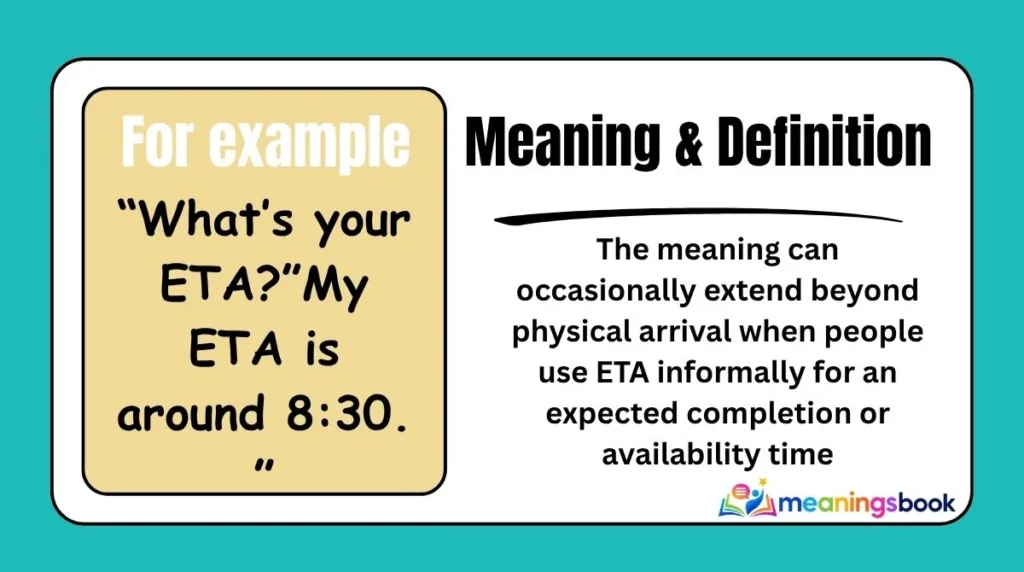
ETA stands for Estimated Time of Arrival. In a text message, it generally refers to the expected time when a person, vehicle, package, service, or other thing will reach a particular destination.
For example, if a friend messages:
“What’s your ETA?”
they are asking when you expect to get there.
You could answer:
“My ETA is around 8:30.”
This means you expect to arrive at approximately 8:30.
The word estimated is important because an ETA is usually a prediction rather than a guaranteed arrival time. Traffic, weather, delays, transportation problems, waiting times, or other unexpected circumstances can change it.
ETA is not normally considered internet slang in the same way as abbreviations such as “LOL” or “BRB.” It is better understood as a common abbreviation that has become convenient in everyday communication.
The term can also be used for things other than people. Someone might say:
- “What’s the ETA on the delivery?”
- “Do you know the ETA for the train?”
- “What’s the ETA for the repair?”
- “Any ETA on the update?”
In these examples, the basic idea remains the same: the speaker wants to know when something is expected to arrive or become available.
In casual texting, the abbreviation can be extremely brief. A person may simply send “ETA?” because both people already understand what they are discussing. If you are meeting a friend, for example, “ETA?” naturally means “When do you expect to arrive?”
The meaning can occasionally extend beyond physical arrival when people use ETA informally for an expected completion or availability time. Context determines whether “arrival” is literal or being used more loosely.
Background
The abbreviation ETA comes from the phrase Estimated Time of Arrival. The concept is straightforward: instead of giving a definite arrival time, a person or system provides a predicted time based on available information.
The exact history of when people first began using the abbreviation is not necessary to understand its modern use, and it is best not to assign a specific invention date without reliable historical evidence. What is clear is that the expression became especially useful in areas where knowing an expected arrival time matters, including transportation, travel, logistics, shipping, and scheduling.
As communication became faster and more informal, ETA naturally moved beyond specialized or professional settings. People began using the abbreviation in ordinary conversations because it communicates a relatively long phrase with only three letters.
Today, you might encounter ETA in a wide range of situations. A driver may provide an ETA to a passenger. A delivery service may give an estimated arrival time for a package. A coworker may ask for an ETA on a requested task. A friend may simply text “ETA?” while waiting at a restaurant.
The development of digital communication made abbreviations particularly convenient. Text messages and instant messaging encourage people to communicate quickly, and familiar terms such as ETA fit naturally into that environment.
Importantly, ETA does not inherently indicate an exact or guaranteed time. If someone says, “ETA 7:15,” they normally mean that they currently expect to arrive at approximately 7:15. Circumstances can change afterward.
This distinction is useful in both professional and personal communication. An ETA is generally an estimate, not a promise.
The abbreviation has therefore retained its original core idea while becoming much more flexible in everyday language. Whether it appears in a work chat, a transportation update, or a message from a friend, ETA usually communicates one central question: When is something expected to arrive or be ready?
Usage in Different Contexts
The meaning of ETA is generally consistent, but the thing being measured can change depending on the situation.
ETA in Chat
In personal messages, ETA usually refers to a person’s expected arrival time.
For example:
“I’m leaving now. ETA 20 minutes.”
This tells the recipient that the sender expects to arrive in approximately 20 minutes.
A short message such as “ETA?” is also common when someone is waiting.
ETA on Social Media
ETA can appear on social media when users discuss travel, events, meetups, deliveries, or other time-sensitive situations.
For example:
“Heading to the concert now. ETA 7:45.”
It can also appear in posts or comments where people are discussing when something is expected to happen or become available.
ETA in Professional Communication
In workplaces, ETA can have a broader practical meaning.
A manager might ask:
“What’s the ETA for the report?”
Here, the speaker may be asking when the report is expected to be completed or delivered rather than when a person will physically arrive.
Similarly:
“Can you give me an ETA on the revised document?”
means the speaker wants an estimate of when the revised document will be ready.
ETA in Casual Conversations
Friends and family members often use ETA as a quick alternative to asking, “What time do you think you’ll get here?”
For example:
“ETA?”
“About 15 mins.”
This is efficient and informal.
ETA for Deliveries and Services
ETA is also commonly associated with packages, food orders, transportation, repairs, and other services.
A person might ask:
“Do you know the delivery ETA?”
The exact meaning depends on the object being discussed, but the underlying concept remains an estimated arrival or completion time.
The tone of ETA is generally neutral. It can sound casual in a text message and professional in a workplace, making it unusually versatile.
Meaning in Chat, WhatsApp, Instagram, and TikTok
On messaging and social platforms, ETA normally means “Estimated Time of Arrival.” The platform itself does not usually change the basic meaning of the abbreviation.
On WhatsApp, someone might write:
“What’s your ETA?”
This usually means they want to know when you expect to arrive.
Another example is:
“ETA 10 mins.”
That means the sender expects to arrive in about ten minutes.
Because WhatsApp conversations are often informal, people may use ETA without writing out the full phrase.
On Instagram, ETA can appear in direct messages, comments, group conversations, or posts related to travel and events.
For example:
“We’re almost there. ETA 6:30.”
The meaning is still estimated arrival time.
TikTok
On TikTok, ETA may appear in comments or messages when users are discussing an upcoming meeting, trip, event, or delivery. A comment such as “ETA?” can simply be a request for information about when something or someone is expected.
However, TikTok and other platforms contain many abbreviations, so context is important. If ETA appears in a specialized community or as part of a particular phrase, its intended meaning should be determined from the surrounding content.
Text Messages
In ordinary SMS or texting, ETA is especially common because it saves space and time.
Compare:
“What time do you expect to arrive?”
with:
“What’s your ETA?”
Both communicate essentially the same question, but the second is shorter.
ETA can also be combined with other casual wording:
“Running a little late. New ETA is 9.”
This indicates that the sender’s expected arrival time has changed.
The abbreviation is therefore useful because it is short, familiar, and easy to understand in contexts involving schedules and timing.
Meaning in Physics, Medical, and Aircraft Terminology
ETA has a well-established general meaning, but its use in specialized fields requires context.
ETA in Physics
ETA is not generally a standard standalone physics abbreviation with one universal meaning comparable to major scientific terms or symbols. If you encounter “ETA” in a physics-related document, its meaning may depend on the specific subject, notation, author, or institution.
Therefore, it would be incorrect to assume that every use of ETA in physics means “Estimated Time of Arrival.” In a scientific context, surrounding terminology should be checked before interpreting an unfamiliar abbreviation.
ETA in Medical Terminology
In everyday medical communication, ETA may still be used in its ordinary sense of Estimated Time of Arrival, particularly when discussing when a person, ambulance, specialist, sample, or service is expected.
For example:
“What’s the ambulance ETA?”
Here, ETA has its normal meaning.
However, ETA is not a single universal medical diagnosis or condition. If the abbreviation appears in a clinical document, its exact meaning should be determined from the document’s context rather than automatically assuming the everyday definition.
ETA in Aircraft and Aviation Terminology
ETA has a particularly natural connection with aviation because arrival times are important when discussing flights and aircraft.
In an aviation context, ETA commonly refers to Estimated Time of Arrival. It indicates the expected time an aircraft will arrive at a particular destination or point.
For example, a flight update may refer to an estimated arrival time.
The important distinction is that an ETA is an estimate. The actual arrival time can differ because of weather, air traffic, operational conditions, routing, or other factors.
Therefore, when you see ETA in aviation, the ordinary expansion “Estimated Time of Arrival” is highly relevant. In other specialized fields, however, context should always be considered.
Common Misconceptions
One common misconception is that ETA is purely internet slang. It is not. Although it is frequently used in texting and online communication, the abbreviation is also common in professional and practical contexts involving transportation, scheduling, deliveries, and operations.
Another misunderstanding is that ETA represents a guaranteed arrival time. It does not. The word estimated indicates that the time is a prediction. If someone says their ETA is 7:00, circumstances can still cause them to arrive later or earlier.
People may also assume that ETA always refers to a person’s physical arrival. That is common, but informal professional communication can use ETA more broadly.
For example:
“What’s the ETA on the report?”
The report obviously does not physically travel to the recipient in the same way a person travels to a location. Here, ETA informally asks when the report is expected to be ready or delivered.
Another misconception is that ETA has one meaning in every specialized field. Abbreviations can have different meanings in different disciplines. While “Estimated Time of Arrival” is the dominant everyday interpretation, specialized documents may use the same letters differently.
Context is therefore the safest guide.
A final misunderstanding occurs when people confuse ETA with an exact schedule. An ETA is useful precisely because it provides an expected time when the exact timing may not yet be certain.
Understanding these distinctions makes it easier to interpret messages accurately without overcomplicating a very common abbreviation.
Similar Terms & Alternatives
Several expressions are related to ETA, but they are not always interchangeable.
ETD — Estimated Time of Departure
ETD generally means Estimated Time of Departure. It concerns when someone or something is expected to leave rather than arrive.
- ETA = expected arrival
- ETD = expected departure
For example:
“The flight’s ETD is 5:00, and its ETA is 7:30.”
Arrival Time
“Arrival time” is a more straightforward expression for when someone or something arrives. Unlike ETA, it does not necessarily emphasize that the time is an estimate.
Expected Arrival
“Expected arrival” communicates an idea very close to ETA and may be used when explaining an estimated arrival time in plain language.
How Long Until…?
In casual conversation, someone may avoid abbreviations altogether and ask:
“How long until you get here?”
This has a similar practical purpose to asking for an ETA.
Coming When?
A very informal message such as:
“When are you getting here?”
can also serve the same purpose.
Delivery Estimate
For packages and online orders, a delivery estimate tells the customer when the item is expected to arrive. It is closely related to the concept of an ETA.
The best expression depends on the situation. ETA is compact and widely understood, while phrases such as “What time will you arrive?” may be clearer when communicating with someone unfamiliar with abbreviations.
How to Respond to It
If someone sends you “ETA?”, they are usually asking when you expect to arrive. The simplest response is to provide an approximate time.
For example:
“Around 7:30.”
You can also include how long you expect the journey to take:
“About 20 minutes.”
If you are delayed, it is useful to give an updated estimate:
“Running late. New ETA is 8:15.”
If you are unsure, you can communicate that uncertainty:
“Probably around 9, but traffic is heavy.”
For a professional conversation, a slightly more complete response may be appropriate:
“My current ETA is approximately 3:30 p.m.”
If someone asks about the ETA of a task, you could respond:
“I should have it ready by tomorrow morning.”
Or:
“The current ETA is Friday afternoon.”
When the other person asks only “ETA?”, there is usually no need for a lengthy explanation. They generally want a practical time estimate.
If you are not yet able to estimate the arrival time, you can say:
“I’m not sure yet. I’ll update you when I know.”
The best response depends on the relationship and context. A friend may prefer a short answer, while a coworker or client may benefit from a clearer estimate and an indication of whether the timing is firm or tentative.
Differences from Similar Words
ETA is closely related to several timing expressions, but each one carries a slightly different meaning.
| Term | Meaning | Main Difference |
|---|---|---|
| ETA | Estimated Time of Arrival | Focuses on expected arrival |
| ETD | Estimated Time of Departure | Focuses on expected departure |
| Arrival time | Time something arrives | May be exact or estimated |
| Deadline | Latest expected or required completion time | Focuses on completion limit rather than arrival |
| Schedule | Planned timing or timetable | Describes an organized plan |
| EOD | End of Day | Refers to a general point in the day |
| ASAP | As Soon As Possible | Expresses urgency rather than a specific time |
For example, if your friend asks:
“What’s your ETA?”
they want an estimated arrival time.
If your manager says:
“What’s the deadline?”
they are asking when something must be completed, which is different from simply asking for an estimated arrival or completion time.
Likewise, ASAP does not provide a specific estimate. Saying “I’ll send it ASAP” indicates urgency but does not tell the recipient when to expect it.
ETA is therefore most useful when someone wants a prediction about timing.
The tone can also vary. “ETA?” is brief and casual, while “Please provide your estimated time of arrival” is much more formal. Both communicate essentially the same basic concept.
Relevance in Online Conversations & Dating Apps
ETA can appear naturally in online conversations whenever people are coordinating plans. This includes group chats, social media messages, event planning, rides, meetups, and dating conversations.
On a dating app, for example, someone might say:
“I’m leaving now. ETA 15 minutes.”
If the two people have already arranged to meet, the meaning is straightforward: the person expects to arrive in about fifteen minutes.
A message such as:
“What’s your ETA?”
can also appear before a first date, a casual meetup, or a social event.
The relationship between the people can influence the tone. Between close friends, “ETA?” may sound completely natural and casual. Between coworkers, it can be a concise professional question. Between two people who have just started talking, the same abbreviation may sound more practical and schedule-focused.
ETA does not inherently have a romantic or sexual meaning. If you see it on a dating app, it normally retains its ordinary timing-related meaning unless the surrounding conversation clearly establishes another interpretation.
Online conversations also make context particularly important. A person might use ETA to refer to arriving at a location, joining a video call, reaching an event, or completing something they previously promised to send.
For example:
“ETA for the photos?”
could mean “When do you expect the photos to be ready?” rather than asking about physical travel.
Therefore, the safest interpretation is to look at what the conversation is about. In most modern online communication, ETA is simply a concise way of discussing an expected time.
Frequently Asked Questions
What does ETA mean in text?
ETA in text usually means Estimated Time of Arrival. It is commonly used when someone wants to know when a person, vehicle, package, or other thing is expected to arrive. For example, “What’s your ETA?” means “What time do you expect to arrive?” The exact subject can vary, but the idea is an estimated arrival time.
What does ETA mean in chat?
In chat, ETA usually means Estimated Time of Arrival. Someone may send “ETA?” as a short way of asking when you will arrive. It is common in conversations about meeting friends, traveling, getting picked up, attending events, or waiting for deliveries. The abbreviation is generally neutral rather than slang.
Is ETA a slang term?
ETA is not primarily slang; it is a widely recognized abbreviation for Estimated Time of Arrival. People use it in both casual and professional communication. Although it appears frequently in texts and social media messages, its use is not limited to internet conversations.
How do you respond to ETA in a text?
You can respond to an ETA question by giving your best estimated arrival time. For example, you could say, “About 20 minutes,” “Around 8:00,” or “My ETA is 8:30.” If you are delayed or uncertain, explain that briefly and provide an updated estimate when possible.
What does ETA mean on social media?
On social media, ETA generally has the same meaning: Estimated Time of Arrival. It may appear in messages, comments, or posts about travel, meetings, events, deliveries, or plans. For example, “ETA 10 minutes” means the person expects to arrive in approximately ten minutes.
Can ETA have different meanings?
ETA can have different interpretations in specialized contexts because abbreviations sometimes overlap between fields. However, in ordinary texts, chats, and everyday online conversations, ETA most commonly means Estimated Time of Arrival. If it appears in a technical or specialized document, the surrounding terminology should be considered before deciding what the abbreviation means.
What does “ETA?” mean when someone is waiting for you?
When someone asks “ETA?” while waiting for you, they are almost certainly asking when you expect to arrive. A simple response such as “15 minutes” or “Around 7:45” gives them the information they need. If your plans have changed, it is helpful to provide a new estimate.
Does ETA mean an exact arrival time?
No, ETA is an estimated arrival time rather than a guaranteed exact time. An ETA can change because of traffic, weather, delays, transportation problems, or other circumstances. If someone gives you an ETA of 6:00, it normally means they currently expect to arrive around that time, not that arrival at exactly 6:00 is guaranteed.
Conclusion
ETA is a simple and widely useful abbreviation that normally means Estimated Time of Arrival. In text messages, chats, social media, and everyday conversations, people commonly use it to ask or provide an expected arrival time. A message such as “What’s your ETA?” usually means “When do you expect to arrive?”
The abbreviation can also be used more broadly in professional communication, such as when discussing the expected delivery or completion of a task. In transportation and aviation contexts, ETA is particularly relevant because estimated arrival times are an important part of scheduling and coordination.
It is important to remember that an ETA is an estimate rather than a guarantee. The meaning can also depend on context, especially when the abbreviation appears in a specialized field. When someone sends “ETA?” in an ordinary conversation, however, the intended meaning is usually straightforward: they want to know when you expect to arrive.

I am Ethan Whitmore, an English teacher and vocabulary enthusiast who explains words, phrases, and meanings in text through simple examples to make English easier for everyone.



