Understanding financial terms can help people make smarter decisions about borrowing money, using credit cards, and making purchases.
One term that often appears in financing offers, store credit agreements, and promotional payment plans is deferred interest. People commonly encounter this phrase when buying furniture, electronics, appliances, or other expensive products through a buy-now-pay-later arrangement.
At first, deferred interest may sound like a convenient way to save money because interest charges are postponed for a specific period.
However, the conditions attached to these offers can be more complicated than they initially appear. Depending on the agreement, failing to pay the required balance before the promotional period ends could result in significant interest charges.
People search for this term because they want to understand how it works, whether it is a good financial option, and what happens when payments are delayed or a balance remains unpaid.
Knowing the definition, common examples, and potential risks can help you evaluate financing offers more confidently and avoid unexpected costs.
Quick Answer
Deferred interest meaning refers to an arrangement in which interest charges are postponed until a later date, often under a promotional financing offer. In many retail credit agreements, interest may accumulate during the promotional period but is waived only if the borrower pays the qualifying balance in full before the deadline. Otherwise, previously deferred interest may become payable.
Meaning & Definition
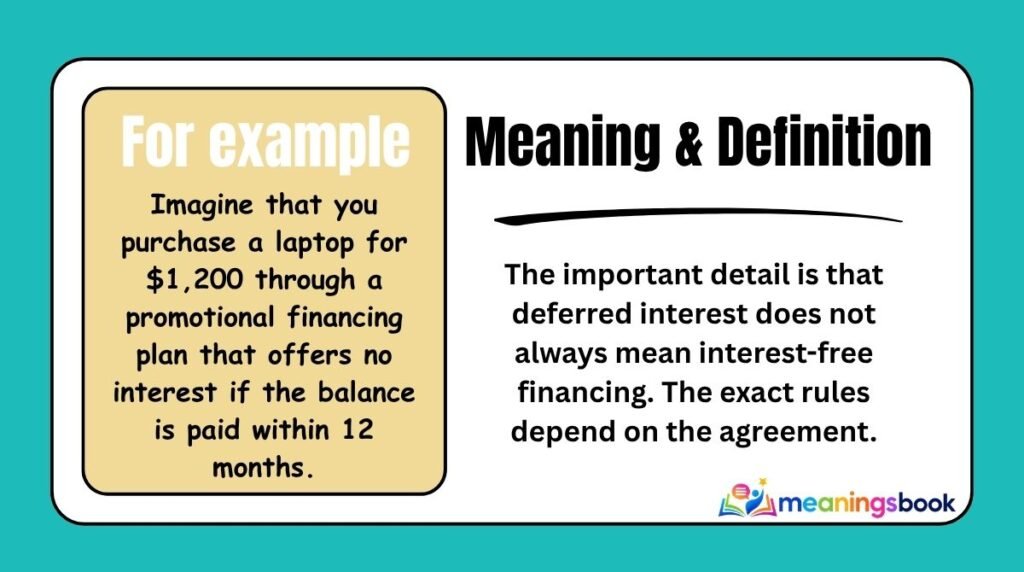
Deferred interest is a financing arrangement that delays when interest must be paid or charged to the customer. It is commonly associated with promotional credit card offers, retail store financing, and installment payment plans.
The important detail is that deferred interest does not always mean interest-free financing. The exact rules depend on the agreement.
For example, imagine that you purchase a laptop for $1,200 through a promotional financing plan that offers no interest if the balance is paid within 12 months.
During those 12 months, you might not have to pay interest if you meet the offer’s conditions. However, the agreement may calculate interest on the original purchase balance from the transaction date.
If you pay the entire qualifying balance before the promotional deadline, the deferred interest may be waived. If you fail to meet the conditions, some agreements allow the accumulated interest to become payable.
How deferred interest works
A typical deferred interest arrangement follows these steps:
- You make a purchase: You buy a product or service using an eligible financing plan.
- The promotional period begins: The lender offers a specified period during which interest payments are postponed or potentially waived.
- You make payments: You may need to make minimum monthly payments according to the agreement.
- You meet or miss the deadline: Paying the qualifying balance in full on time may prevent deferred interest from becoming payable. Missing the deadline may trigger interest charges under the contract.
Is deferred interest the same as zero interest?
Not necessarily. A genuine 0% APR promotional offer generally charges no interest during the specified promotional period, provided the offer’s terms are followed. A deferred interest offer may calculate interest during that period and waive it only if specific conditions are satisfied.
Always check the financing terms rather than relying solely on advertising phrases such as “no interest” or “pay later.”
Background
The phrase deferred interest combines two familiar financial concepts: deferral and interest.
Deferral means postponing something until a later time. In finance, it can refer to delaying a payment, a charge, or the recognition of an amount. Interest is generally the cost of borrowing money, usually calculated as a percentage of an outstanding balance over time.
Together, these words describe an arrangement in which interest is postponed or its payment is made conditional on certain requirements.
There is no need to assume that the expression originated with a particular company or a specific promotional program. It uses established financial terminology, and its exact historical origin is not clearly established here.
How deferred interest became familiar to consumers
Deferred interest became a familiar phrase in consumer finance through promotional credit arrangements that help customers purchase products without paying the entire price immediately.
Retailers may offer financing for expensive purchases, including:
- Furniture and mattresses
- Computers and electronic devices
- Household appliances
- Medical or dental services through eligible financing programs
- Other products and services purchased on credit
These arrangements can make large purchases more manageable by spreading payments across several months.
However, promotional financing also creates a need for clear disclosures. Customers must understand the promotional deadline, minimum payment requirements, applicable interest rate, and consequences of failing to pay the balance on time.
Why the term matters today
Modern consumers encounter financing offers through online stores, retail websites, credit card accounts, and checkout pages. An offer may emphasize a period without interest payments while giving less attention to the conditions that determine whether interest will ultimately be waived.
Understanding deferred interest helps consumers distinguish between delayed interest, genuinely interest-free promotional financing, and ordinary loans with scheduled interest payments.
The phrase is therefore most useful when interpreted within the actual financial agreement. Its meaning is related to the timing and conditions of interest charges, not simply to whether a customer has to make payments immediately.
Usage in Different Contexts
Deferred interest is primarily a financial term rather than an expression of everyday slang. Its interpretation is generally consistent, but the circumstances in which people encounter it can differ.
1. In financial documents
Banks, credit card issuers, and financing companies may use the term to explain how promotional interest works.
Example:
“Your purchase qualifies for 12-month deferred interest financing.”
This indicates that the purchase is subject to a financing arrangement in which interest is deferred according to the offer’s terms. It does not automatically guarantee that the purchase will remain interest-free.
2. In online shopping
An online store might advertise a payment plan that allows a customer to purchase an item immediately and pay over time.
Example:
“Get your new sofa with deferred interest financing.”
The phrase describes the financing terms, not a discount on the sofa itself. Customers should review the promotional period and payment conditions before accepting the offer.
3. In professional conversations
Accountants, financial advisers, and lending professionals may discuss deferred interest when reviewing credit agreements, financing costs, or consumer debt.
Example:
“The customer needs to understand the deferred interest conditions before accepting the financing plan.”
In this setting, the phrase is used in its conventional financial sense.
4. In casual conversations
People may use the expression when discussing purchases, debt, or a credit card promotion with friends and family.
Example:
“My phone came with deferred interest, so I need to check the payment deadline.”
The speaker is explaining a financial obligation, not using an abbreviation or internet slang.
5. In educational content
Financial literacy articles may explain deferred interest to help readers understand credit costs, promotional offers, and debt management.
Across these contexts, the central idea remains the same: interest is postponed or conditionally waived according to an agreement. The specific consequences depend on the product and its terms.
Meaning in Chat, WhatsApp, Instagram, and TikTok
Deferred interest does not have a widely established, separate slang meaning on messaging apps or social media platforms. When the phrase appears in a message, it generally retains its financial meaning.
The context of the conversation helps explain why someone is discussing it.
Deferred interest in text messages
A friend might send:
“My credit card has deferred interest for six months.”
This means the person has a credit arrangement involving a six-month promotional period. The message does not necessarily mean that the credit is free of interest under every circumstance.
Another example:
“Make sure you pay it off before the deferred interest deadline.”
Here, the sender is reminding someone to check the financing conditions and settle the required balance on time.
Deferred interest on WhatsApp
On WhatsApp, the phrase may appear in a conversation about shopping, household expenses, or borrowing money.
Example:
Person A: “I’m thinking about buying a new laptop on installments.”
Person B: “Check whether the offer includes deferred interest before you agree.”
The second person is recommending that the buyer understand the financing terms before committing.
Deferred interest on Instagram
Instagram users may encounter the phrase in sponsored posts, financial education content, product promotions, or comments about credit cards.
For example, a caption might mention a promotional financing offer. The phrase should be interpreted according to the terms of that offer rather than treated as a guarantee that no interest will ever be charged.
Deferred interest on TikTok
TikTok videos may explain the risks of promotional credit cards or show examples of how deferred interest can affect a purchase.
A creator might say:
“Always read the fine print before choosing deferred interest financing.”
The message is about understanding credit terms and avoiding unexpected costs.
Important: If someone uses “deferred interest” in a social media message, do not assume it is slang, flirting language, or a hidden abbreviation. Unless the surrounding conversation suggests otherwise, its ordinary financial meaning is the most reasonable interpretation.
Meaning in Physics, Medical, and Aircraft Terminology
Deferred interest is not a standard technical expression with a separate, widely recognized meaning in physics, medicine, or aviation. Its established meaning belongs primarily to finance and lending.
Deferred interest in physics
In physics, the phrase does not have a generally accepted technical definition comparable to terms such as momentum, inertia, or electrical resistance.
A physics discussion could mention financial interest when discussing an economic example, but that would not create a special physics meaning for the phrase.
For instance, a student calculating the cost of financing laboratory equipment might encounter deferred interest in the financial details of the purchase. The term would still refer to the financing arrangement.
Deferred interest in medical terminology
Deferred interest is not a standard medical diagnosis, symptom, or treatment term.
However, a patient might encounter it when reviewing a payment plan for dental treatment, medical procedures, or healthcare expenses financed through a credit provider.
For example, a clinic might offer promotional financing for an eligible procedure. In that situation, deferred interest describes the payment agreement rather than the medical procedure itself.
Patients should review the financing contract separately from information about their treatment.
Deferred interest in aircraft and aviation terminology
Deferred interest is not a standard aviation term for aircraft performance, navigation, flight operations, or aircraft maintenance.
It could appear in the financial records of an airline, aircraft owner, or aviation company when discussing financing costs. In that case, it would retain its normal accounting or lending meaning.
Why context is important
Some expressions have different meanings across specialized fields, while others remain specific to one subject.
For deferred interest, the most reliable interpretation is financial. If the phrase appears in a physics textbook, medical bill, or aviation document, examine the surrounding text to determine whether it refers to financing or whether the writer is using the words in an unusual, nontechnical way.
Avoid assigning it a specialized meaning without evidence from the relevant field.
Common Misconceptions
Deferred interest can be confusing because promotional financing is often presented in simple advertising language. Several common misunderstandings can lead to unexpected costs.
Misconception 1: Deferred interest always means free money
Deferred interest does not mean that borrowing money is automatically free. Depending on the agreement, interest may accumulate during the promotional period and become payable if the conditions for waiving it are not met.
Misconception 2: No monthly interest payment means no interest exists
A customer might not see an interest charge on a monthly statement during a promotional period. However, the agreement may still calculate interest in the background.
The absence of a current interest payment does not necessarily mean that interest is not accruing.
Misconception 3: Making the minimum payment guarantees zero interest
Minimum monthly payments may keep an account in good standing, but they might not be sufficient to clear the entire promotional balance before the deadline.
For example, a customer could make every required minimum payment but still have a remaining balance when the promotional period ends.
Misconception 4: All promotional financing offers work the same way
Different lenders use different financing structures. Some offers use deferred interest, while others provide a genuine introductory 0% APR period.
The distinction matters because the conditions for interest charges can be different.
Misconception 5: Deferred interest is a late fee
Deferred interest and late fees are separate concepts.
A late fee is a charge that may apply when a payment is missed or made after its due date. Deferred interest relates to interest that has been postponed or conditionally waived under a financing agreement. Both charges could potentially apply to the same account, depending on its terms.
Misconception 6: The deadline is the same as the final monthly payment date
The promotional deadline and the normal monthly payment due date may differ. Customers should confirm the exact date by which the qualifying balance must be paid in full.
Understanding these distinctions makes it easier to compare financing offers and avoid confusing interest charges with other account fees.
Similar Terms & Alternatives
Several financial expressions are closely related to deferred interest. Although they may appear in similar situations, they do not all mean the same thing.
| Term | Meaning |
|---|---|
| Deferred interest | Interest is postponed or conditionally waived under a financing agreement. |
| 0% APR | An advertised annual percentage rate of zero during a specified period, subject to the offer’s terms. |
| Accrued interest | Interest that has accumulated over time. |
| Simple interest | Interest calculated on the principal amount, according to the applicable rate and period. |
| Compound interest | Interest calculated on principal plus previously accumulated interest, where applicable. |
| Interest-free financing | Financing that charges no interest under the stated conditions. |
| Buy now, pay later (BNPL) | A payment arrangement that allows customers to purchase now and pay later, sometimes in installments. |
| Grace period | A specified period during which particular interest charges may be avoided if the applicable conditions are met. |
| Late fee | A charge that may apply when a payment is overdue. |
| Interest waiver | A cancellation or non-application of interest under specified conditions. |
Deferred interest vs. accrued interest
Deferred interest describes an arrangement concerning the timing or conditional payment of interest. Accrued interest describes interest that has already accumulated.
A deferred interest offer may involve interest accruing during the promotional period, depending on the contract.
Deferred interest vs. 0% APR
A deferred interest promotion may result in interest becoming payable retroactively or from the original transaction date if the conditions are not met.
A 0% APR offer generally has no interest during the stated promotional period, although other terms and charges may apply.
Deferred interest vs. a grace period
A grace period is a defined interval in which certain charges can be avoided by meeting specified requirements. For example, a credit card may provide a grace period on eligible purchases when the statement balance is paid in full.
Deferred interest is a different financing arrangement and can involve a longer promotional period with specific payoff conditions.
Deferred interest vs. BNPL
Buy now, pay later describes a payment method, not a single interest structure. Some BNPL plans are interest-free, while other financing products may charge interest.
Always identify the actual financing terms instead of assuming that two similarly advertised offers work identically.
How to Respond to It
If someone mentions deferred interest in a message, your response should depend on the conversation. You might want to understand the term, ask for clarification, or discuss a financing decision.
If you do not understand the term
You can respond with a simple question:
- “What does deferred interest mean in this offer?”
- “Does that mean I won’t have to pay interest?”
- “Can you explain how the financing works?”
These questions encourage the other person to explain the agreement without assuming how it works.
If someone recommends a financing offer
You could reply:
- “Thanks! I’ll check the terms before accepting it.”
- “I’ll make sure I understand the promotional deadline.”
- “I’ll compare it with a regular 0% APR offer first.”
These responses show that you understand the importance of reviewing the conditions.
If a friend is worried about deferred interest
You might say:
- “Check your agreement to see when the promotional period ends.”
- “Make sure you know the total balance that needs to be paid.”
- “Contact the lender if you’re unsure about the interest charges.”
If a lender or retailer mentions deferred interest
Ask specific questions about the financing arrangement:
- Does interest accumulate during the promotional period?
- What happens if the balance is not paid in full by the deadline?
- What interest rate applies if the promotional conditions are not met?
- Are minimum monthly payments required?
- How will payments be allocated if the account has multiple balances?
These questions help clarify the actual cost of financing.
The best response is one that addresses the situation directly. Since deferred interest is a financial term rather than conventional internet slang, you generally do not need a humorous, romantic, or informal reply unless the surrounding conversation calls for one.
Differences from Similar Words
Deferred interest is sometimes confused with other financial terms because they all concern payments, charges, or borrowing costs. Understanding the differences helps prevent mistakes when reading a financing agreement.
Deferred vs. delayed
Deferred means postponed to a later time, often under a formal arrangement. Delayed means something happens later than expected or planned.
For example, deferred interest is usually part of a defined financing structure. A delayed payment simply means a payment has occurred later than its expected time.
Deferred interest vs. waived interest
Deferred interest concerns postponing interest or making its payment conditional. Waived interest means interest is not charged or is removed under the applicable conditions.
In a promotional deferred interest agreement, interest may be waived if the borrower meets the specified requirements.
Deferred interest vs. forgiven debt
Forgiven debt means a creditor cancels some or all of an amount owed. Deferred interest does not automatically cancel the underlying debt or the interest associated with it.
The interest may remain payable depending on the financing agreement.
Deferred interest vs. a payment deferral
A payment deferral postpones a required payment. Deferred interest concerns interest charges and their timing or conditions.
A lender might offer a payment deferral without waiving interest, meaning the borrower still owes the interest that accumulates under the agreement.
Deferred interest vs. interest-only payments
With interest-only payments, the borrower pays interest without necessarily reducing the principal balance during a specified period.
With deferred interest, interest payments are postponed or made conditional on particular requirements. The principal balance and interest obligations are governed by the specific agreement.
Why these differences matter
These terms describe different aspects of borrowing. A customer who confuses a payment deferral with an interest waiver could underestimate the eventual amount owed.
Before signing a contract, check which amounts are postponed, which charges continue to accrue, and which conditions must be met to avoid additional costs.
Relevance in Online Conversations & Dating Apps
Deferred interest is not an established dating abbreviation or romantic slang expression. Its normal meaning is financial, even when the phrase appears in casual online conversations.
However, people may discuss deferred interest in digital spaces for several reasons.
In online shopping conversations
Friends may share links to financing offers or ask whether a particular purchase is worth making.
For example:
“I’m considering this phone because it offers deferred interest.”
The person is discussing a payment option rather than using a hidden social meaning.
In personal finance communities
People discussing credit cards, budgeting, or debt repayment may use the term when asking for advice.
A typical question might be:
“How can I avoid paying deferred interest on my store credit account?”
Such a question concerns the promotional balance, the deadline, and the agreement’s requirements.
On dating apps
Deferred interest has no widely recognized romantic meaning on mainstream dating apps. It might appear if two people are discussing their jobs, financial goals, expensive purchases, or credit management.
For example, one person might mention using promotional financing to buy furniture for a new apartment. The term would still refer to the financing arrangement.
Could it be a joke or metaphor?
Someone could use the words creatively in a joke about relationships, money, or postponed responsibilities. However, that would be an individual use rather than an established meaning of the expression.
For instance, a person might jokingly compare putting off an uncomfortable conversation to postponing a financial obligation. The meaning would depend on the surrounding message.
The safest interpretation is straightforward: if someone uses deferred interest without an obvious joking context, assume they are referring to financing or interest charges. If the phrase appears in an unusual conversation, ask what they mean rather than assigning it a slang definition.
FAQs
1. What does deferred interest mean on a credit card?
Deferred interest on a credit card means interest is postponed or conditionally waived under the card’s promotional financing terms. Interest may accumulate during the promotional period. If you fail to pay the qualifying balance in full by the deadline, the agreement may require you to pay the accumulated interest. Review your cardholder agreement for the exact conditions.
2. Is deferred interest good or bad?
Deferred interest can be useful if you understand the conditions and can reliably pay the required balance before the promotional deadline. It can be costly if you underestimate the remaining balance or miss the deadline. Whether it is a good option depends on the interest rate, payment requirements, fees, and your ability to repay the purchase on time.
3. What happens when deferred interest expires?
When a deferred interest promotion expires, the lender applies the terms specified in the agreement. If you meet the requirements, the deferred interest may be waived. If you do not, some agreements allow the accumulated interest to become payable. Any remaining principal may also continue to accrue interest at the applicable rate.
4. Does deferred interest mean no interest for a certain period?
Not necessarily. Deferred interest may mean that interest payments are postponed while interest continues to accumulate. In some promotional agreements, accumulated interest is waived if the borrower meets specific conditions. A genuine 0% APR offer generally does not charge interest during its promotional period, subject to the agreement’s terms.
5. How can I avoid paying deferred interest?
To avoid deferred interest becoming payable, review the promotional deadline, understand the qualifying balance, and make payments sufficient to clear that balance before the deadline. Consider paying more than the required minimum when possible. Check the lender’s payment-processing rules and allow enough time for your final payment to post.
6. Is deferred interest the same as a late payment fee?
No, deferred interest and a late payment fee are different charges. Deferred interest concerns interest that is postponed or conditionally waived under a financing agreement. A late fee may apply when a payment is overdue. Depending on the account’s terms, both charges may be possible, so check the agreement for details.
7. What does deferred interest mean in simple words?
In simple words, deferred interest means paying interest later or having it waived if you meet certain conditions. For example, a store might offer financing that waives interest if you pay the entire qualifying purchase balance within 12 months. If you miss the conditions, interest may become payable under the agreement.
8. Does deferred interest have a slang meaning in text messages?
Deferred interest does not have a widely established slang meaning in text messages. It normally refers to a financial arrangement involving postponed or conditionally waived interest. If someone uses the phrase in a joke or unusual conversation, its intended meaning may depend on the context, but you should not assume it is a common abbreviation or dating expression.
Conclusion
Deferred interest is a financial term describing an arrangement in which interest payments are postponed or interest is conditionally waived according to a financing agreement. It commonly appears in retail credit cards, promotional payment plans, and financing offers for expensive purchases.
The most important point is that deferred interest does not automatically mean borrowing money is free. In some agreements, interest accumulates throughout the promotional period and becomes payable if the qualifying balance is not paid in full by the required deadline.
Understanding the difference between deferred interest, 0% APR, accrued interest, and payment deferral can help you compare offers and avoid unexpected charges.
Always review the interest rate, payment requirements, promotional deadline, and consequences of missing the conditions before accepting financing.
In everyday conversations, the phrase generally retains its financial meaning rather than functioning as slang.
Whether you encounter it in a credit agreement, an online shopping promotion, or a message from a friend, the surrounding context and actual financing terms provide the clearest explanation.

I am Ethan Whitmore, an English teacher and vocabulary enthusiast who explains words, phrases, and meanings in text through simple examples to make English easier for everyone.