
Short abbreviations are everywhere in modern digital communication. People use them in text messages, group chats, comments, gaming conversations, and social media because typing a few letters is often faster than writing a complete phrase.
One abbreviation that can be confusing is DC, because its meaning can change depending on the conversation.
When someone receives a message such as “dc,” “I dc,” or “dc about it,” they may wonder whether the sender is expressing indifference, referring to a social-media trend, or using the abbreviation in a completely different technical sense. The surrounding words usually provide the answer.
Understanding the DC slang meaning in text therefore requires looking at context rather than assuming that every “DC” has one universal definition.
In everyday texting, it can commonly express that someone does not care, while online communities and professional fields may use the same letters differently. This guide explains the major interpretations and shows how to respond naturally.
Quick Answer
DC slang meaning in text usually refers to “don’t care,” especially in casual messages. It is commonly used when someone wants to say that something does not matter to them or that they are indifferent. However, DC can have other meanings in social media, gaming, technical fields, and professional contexts, so the surrounding conversation matters.
Meaning & Definition
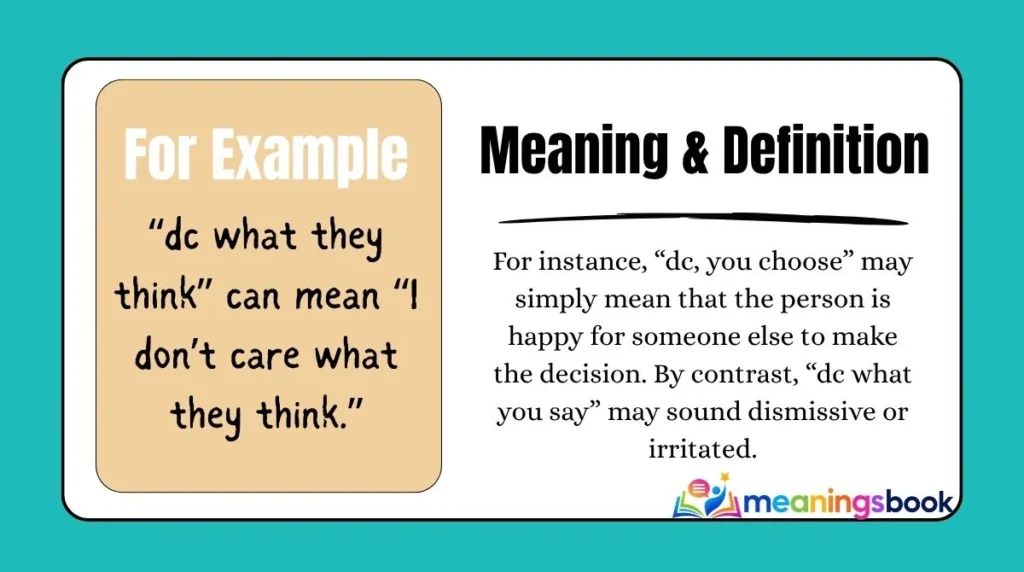
In casual texting, DC most commonly means “don’t care.” It is a shortened expression used to communicate indifference, lack of concern, or the idea that a particular choice or situation does not matter to the speaker.
For example:
- “dc what they think” can mean “I don’t care what they think.”
- “dc anymore” can mean “I don’t care anymore.”
- “dc which one we choose” can mean “I don’t care which one we choose.”
- “Honestly dc” can communicate a dismissive or indifferent attitude.
The abbreviation is especially likely to appear in informal conversations where people are comfortable using shortened language. It is generally not appropriate to assume that the sender is being hostile simply because they wrote “dc.” Tone depends heavily on the rest of the message.
For instance, “dc, you choose” may simply mean that the person is happy for someone else to make the decision. By contrast, “dc what you say” may sound dismissive or irritated.
Capitalization also does not necessarily change the meaning. Someone may write DC, dc, or occasionally Dc. In informal digital communication, people often use lowercase abbreviations because they type quickly.
There is an important distinction between DC and IDC. “IDC” is the more explicit and widely recognizable abbreviation for “I don’t care,” while “DC” can be interpreted from context as “don’t care.” Because DC has many other established meanings, it can be less immediately clear.
The safest interpretation is therefore contextual. If the conversation is casual and the abbreviation appears alongside words about opinions, choices, or preferences, “don’t care” is a strong possibility. If the conversation involves gaming, social media trends, work, science, medicine, or aviation, another meaning may be intended.
Background
There is no single, universally documented origin for DC as a texting abbreviation meaning “don’t care.” Like many internet abbreviations, it developed from the broader habit of shortening frequently used expressions in digital communication.
Texting culture encouraged people to communicate quickly, particularly when mobile keyboards were less convenient than they are today. Abbreviations such as “idk,” “brb,” “imo,” and “lol” became familiar examples of this style. Shortening expressions can make messages faster and more casual.
“Don’t care” naturally lends itself to abbreviation because it consists of two common words. However, IDC became a particularly recognizable form because the pronoun “I” makes the intended sentence clearer: “I don’t care.” “DC” can still appear when the context makes the missing subject obvious.
The development of online communities also contributed to DC having several unrelated meanings. Digital language is not controlled by one central authority. Different groups create abbreviations according to their own habits, and the same two letters can develop separate meanings in different environments.
For example, social-media users may use “DC” in connection with dance content, while gamers may use it to refer to a disconnection. In technical writing, “DC” has long-established meanings that have nothing to do with slang.
This is why it would be inaccurate to claim that DC has one fixed origin or one universal definition. Its interpretation depends on the community, subject, and sentence in which it appears.
When the abbreviation is encountered in ordinary personal texting, “don’t care” is a reasonable first interpretation. But if the surrounding conversation does not support that meaning, it is better to consider alternatives rather than automatically treating DC as slang.
Usage in Different Contexts
The meaning of DC can shift considerably depending on where it appears.
Chat
In ordinary one-to-one or group chats, DC may mean “don’t care.” It often communicates indifference toward a choice, opinion, or situation.
Example:
“Pizza or burgers?”
“dc, whatever you want.”
Here, the person is saying that either option is fine.
Social Media
On social platforms, DC can have several interpretations. In content involving dances or viral trends, it may refer to dance credit or a dance-related reference. The exact use can vary between communities.
A caption such as “DC: @creator” may indicate that the poster is giving credit to the person associated with a dance or creative trend.
Gaming
In gaming and online multiplayer conversations, DC can commonly refer to disconnect or disconnected.
For example:
“Sorry, I dc’d.”
This usually means the player lost their connection or was disconnected from the game.
That interpretation is very different from “don’t care.”
Professional Fields
In professional communication, DC is generally not interpreted as casual slang unless the surrounding workplace has established that usage. It can represent specialized terminology, abbreviations, or organizational language.
For example, in electrical and physics-related contexts, DC commonly means direct current.
Casual Conversations
In a casual conversation, the sentence around DC is often enough to determine its meaning. If someone says “dc which movie,” the likely interpretation is “I don’t care which movie.” If someone says “my internet dc again,” the likely meaning is related to disconnection.
The key principle is simple: do not interpret DC in isolation when several meanings are possible.
Meaning in Chat, WhatsApp, Instagram, and TikTok
The interpretation of DC can vary across messaging and social-media platforms.
In WhatsApp conversations, dc may be used informally to mean “don’t care.”
Example:
“Do you want to go at 6 or 7?”
“dc, both work.”
The sender is saying that either time is acceptable.
WhatsApp also contains group chats where abbreviations can develop their own meanings. If a particular group repeatedly uses DC for something else, the group’s established meaning takes priority.
On Instagram, the meaning depends on whether DC appears in a private message, caption, comment, or creator-related post.
In a normal conversation, it can mean “don’t care.” In creator culture, however, DC may appear alongside a username or dance-related content and indicate credit connected with a dance or trend.
TikTok
TikTok has its own vocabulary surrounding trends, sounds, dances, creators, and credits. Because of that, DC can sometimes be associated with dance credit or a dance/choreography reference.
For example:
“DC: @username”
may indicate that the poster is crediting the creator associated with the dance.
That does not mean every TikTok use of “DC” refers to dance credit. A private TikTok message saying “dc lol” could still use the abbreviation in the “don’t care” sense.
General Messaging
The same principle applies across texting platforms: examine the words immediately before and after DC.
- “dc what happens” → likely “don’t care”
- “I dc from the match” → likely “disconnected”
- “DC: @creator” → likely a social-media credit
- “DC circuit” → likely “direct current”
Context is more reliable than capitalization.
Meaning in Physics, Medical, and Aircraft Terminology
DC is not exclusively slang. It is a well-established abbreviation in several technical fields.
Physics
In physics and electrical engineering, DC means direct current. Direct current is electric current that flows in a single direction, in contrast with alternating current, commonly abbreviated AC.
Therefore, if someone writes about a DC circuit, DC voltage, or DC power supply, the meaning is almost certainly direct current, not “don’t care.”
Medical Terminology
In medical environments, DC can have multiple meanings depending on the specialty and documentation system. It may be used as an abbreviation for terms such as “discontinue,” “discontinued,” or “discharge,” depending on the context and local conventions.
Because medical abbreviations can be ambiguous and potentially unsafe when misunderstood, the exact meaning should be confirmed from the surrounding documentation rather than guessed from the letters alone.
Consequently, DC should not automatically be interpreted as texting slang in a medical setting.
Aircraft and Aviation Terminology
There is no single universal aviation slang meaning of DC equivalent to the casual texting definition.
In aviation and aerospace contexts, DC can refer to technical concepts such as direct current, depending on the subject. It can also appear as part of aircraft designations, model names, organizational terminology, or other specialized abbreviations.
For that reason, someone reading DC in an aircraft manual, maintenance document, cockpit-related discussion, or aviation specification should interpret it according to the specific document and context.
The important distinction is that technical meanings are separate from the casual “don’t care” interpretation.
Common Misconceptions
One common misconception is that DC always means “don’t care.” That is not correct. The abbreviation has several unrelated meanings.
Another misunderstanding is assuming that DC and IDC are identical in every situation. They can communicate a similar idea in casual texting, but IDC more directly represents “I don’t care,” while DC can be ambiguous.
Some people also confuse DC with IDK, which means “I don’t know.” These expressions communicate different things:
- DC → commonly “don’t care”
- IDC → “I don’t care”
- IDK → “I don’t know”
Someone saying “dc” is expressing indifference, whereas someone saying “idk” is expressing uncertainty or lack of knowledge.
A further misconception is that “DC” always sounds rude. It can sound dismissive in some situations, but it can also be neutral. For example, “dc, you pick” may simply mean “I have no preference; you choose.”
Tone becomes more negative when DC is used in a statement that dismisses another person’s feelings or concerns.
Finally, not every abbreviation found on TikTok, Instagram, or WhatsApp should be interpreted as slang. Some abbreviations retain technical or community-specific meanings even when they appear in casual digital environments.
Similar Terms & Alternatives
Several abbreviations and expressions can be confused with DC.
| Term | Common meaning | Typical tone |
|---|---|---|
| DC | Often “don’t care” in casual texting | Casual, sometimes dismissive |
| IDC | “I don’t care” | Casual, direct |
| IDK | “I don’t know” | Neutral, uncertain |
| NVM | “Never mind” | Casual |
| IDGAF | “I don’t give a f***” | Much stronger and often rude |
| Whatever | Shows lack of preference or concern | Can be neutral or dismissive |
| Doesn’t matter | Indicates that a choice is unimportant | Usually neutral |
| I don’t mind | Indicates no strong preference | Usually polite |
The closest alternatives to the texting use of DC are IDC, “I don’t care,” “I don’t mind,” “whatever,” and “doesn’t matter.”
However, these are not always interchangeable. “I don’t mind” can sound considerably more polite than “I don’t care,” while “whatever” can sound irritated depending on tone.
How to Respond to It
How you respond to DC depends on what the sender means and the tone of the conversation.
If DC means “don’t care” and the person is simply saying they have no preference, you can respond casually:
- “Okay, you choose 😂”
- “Fair enough.”
- “No worries.”
- “Cool, I’ll decide.”
- “Either works for me too.”
If the message seems dismissive, you can ask for clarification:
- “Do you mean you don’t care?”
- “Are you okay with either option?”
- “Just checking—are you saying it doesn’t matter?”
If DC appears in a gaming conversation and means “disconnect,” a suitable response might be:
- “No worries, reconnect when you can.”
- “Did you lose connection?”
- “Want to try again?”
If it appears as a social-media credit, no response may be necessary unless you are discussing the content itself.
The best response is therefore based on meaning first and tone second. Do not assume that a short abbreviation is intentionally rude.
Differences from Similar Words
The biggest distinction is between DC, IDC, and IDK.
DC can commonly mean “don’t care,” but it is ambiguous because the same abbreviation has many other meanings.
IDC is more explicit. When someone writes “IDC,” readers are much more likely to understand that the person means “I don’t care.”
IDK, meanwhile, means “I don’t know.” It indicates uncertainty rather than indifference.
Consider these examples:
“Which restaurant should we go to?”
“DC.”
The speaker probably has no preference.
“Which restaurant is open?”
“IDK.”
The speaker does not know the answer.
“Do you care if we go somewhere else?”
“IDC.”
The speaker is explicitly saying that the choice does not matter to them.
There is also a difference in emotional tone. “I don’t mind” is generally softer than “I don’t care,” while “IDGAF” is substantially stronger and can sound aggressive or vulgar.
Therefore, even when two expressions have similar dictionary-level meanings, their social tone can differ significantly.
Relevance in Online Conversations & Dating Apps
Short abbreviations are especially common in online conversations because users often want to keep messages quick and informal. DC can therefore appear in direct messages, comments, group chats, gaming communities, and dating-app conversations.
On dating apps, context is particularly important. If someone asks:
“Coffee or dinner?”
and the other person replies:
“dc, you choose.”
the likely meaning is that they are flexible about the activity.
However, if someone repeatedly replies with extremely short messages such as “dc,” “k,” or “whatever,” the issue may be less about the literal abbreviation and more about conversational tone. The person could be indifferent, distracted, annoyed, or simply communicating casually.
Dating conversations also contain many abbreviations that may be specific to a platform or community. A social-media-related use of DC should not automatically be interpreted as “don’t care.”
If you are uncertain, a simple clarification is usually better than guessing:
“Do you mean either option is fine?”
That gives the other person an opportunity to explain without creating unnecessary tension.
The same approach works in friendships, professional networking, and group conversations. Context, relationship, and tone all influence how an abbreviation is understood.
Frequently Asked Questions
What does DC mean in text?
DC usually means “don’t care” in casual text messages. It is used when someone wants to say that a choice, opinion, or situation does not matter to them. However, DC is not exclusive to slang, so the surrounding message matters. In gaming, social media, and technical discussions, it can have completely different meanings.
What does DC mean in chat?
In casual chat, DC can mean “don’t care.” For example, “dc which one” may mean that the sender has no preference about which option is selected. Because DC is also used for “disconnect” in some online communities, you should consider the conversation before deciding which interpretation fits.
Is DC a slang term?
DC can function as slang when it is used as a shortened form of “don’t care.” It is an informal abbreviation rather than a formal English expression. However, DC also has established meanings outside slang, including “direct current” in electrical and physics contexts and other specialized meanings.
What does DC mean on social media?
On social media, DC can have different meanings depending on the post or community. In an ordinary conversation, it may mean “don’t care.” Around dance or creator content, it can be associated with dance credit or a dance-related reference. The words surrounding DC usually make the intended meaning clearer.
What does DC mean on TikTok?
On TikTok, DC can sometimes refer to dance credit or a dance-related trend. It may appear with a creator’s username when someone is giving credit. However, DC in a private message can still mean “don’t care,” so the platform alone does not determine the meaning.
What does DC mean in gaming?
In gaming, DC often means “disconnect” or “disconnected.” A player might say “I dc’d” to explain that they lost their connection to a game or server. This is different from the casual texting meaning “don’t care,” which is why gaming context is particularly important.
Is DC the same as IDC?
DC and IDC can both communicate the idea of “don’t care,” but IDC is more explicit. “IDC” directly represents “I don’t care,” while DC is more ambiguous because it has several unrelated meanings. In casual texting, either may express indifference, but IDC is generally easier to interpret.
How should I respond when someone texts DC?
Respond according to the context and tone. If DC means “don’t care” and the person is simply flexible, you can say, “Okay, I’ll choose.” If the meaning is unclear, ask, “Do you mean either option is fine?” Clarifying is especially useful when the message could reasonably have more than one interpretation.
Conclusion
The meaning of DC depends strongly on context. In casual texting, it commonly stands for “don’t care,” expressing indifference or a lack of preference. It can be used in messages such as “dc which one” when the sender is happy for someone else to make a choice.
However, DC is not limited to texting slang. In gaming, it can refer to being disconnected; on social media, it can appear in connection with dance or creator credits; and in physics and electrical contexts, it commonly means direct current. Medical and aviation contexts can also use DC in specialized ways.
The best way to understand the abbreviation is to examine the surrounding words, platform, subject, and relationship between the people communicating. If the meaning remains unclear, a short clarification is better than assuming.
In short, DC often means “don’t care” in everyday text conversations, but context determines the correct interpretation.

I am Ethan Whitmore, an English teacher and vocabulary enthusiast who explains words, phrases, and meanings in text through simple examples to make English easier for everyone.



